
Recent from talks
Northwest Caucasian languages
Knowledge base stats:
Talk channels stats:
Members stats:
Northwest Caucasian languages
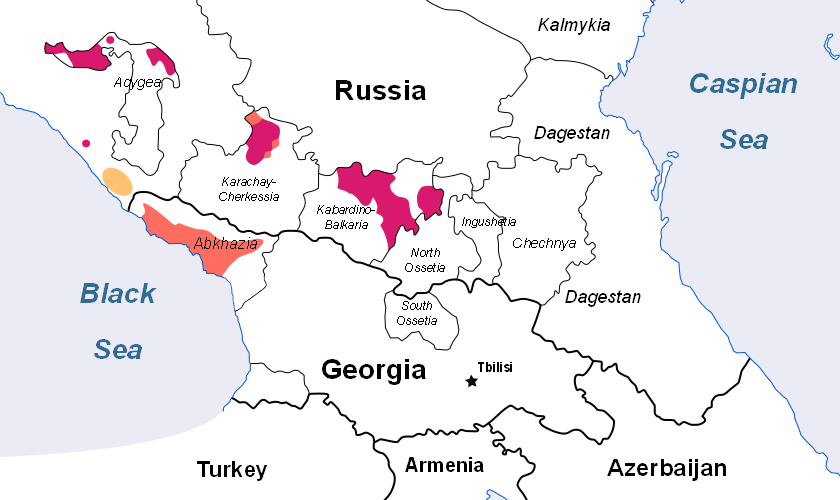
The Northwest Caucasian languages, also called West Caucasian, Abkhazo–Adyghean, Abkhazo–Circassian, Circassic, or sometimes Pontic languages (from Ancient Greek, pontos, referring to the Black Sea, in contrast to the Northeast Caucasian languages as the Caspian languages), is a family of languages spoken in the northwestern Caucasus region, chiefly in three Russian republics (Adygea, Kabardino-Balkaria, Karachay-Cherkessia), the disputed territory of Abkhazia, Georgia, and Turkey, with smaller communities scattered throughout the Middle East.
The group's relationship to any other language family is uncertain and unproven. One language, Ubykh, became extinct in 1992, while all of the other languages are in some form of endangerment, with UNESCO classifying all as either "vulnerable", "endangered", or "severely endangered". Within the Northwest Caucasian languages, only Abkhaz has a first-set code in the ISO 639 standard.
The Northwest Caucasian languages possess highly complex sets of consonant distinctions paired with a lack of vowel distinctions, often providing archetypical cases of vertical vowel systems, also known as "linear" vowel systems.
Linguistic reconstructions suggest that both the richness of the consonantal systems and the poverty of the vocalic systems may be the result of a historical process, whereby vowel features such as labialization and palatalization were reassigned to adjacent consonants. For example, ancestral */ki/ may have become /kʲə/ and */ku/ may have become /kʷə/, losing the old vowels */i/ and */u/ but gaining the new consonants /kʲ/ and /kʷ/. The linguist John Colarusso has further postulated that some instances of this may also be due to the levelling of an old grammatical class prefix system (so */w-ka/ may have become /kʷa/), on the basis of pairs like Ubykh /ɡʲə/ vs. Kabardian and Abkhaz /ɡʷə/ heart. This same process is claimed by some[who?] to lie behind the development of labiovelars in Proto-Indo-European, which once neighboured Proto-NWC.
The entire family is characterised by a paucity of phonemic vowels (two or three, depending upon the analysis) coupled with rich consonantal systems that include many forms of secondary articulation. Ubykh (Ubyx), for example, had two vowels and probably the largest inventory of consonants outside Southern Africa.
Northwest Caucasian languages have rather simple noun systems, with only a handful of cases at the most, coupled with highly agglutinative verbal systems that can contain almost the entire syntactic structure of the sentence. All finite verbs are marked for agreement with three arguments: absolutive, ergative, and indirect object, and there are also a wide range of applicative constructions. There is a split between "dynamic" and "stative" verbs, with dynamic verbs having an especially complex morphology. A verb's morphemes indicate the subject's and object's person, place, time, manner of action, negative, and other types of grammatical categories.
All Northwest Caucasian languages are left-branching, so that the verb comes at the end of the sentence and modifiers such as relative clauses precede a noun.
Northwest Caucasian languages do not generally permit more than one finite verb in a sentence, which precludes the existence of subordinate clauses in the Indo-European sense. Equivalent functions are performed by extensive arrays of nominal and participial non-finite verb forms, though Abkhaz appears to be developing limited subordinate clauses, perhaps under the influence of Russian.
Hub AI
Northwest Caucasian languages AI simulator
(@Northwest Caucasian languages_simulator)
Northwest Caucasian languages
The Northwest Caucasian languages, also called West Caucasian, Abkhazo–Adyghean, Abkhazo–Circassian, Circassic, or sometimes Pontic languages (from Ancient Greek, pontos, referring to the Black Sea, in contrast to the Northeast Caucasian languages as the Caspian languages), is a family of languages spoken in the northwestern Caucasus region, chiefly in three Russian republics (Adygea, Kabardino-Balkaria, Karachay-Cherkessia), the disputed territory of Abkhazia, Georgia, and Turkey, with smaller communities scattered throughout the Middle East.
The group's relationship to any other language family is uncertain and unproven. One language, Ubykh, became extinct in 1992, while all of the other languages are in some form of endangerment, with UNESCO classifying all as either "vulnerable", "endangered", or "severely endangered". Within the Northwest Caucasian languages, only Abkhaz has a first-set code in the ISO 639 standard.
The Northwest Caucasian languages possess highly complex sets of consonant distinctions paired with a lack of vowel distinctions, often providing archetypical cases of vertical vowel systems, also known as "linear" vowel systems.
Linguistic reconstructions suggest that both the richness of the consonantal systems and the poverty of the vocalic systems may be the result of a historical process, whereby vowel features such as labialization and palatalization were reassigned to adjacent consonants. For example, ancestral */ki/ may have become /kʲə/ and */ku/ may have become /kʷə/, losing the old vowels */i/ and */u/ but gaining the new consonants /kʲ/ and /kʷ/. The linguist John Colarusso has further postulated that some instances of this may also be due to the levelling of an old grammatical class prefix system (so */w-ka/ may have become /kʷa/), on the basis of pairs like Ubykh /ɡʲə/ vs. Kabardian and Abkhaz /ɡʷə/ heart. This same process is claimed by some[who?] to lie behind the development of labiovelars in Proto-Indo-European, which once neighboured Proto-NWC.
The entire family is characterised by a paucity of phonemic vowels (two or three, depending upon the analysis) coupled with rich consonantal systems that include many forms of secondary articulation. Ubykh (Ubyx), for example, had two vowels and probably the largest inventory of consonants outside Southern Africa.
Northwest Caucasian languages have rather simple noun systems, with only a handful of cases at the most, coupled with highly agglutinative verbal systems that can contain almost the entire syntactic structure of the sentence. All finite verbs are marked for agreement with three arguments: absolutive, ergative, and indirect object, and there are also a wide range of applicative constructions. There is a split between "dynamic" and "stative" verbs, with dynamic verbs having an especially complex morphology. A verb's morphemes indicate the subject's and object's person, place, time, manner of action, negative, and other types of grammatical categories.
All Northwest Caucasian languages are left-branching, so that the verb comes at the end of the sentence and modifiers such as relative clauses precede a noun.
Northwest Caucasian languages do not generally permit more than one finite verb in a sentence, which precludes the existence of subordinate clauses in the Indo-European sense. Equivalent functions are performed by extensive arrays of nominal and participial non-finite verb forms, though Abkhaz appears to be developing limited subordinate clauses, perhaps under the influence of Russian.
Recent media