
Recent from talks
Ubykh language
Knowledge base stats:
Talk channels stats:
Members stats:
Ubykh language
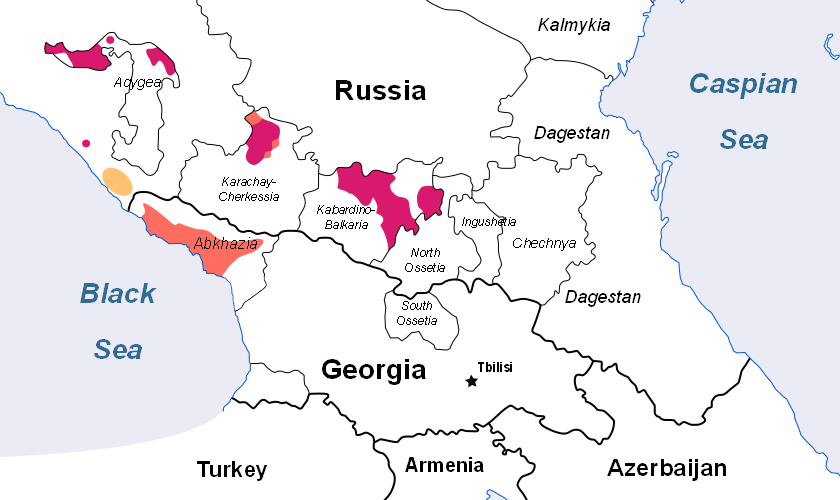
Ubykh was a Northwest Caucasian language once spoken by the Ubykh people, an ethnic group of Circassians who originally inhabited the eastern coast of the Black Sea before being killed or deported en masse by Russia to the Ottoman Empire during the Circassian genocide.
Ubykh is ergative and polysynthetic, with a high degree of agglutination, with polypersonal verbal agreement and a very large number of distinct consonants but only two phonemically distinct vowels. With around eighty consonants, it has one of the largest inventories of consonants in the world, and the largest number for any language without clicks.
The name Ubykh is derived from Убых (/wɨbɨx/), from Убыхыбзэ, its name in the Adyghe language. It is known in linguistic literature by many names: variants of Ubykh, such as Ubikh, Oubykh (French); and its Germanised variant Päkhy (from Ubykh /tʷɜχɨ/).
Ubykh is distinguished by the following features, some of which are shared with other Northwest Caucasian languages:
Ubykh has 84 phonemic consonants, a record high amongst languages without click consonants, but only 3 phonemic vowels. Four of these consonants are found only in loanwords and onomatopoeiae. There are nine basic places of articulation for the consonants and extensive use of secondary articulation, such that Ubykh has 20 different uvular phonemes. Ubykh distinguishes three types of postalveolar consonants: apical, laminal, and laminal closed. Regarding the vowels, since there are only three phonemic vowels, there is a great deal of allophony.
Writing systems for the Ubykh language have been proposed, but there has never been a standard written form. However, Fenwick gives a guide for their "practical Ubykh orthography", intended to be typeable on a Turkish computer keyboard, which is shown below:
Ubykh is agglutinative and polysynthetic: /ʃɨkʲʼɐjɨfɜnɜmɨt/ ('we will not be able to go back'), /ɐwqʼɜqʼɜjtʼbɜ/ ('if you had said it'). It is often extremely concise in its word forms.
The boundaries between nouns and verbs is somewhat blurred. Any noun can be used as the root of a stative verb (/mɨzɨ/ 'child', /sɨmɨzɨjtʼ/ 'I was a child'), and many verb roots can become nouns simply by the use of noun affixes (/qʼɜ/ 'to say', /sɨqʼɜ/ 'what I say').
Hub AI
Ubykh language AI simulator
(@Ubykh language_simulator)
Ubykh language
Ubykh was a Northwest Caucasian language once spoken by the Ubykh people, an ethnic group of Circassians who originally inhabited the eastern coast of the Black Sea before being killed or deported en masse by Russia to the Ottoman Empire during the Circassian genocide.
Ubykh is ergative and polysynthetic, with a high degree of agglutination, with polypersonal verbal agreement and a very large number of distinct consonants but only two phonemically distinct vowels. With around eighty consonants, it has one of the largest inventories of consonants in the world, and the largest number for any language without clicks.
The name Ubykh is derived from Убых (/wɨbɨx/), from Убыхыбзэ, its name in the Adyghe language. It is known in linguistic literature by many names: variants of Ubykh, such as Ubikh, Oubykh (French); and its Germanised variant Päkhy (from Ubykh /tʷɜχɨ/).
Ubykh is distinguished by the following features, some of which are shared with other Northwest Caucasian languages:
Ubykh has 84 phonemic consonants, a record high amongst languages without click consonants, but only 3 phonemic vowels. Four of these consonants are found only in loanwords and onomatopoeiae. There are nine basic places of articulation for the consonants and extensive use of secondary articulation, such that Ubykh has 20 different uvular phonemes. Ubykh distinguishes three types of postalveolar consonants: apical, laminal, and laminal closed. Regarding the vowels, since there are only three phonemic vowels, there is a great deal of allophony.
Writing systems for the Ubykh language have been proposed, but there has never been a standard written form. However, Fenwick gives a guide for their "practical Ubykh orthography", intended to be typeable on a Turkish computer keyboard, which is shown below:
Ubykh is agglutinative and polysynthetic: /ʃɨkʲʼɐjɨfɜnɜmɨt/ ('we will not be able to go back'), /ɐwqʼɜqʼɜjtʼbɜ/ ('if you had said it'). It is often extremely concise in its word forms.
The boundaries between nouns and verbs is somewhat blurred. Any noun can be used as the root of a stative verb (/mɨzɨ/ 'child', /sɨmɨzɨjtʼ/ 'I was a child'), and many verb roots can become nouns simply by the use of noun affixes (/qʼɜ/ 'to say', /sɨqʼɜ/ 'what I say').
Recent media