
Recent from talks
Nothomyrmecia
Knowledge base stats:
Talk channels stats:
Members stats:
Nothomyrmecia
Nothomyrmecia, also known as the dinosaur ant or dawn ant, is an extremely rare genus of ants consisting of a single species, Nothomyrmecia macrops. These ants live in South Australia, nesting in old-growth mallee woodland and Eucalyptus woodland. The full distribution of Nothomyrmecia has never been assessed, and it is unknown how widespread the species truly is; its potential range may be wider if it does favour old-growth mallee woodland. Possible threats to its survival include habitat destruction and climate change. Nothomyrmecia is most active when it is cold because workers encounter fewer competitors and predators such as Camponotus and Iridomyrmex, and it also increases hunting success. Thus, the increase of temperature may prevent them from foraging and very few areas would be suitable for the ant to live in. As a result, the IUCN lists the ant as Critically Endangered.
As a medium-sized ant, Nothomyrmecia measures 9.7–11 mm (0.38–0.43 in). Workers are monomorphic, showing little morphological differentiation among one another. Mature colonies are very small, with only 50 to 100 individuals in each nest. Workers are strictly nocturnal and are solitary foragers, collecting arthropod prey and sweet substances such as honeydew from scale insects and other Hemiptera. They rely on their vision to navigate and there is no evidence to suggest that the species use chemicals to communicate when foraging, but they do use chemical alarm signals. A queen ant will mate with one or more males and, during colony foundation, she will hunt for food until the brood have fully developed. Queens are univoltine (they produce just one generation of ants each year). Two queens may establish a colony together, but only one will remain once the first generation of workers has been reared.
Nothomyrmecia was first described by Australian entomologist John S. Clark in 1934 from two specimens of worker ants. These were reportedly collected in 1931 near the Russell Range, inland from Israelite Bay in Western Australia. After its initial discovery, the ant was not seen again for four decades until a group of entomologists rediscovered it in 1977, 1,300 km (810 mi) away from the original reported site. Dubbed as the 'Holy Grail' of myrmecology, the ant was subject to great scientific interest after its rediscovery, attracting scientists from around the world. In Poochera (the rediscovery site), pictures of the ant are stencilled on the streets, and it is perhaps the only town in the world that thrives off ant-based tourism. Some entomologists have suggested a relationship to the Baltic Eocene fossil ant genus Prionomyrmex based on morphological similarities, but this interpretation is not widely accepted by the entomological community. Owing to its body structure, Nothomyrmecia is regarded to be the most plesiomorphic ant alive and a 'living fossil', stimulating studies on its morphology, behaviour, ecology, and chromosomes.
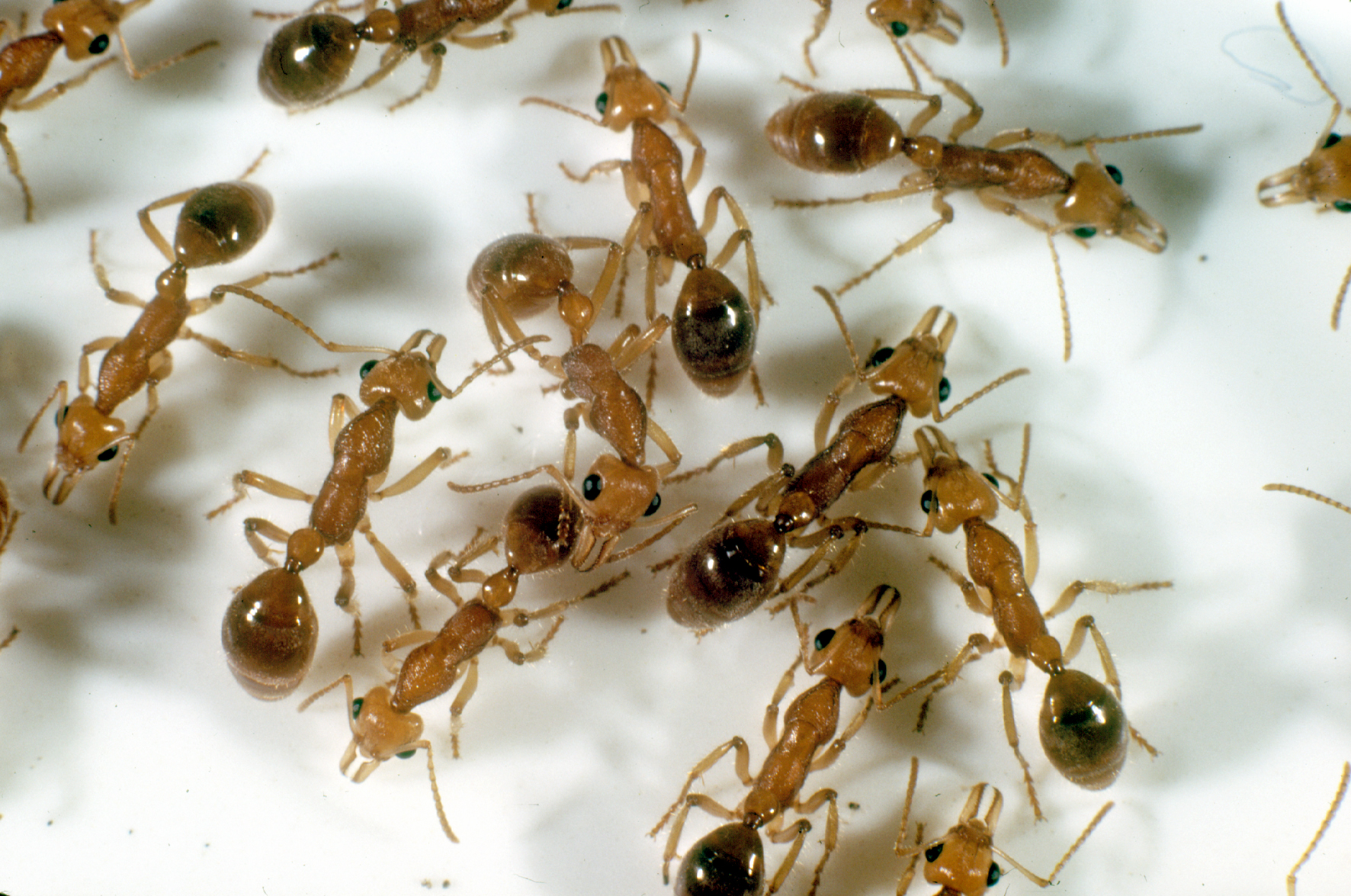
Nothomyrmecia is a medium-sized ant measuring 9.7–11 mm (0.38–0.43 in) in length. Workers are monomorphic, meaning that there is little morphological differentiation among one another. The mandibles, clypeus (one of the sclerites that make up the "face" of an arthropod or insect), antennae and legs are pale yellow. The hairs on the body are yellow, erect and long and abundant, but on the antennae and legs they are shorter and suberect (standing almost in an erect position). It shows similar characteristics to Myrmecia, and somewhat resembles Oecophylla, commonly known as weaver ants. Workers are strictly nocturnal (active mainly at night) but navigate by vision, relying on large compound eyes. The mandibles are shorter than the head. They have 10 to 15 intermeshing teeth and are less specialised than those of Myrmecia and Prionomyrmex, being elongate and triangular. The head is longer than it is wide and broader towards the back. The sides of the head are convex around the eyes. The long antennal scapes (the base of the antenna) extend beyond the occipital border, and the second segment of the funiculus (a series of segments between the base and club) is slightly longer than the first, third and fourth segment. The node, pronotum, epinotum and thorax are longer than broad, and the mesonotum is just as long as it is wide. The first segment of the gaster (the bulbous posterior portion of the metasoma) is broader than long by a third and broader at the back than the front with strongly convex sides.
A long and retractable stinger is present at the rear of the abdomen. It has been described as "prominent and effective" and is capable of inflicting a painful sting to humans. A 'sting bulb gland' is also present in Nothomyrmecia; this is a small exocrine gland of unknown function, first discovered and named in 1990. It is situated in the basal part of the insect's sting, and is located between the two ducts of the venom gland and the Dufour's gland. Despite its many plesiomorphic features, the sting apparatus of Nothomyrmecia is considered less primitive than those found in other ants such as Stigmatomma pallipes. It is the only known species of ant that contains both a sting and a 'waist' (i.e. it has no postpetiole between the first and second gastral segments).
Queens look similar to workers, but several morphological features distinguish the two castes from each other. The queen's body is usually larger. Ocelli are highly developed, but the eyes on the queen are not enlarged. The structure of the pterothorax (the wing-bearing area of the thorax) is consistent with other reproductive ants, but it does not occupy as much of its mesosomal bulk. The wings of the queens are rudimentary and stubby, barely overlapping the first gastral segment, and are brachypterous (non-functional). Males resemble those of Myrmecia, but Nothomyrmecia males bear a single waist node. The wings on the male ant are not stubby like a queen's; rather they are long and fully developed, exhibiting a primitive venational complement. They have a jugal anal lobe (a portion of the hindwing), a feature found in many primitive ants, and basal hamuli (hook-like projections that link the forewings and hindwings). Most male specimens collected have two tibial spurs (spines located on the distal end of the tibia); the first spur is a long calcar and the second spur is short and thick. Adults have a stridulatory organ on the ventral side of the abdomen – unlike all other hymenopterans in which such organs are located dorsally.
In all castes, these ants have six maxillary palps (palps that serve as organs of touch and taste in feeding) and four labial palps (sensory structures on the labium), a highly primitive feature. The females have a 12-segmented antenna, whereas males have 13 segments. Other features include paired calcariae found on both the hind and middle tibiae, and the claws have a median tooth. The unspecialised nature of the cuticle (outer exoskeleton of the body) is similar to Pseudomyrmex, a member of the subfamily Pseudomyrmecinae. Many of the features known in Nothomyrmecia are found in Ponerinae and Pseudomyrmecinae.
The eggs of Nothomyrmecia are similar to those of Myrmecia, being subspherical and non-adhesive. The larvae bear a primitive body structure with no specialised tubercles, sharing similar characteristics with the subfamily Ponerinae, but the sensilla are more abundant on the mouthparts. The larvae are characterised into three stages: very young, young, and mature, measuring 2.8 mm (0.1 in), 6.3 mm (0.2 in) and 11 mm (0.4 in), respectively. The cocoons have thin walls and produce meconium (a metabolic waste product expelled through the anal opening after an insect emerges from its pupal stage). The cuticular hydrocarbons have internally branched alkenes, a feature rarely found in ants and most insects.
Hub AI
Nothomyrmecia AI simulator
(@Nothomyrmecia_simulator)
Nothomyrmecia
Nothomyrmecia, also known as the dinosaur ant or dawn ant, is an extremely rare genus of ants consisting of a single species, Nothomyrmecia macrops. These ants live in South Australia, nesting in old-growth mallee woodland and Eucalyptus woodland. The full distribution of Nothomyrmecia has never been assessed, and it is unknown how widespread the species truly is; its potential range may be wider if it does favour old-growth mallee woodland. Possible threats to its survival include habitat destruction and climate change. Nothomyrmecia is most active when it is cold because workers encounter fewer competitors and predators such as Camponotus and Iridomyrmex, and it also increases hunting success. Thus, the increase of temperature may prevent them from foraging and very few areas would be suitable for the ant to live in. As a result, the IUCN lists the ant as Critically Endangered.
As a medium-sized ant, Nothomyrmecia measures 9.7–11 mm (0.38–0.43 in). Workers are monomorphic, showing little morphological differentiation among one another. Mature colonies are very small, with only 50 to 100 individuals in each nest. Workers are strictly nocturnal and are solitary foragers, collecting arthropod prey and sweet substances such as honeydew from scale insects and other Hemiptera. They rely on their vision to navigate and there is no evidence to suggest that the species use chemicals to communicate when foraging, but they do use chemical alarm signals. A queen ant will mate with one or more males and, during colony foundation, she will hunt for food until the brood have fully developed. Queens are univoltine (they produce just one generation of ants each year). Two queens may establish a colony together, but only one will remain once the first generation of workers has been reared.
Nothomyrmecia was first described by Australian entomologist John S. Clark in 1934 from two specimens of worker ants. These were reportedly collected in 1931 near the Russell Range, inland from Israelite Bay in Western Australia. After its initial discovery, the ant was not seen again for four decades until a group of entomologists rediscovered it in 1977, 1,300 km (810 mi) away from the original reported site. Dubbed as the 'Holy Grail' of myrmecology, the ant was subject to great scientific interest after its rediscovery, attracting scientists from around the world. In Poochera (the rediscovery site), pictures of the ant are stencilled on the streets, and it is perhaps the only town in the world that thrives off ant-based tourism. Some entomologists have suggested a relationship to the Baltic Eocene fossil ant genus Prionomyrmex based on morphological similarities, but this interpretation is not widely accepted by the entomological community. Owing to its body structure, Nothomyrmecia is regarded to be the most plesiomorphic ant alive and a 'living fossil', stimulating studies on its morphology, behaviour, ecology, and chromosomes.
Nothomyrmecia is a medium-sized ant measuring 9.7–11 mm (0.38–0.43 in) in length. Workers are monomorphic, meaning that there is little morphological differentiation among one another. The mandibles, clypeus (one of the sclerites that make up the "face" of an arthropod or insect), antennae and legs are pale yellow. The hairs on the body are yellow, erect and long and abundant, but on the antennae and legs they are shorter and suberect (standing almost in an erect position). It shows similar characteristics to Myrmecia, and somewhat resembles Oecophylla, commonly known as weaver ants. Workers are strictly nocturnal (active mainly at night) but navigate by vision, relying on large compound eyes. The mandibles are shorter than the head. They have 10 to 15 intermeshing teeth and are less specialised than those of Myrmecia and Prionomyrmex, being elongate and triangular. The head is longer than it is wide and broader towards the back. The sides of the head are convex around the eyes. The long antennal scapes (the base of the antenna) extend beyond the occipital border, and the second segment of the funiculus (a series of segments between the base and club) is slightly longer than the first, third and fourth segment. The node, pronotum, epinotum and thorax are longer than broad, and the mesonotum is just as long as it is wide. The first segment of the gaster (the bulbous posterior portion of the metasoma) is broader than long by a third and broader at the back than the front with strongly convex sides.
A long and retractable stinger is present at the rear of the abdomen. It has been described as "prominent and effective" and is capable of inflicting a painful sting to humans. A 'sting bulb gland' is also present in Nothomyrmecia; this is a small exocrine gland of unknown function, first discovered and named in 1990. It is situated in the basal part of the insect's sting, and is located between the two ducts of the venom gland and the Dufour's gland. Despite its many plesiomorphic features, the sting apparatus of Nothomyrmecia is considered less primitive than those found in other ants such as Stigmatomma pallipes. It is the only known species of ant that contains both a sting and a 'waist' (i.e. it has no postpetiole between the first and second gastral segments).
Queens look similar to workers, but several morphological features distinguish the two castes from each other. The queen's body is usually larger. Ocelli are highly developed, but the eyes on the queen are not enlarged. The structure of the pterothorax (the wing-bearing area of the thorax) is consistent with other reproductive ants, but it does not occupy as much of its mesosomal bulk. The wings of the queens are rudimentary and stubby, barely overlapping the first gastral segment, and are brachypterous (non-functional). Males resemble those of Myrmecia, but Nothomyrmecia males bear a single waist node. The wings on the male ant are not stubby like a queen's; rather they are long and fully developed, exhibiting a primitive venational complement. They have a jugal anal lobe (a portion of the hindwing), a feature found in many primitive ants, and basal hamuli (hook-like projections that link the forewings and hindwings). Most male specimens collected have two tibial spurs (spines located on the distal end of the tibia); the first spur is a long calcar and the second spur is short and thick. Adults have a stridulatory organ on the ventral side of the abdomen – unlike all other hymenopterans in which such organs are located dorsally.
In all castes, these ants have six maxillary palps (palps that serve as organs of touch and taste in feeding) and four labial palps (sensory structures on the labium), a highly primitive feature. The females have a 12-segmented antenna, whereas males have 13 segments. Other features include paired calcariae found on both the hind and middle tibiae, and the claws have a median tooth. The unspecialised nature of the cuticle (outer exoskeleton of the body) is similar to Pseudomyrmex, a member of the subfamily Pseudomyrmecinae. Many of the features known in Nothomyrmecia are found in Ponerinae and Pseudomyrmecinae.
The eggs of Nothomyrmecia are similar to those of Myrmecia, being subspherical and non-adhesive. The larvae bear a primitive body structure with no specialised tubercles, sharing similar characteristics with the subfamily Ponerinae, but the sensilla are more abundant on the mouthparts. The larvae are characterised into three stages: very young, young, and mature, measuring 2.8 mm (0.1 in), 6.3 mm (0.2 in) and 11 mm (0.4 in), respectively. The cocoons have thin walls and produce meconium (a metabolic waste product expelled through the anal opening after an insect emerges from its pupal stage). The cuticular hydrocarbons have internally branched alkenes, a feature rarely found in ants and most insects.
Recent media