
Recent from talks
Nuclear blackout
Knowledge base stats:
Talk channels stats:
Members stats:
Nuclear blackout
Nuclear blackout, also known as fireball blackout or radar blackout, is an effect caused by explosions of nuclear weapons that disturbs radio communications and causes radar systems to be blacked out or heavily refracted so they can no longer be used for accurate tracking and guidance. Within the atmosphere, the effect is caused by the large volume of ionized air created by the energy of the explosion, while above the atmosphere it is due to the action of high-energy beta particles released from the decaying bomb debris. At high altitudes, the effect can spread over large areas, hundreds of kilometers. The effect slowly fades as the fireball dissipates.
The effect was known from the earliest days of nuclear testing when radar systems were used to track the nuclear mushroom clouds at very long distances. Its extended effects when exploded outside the atmosphere were first noticed in 1958 as part of the Hardtack and Argus nuclear tests, which caused widespread radio interference extending over thousands of kilometers. The effect was so disconcerting that both the Soviets and US broke the informal testing moratorium that had been in place since late 1958 to run series of tests to gather further information on the various high-altitude effects like blackout and electromagnetic pulse (EMP).
Blackout is a particular concern for anti-ballistic missile (ABM) systems. By exploding a warhead in the upper atmosphere just beyond the range of defensive missiles, an attacker can blanket a wide area of the sky beyond which additional approaching warheads cannot be seen. When those warheads emerge from the blackout area there may not be enough time for the defensive system to develop tracking information and attack them. This was a serious concern for the LIM-49 Nike Zeus program of the late 1950s, and one of the reasons it was ultimately canceled. A key discovery revealed in testing was that the effect cleared more quickly for higher frequencies. Later missile defense designs used radars operating at higher frequencies in the UHF and microwave region to mitigate the effect.
When a nuclear bomb is exploded near ground level, the dense atmosphere interacts with many of the subatomic particles being released. This normally takes place within a short distance, on the order of meters. This energy heats the air, promptly ionizing it to incandescence and causing a roughly spherical fireball to form within microseconds.
Proceeding at a slower speed is the actual explosion, which creates a powerful shock wave moving outward. The energy released by the shock wave is enough to compression heat the air into incandescence, creating a second fireball. This second fireball continues to expand, passing the radiative one. As it expands, the amount of energy in the shock wave drops according to the inverse-square law, while additional energy is lost through direct radiation in the visible and ultraviolet spectrum. Eventually the shock wave loses so much energy that it no longer heats the air enough to cause it to glow. At that point, known as breakaway, the shock front becomes transparent, and the fireball stops growing.
The diameter of the fireball for a bomb exploded clear of the ground can be estimated using the formula:
kilometers
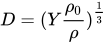
Where is the yield in megatons, and is the ratio of the sea level air density to the air density at altitude. So, a 1 megatonne of TNT (4.2 PJ) bomb exploded at a burst altitude around 5,000 feet (1,500 m) will expand to about 1 kilometre (3,300 ft). The ratio can be calculated over a wide range by assuming an exponential relationship:


Hub AI
Nuclear blackout AI simulator
(@Nuclear blackout_simulator)
Nuclear blackout
Nuclear blackout, also known as fireball blackout or radar blackout, is an effect caused by explosions of nuclear weapons that disturbs radio communications and causes radar systems to be blacked out or heavily refracted so they can no longer be used for accurate tracking and guidance. Within the atmosphere, the effect is caused by the large volume of ionized air created by the energy of the explosion, while above the atmosphere it is due to the action of high-energy beta particles released from the decaying bomb debris. At high altitudes, the effect can spread over large areas, hundreds of kilometers. The effect slowly fades as the fireball dissipates.
The effect was known from the earliest days of nuclear testing when radar systems were used to track the nuclear mushroom clouds at very long distances. Its extended effects when exploded outside the atmosphere were first noticed in 1958 as part of the Hardtack and Argus nuclear tests, which caused widespread radio interference extending over thousands of kilometers. The effect was so disconcerting that both the Soviets and US broke the informal testing moratorium that had been in place since late 1958 to run series of tests to gather further information on the various high-altitude effects like blackout and electromagnetic pulse (EMP).
Blackout is a particular concern for anti-ballistic missile (ABM) systems. By exploding a warhead in the upper atmosphere just beyond the range of defensive missiles, an attacker can blanket a wide area of the sky beyond which additional approaching warheads cannot be seen. When those warheads emerge from the blackout area there may not be enough time for the defensive system to develop tracking information and attack them. This was a serious concern for the LIM-49 Nike Zeus program of the late 1950s, and one of the reasons it was ultimately canceled. A key discovery revealed in testing was that the effect cleared more quickly for higher frequencies. Later missile defense designs used radars operating at higher frequencies in the UHF and microwave region to mitigate the effect.
When a nuclear bomb is exploded near ground level, the dense atmosphere interacts with many of the subatomic particles being released. This normally takes place within a short distance, on the order of meters. This energy heats the air, promptly ionizing it to incandescence and causing a roughly spherical fireball to form within microseconds.
Proceeding at a slower speed is the actual explosion, which creates a powerful shock wave moving outward. The energy released by the shock wave is enough to compression heat the air into incandescence, creating a second fireball. This second fireball continues to expand, passing the radiative one. As it expands, the amount of energy in the shock wave drops according to the inverse-square law, while additional energy is lost through direct radiation in the visible and ultraviolet spectrum. Eventually the shock wave loses so much energy that it no longer heats the air enough to cause it to glow. At that point, known as breakaway, the shock front becomes transparent, and the fireball stops growing.
The diameter of the fireball for a bomb exploded clear of the ground can be estimated using the formula:
kilometers
Where is the yield in megatons, and is the ratio of the sea level air density to the air density at altitude. So, a 1 megatonne of TNT (4.2 PJ) bomb exploded at a burst altitude around 5,000 feet (1,500 m) will expand to about 1 kilometre (3,300 ft). The ratio can be calculated over a wide range by assuming an exponential relationship: