



Community hub
Recent from talks
Knowledge base stats:
Talk channels stats:
Members stats:
Operation Hardtack I
Download coordinates as:
Operation Hardtack I was a series of 35 nuclear tests conducted by the United States from April 28 to August 18, 1958, at the Pacific Proving Grounds. At the time of testing, the Operation Hardtack I test series included more nuclear detonations than the total of prior nuclear explosions in the Pacific Ocean. These tests followed the Project 58/58A series, which occurred from December 6, 1957, to March 14, 1958, and preceded the Operation Argus series, which took place in 1958 from August 27 to September 6.
Operation Hardtack I was directed by Joint Task Force 7 (JTF 7). JTF-7 was a collaboration between the military and many civilians, but was structured like a military organization. Its 19,100 personnel were composed of members of the US military, federal civilian employees, as well as workers affiliated with the Department of Defense (DOD) and the Atomic Energy Commission (AEC).
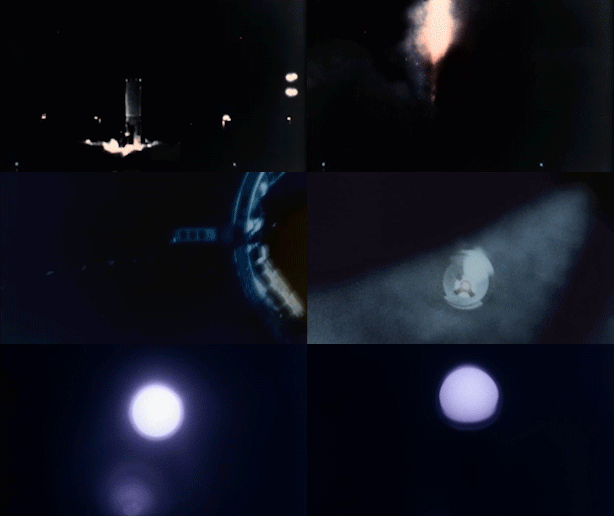
There were three main research directions. The first was the development of new types of nuclear weapons. This was undertaken by detonating experimental devices created by the AEC's Los Alamos Scientific Laboratory and the University of California Radiation Laboratory (UCRL). The DOD performed experiments and tests on these detonations that did not hamper the AEC's research. The second research direction was to examine how underwater explosions affected materiel, especially Navy ships, and was performed by the DOD. The Wahoo test was conducted in the open ocean, whereas Umbrella was in a lagoon. The final avenue of study was to analyze high-altitude nuclear tests to refine the detection of high-altitude nuclear tests and investigate defensive practices for combatting ballistic missiles. This research direction was composed of three individual tests and were the first high-altitude tests. The individual tests in the series were Orange, Teak, and Yucca. Orange and Teak were known collectively as Operation Newsreel and were rocket boosted. Yucca reached its altitude using balloons.
Many events and proceedings leading up to Operation Hardtack I, such as previous nuclear testing results and the global political atmosphere, influenced its creation and design. One such historical circumstance was that nuclear radiation concerns were mounting publicly and abroad by 1956. During the 1956 Presidential Election, ending nuclear testing was a campaign issue and nuclear safety was one part of that discussion. At the same time, the Union of Soviet Socialist Republics (USSR) was publicly proposing a moratorium on testing.
In 1956 during June, the National Academy of Sciences (NAS) recommended new radiation exposure limits for the general public in a report entitled: "The Biological Effects of Atomic Radiation". The AEC, which was the body that developed nuclear weapons, accepted the NAS recommended radiation exposure limits. Some AEC members asserted that the limits were reached incorrectly and should be reviewed in the future. Charles L. Dunham, AEC Director of the Division of Biology and Medicine (DBM), said that the new limits of nuclear radiation exposure would prevent them from continuing testing in Nevada. Dunham, in association with other AEC offices and officials, made recommendations to move further tests to the Pacific to eliminate the need to determine radiological fallout safety.
Also in 1956, the AEC was designing a test series that included nuclear detonations which would release significant amounts of nuclear fallout. The series came to be known as Operation Plumbbob and took place in 1957 from April 24 to October 7. Operation Plumbbob was followed by Project 58/58A and Operation Hardtack I. At the time of testing, Operation Plumbbob was the most extensive nuclear test series held at the Nevada Test Site. President Eisenhower was very cautious in approving Plumbbob due to public concern. Consequently, the AEC held brief and ultimately fruitless discussions of moving some of the tests in the Plumbbob series to the next planned Pacific Ocean series, Operation Hardtack I, to minimize radioactive fallout in and around the Nevada Test Site.
When Operation Plumbbob began in the spring of 1957, the planning process of Operation Hardtack I was well underway and the number of nuclear detonations planned were more than those in the Plumbbob series. At the same time, radiation and nuclear proliferation concerns around the world had led to formal discussions between the US, USSR, and other countries on the topic of instituting a global ban on nuclear testing as a path to disarmament. In 1957 on August 9 AEC chairman Lewis L. Strauss proposed to President Eisenhower a preliminary plan of Operation Hardtack I. President Eisenhower objected to the length of the four-month testing period and that the plan called for 25 shots, which was one more than in Plumbbob. As a result of the discussion, Eisenhower consented to yields no larger than 15 megatons of TNT (63 PJ), and ordered that the testing period be as brief as possible.
Hub AI
Operation Hardtack I AI simulator
(@Operation Hardtack I_simulator)
Operation Hardtack I
Download coordinates as:
Operation Hardtack I was a series of 35 nuclear tests conducted by the United States from April 28 to August 18, 1958, at the Pacific Proving Grounds. At the time of testing, the Operation Hardtack I test series included more nuclear detonations than the total of prior nuclear explosions in the Pacific Ocean. These tests followed the Project 58/58A series, which occurred from December 6, 1957, to March 14, 1958, and preceded the Operation Argus series, which took place in 1958 from August 27 to September 6.
Operation Hardtack I was directed by Joint Task Force 7 (JTF 7). JTF-7 was a collaboration between the military and many civilians, but was structured like a military organization. Its 19,100 personnel were composed of members of the US military, federal civilian employees, as well as workers affiliated with the Department of Defense (DOD) and the Atomic Energy Commission (AEC).
There were three main research directions. The first was the development of new types of nuclear weapons. This was undertaken by detonating experimental devices created by the AEC's Los Alamos Scientific Laboratory and the University of California Radiation Laboratory (UCRL). The DOD performed experiments and tests on these detonations that did not hamper the AEC's research. The second research direction was to examine how underwater explosions affected materiel, especially Navy ships, and was performed by the DOD. The Wahoo test was conducted in the open ocean, whereas Umbrella was in a lagoon. The final avenue of study was to analyze high-altitude nuclear tests to refine the detection of high-altitude nuclear tests and investigate defensive practices for combatting ballistic missiles. This research direction was composed of three individual tests and were the first high-altitude tests. The individual tests in the series were Orange, Teak, and Yucca. Orange and Teak were known collectively as Operation Newsreel and were rocket boosted. Yucca reached its altitude using balloons.
Many events and proceedings leading up to Operation Hardtack I, such as previous nuclear testing results and the global political atmosphere, influenced its creation and design. One such historical circumstance was that nuclear radiation concerns were mounting publicly and abroad by 1956. During the 1956 Presidential Election, ending nuclear testing was a campaign issue and nuclear safety was one part of that discussion. At the same time, the Union of Soviet Socialist Republics (USSR) was publicly proposing a moratorium on testing.
In 1956 during June, the National Academy of Sciences (NAS) recommended new radiation exposure limits for the general public in a report entitled: "The Biological Effects of Atomic Radiation". The AEC, which was the body that developed nuclear weapons, accepted the NAS recommended radiation exposure limits. Some AEC members asserted that the limits were reached incorrectly and should be reviewed in the future. Charles L. Dunham, AEC Director of the Division of Biology and Medicine (DBM), said that the new limits of nuclear radiation exposure would prevent them from continuing testing in Nevada. Dunham, in association with other AEC offices and officials, made recommendations to move further tests to the Pacific to eliminate the need to determine radiological fallout safety.
Also in 1956, the AEC was designing a test series that included nuclear detonations which would release significant amounts of nuclear fallout. The series came to be known as Operation Plumbbob and took place in 1957 from April 24 to October 7. Operation Plumbbob was followed by Project 58/58A and Operation Hardtack I. At the time of testing, Operation Plumbbob was the most extensive nuclear test series held at the Nevada Test Site. President Eisenhower was very cautious in approving Plumbbob due to public concern. Consequently, the AEC held brief and ultimately fruitless discussions of moving some of the tests in the Plumbbob series to the next planned Pacific Ocean series, Operation Hardtack I, to minimize radioactive fallout in and around the Nevada Test Site.
When Operation Plumbbob began in the spring of 1957, the planning process of Operation Hardtack I was well underway and the number of nuclear detonations planned were more than those in the Plumbbob series. At the same time, radiation and nuclear proliferation concerns around the world had led to formal discussions between the US, USSR, and other countries on the topic of instituting a global ban on nuclear testing as a path to disarmament. In 1957 on August 9 AEC chairman Lewis L. Strauss proposed to President Eisenhower a preliminary plan of Operation Hardtack I. President Eisenhower objected to the length of the four-month testing period and that the plan called for 25 shots, which was one more than in Plumbbob. As a result of the discussion, Eisenhower consented to yields no larger than 15 megatons of TNT (63 PJ), and ordered that the testing period be as brief as possible.