Hubbry Logo
Operation ArgusOperation ArgusMain
Open search
Operation Argus
Community hub
Operation Argus
logo
8 pages, 0 posts
0 subscribers
Be the first to start a discussion here.
Operation Argus
Operation Argus
from Wikipedia

Operation Argus
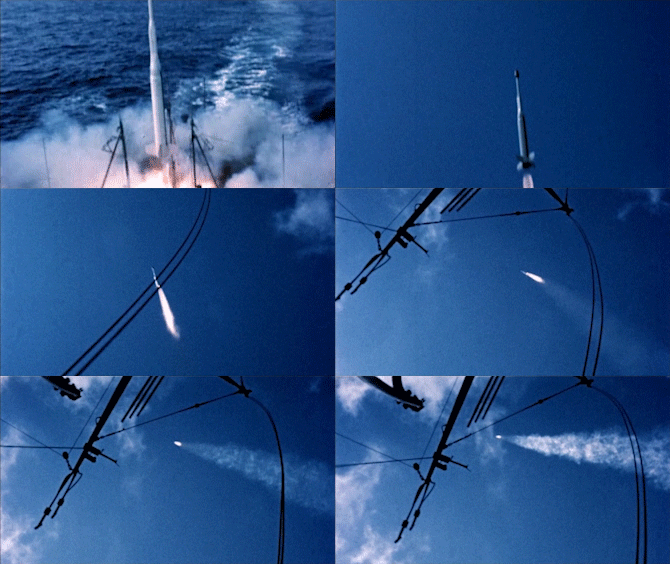
X-17 with nuclear warhead launched from aboard the USS Norton Sound
Information
CountryUnited States
Test siteSouth Atlantic Ocean
Period1958
Number of tests3
Test typespace rocket (> 80 km)
Max. yield1.7 kilotonnes of TNT (7.1 TJ)
Test series chronology

Operation Argus was a series of United States low-yield, high-altitude nuclear weapons tests and missile tests secretly conducted from 27 August to 9 September 1958 over the South Atlantic Ocean.[1][2] The tests were performed by the Defense Nuclear Agency.

The tests were to study the Christofilos effect, which suggested it was possible to defend against Soviet nuclear missiles by exploding a small number of nuclear bombs high over the South Pacific. This would create a disk of electrons over the United States that would overload the electronics on the Soviet warheads as they descended. It was also possible to use the effect to blind Soviet radars, meaning that any Soviet missile-based ABM system would be unable to attack the US counterstrike.

The tests demonstrated that the effect did occur, but that it dissipated too rapidly to be very effective. Papers concerning the topic were published the next year, emphasizing the events as purely scientific endeavors.

Objectives

[edit]

The tests were proposed by Nicholas Christofilos in an unpublished paper[3] of what was then the Livermore branch of the Lawrence Radiation Laboratory (now Lawrence Livermore National Laboratory) as a means to verify the Christofilos effect, which argued that high-altitude nuclear detonations would create a radiation belt in the extreme upper regions of the Earth's atmosphere.[4] Such belts would be similar in effect to the Van Allen radiation belts. "Such radiation belts were viewed as having possible tactical use in war, including degradation of radio and radar transmissions, damage or destruction of the arming and fuzing mechanisms of ICBM warheads, and endangering the crews of orbiting space vehicles that might enter the belt."[2] Prior to Argus, Hardtack Teak had shown disruption of radio communications from a nuclear blast, though this was not due to the creation of radiation belts.

Operation Argus: Report of Chief, ASFWP to ARPA (1958) Official AEC information film reel.

Argus was implemented rapidly after inception due to forthcoming bans on atmospheric and exoatmospheric testing in October 1958.[1] Consequently, the tests were performed within a mere half-year of conception (whereas "normal" testing took one to two years).[5] Because nuclear testing during this time was arguably a violation of the rules, the military borrowed International Geophysical Year equipment to disguise the nuclear tests.[1]

  • Two missiles, with warheads 136–227 kg to be launched within one month of each other, originating from a single site.
  • The missiles were to be detonated at altitudes of 200–1,000 miles (320–1,610 km), and also at 2,000–4,000 miles (3,200–6,400 km). Both detonations should occur near the geomagnetic equator.
  • Satellites were to be placed in equatorial (up to 30°) and polar (up to 70°) orbits, with perigees of roughly 322 kilometers (200 mi) and apogees of roughly 2,900 kilometers (1,800 mi) or greater. These satellites were to be used to measure electron density over time, and include a magnetometer, as well as a means for measuring ambient radio noise. Measurements were to be taken before the shots to determine a baseline, as well as during and after the events.
  • Sounding rockets, launched from appropriate ground locations, were to carry the same instrumentation as the satellites, except for radio noise. Ground stations to be used to study effects on radio astronomy and radar probing as well as auroral measurements.

Originally Argus was designated Hardtack-Argus, and later Floral. For reasons of security, both names were disused in favor of the independent name Argus.

Funding was provided by the Armed Forces Special Weapons Project (AFSWP), the predecessor of the present Defense Threat Reduction Agency (DTRA). Total funds allotted for the project were US$9,023,000.

Task Force 88

[edit]
Path of TF-88 during August and September 1958.

The United States Navy Task Force 88 (or TF-88), was formed 28 April 1958. TF-88 was organized solely to conduct Operation Argus. Once Argus was completed, the task force was dissolved, and its records dispersed. Some of these records have been destroyed or lost during the time period intervening. Of particular note among the missing documents were the film records (which recorded radiation levels during the Argus tests). This has proved contentious due to the greater-than-normal number of leukemia claims among TF-88 participants to the Veterans Administration. Because of this, it has been difficult to resolve to how much radiation the participants were exposed.

USS Norton Sound

[edit]

USS Norton Sound (AVM-1) was a United States Navy-guided missile ship responsible for missile-launching functions. It also served as a training facility for crews involved in the testing. The X-17A missiles to be used in the test were unfamiliar to those conducting the tests. Exercises including assembly and repair of dummy missiles were performed aboard Norton Sound. It also carried a 27-MHz COZI radar, which was operated by the Air Force Cambridge Research Center, which was used to monitor effects of the shots. It was responsible for the launching of three low-yield nuclear warheads into the high atmosphere.[1] Its commanding officer, Captain Arthur R. Gralla, commanded Task Force 88.[6] Gralla would later receive the Legion of Merit for his role conducting the tests expeditiously.[7]

USS Albemarle

[edit]

USS Albemarle, fresh out of an overhaul, was not listed on the TF-88 order. It set out to the Atlantic Ocean, supposedly as a shakedown cruise. It, too, had a COZI radar and other instrumentation for detecting man-made ionization. This instrumentation included International Geophysical Year (IGY) radiometers, receivers, radar, and optical equipment. After the IGY equipment was added, it sailed to the ocean around the area of the Azores to record data at the geomagnetic conjugate point of the South Atlantic test site, as the rest of task force 88 headed to the South Atlantic to perform the tests.[1]

USS Tarawa

[edit]

USS Tarawa served as overall command of the operation, with her commander serving as Task Group Commander. It carried an Air Force MSQ-1A radar and communication system for missile tracking. It also housed VS-32 aircraft for search and security operations as well as scientific measurement, photographic, and observer missions for each test. HS-5 was also aboard and provided intra-task-force transportation for personnel and cargo.

USS Warrington

[edit]

USS Warrington, in conjunction with Bearss, Hammerberg, and Courtney, maintained a weather picket 250 nautical miles (460 km; 290 mi) west of the task force, provided an airplane guard for Tarawa during flight operations, and performed standard destroyer functions (such as surface security and search and rescue). Warrington also carried equipment for launching Loki Dart sounding rockets.

Task Group 88.3

[edit]

USS Neosho refueled task force ships during the operation. It was also outfitted with Air Force MSQ-1A radar and communication vans. Neosho also served as the flagship for TG 88.3, the Mobile Logistics Group, which consisted of Neosho, USS Salamonie (AO-26), and assigned destroyers.

USS Salamonie returned to the United States upon arrival at TF-88, and did not participate with any tests.

Satellite tracking

[edit]
High Altitude Weapons Effects (1962) Official de-classified AEC information film reel.

Two satellite launches were attempted in order to obtain data from these high-altitude tests. Explorer 4 was launched successfully to orbit on 26 July on Juno I missile from Cape Canaveral. The satellite had enough battery power to function for sixty days. This was long enough for the satellite to track and measure ARGUS.[1] Explorer 5 experienced a launch failure on 24 August.

There were many tracking systems used by the task force along with these satellites along with many organizations that helped track these missiles. "These included the Naval Research Laboratory, the Army Signal Research and Development Laboratory, the Smithsonian Astrophysical Laboratory, the Army Map Service, the Naval Ordnance Test Station, and the Ballistic Research Laboratory along with ground tracking stations from the Aleutian Islands through the Azores from academic, industrial, and military organizations."[1]

Preparation

[edit]
Deployment of X-17A aboard USS-Norton Sound.

To prepare for the launch of the ARGUS missiles, many tests and preparations were performed. As the east coast units of TF 88 were heading towards the South Atlantic, they participated with countdown, launch, and missile- tracking drills using Loki/Dart high-altitude, antiaircraft rockets launched from the USS Warrington. Fourteen of these Loki launches were conducted from 12 to 22 August. These tests were performed to test equipment and procedures, and to train personnel in specialized assignments. Some of these assignments necessary for the ARGUS missile launchings were "stationing of ships, MSQ-1A radar tracking by the USS Neosho and the USS Tarawa, communications, positioning of sky-camera S2F aircraft, and area surveillance S2F aircraft."[2]

Tests

[edit]
X-17A warhead.

About 1800 km southwest of Cape Town, South Africa, USS Norton Sound launched three modified X-17A missiles armed with 1.7 kt W-25 nuclear warheads into the upper atmosphere, where high altitude nuclear explosions occurred. Due to the South Atlantic Anomaly, the Van Allen radiation belt is closer to the Earth's surface at that location. The (extreme) altitude of the tests was chosen so as to prevent personnel involved with the test from being exposed to any ionizing radiation.[8] Even with the very minor threat of radiation exposure, precautions were taken to prevent radiological exposure. The task force commander and his staff had devised a series of precautionary radiation safe measures to be followed in each stage of the operation. Though the chance of exposure to radiation from these missiles was minute, the safety measures were performed as directed by the commander by the crew of Task Force 88.[2]

Coordinated measurement programs involving satellite, rocket, aircraft, and surface stations were employed by the services as well as other government agencies and various contractors worldwide.

The Argus explosions created artificial electron belts resulting from the β-decay of fission fragments. These lasted for several weeks. Such radiation belts affect radio and radar transmissions, damage or destroy arming and fusing mechanisms of intercontinental ballistic missile warheads, and endanger crews of orbiting space vehicles. It was found after performing these tests that the explosions did in fact degrade the reception and transmission of radar signals, another proof that Christofilos was correct about the Christofilos effect.[2]

Argus proved the validity of Christofilos' theory: the establishment of an electron shell derived from neutron and β-decay of fission products and ionization of device materials in the upper atmosphere was demonstrated. It not only provided data on military considerations, but produced a "great mass" of geophysical data.

X-17A awaiting launch aboard USS-Norton Sound.

The tests were first reported journalistically by Hanson Baldwin and Walter Sullivan of The New York Times on 19 March 1959,[9][10] headlining it as the "greatest scientific experiment ever conducted". This was an unauthorized publication that caused great controversy among scientists because many of them were unaware of the presence of artificial particles in the Earth's atmosphere.[1] Approximately nine ships and 4,500 people participated with the operation. After the completion of testing, the task force returned to the United States via Rio de Janeiro, Brazil.

The tests were announced officially the next year, but the full results and documentation of the tests were not declassified until 30 April 1982.

List of Argus launches

[edit]
United States' Argus series tests and detonations
Name[note 1] Date time (UT) Local Time Zone[note 2][11] Location[note 3] Elevation + height[note 4] Delivery[note 5]
Purpose[note 6]
Device[note 7] Yield[note 8] Fallout[note 9] References Notes
1 August 27, 1958 02:28:?? WET (0 hrs)
Launch from South Atlantic Ocean 38°30′S 11°30′W / 38.5°S 11.5°W / -38.5; -11.5 (Launch_1), elv: 0 + 0 m (0 + 0 ft);
Detonation over South Atlantic Ocean 38°30′S 11°30′W / 38.5°S 11.5°W / -38.5; -11.5 (1)
N/A + 170 kilometers (110 mi) space rocket (> 80 km),
weapon effect
W-25 1.7 kilotonnes of TNT (7.1 TJ)[12] [13][14][15][16][17][18]
2 August 30, 1958 03:18:?? WET (0 hrs)
Launch from South Atlantic Ocean 49°30′S 8°12′W / 49.5°S 8.2°W / -49.5; -8.2 (Launch_2), elv: 0 + 0 m (0 + 0 ft);
Detonation over South Atlantic Ocean 49°30′S 8°12′W / 49.5°S 8.2°W / -49.5; -8.2 (2)
N/A + 310 kilometers (190 mi) space rocket (> 80 km),
weapon effect
W-25 1.7 kilotonnes of TNT (7.1 TJ)[12] [13][14][15][16][17][18]
3 September 6, 1958 22:13:?? WET (0 hrs)
Launch from South Atlantic Ocean 48°30′S 9°42′W / 48.5°S 9.7°W / -48.5; -9.7 (Launch_3), elv: 0 + 0 m (0 + 0 ft);
Detonation over South Atlantic Ocean 48°30′S 9°42′W / 48.5°S 9.7°W / -48.5; -9.7 (3)
N/A + 794 kilometers (493 mi) space rocket (> 80 km),
weapon effect
W-25 1.7 kilotonnes of TNT (7.1 TJ)[12] [13][14][15][16][17][18]
  1. ^ The US, France and Great Britain have code-named their test events, while the USSR and China did not, and therefore have only test numbers (with some exceptions – Soviet peaceful explosions were named). Word translations into English in parentheses unless the name is a proper noun. A dash followed by a number indicates a member of a salvo event. The US also sometimes named the individual explosions in such a salvo test, which results in "name1 – 1(with name2)". If test is canceled or aborted, then the row data like date and location discloses the intended plans, where known.
  2. ^ To convert the UT time into standard local, add the number of hours in parentheses to the UT time; for local daylight saving time, add one additional hour. If the result is earlier than 00:00, add 24 hours and subtract 1 from the day; if it is 24:00 or later, subtract 24 hours and add 1 to the day.
  3. ^ Rough place name and a latitude/longitude reference; for rocket-carried tests, the launch location is specified before the detonation location, if known. Some locations are extremely accurate; others (like airdrops and space blasts) may be quite inaccurate. "~" indicates a likely pro-forma rough location, shared with other tests in that same area.
  4. ^ Elevation is the ground level at the point directly below the explosion relative to sea level; height is the additional distance added or subtracted by tower, balloon, shaft, tunnel, air drop or other contrivance. For rocket bursts the ground level is "N/A". In some cases it is not clear if the height is absolute or relative to ground, for example, Plumbbob/John. No number or units indicates the value is unknown, while "0" means zero. Sorting on this column is by elevation and height added together.
  5. ^ Atmospheric, airdrop, balloon, gun, cruise missile, rocket, surface, tower, and barge are all disallowed by the Partial Nuclear Test Ban Treaty. Sealed shaft and tunnel are underground, and remained useful under the PTBT. Intentional cratering tests are borderline; they occurred under the treaty, were sometimes protested, and generally overlooked if the test was declared to be a peaceful use.
  6. ^ Include weapons development, weapon effects, safety test, transport safety test, war, science, joint verification and industrial/peaceful, which may be further broken down.
  7. ^ Designations for test items where known, "?" indicates some uncertainty about the preceding value, nicknames for particular devices in quotes. This category of information is often not officially disclosed.
  8. ^ Estimated energy yield in tons, kilotons, and megatons. A ton of TNT equivalent is defined as 4.184 gigajoules (1,162 kWh).
  9. ^ Radioactive emission to the atmosphere aside from prompt neutrons, where known. The measured species is only iodine-131 if mentioned, otherwise it is all species. No entry means unknown, probably none if underground and "all" if not; otherwise notation for whether measured on the site only or off the site, where known, and the measured amount of radioactivity released.

List of ships involved in Operation Argus

[edit]

See also

[edit]

References

[edit]

Further reading

[edit]
[edit]
Revisions and contributorsEdit on WikipediaRead on Wikipedia
from Grokipedia
Operation Argus was a classified series of three high-altitude nuclear tests conducted by the in the South during late August and early September 1958, aimed at validating the Christofilos effect—the generation of artificial radiation belts in through the detonation of low-yield nuclear devices at altitudes exceeding 200 kilometers. The operation utilized Task Force 88, comprising nine ships and approximately 4,500 personnel, which launched the W-25 warheads via X-17A solid-fuel rockets from the modified USS Norton Sound, with detonations occurring on 27 August, 30 August, and 6 September at heights of roughly 170 to 540 kilometers above the surface. Proposed by Nicholas Christofilos of , the tests sought to demonstrate the entrapment of beta particles and neutrons from the explosions, creating electron shells capable of interfering with electromagnetic signals and potentially ballistic missile reentry vehicles. The experiments produced observable phenomena, including enhanced whistler waves and artificial auroras, confirming the formation of temporary belts that persisted for several weeks and were detected by ground-based and airborne instruments across the . Operation Argus represented a rapid proof-of-concept effort amid escalating tensions, executed in secrecy just prior to a voluntary moratorium on atmospheric testing, and underscored the strategic interest in geophysical manipulations for defense without reliance on permanent infrastructure. While the tests yielded no immediate weaponization, they provided foundational data on high-altitude nuclear effects, influencing subsequent into space-based environments and their implications for vulnerability and communications disruption.

Strategic and Scientific Background

Cold War Context and Missile Gap Fears

The Soviet Union achieved the first successful intercontinental ballistic missile (ICBM) test with its R-7 rocket on August 21, 1957, demonstrating a capability to deliver nuclear warheads over intercontinental distances. This breakthrough, followed by the launch of Sputnik 1 on October 4, 1957, using a modified R-7 variant, signaled to U.S. policymakers that the Soviets possessed the technological means to threaten the American mainland directly. U.S. intelligence assessments at the time interpreted these developments as evidence of Soviet superiority in long-range missile systems, amplifying anxieties over a potential "missile gap" where the USSR could outpace American deployment of operational ICBMs. The Sputnik launch intensified public and congressional alarm, with widespread perceptions that Soviet rocketry advancements implied an imminent nuclear threat to U.S. territory, prompting criticism of the Eisenhower administration for perceived delays in missile programs. Compounding these concerns, the high-profile failure of the U.S. Vanguard rocket launch on December 6, 1957, which exploded seconds after liftoff in a televised debacle, underscored American setbacks in contrast to Soviet successes and fueled demands for accelerated countermeasures. President Eisenhower responded by prioritizing rapid advancements in defensive technologies, including exploratory concepts for high-altitude nuclear detonations to generate artificial radiation belts capable of disrupting or destroying incoming Soviet warheads. These fears of Soviet numerical advantages in ICBMs drove interest in asymmetric defenses, as conventional systems lagged behind offensive threats, necessitating innovative area-denial strategies to counter potential massed launches without matching missile-for-missile parity. Although later declassified intelligence revealed the to be overstated—with Soviet ICBM numbers remaining limited into the early —the contemporaneous U.S. assessments justified urgent experimentation with unorthodox measures to restore strategic balance.

The Christofilos Effect Hypothesis

In 1957, physicist Nicholas Christofilos at the Lawrence Livermore National Laboratory proposed a theoretical mechanism for generating artificial radiation belts in Earth's magnetosphere through high-altitude nuclear detonations. Christofilos hypothesized that the beta particles—high-energy electrons emitted primarily from the fission products of a nuclear explosion—could be injected into the geomagnetic field at altitudes above 200 kilometers, where atmospheric scattering is minimal. These electrons, upon release, would gyrate around magnetic field lines due to the Lorentz force, with their trajectories constrained by the field's dipole geometry, potentially forming a persistent shell of trapped charged particles spanning thousands of kilometers. The causal chain posited by Christofilos relied on fundamental plasma physics: charged particles in a magnetic field experience perpendicular motion as circular orbits (gyroradius inversely proportional to field strength and charge-to-mass ratio), while parallel motion allows oscillation between conjugate points near the magnetic poles via magnetic mirroring, where the increasing field intensity reflects particles back along field lines. For electrons with energies in the 100 keV to several MeV range typical of nuclear fission betas, lifetimes in the trap could extend to months or years before precipitation into the atmosphere, limited mainly by energy loss to synchrotron radiation or collisions. This trapped population would elevate electron density in the magnetosphere, creating a partially ionized, conductive layer capable of generating electromagnetic disturbances—such as enhanced whistler-mode waves or prompt electromagnetic pulses—that could couple to incoming missiles, inducing currents to damage electronics or perturb guidance systems via trajectory deviations. Christofilos's reasoning drew from pre-1958 empirical observations of geomagnetic particle trapping, including auroral phenomena attributed to solar-flare electrons spiraling along field lines, and laboratory analogs using particle accelerators to simulate betatron-like injection into magnetic bottles. Although the natural Van Allen radiation belts—comprising proton and electron populations trapped by the same mechanism—were not discovered until January 1958 via Explorer 1 satellite data, Christofilos's proposal anticipated their existence by invoking analogous physics, predicting that anthropogenic bursts could amplify or replicate such belts for defensive applications. Declassified analyses later confirmed the hypothesis's grounding in verifiable geomagnetic dynamics, though quantitative predictions of disruption efficacy required empirical validation.

Proposal and Approval Process

In late 1957 and early 1958, physicist Nicholas Christofilos, working at the Radiation Laboratory (UCRL), advocated for high-altitude nuclear tests to empirically validate his that such detonations could generate artificial radiation belts capable of disrupting incoming ballistic missiles through the Christofilos effect. Christofilos presented his proposals to the Advanced Research Projects Agency (ARPA) and U.S. Navy representatives, emphasizing the potential military utility amid escalating tensions and fears of a Soviet missile advantage. A February 1958 working group at Lawrence Livermore Laboratory reviewed the theory, recommending a proof-of-concept test series to assess its viability before committing to resource-intensive full-scale deployment. Following these evaluations, the President's Science Advisory Committee (PSAC) briefed President on March 6, , leading to initial concept approval; final authorization for Project Argus came on May 1, , after coordination with the Atomic Energy Commission (AEC), , and State Department. assumed overall responsibility, issuing Order 4-58 on , , with funding rapidly allocated at $9,023,000 to cover missile launches, instrumentation, and low-yield W-25 warheads (approximately 1.7 kilotons each), selected for their suitability in minimizing ground-level effects while enabling precise hypothesis testing. The was tasked with operational execution via Task Force 88, reflecting a pragmatic division prioritizing scientific over extended deliberations. Decision-making centered on risk-assessed empirical validation, with declassified assessments highlighting negligible fallout hazards from high-altitude bursts (over 200 miles) and contingency planning for launch failures, rather than ethical or international repercussions. This urgency stemmed from an anticipated atmospheric testing moratorium, with the U.S. unilaterally halting tests after Phase II on November 1, 1958, compelling Argus's compressed timeline from approval to execution in under five months to secure data before prohibitions took effect.

Operational Planning

Primary Objectives

The primary objective of Operation Argus was to verify the Christofilos effect, a hypothesis proposing that high-altitude nuclear detonations could inject energetic electrons into Earth's magnetosphere, creating artificial radiation belts capable of trapping charged particles for defensive purposes. This involved measuring the density of trapped electrons and their persistence following detonation, with experiments designed to confirm whether such belts could be generated predictably at altitudes ranging from approximately 170 to 540 kilometers. Secondary objectives focused on assessing the belts' potential to interfere with adversarial systems, including tracking, radio communications, and reentry vehicles, by simulating disruptions through enhanced and electromagnetic effects. Detonations utilized low-yield devices estimated at 1.7 to 3.8 kilotons to minimize extraneous atmospheric interactions while maximizing magnetospheric injection. The South Atlantic launch site was selected for its proximity to the geomagnetic equator, which facilitated optimal particle trapping by aligning detonation points with low-latitude lines, enhancing the efficiency of electron mirroring and adiabatic invariance as predicted by the .

Organizational Structure and Task Force 88

The established Task Force 88 (TF-88) on April 28, 1958, specifically to execute Operation Argus under the command of Lloyd M. Mustin. This force comprised nine ships and approximately 4,500 personnel, mobilized in secrecy to maintain operational security amid tensions, with contingency measures prepared in case of Soviet detection. The Navy maintained overall leadership, ensuring efficient coordination across services by integrating Air Force radar and communication assets alongside civilian scientists from the and the . Task Group 88.3 handled the core launch responsibilities, primarily utilizing the missile trials ship USS Norton Sound (AVM-1) as the platform for deploying X-17A rockets carrying the nuclear warheads. Command operations were directed from the support carrier USS Tarawa (CVS-40), which also hosted MSQ-1A systems for tracking and data collection. Support functions included refueling by USS Neosho and escort duties by destroyers such as USS Warrington (DD-843), facilitating the task force's remote positioning in the South Atlantic. This structure exemplified streamlined inter-service collaboration, with non- Department of Defense and Commission personnel embedded aboard ships to support scientific instrumentation without compromising naval command authority.

Preparation and Secrecy Measures

Task Force 88, consisting of nine ships and approximately 4,500 personnel, underwent rapid logistical preparation in July and August 1958 to deploy to the remote South Atlantic Ocean. The lead vessel, USS Norton Sound, was modified at the Naval Shipyard in June 1958 with vertical launchers and fuel storage adaptations for three-stage X-17A missiles, each configured to deliver a low-yield W-25 of 1-2 kilotons. Following a 10-day training course for crew on missile assembly, the ship departed —near —on August 1, 1958, with the missiles already loaded. Supporting ships, including the antisubmarine carrier USS Tarawa (CVS-40) and destroyers USS Bearss (DD-654) and USS Warrington (DD-843), sailed from East Coast ports on August 7, 1958, rendezvousing by August 23 at approximately 45°S, 8°W, a location chosen to evade commercial shipping lanes and reduce the risk of foreign surveillance. Operational security dominated preparations to prevent Soviet detection amid heightened tensions. Protocols enforced during transit and station-keeping, while campaigns framed the task force's activities as routine equipment trials or antisubmarine exercises, backed by a confidential operation order distributed to participants for plausibility. Compartmentalization limited detailed knowledge to essential personnel, excluding even many within the Department of Defense from the nuclear test objectives; the operation remained classified until declassification in March 1959. These measures addressed intelligence vulnerabilities, as the South Atlantic site's isolation complemented the low-profile assembly to obscure the mission from adversaries. Pre-deployment calibrations ensured system reliability, including four non-nuclear X-17A test firings off , , from July 2 to 24, 1958, yielding two successes with apogees of 302 and 363 nautical miles. The launched on July 26, 1958, to record baseline charged-particle fluxes in Earth's radiation belts, supported by tracking from over 40 global stations. Upon arrival, rehearsals featured 14 Loki-Dart launches from August 12 to 22 for instrumentation checks and four Pogo rocket simulations on August 25-26 as final non-nuclear dry runs.

Execution of the Tests

Launch Platforms and Missiles

The primary launch platform for Operation Argus was the USS Norton Sound (AVM-1), a U.S. Navy missile trials ship specially modified to accommodate the X-17A rockets, including deck reinforcements and crew training for handling and firing operations. The ship served as the mobile base from which all three successful X-17A launches originated in the South Atlantic Ocean, positioned at coordinates ensuring the required burst altitudes and geomagnetic conditions. The X-17A was a three-stage, solid-propellant research rocket originally developed by Lockheed for reentry vehicle testing, adapted for Argus with modifications to carry nuclear payloads and achieve altitudes exceeding 500 km. Each missile weighed approximately 2,700 kg at launch and was fired vertically from the 's deck-mounted launcher, relying on inertial guidance for trajectory control without ground-based assistance during the operational phase. The warheads employed were W-25 thermonuclear devices, boosted fission designs with yields of 1.5 to 1.7 kilotons, optimized for high-altitude detonation to minimize ground fallout while maximizing electromagnetic effects. Task Force 88 provided supporting observation platforms, including surface ships for reception and such as those from USS Tarawa (CVS-40) for visual monitoring, search, and security patrols. -based instrumentation refined tracking techniques during pre-launch rehearsals, with contingencies for launch aborts due to weather or system anomalies; one planned firing was scrubbed to ensure reliability after diagnostic checks. Backup procedures emphasized redundant shipboard diagnostics and rapid missile assembly to mitigate single-point failures in the isolated oceanic environment.

Sequence of Detonations

The initial detonation, designated Argus I, took place on August 27, 1958, at 02:20 UTC, with the low-yield nuclear device (1-2 kilotons) reaching an altitude of approximately 200 km over the South Atlantic Ocean following launch from the USS Norton Sound using an X-17A rocket. The injection was successful despite a slightly errant trajectory attributed to surface winds of 25 knots and rough sea conditions, confirming the procedural feasibility of high-altitude delivery. Argus II followed on August 30, 1958, at 03:10 UTC, employing similar parameters including a comparable altitude of around 250-300 km and the same launch platform and type, after a 26-hour delay due to a malfunction on the prior attempt. This shot achieved a near-vertical under 22-knot winds and rough seas, demonstrating repeatability of the injection process. The final detonation, Argus III, occurred on September 6, 1958, at 22:05 UTC, at the highest altitude of the series—approximately 500 km—to simulate broader geomagnetic effects, launched again from the USS Norton Sound amid multiple prior delays from weather and a firing circuit failure. The procedure succeeded with the desired burst altitude under moderate 15-knot winds, marking completion of the test sequence.

Observation and Tracking Methods

Satellite observations were conducted using Explorer IV, launched on July 26, 1958, equipped with to measure fluxes in the artificial radiation belts. These included a thin for low-energy electrons and a thick for higher-energy particles, alongside a Geiger-Müller counter for broader detection, providing data on trapped particle intensities via to ground stations. Ground-based stations supplemented satellite efforts with their own instruments to monitor fluxes, coordinated through Department of Defense networks. Ship-based tracking from Task Force 88 vessels utilized systems to monitor trajectories and points in the South Atlantic, with ionosondes deployed to record ionospheric disturbances. These platforms enabled real-time positional data relay during launches from the . Aircraft, including specialized reconnaissance flights, were positioned to detect (EMP) signatures through onboard sensors, capturing transient field variations post-. Surface stations in South Africa and Argentina contributed observations of auroral-like effects, employing photometers and magnetometers to track luminous phenomena and geomagnetic perturbations visible in southern latitudes. Due to operational secrecy, real-time telemetry from all platforms faced transmission restrictions, with raw data packets encrypted and relayed via secure channels to analysis centers in Washington, D.C., limiting immediate on-site processing.

Scientific Results and Analysis

Creation of Artificial Radiation Belts

The high-altitude detonations of Operation Argus injected beta s from the fission fragments of low-yield nuclear devices into geomagnetic field lines, creating detectable enhancements in trapped particle populations. Explorer IV observations following the August 27, 1958, Argus I detonation recorded peak counting rates exceeding 25,000 counts per second at altitudes around 2,000 km, indicating significant electron fluxes in the artificial shell. Similar enhancements were measured after subsequent shots on August 30 and September 6, with the shell positioned at approximately L = 1.7 and exhibiting a thickness of 100–200 km. Empirical electron densities reached approximately 10^{-3} /cm³ in the vicinity of the injections, with omnidirectional fluxes on the order of 2.5 × 10^6 /cm²/sec for energies above ~0.5 MeV. measurements from Explorer IV's Geiger-Müller counters confirmed a dominance of beta-decay with peak energies around 0.5 MeV and a high-energy tail extending beyond 3.5 MeV, consistent with fission product decay spectra rather than prompt products. These particles were trapped along specific field lines mirroring at altitudes of several hundred kilometers, with no evidence of significant radial or degradation in the initial observations. The artificial belts persisted for several weeks, with decay timescales varying by altitude and energy: trapped 1 MeV electrons exhibited lifetimes of about 0.14 days at 700 km mirror height but extended to roughly 10 days at 1,200 km, following an approximate 1/t temporal decay profile attributable to atmospheric and interactions near mirror points. In comparison to the natural Van Allen belts, the Argus enhancements were localized to a narrow range of L-shells near the geomagnetic over the South Atlantic, with peak intensities comparable to inner-belt regions but lacking the broader spatial extent and sustained high fluxes of the natural proton-dominated outer belts. Residual effects were potentially detectable as late as December 1958 by Pioneer III, though at diminished levels.

Observed Effects on Electronics and Communications

The artificial shells produced by Operation Argus detonations caused observable degradations in and radio signal performance, primarily through interactions with the and . Following the Argus I shot on August 27, 1958, the USS Albemarle detected strong high-frequency (HF) echoes at 27 MHz using its COZI system, indicating enhanced likely from irregularities over the South Atlantic. Similar strong HF echoes were recorded after the Argus III detonation on September 6, 1958, with Project 7.3 instrumentation on the USS Neosho also capturing echoes at conjugate points aligned with geomagnetic predictions. These radar effects stemmed from the injected high-energy electrons (energies exceeding 8 MeV) trapped in , which scattered signals in the 50-200 MHz band and produced sporadic ionospheric disturbances. C-97 observations post-Argus III confirmed transient ionospheric variations suggestive of test-induced scintillation, though no complete HF communication blackouts were documented due to the localized and short-lived nature of the shells (persisting hours to days). (VLF) receiver perturbations were noted by the USS Albemarle after Argus II on August 30, 1958, but riometer and data yielded no positive indications of broader absorption events. No direct (EMP) damage to ground electronics occurred, as the low yields (classified but inferred as 1-2 kilotons) and altitudes around 500 km limited source-region EMP propagation to surface assets, with observations confined to remote shipboard and aerial platforms. Satellite impacts were minimal; Explorer IV, launched July 26, 1958, successfully measured intensities exceeding 10,000 counts per second—far above natural backgrounds of ~1 count per second—without reported anomalies in its scintillation counters or telemetry systems.

Data Interpretation and Initial Assessments

Following the execution of the three Argus detonations in late August and early September 1958, Department of Defense scientists conducted initial analyses using data from Explorer IV satellite instrumentation, ground-based observatories, and shipborne detectors, confirming the injection of high-energy into the Earth's geomagnetic field as predicted by Nicholas Christofilos' theory. Measurements indicated a 200-mile-thick electron band with intensities 2-5 times above background levels, drifting eastward and detectable over regions including , , and , with shell strengths exceeding 1 roentgen per hour in affected areas. Christofilos' theoretical models, based on adiabatic invariants governing motion in , accurately described the initial and mirroring of beta-decay electrons from fission fragments, validating the core mechanism of belt formation. However, empirical revealed rapid decay, with the artificial belts persisting only several weeks before dissipating, primarily due to pitch-angle scattering, across L-shells, and into the atmosphere—processes that shortened lifetimes to under one year rather than the multi-year durations anticipated for sustained defensive applications. Early 1959 DoD assessments, drawn from declassified and surveys, deemed the tests a partial validation of the , demonstrating feasibility for temporary disruption of and communications via enhanced flux but highlighting limitations in achieving a persistent, high-density capable of broad-area denial. Internal evaluations noted that while injection rates aligned with predictions, the models overestimated efficiency against atmospheric losses, rendering the belts viable for short-term tactical effects but insufficient for long-term strategic barriers.

Strategic Evaluation and Legacy

Military and Defensive Implications

Operation Argus demonstrated the potential for high-altitude nuclear detonations to generate artificial radiation belts capable of disrupting enemy missile electronics and guidance systems through charged particle injection into Earth's , validating aspects of Nicholas Christofilos's theory for space-based strategies. The tests, conducted with low-yield devices of approximately 1-2 kilotons at altitudes of 170-540 kilometers, produced observable effects such as enhanced auroral displays and temporary degradation of radio communications, suggesting tactical utility in blinding adversary radars or interfering with Soviet ICBM reentry vehicles during the vulnerable exo-atmospheric phase. This proof-of-concept influenced subsequent U.S. programs, including the higher-yield test in 1962, which sought to amplify these effects for broader defense applications. Despite these outcomes, the belts formed by Argus proved too diffuse and short-lived—persisting for days to weeks at most—to enable reliable destruction of incoming warheads, with particle densities insufficient for high-probability intercepts against hardened or multiple independent reentry vehicles. The configuration also exposed vulnerabilities to countermeasures, such as Soviet development of shielded or alternative trajectories, limiting its viability as a persistent defensive shield and highlighting the challenges of maintaining belt intensity against geophysical dissipation. Strategically, Argus bolstered U.S. deterrence posture in the late by underscoring American technical resolve to explore asymmetric nuclear options amid escalating Soviet missile threats, countering domestic and international pressures for testing moratoriums that preceded the 1963 Limited Test Ban Treaty. The operation's secrecy and rapid execution reinforced perceptions of U.S. innovation in high-altitude effects, informing calculations on space weaponization even as practical deployment remained constrained by yield limitations and mutual assured destruction dynamics.

Long-term Technological Influences

The empirical confirmation of injection and trapping in the Earth's during Operation Argus provided foundational data for modeling artificial and natural radiation belts, enhancing predictions of behavior essential for orbit planning and longevity. Measurements from Explorer IV , which detected elevated fluxes following the August 27, 1958, detonation, quantified shell lifetimes and intensities, directly informing geophysical models of the Van Allen belts and their impacts on spacecraft electronics. This magnetospheric data contributed to early advancements in radiation-resistant materials and shielding techniques, as the observed enhancement of high-energy electron populations highlighted vulnerabilities in unhardened systems, paving the way for standards that mitigate total ionizing dose and single-event effects in subsequent satellite designs. Although not immediately codified, Argus results influenced preparatory analyses for higher-yield tests like in 1962, whose satellite disruptions underscored the need for proactive hardening protocols in defense and commercial space assets. Observed disruptions to radio and signals in the 50-200 MHz band demonstrated causal links between beta electron precipitation and ionospheric scintillation, advancing comprehension of dynamics that affect global navigation systems like GPS, where ionospheric delays and scintillation remain operational concerns. These insights supported resilient architectures for early warning and communication networks by quantifying anomalies, though direct weaponization of the Christofilos effect was not pursued due to the 1963 Limited Test Ban Treaty. The legacy persists in conceptual frameworks for countering peer-adversary constellations through electromagnetic , emphasizing asymmetric disruptions over kinetic intercepts.

Environmental and Health Assessments

The detonations during Operation Argus, conducted at altitudes of 125 to 300 miles above the South Atlantic Ocean, produced no significant local fallout due to the exo-atmospheric explosions, which limited interaction with the lower atmosphere and prevented the formation of ground-depositing radioactive particles. Residual remained confined to the upper atmosphere for approximately six months, resulting in no measurable surface . The remote, unpopulated test location ensured zero population exposure to from these events. Dosimetry assessments of personnel revealed negligible doses, with 264 distributed film packets yielding only 21 positive readings, the highest at 0.010 roentgens—below detection thresholds for health concern—and pocket dosimeters registering zero exposure. Control packets recorded a spurious maximum of 0.025 roentgens, further confirming the absence of meaningful personnel doses from the high-altitude bursts. The artificial electron belts generated by beta decay of fission products posed theoretical hazards to high-orbit electronics or crews, such as signal degradation or internal charging, but these effects were transient, persisting for many hours to several weeks before dissipating via atmospheric scattering and natural decay. In 1958, with minimal satellites in orbit (primarily low-Earth examples like ), no operational assets were demonstrably affected, and post-test geophysical monitoring through identified no links to auroral disturbances or health anomalies attributable to the belts.

Controversies and Criticisms

Secrecy and Disclosure Issues

Operation Argus was executed under stringent secrecy measures to protect , primarily to deny the intelligence on the tests' methodology, yields, altitudes, and potential applications for via artificial belts. Planning emphasized informal coordination among a limited cadre of scientists and military personnel, with minimal written records and cover stories portraying activities as routine equipment trials or Pacific-based operations to evade detection. This approach mitigated risks from the globally detectable ionospheric disturbances caused by the detonations on , , and September 6, 1958, ensuring adversaries could not correlate anomalies with U.S. actions or infer strategic objectives. Secrecy faced challenges from early investigative journalism and scientific circles, with New York Times military affairs editor Hanson Baldwin uncovering details as early as summer 1958, possibly via leaks from James Van Allen's laboratory. Internal administration debates intensified by January 1959, balancing disclosure pressures against risks to ongoing Geneva nuclear test-ban talks; the prioritized avoiding diplomatic fallout and preserving surprise elements, while scientists argued continued classification offered no enduring military edge and contravened transparency norms. President Eisenhower's team, advised by the President's Advisory on March 16, 1959, opted against proactive release but acquiesced following leaks, leading to official partial acknowledgment. The operation's covert nature precluded international protests during execution, enabling 88's unencumbered deployment of approximately 4,500 personnel across nine ships without foreign interference. Full arrived on April 30, 1982, via Defense Nuclear Agency reports detailing the program's scope and findings, confirming the initial secrecy's success in forestalling Soviet countermeasures.

Effectiveness Debates and Strategic Shortcomings

Operation Argus provided empirical confirmation of the Christofilos effect, demonstrating that high-altitude nuclear detonations could inject beta-decay electrons into Earth's geomagnetic field to form artificial radiation belts, thereby advancing fundamental knowledge of magnetospheric physics and particle trapping dynamics. Satellite observations from Explorer IV recorded elevated electron fluxes reaching approximately 10^6 electrons/cm²/sec above background levels, with belts spanning several hundred kilometers in thickness and exhibiting whistler wave propagation as predicted. These results validated partial disruption mechanisms, including degradation of and radio signals in the 50–200 MHz frequency range, which could theoretically impair reentry electronics or communications. Proponents within the , including Nicholas Christofilos, argued that such tests offered a proof-of-principle for leveraging geomagnetic phenomena in space defense, countering the rapid Soviet ICBM buildup observed in the late 1950s. Critics in Department of Defense evaluations, however, emphasized the belts' insufficient densities—on the order of 10^{-8} electrons/cm³—to achieve reliable interference with hardened warheads, resulting in only marginal probabilities of disruption for incoming . The shells failed to produce the dense, persistent barrier envisioned for active defense, with effects limited by low injection efficiencies from the 1–10 kiloton yields and suboptimal detonation altitudes in the initial shots due to errors. Military assessments post-Argus concluded that scaling the approach to operational levels would require impractical numbers of repeated detonations, yielding against countermeasures like shielding or decoys. Debates in DoD reviews highlighted overhype by theoretical advocates versus pragmatic strategic calculus, acknowledging the tests' necessity for empirical data amid intelligence on Soviet high-altitude threats but underscoring high resource demands relative to achieved gains. Electron lifetimes, estimated at days for 1-MeV particles depending on mirror altitudes, led to rapid dissipation via precipitation and atmospheric interactions, precluding sustained shielding without continuous replenishment—an untenable burden. Ultimately, these shortcomings shifted focus to ground-based interceptors and other non-nuclear ABM systems, as Argus illuminated causal limits in nuclear-generated plasma defenses without ideological aversion to the underlying innovation.

International and Ethical Repercussions

Operation Argus, executed in secrecy during August and September , generated no immediate international reactions due to its classified status, which prevented detection by adversaries including the . Disclosure occurred in March 1959 following a presentation by physicist Nicholas Christofilos, prompting U.S. media coverage that framed the tests as the "greatest scientific experiment ever conducted" rather than eliciting diplomatic protests. The operation preceded both the 1963 Partial Test Ban Treaty, which prohibited atmospheric and high-altitude detonations, and the 1967 , which barred nuclear weapons in orbit; as suborbital bursts under 600 km altitude with yields of 1-2 kilotons, they complied with prevailing international norms absent specific prohibitions on such . Soviet unawareness during the tests underscored the operation's covert success, with no evidence of contemporaneous accusations; subsequent Soviet high-altitude experiments, such as those in Project K during 1961-1962, mirrored Argus in exploring artificial radiation belts for potential defensive applications, highlighting reciprocal Cold War imperatives under mutual assured destruction rather than unilateral recklessness. Concerns arose during Geneva test-ban talks about possible diplomatic fallout from revelation, yet none materialized, as the tests' scientific framing aligned with International Geophysical Year data-sharing ethos without violating disclosure pledges on non-nuclear observations. Ethically, deliberations focused on secrecy's trade-offs against scientific openness, with proponents arguing declassification posed negligible military risk while advancing geophysical knowledge, as the transient artificial belts dissipated within weeks without global fallout. In the post-Sputnik context of Soviet ICBM advancements, the tests empirically validated defensive concepts like the Christofilos effect to enhance U.S. survivability, prioritizing causal deterrence against verifiable threats over speculative prohibitions on space experimentation; radiological monitoring confirmed exposures below 0.01 roentgen, yielding no disproportionate harms to outweigh strategic imperatives. This approach reflected pragmatic realism, as untested alternatives risked national vulnerability absent mutual restraints.

References

Add your contribution
Related Hubs
User Avatar
No comments yet.