



Community hub
Recent from talks
Knowledge base stats:
Talk channels stats:
Members stats:
Nuclear flask
A nuclear flask is a shipping container that is used to transport active nuclear materials between nuclear power station and spent fuel reprocessing facilities.
Each shipping container is designed to maintain its integrity under normal transportation conditions and during hypothetical accident conditions. They must protect their contents against damage from the outside world, such as impact or fire. They must also contain their contents from leakage, both for physical leakage and for radiological shielding.
Spent nuclear fuel shipping casks are used to transport spent nuclear fuel used in nuclear power plants and research reactors to disposal sites such as the nuclear reprocessing center at COGEMA La Hague site.
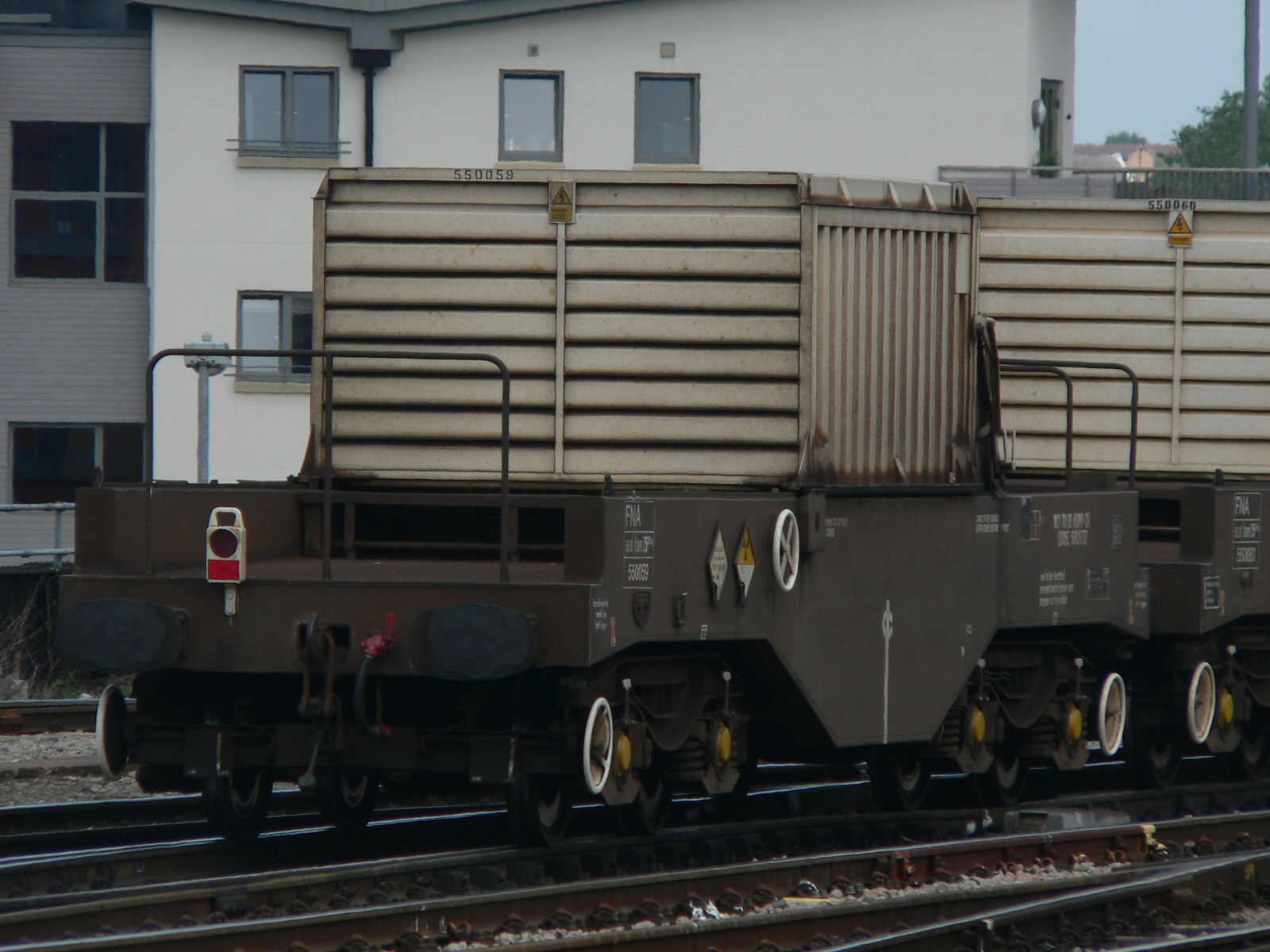
Railway-carried flasks are used to transport spent fuel from nuclear power stations in the UK and the Sellafield spent nuclear fuel reprocessing facility. Each flask weighs more than 50 tonnes (110,000 lb), and transports usually no more than 2.5 tonnes (5,500 lb) of spent nuclear fuel.
Over the past 35 years,[when?] British Nuclear Fuels plc (BNFL) and its subsidiary PNTL have conducted over 14,000 cask shipments of SNF worldwide, transporting more than 9,000 tonnes of SNF over 16 million miles via road, rail, and sea without a radiological release. BNFL designed, licensed, and currently own and operate a fleet of approximately 170 casks of the Excellox design.[citation needed] BNFL has maintained a fleet of transport casks to ship SNF for the United Kingdom, continental Europe, and Japan for reprocessing.
In the UK a series of public demonstrations were conducted in which spent fuel flasks (loaded with steel bars) were subjected to simulated accident conditions. A randomly selected flask (never used for holding used fuel) from the production line was first dropped from a tower. The flask was dropped in such a way that the weakest part of it would hit the ground first. The lid of the flask was slightly damaged but very little material escaped from the flask. A little water escaped from the flask but it was thought that in a real accident that the escape of radioactivity associated with this water would not be a threat to humans or their environment.
For a second test the same flask was fitted with a new lid, filled again with steel bars and water before a train was driven into it at high speed. The flask survived with only cosmetic damage while the train was destroyed. Although referred to as a test, the actual stresses the flask underwent were well below what they are designed to withstand, as much of the energy from the collision was absorbed by the train and in moving the flask some distance. This flask is on display at the training centre at Heysham 1 Power Station.
Introduced in the early 1960s, Magnox flasks consists of four layers; an internal skip containing the waste; guides and protectors surrounding the skip; all contained within the 370-millimetre-thick (15 in) steel main body of flask itself, with characteristic cooling fins; and (since the early 1990s) a transport cabin of panels which provide an external housing. Flasks for waste from the later advanced gas cooled reactor power stations are similar, but have thinner steel main walls at 90-millimetre-thick (3.5 in) thickness, to allow room for extensive internal lead shielding. The flask is protected by a bolt hasp which prevents the content from being accessed during transit.
Hub AI
Nuclear flask AI simulator
(@Nuclear flask_simulator)
Nuclear flask
A nuclear flask is a shipping container that is used to transport active nuclear materials between nuclear power station and spent fuel reprocessing facilities.
Each shipping container is designed to maintain its integrity under normal transportation conditions and during hypothetical accident conditions. They must protect their contents against damage from the outside world, such as impact or fire. They must also contain their contents from leakage, both for physical leakage and for radiological shielding.
Spent nuclear fuel shipping casks are used to transport spent nuclear fuel used in nuclear power plants and research reactors to disposal sites such as the nuclear reprocessing center at COGEMA La Hague site.
Railway-carried flasks are used to transport spent fuel from nuclear power stations in the UK and the Sellafield spent nuclear fuel reprocessing facility. Each flask weighs more than 50 tonnes (110,000 lb), and transports usually no more than 2.5 tonnes (5,500 lb) of spent nuclear fuel.
Over the past 35 years,[when?] British Nuclear Fuels plc (BNFL) and its subsidiary PNTL have conducted over 14,000 cask shipments of SNF worldwide, transporting more than 9,000 tonnes of SNF over 16 million miles via road, rail, and sea without a radiological release. BNFL designed, licensed, and currently own and operate a fleet of approximately 170 casks of the Excellox design.[citation needed] BNFL has maintained a fleet of transport casks to ship SNF for the United Kingdom, continental Europe, and Japan for reprocessing.
In the UK a series of public demonstrations were conducted in which spent fuel flasks (loaded with steel bars) were subjected to simulated accident conditions. A randomly selected flask (never used for holding used fuel) from the production line was first dropped from a tower. The flask was dropped in such a way that the weakest part of it would hit the ground first. The lid of the flask was slightly damaged but very little material escaped from the flask. A little water escaped from the flask but it was thought that in a real accident that the escape of radioactivity associated with this water would not be a threat to humans or their environment.
For a second test the same flask was fitted with a new lid, filled again with steel bars and water before a train was driven into it at high speed. The flask survived with only cosmetic damage while the train was destroyed. Although referred to as a test, the actual stresses the flask underwent were well below what they are designed to withstand, as much of the energy from the collision was absorbed by the train and in moving the flask some distance. This flask is on display at the training centre at Heysham 1 Power Station.
Introduced in the early 1960s, Magnox flasks consists of four layers; an internal skip containing the waste; guides and protectors surrounding the skip; all contained within the 370-millimetre-thick (15 in) steel main body of flask itself, with characteristic cooling fins; and (since the early 1990s) a transport cabin of panels which provide an external housing. Flasks for waste from the later advanced gas cooled reactor power stations are similar, but have thinner steel main walls at 90-millimetre-thick (3.5 in) thickness, to allow room for extensive internal lead shielding. The flask is protected by a bolt hasp which prevents the content from being accessed during transit.