




Community hub
Recent from talks
Contribute something to knowledge base
Content stats: 0 posts, 0 articles, 1 media, 0 notes
Members stats: 0 subscribers, 0 contributors, 0 moderators, 0 supporters
Subscribers
Supporters
Contributors
Moderators
Nundinae
The nundinae (/nənˈdɪnaɪ/, /-niː/), sometimes anglicized to nundines, were the market days of the ancient Roman calendar, forming a kind of weekend including, for a certain period, rest from work for the ruling class (patricians).
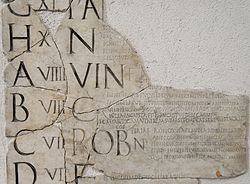
The nundinal cycle, market week, or eight-day week (Latin: nundinum or internundinum) was the cycle of days preceding and including each nundinae. These were marked on fasti using nundinal letters from A to H. The earliest form of the Roman calendar is sometimes said to have included exactly 38 such cycles, running for 304 days from March to December before an unorganized expanse of about 50 winter days. The lengths of the Republican and Julian calendars, however, were not evenly divisible by 8; under these systems, the nundinae fell on a different letter each year. These letters formed the basis of the later Christian dominical letters.
The name nūndinae (Latin: [ˈnuːn.dɪ.nae̯]) was apparently formed from an early form of nōnus ("ninth") and -din- ("day"), a root related to diēs and ultimately the Proto-Indo-European root reconstructed as *dyew- ("to shine"). It is now glossed as an adjective modifying an understood feriae ("festival; holiday"), but not all Romans considered it to be one: a writer named Titius listed the nundinae as a "customary occasion" (sollemnes) and the Roman pontiffs themselves told the augur Messala that they did not consider the nones or nundinae to be religious occasions. Like feriae and the names of most other recurring days of the Roman calendar, nundinae always appeared as a plural in classical Latin, even in references to a single day. The English form "nundine", following French nundines, similarly appeared only as a plural at first, although it is now used in the singular number for individual days. In Roman inscriptions, the word was abbreviated NVN.
The form nundinum for the span between the nundinae seems to have been standard in early Latin, but only appears in compounds (internundinum, trinundinum, &c.) and phrases (inter nundinum) in the classical period.
The name of the 8-day cycle is based upon the Latin word for "nine" because the Romans tended to count dates inclusively. Each nundinae was thought to follow the next after a 9-day interval because the first day was included in the count.
The Etruscans also celebrated an 8-day week which may have been the basis of the Roman system. They supposedly used each day for royal audiences and councils with their various kings. According to Macrobius, the people of the Roman countryside were first obliged to gather in the city on the nones of each month, about a week after the new moon, to hear from the king or his equivalent what the holy days would be and what they were to do over the course of the coming month. The regular nundinae were credited by Roman legend variously to Romulus when he ruled jointly with Titus Tatius and first established Rome's religious observances, to Servius Tullius when he aimed to improve commerce in the town, or to the plebeians when they began to gather after the expulsion of Tarquin to offer sacrifices to Servius Tullius. Macrobius relates that the prohibition against the nundinae occurring on months' nones arose out of concern that these plebeians visiting the city would cause trouble out of remembrance of the popular Servius Tullius, since it was supposedly generally known that his birthday fell on one of the nones but it was uncertain which.
All patrician business was originally suspended during the nundinae but it seems to have been fasti by the time of the Twelve Tables and, among its provisions, the Hortensian Law (Lex Hortensia) of 287 BC permitted their use for most legal and business purposes. Dates otherwise permitted for public assemblies (dies comitialis) were still downgraded if a nundinae occurred on them.
The theoretical proscriptions concerning the nundinae were not always observed. The rebellion of M. Aemilius Lepidus in 78 BC was later remembered as an example of the pernicious effects of having the nundinae occur on the January kalends; the New Year was allowed to coincide with a market again in 52 BC. Cicero complains in one of his letters about a contio being held in the Circus Flaminius despite the nundinae. Following the 46 BC Julian reform of the calendar, the inalterable nature of its leap day intercalation meant that the nundinae began to fall upon the supposedly unlucky days of 1 January and the nones of each month. Early on in the Julian calendar, though, the strength of this superstition caused the priests to insert an extra day as under the former system; it was accommodated by removing another day sometime later in the year; this seems to have occurred in 40 BC and AD 44.
Nundinae
The nundinae (/nənˈdɪnaɪ/, /-niː/), sometimes anglicized to nundines, were the market days of the ancient Roman calendar, forming a kind of weekend including, for a certain period, rest from work for the ruling class (patricians).
The nundinal cycle, market week, or eight-day week (Latin: nundinum or internundinum) was the cycle of days preceding and including each nundinae. These were marked on fasti using nundinal letters from A to H. The earliest form of the Roman calendar is sometimes said to have included exactly 38 such cycles, running for 304 days from March to December before an unorganized expanse of about 50 winter days. The lengths of the Republican and Julian calendars, however, were not evenly divisible by 8; under these systems, the nundinae fell on a different letter each year. These letters formed the basis of the later Christian dominical letters.
The name nūndinae (Latin: [ˈnuːn.dɪ.nae̯]) was apparently formed from an early form of nōnus ("ninth") and -din- ("day"), a root related to diēs and ultimately the Proto-Indo-European root reconstructed as *dyew- ("to shine"). It is now glossed as an adjective modifying an understood feriae ("festival; holiday"), but not all Romans considered it to be one: a writer named Titius listed the nundinae as a "customary occasion" (sollemnes) and the Roman pontiffs themselves told the augur Messala that they did not consider the nones or nundinae to be religious occasions. Like feriae and the names of most other recurring days of the Roman calendar, nundinae always appeared as a plural in classical Latin, even in references to a single day. The English form "nundine", following French nundines, similarly appeared only as a plural at first, although it is now used in the singular number for individual days. In Roman inscriptions, the word was abbreviated NVN.
The form nundinum for the span between the nundinae seems to have been standard in early Latin, but only appears in compounds (internundinum, trinundinum, &c.) and phrases (inter nundinum) in the classical period.
The name of the 8-day cycle is based upon the Latin word for "nine" because the Romans tended to count dates inclusively. Each nundinae was thought to follow the next after a 9-day interval because the first day was included in the count.
The Etruscans also celebrated an 8-day week which may have been the basis of the Roman system. They supposedly used each day for royal audiences and councils with their various kings. According to Macrobius, the people of the Roman countryside were first obliged to gather in the city on the nones of each month, about a week after the new moon, to hear from the king or his equivalent what the holy days would be and what they were to do over the course of the coming month. The regular nundinae were credited by Roman legend variously to Romulus when he ruled jointly with Titus Tatius and first established Rome's religious observances, to Servius Tullius when he aimed to improve commerce in the town, or to the plebeians when they began to gather after the expulsion of Tarquin to offer sacrifices to Servius Tullius. Macrobius relates that the prohibition against the nundinae occurring on months' nones arose out of concern that these plebeians visiting the city would cause trouble out of remembrance of the popular Servius Tullius, since it was supposedly generally known that his birthday fell on one of the nones but it was uncertain which.
All patrician business was originally suspended during the nundinae but it seems to have been fasti by the time of the Twelve Tables and, among its provisions, the Hortensian Law (Lex Hortensia) of 287 BC permitted their use for most legal and business purposes. Dates otherwise permitted for public assemblies (dies comitialis) were still downgraded if a nundinae occurred on them.
The theoretical proscriptions concerning the nundinae were not always observed. The rebellion of M. Aemilius Lepidus in 78 BC was later remembered as an example of the pernicious effects of having the nundinae occur on the January kalends; the New Year was allowed to coincide with a market again in 52 BC. Cicero complains in one of his letters about a contio being held in the Circus Flaminius despite the nundinae. Following the 46 BC Julian reform of the calendar, the inalterable nature of its leap day intercalation meant that the nundinae began to fall upon the supposedly unlucky days of 1 January and the nones of each month. Early on in the Julian calendar, though, the strength of this superstition caused the priests to insert an extra day as under the former system; it was accommodated by removing another day sometime later in the year; this seems to have occurred in 40 BC and AD 44.
Recent media
Recent media