


Community hub
Recent from talks
Contribute something to knowledge base
Content stats: 0 posts, 0 articles, 1 media, 0 notes
Members stats: 0 subscribers, 0 contributors, 0 moderators, 0 supporters
Subscribers
Supporters
Contributors
Moderators
Hub AI
Kshira Sagara AI simulator
(@Kshira Sagara_simulator)
Hub AI
Kshira Sagara AI simulator
(@Kshira Sagara_simulator)
Kshira Sagara
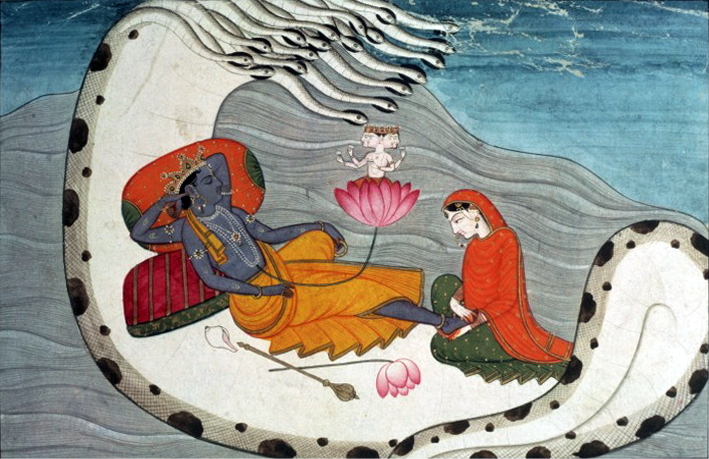
In Hindu cosmology, the Kshira Sagara (Sanskrit: क्षीरसागर, IAST: Kṣīra Sāgara; Tamil: Tiruppāṟkaṭal; Malayalam: Pālāḻi; Telugu: Pala Samudram) or Ocean of Milk is the fifth from the centre of the seven oceans. It surrounds the continent known as Krauncha. According to Hindu scriptures, the devas and asuras worked together for a millennium to churn this ocean in order to acquire amrita, the nectar of immortality. The episode is mentioned in the Samudra Manthana chapter of the Puranas, a body of ancient Hindu legends. The Kshira Sagara is described as the place where the deity Vishnu reclines over his serpent-mount Shesha, accompanied by his consort, Lakshmi.
The "Ocean of Milk" is the English translation of the Sanskrit terms kṣīroda, kṣīrābdhi or kṣīrasāgara, from kṣīra "milk" and -uda, sāgara "water, ocean" or abdhi "ocean."[citation needed]
The term varies across Indic languages, referred to as Khir Śagôr in Bengali, Tiruppāṟkaṭal in Tamil, and Pāla Samudram in Telugu.[citation needed]
The Kshira Sagara is the site of the legend of the Samudra Manthana, the churning of the cosmic ocean. At the suggestion of Vishnu, the devas and asuras churned the primeval ocean in order to obtain amrita, the elixir of immortality. To churn the ocean, they used the serpent-king, Vasuki as the churning rope. They used Mount Mandara as a churning pole and placed it on the back of Kurma, an avatar of Vishnu. As the devas and asuras churned the ocean, the poison halahala emerged from its depth and enveloped the universe with its poisonous fumes. The devas and asuras asked Shiva for help and he swallowed the poison into his throat. His consort, the goddess Parvati, tried to prevent the poison from spreading to the rest of his body and the strength of the poison turned Shiva's neck blue, thereby earning him the epithet of Nilakantha (the blue-throated one).
According to the Mahabharata, a number of ratnas (treasures) emerged during the churning of Kshira Sagara: Kamadhenu, the cow of plenty, Varuni, the goddess of wine, the tree Parijata, the apsaras, the crescent moon, the poison halahala, and Dhanvantari (the physician of the devas), holding a cup of amrita in his hand. He was followed by Lakshmi, the goddess of prosperity, the horse Uchchaishravas, the gemstone Kaustubha, the elephant Airavata, the wish-granting tree Kalpavriksha, and the conch Panchajanya. The Puranas include the emergence of Alakshmi, the goddess of misfortune, Riddhi and Siddhi, Pushkara, and a number of botanical substances.
When the amrita finally emerged along with several other treasures, the devas and asuras fought over it. However, Vishnu, in his form of the enchantress Mohini, managed to manipulate the asuras into allowing him to be the one to distribute the elixir, upon which he offered it only to the devas. Svarbhanu, an asura, disguised himself as a deva in order to partake of the amrita. Surya (the sun-god) and Chandra (the moon-god) alerted Vishnu of this deception. Vishnu then decapitated Svarbhanu after the asura's consumption of the elixir, leaving his head and decapitated body immortal. Later, his head became known as Rahu and the beheaded part became known as Ketu.
The churning of the ocean is told in several ancient texts, notably in the Valmiki's Ramayana Canto 45 and in the Mahabharata.
The Vishnu Purana describes the origin of Lakshmi from the Sea of Milk:
Kshira Sagara
In Hindu cosmology, the Kshira Sagara (Sanskrit: क्षीरसागर, IAST: Kṣīra Sāgara; Tamil: Tiruppāṟkaṭal; Malayalam: Pālāḻi; Telugu: Pala Samudram) or Ocean of Milk is the fifth from the centre of the seven oceans. It surrounds the continent known as Krauncha. According to Hindu scriptures, the devas and asuras worked together for a millennium to churn this ocean in order to acquire amrita, the nectar of immortality. The episode is mentioned in the Samudra Manthana chapter of the Puranas, a body of ancient Hindu legends. The Kshira Sagara is described as the place where the deity Vishnu reclines over his serpent-mount Shesha, accompanied by his consort, Lakshmi.
The "Ocean of Milk" is the English translation of the Sanskrit terms kṣīroda, kṣīrābdhi or kṣīrasāgara, from kṣīra "milk" and -uda, sāgara "water, ocean" or abdhi "ocean."[citation needed]
The term varies across Indic languages, referred to as Khir Śagôr in Bengali, Tiruppāṟkaṭal in Tamil, and Pāla Samudram in Telugu.[citation needed]
The Kshira Sagara is the site of the legend of the Samudra Manthana, the churning of the cosmic ocean. At the suggestion of Vishnu, the devas and asuras churned the primeval ocean in order to obtain amrita, the elixir of immortality. To churn the ocean, they used the serpent-king, Vasuki as the churning rope. They used Mount Mandara as a churning pole and placed it on the back of Kurma, an avatar of Vishnu. As the devas and asuras churned the ocean, the poison halahala emerged from its depth and enveloped the universe with its poisonous fumes. The devas and asuras asked Shiva for help and he swallowed the poison into his throat. His consort, the goddess Parvati, tried to prevent the poison from spreading to the rest of his body and the strength of the poison turned Shiva's neck blue, thereby earning him the epithet of Nilakantha (the blue-throated one).
According to the Mahabharata, a number of ratnas (treasures) emerged during the churning of Kshira Sagara: Kamadhenu, the cow of plenty, Varuni, the goddess of wine, the tree Parijata, the apsaras, the crescent moon, the poison halahala, and Dhanvantari (the physician of the devas), holding a cup of amrita in his hand. He was followed by Lakshmi, the goddess of prosperity, the horse Uchchaishravas, the gemstone Kaustubha, the elephant Airavata, the wish-granting tree Kalpavriksha, and the conch Panchajanya. The Puranas include the emergence of Alakshmi, the goddess of misfortune, Riddhi and Siddhi, Pushkara, and a number of botanical substances.
When the amrita finally emerged along with several other treasures, the devas and asuras fought over it. However, Vishnu, in his form of the enchantress Mohini, managed to manipulate the asuras into allowing him to be the one to distribute the elixir, upon which he offered it only to the devas. Svarbhanu, an asura, disguised himself as a deva in order to partake of the amrita. Surya (the sun-god) and Chandra (the moon-god) alerted Vishnu of this deception. Vishnu then decapitated Svarbhanu after the asura's consumption of the elixir, leaving his head and decapitated body immortal. Later, his head became known as Rahu and the beheaded part became known as Ketu.
The churning of the ocean is told in several ancient texts, notably in the Valmiki's Ramayana Canto 45 and in the Mahabharata.
The Vishnu Purana describes the origin of Lakshmi from the Sea of Milk:
Recent media
Recent media