


Community hub
Recent from talks
Contribute something
Nothing was collected or created yet.
Mount Mandara
View on Wikipedia
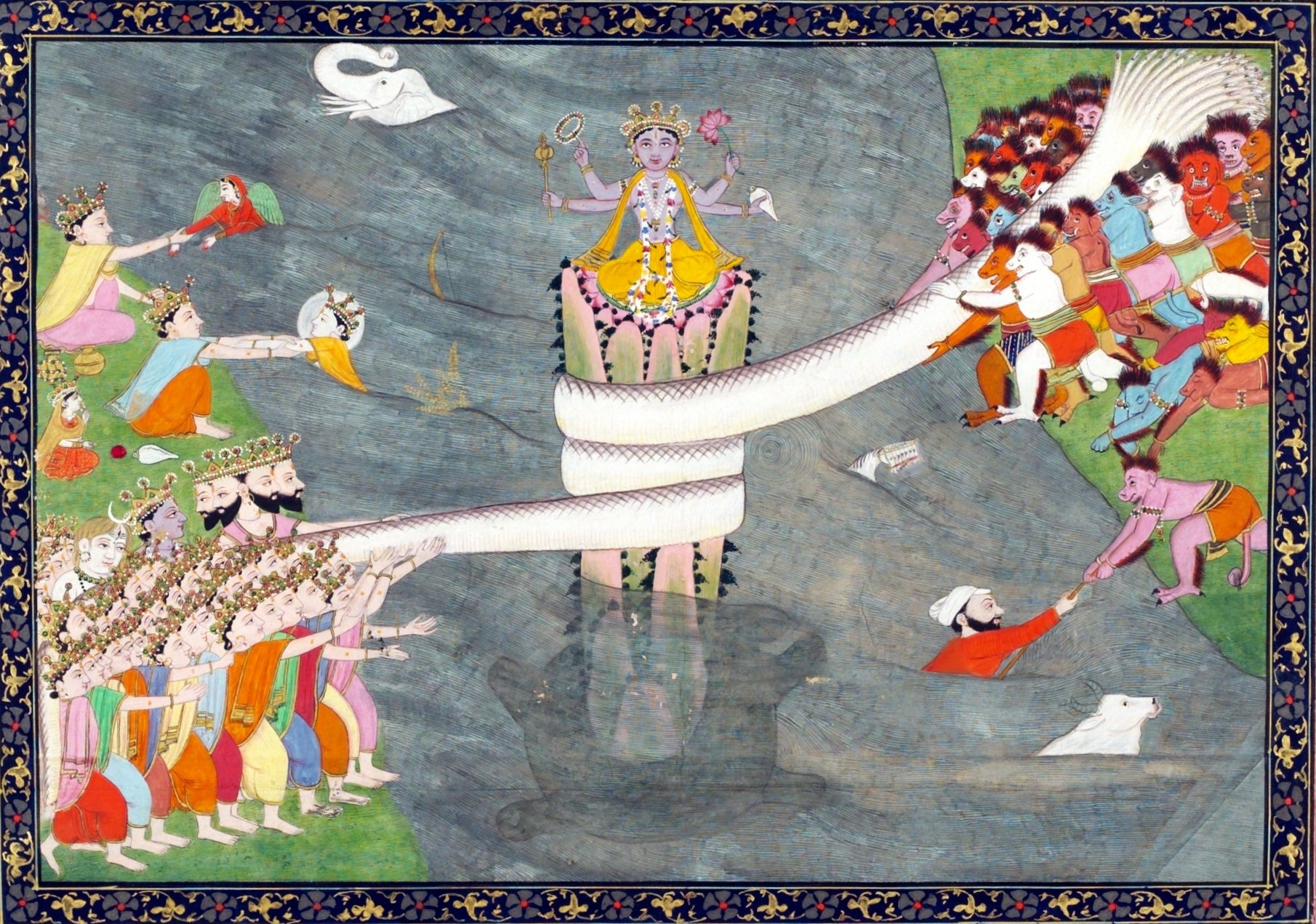
Mandara (Sanskrit: मन्दर, मन्दार; mandara, mandāra) is the name of the mountain that appears in the Samudra Manthana episode in the Hindu Puranas, where it was used as a churning rod to churn the Ocean of Milk. Shiva's serpent, Vasuki, offered to serve as the rope pulled on one side by a team of asuras (i.e., demons), and on the other, by a team of devas (i.e., gods). It is frequently identified as a residence of the deity Shiva and a site of intense spirituality.[1]
Literature
[edit]The primary puranic significance of Mount Mandara is its use as a churning rod to retrieve amrita, the nectar of immortality, from the depths of the primal ocean.[2] In the narrative, the devas (i.e., gods) and asuras (i.e., demons) were unable to uproot the mountain themselves and required the assistance of the celestial serpent, Ananta, to move it to the ocean.[3][4]
During the churning process, the serpent, Vasuki, served as the churning rope, wrapped around the mountain.[5] The asuras held the serpent's head while the devas held the tail.[3] To prevent the massive mountain from sinking into the ocean floor, the god Vishnu assumed his second avatar as a tortoise, Kurma, to act as a pivoting base for the mountain's weight.[6]
During the churning of the ocean, using Mount Mandara produced fourteen precious treasures, including the goddess Lakshmi, the celestial horse Uchchaihshravas, the white elephant Airavata, Soma (i.e., the moon), and eventually the vessel of amrita.[7] However, the process also released the deadly Kalakuta poison, which Shiva consumed to protect the universe.[2]
Religious Significance
[edit]Mount Mandara is heavily associated with the god Shiva, who is said to have established a golden residence there.[8] It is the setting for numerous divine interactions, for example, the Skandapurana recounts Shiva playfully addressing Parvati on the mountain inspiring her to perform tapas (i.e., austerities).[8] Mandara itself is described to have practiced tapas for five thousand divine years to win Shiva's favor.[8]
Symbolism and Interpretation
[edit]Philosophically, Mount Mandara is interpreted as the world axis or stambha, representing a pillar linking different planes of existence and consciousness.[2][9] In Tantric and psychological interpretations, the mountain symbolizes the human spine or the physical consciousness that must be "churned" through spiritual practice to achieve the nectar of enlightenment.[2]
Depictions
[edit]
The imagery of Mount Mandara and the Churning of the Ocean is a common motif in Hindu and Buddhist art, seen in India and Southeast Asia:
- Angkor Wat: The most famous depiction is a massive 12th-century bas-relief in Cambodia showing hundreds of gods and demons pulling Vasuki around the mountain.[10]
- Indonesia: Archaeological finds in East Java, such as the Sirah Kentjong spot, depict the churning process as part of hydraulic systems where water gushes from the mountain peak, symbolizing the production of auspicious water.[4][11]
- Indian Temples: Narrative reliefs on the Padamata temple in Rajasthan, from the 8th century, depict myths of Parvati and the emergence of warrior goddesses associated with the mountain.[12] In South India, tortoise-shaped bases for lamps and wedding platforms (i.e., kalyana mandapams) evoke the stability Mandara provided during the emergence of the world's treasures.[4]
The depiction of the Churning of the Ocean of Milk became very popular in Khmer art, perhaps because their creation myth involved a Nāga ancestor.
References
[edit]- ^ "Synopses of Chapters 31 to 52 from The Skandapurāṇa Volume IIb: Adhyāyas 31-52. The Vāhana and Naraka Cycles on JSTOR". www.jstor.org. doi:10.1163/j.ctv2gjwvds.8. Retrieved 19 February 2026.
- ^ a b c d Bhattacharya, Pradip (1986). "Symbols of Immortality in the Mahabharata". India International Centre Quarterly. 13 (1): 106–115. ISSN 0376-9771.
- ^ a b "5. Churning the ocean of milk – a historical-comparative study of the Indo-European root menth from Indo-European Ecologies: Cattle and Milk – Snakes and Water on JSTOR". www.jstor.org. Retrieved 19 February 2026.
- ^ a b c Williams, Joanna (1992). "The Churning of the Ocean of Milk— Myth, Image and Ecology". India International Centre Quarterly. 19 (1/2): 145–155. ISSN 0376-9771.
- ^ Lenhart, Lawrence (2016). "Too Slow Is How That Tortoise Go: A Carapace in 37 Parts". Fourth Genre: Explorations in Nonfiction. 18 (1): 000–000. doi:10.14321/fourthgenre.18.1.0089. ISSN 1522-3868.
- ^ Van Den Bossche, Frank (1997). "Jain Arguments Against Vedānta Monistic Idealism; a Translation of the "Parabrahmotthāpanasthala of Bhuvanasundara Sūri"". Journal of Indian Philosophy. 25 (4): 337–374. ISSN 0022-1791.
- ^ Allchin, F. R. (1976). "The Reconciliation of Jñāna and Bhakti in "Rāmacaritamānasa"". Religious Studies. 12 (1): 81–91. ISSN 0034-4125.
- ^ a b c "The Myth Cycles of Skandapurāṇa 31–52 from The Skandapurāṇa Volume IIb: Adhyāyas 31-52. The Vāhana and Naraka Cycles on JSTOR". www.jstor.org. doi:10.1163/j.ctv2gjwvds.4. Retrieved 19 February 2026.
- ^ Grossato, Alessandro (1984). "Review of Ancient Indian Cosmogony". East and West. 34 (1/3): 371–376. ISSN 0012-8376.
- ^ Gratza, Agnieszka (2010). Ayala, Raúl Ortega; Judge, Harminder Singh; Couch, Amanda (eds.). "Spiritual Nourishment: Food and Ritual in Performance Art". PAJ: A Journal of Performance and Art. 32 (1): 67–75. ISSN 1520-281X.
- ^ Williams, Joanna (2001). "ESSAY: The Churning of the Ocean of Milk— myth, image and ecology". India International Centre Quarterly. 28 (4): 229–235. ISSN 0376-9771.
- ^ Meister, Michael W. (2009). "Gaurīśikhara: Temple as an Ocean of Story". Artibus Asiae. 69 (2): 295–315. ISSN 0004-3648.
- Dictionary of Hindu Lore and Legend (ISBN 0-500-51088-1) by Anna Dallapiccola
Hindu deities and texts | ||
|---|---|---|
| Gods |  | |
| Goddesses | ||
| Deity groups | ||
| Texts (list) | ||
Mount Mandara
View on GrokipediaMythology
Role in Samudra Manthan
In the Hindu mythological episode known as Samudra Manthan, or the churning of the ocean of milk (Kshirasagara), the gods (Devas) and demons (Asuras) temporarily allied to obtain amrita, the nectar of immortality, after the Devas lost their strength to the demon king Bali following a curse by the sage Durvasa.[5][6] Advised by Lord Vishnu, the Devas and Asuras gathered celestial herbs and plants, casting them into the ocean to enrich the churning process, with the goal of sharing the resulting amrita equally.[5][6] Mount Mandara played the pivotal role of the churning rod (mathani) in this cosmic endeavor, uprooted from its earthly base by the combined efforts of the Devas and Asuras, who, empowered by their pride in strength, lifted it but soon grew exhausted, leading to the death of many participants until Vishnu revived them with a mere glance.[5] Vishnu then transported the massive mountain to the ocean's edge on the back of his mount Garuda, positioning it upright near the milky waters for the churning to commence.[5] The serpent king Vasuki, king of the Nagas, volunteered as the churning rope, coiled around Mount Mandara, with the Asuras grasping his head and the Devas his tail to rotate the mountain in a rhythmic pull.[7][6] As the churning began, Mount Mandara's immense weight caused it to sink into the ocean bed, threatening to halt the process until Vishnu incarnated as Kurma, the gigantic tortoise avatar, positioning himself beneath the mountain to bear its load steadily on his shell, ensuring stability while also entering the bodies of both sides to infuse them with vigor.[7][6] The initial extractions included the virulent poison halahala (or kalakuta), which emerged as a blazing fire threatening all creation; Lord Shiva intervened by consuming it at Parvati's urging, holding it in his throat to turn it blue (hence his name Neelakantha), thus safeguarding the universe.[7][6] Subsequent churnings yielded fourteen divine treasures (ratnas), including the goddess Lakshmi, who emerged radiant and chose Vishnu as her consort; the wish-fulfilling tree Parijata; the celestial cow Kamadhenu; the apsaras (nymphs) such as Rambha; the moon (appropriated by Shiva); the goddess Varuni of wine; and finally, Dhanvantari, the physician of the gods, bearing a pot of amrita.[7][6] A dispute arose over the nectar, prompting Vishnu to assume the enchanting form of Mohini, a beautiful woman, who distributed the amrita preferentially to the Devas, restoring their immortality and supremacy while tricking the Asuras, thereby concluding the churning with Mount Mandara's role as the enduring axis of this divine collaboration.[6]Other Mythological Appearances
In Puranic cosmogony, Mount Mandara is portrayed as a central cosmic mountain, often described as a spur or prominent feature adjacent to Mount Meru, the axis mundi that supports the structure of the universe and connects the earthly and divine realms. This positioning underscores its role in upholding the cosmic order, with its roots extending into the foundational layers of creation as detailed in texts like the Vishnu Purana. Beyond its structural significance, Mount Mandara serves as a sacred refuge for deities, sages, and mythical beings in various legends. For instance, in the Bhagavata Purana, King Agnidhra performed severe penances in a cave on Mandara to obtain a son, attracting the apsara Purvacitti sent by Brahma, whom he married. Similarly, the demon Hiranyakashipu undertook intense austerities on the mountain, standing motionless for years with arms raised, to gain boons of immortality and dominion from Brahma. In the Shiva Purana, it is depicted as a serene abode where Lord Shiva and Parvati engage in divine sports and reside amid its lush caves, streams, and supernatural beauty, making it a favored site for their divine pastimes.[8] The mountain is home to great rishis, virtuous siddhas, and celestial creatures such as elephants and herbs of immense potency, providing an ideal environment for ascetic practices and spiritual seclusion.[9] Certain Puranic accounts further identify sacred locales on Mandara as the dwelling of Krishna in his Madhusudana form, the slayer of the demon Madhu, emphasizing its sanctity as a divine retreat.[10] Mount Mandara also features prominently as a site of meditation and penance for gods. In the Shiva Purana, Shiva performs the severe Pasupata rite in a cavern on the mountain, accompanied by Parvati, highlighting its role as a place of intense yogic discipline.[11] A notable incident occurs when Parvati playfully covers Shiva's eyes during his meditation, causing a drop of sweat to fall and give birth to the demon Andhaka, symbolizing the emergence of darkness from obstructed divine vision.[12] The mountain plays a key role in epic battles between gods and demons, particularly in conflicts involving Shiva. In the Harivamsa Purana, the demon Andhaka, inflamed by lust for the Parijata forest on Mandara, uproots parts of the mountain, prompting Shiva's intervention; Shiva restores the peak's glory and defeats Andhaka with a fiery mace, liberating the three worlds from demonic tyranny.[9] Similarly, the Vamana Purana recounts a prolonged war at Mandara where Andhaka's vast army clashes with Shiva's ganas over 2,800 years; Shiva, riding his bull and aided by deities like Vishnu, ultimately slays Andhaka with his trident after swallowing the demon's preceptor Shukracharya to prevent resurrections, transforming the vanquished foe into the devoted gana Bhringi.[13] These narratives position Mandara as a strategic landmark and battleground in divine-demon conflicts.[2]Symbolism and Significance
Spiritual and Philosophical Meanings
In Hindu tantric and yogic traditions, Mount Mandara symbolizes the central axis of the spine, particularly associated with the Muladhara chakra at its base, where the coiled kundalini energy resides before its awakening and ascent through the sushumna nadi.[14] This representation underscores Mandara as the foundational pillar for spiritual awakening, embodying the dormant potential of divine energy that, when aroused, facilitates the transformation of consciousness.[14] Philosophically, Mount Mandara serves as the stable pivot in the Samudra Manthan narrative, illustrating the principle of dualism by maintaining equilibrium between opposing forces—such as the devas (representing positive tendencies like virtue and light) and asuras (symbolizing negative impulses like ego and darkness)—amid the chaos of cosmic churning.[15] This role highlights the necessity of a grounded center to harmonize contradictions, reflecting broader Hindu concepts of non-duality where apparent opposites converge toward unity under divine oversight.[15] The imagery of uprooting Mount Mandara from the earth and stabilizing it on Vishnu's Kurma avatar offers a metaphor for meditation, signifying the detachment from material attachments (the "uprooting" of worldly roots) and the cultivation of inner steadiness to achieve balanced awareness.[15] In this allegory, the mountain's endurance during the churning process parallels the yogi's focused concentration (dharana), enabling the transcendence of mental turbulence to realize inner equilibrium and self-realization.[15] While akin to Mount Meru as the static cosmic axis in Hindu cosmology, Mandara's symbolism is distinctly dynamic, emphasizing event-driven transformation through trial and divine intervention rather than eternal centrality.[14]Cultural and Religious Importance
Mount Mandara's mythological role as the churning rod in the Samudra Manthan has deeply influenced Hindu festivals, particularly Diwali, where the event is invoked to symbolize the emergence of prosperity and divine order from cosmic turmoil. During Dhanteras, the inaugural day of Diwali, rituals celebrate the surfacing of Goddess Lakshmi and Lord Dhanvantari from the churned ocean, representing the victory of good over evil through perseverance and unity. Reenactments of the churning, often involving community tug-of-war games or dramatic performances, occur in various regions during these celebrations to reinforce themes of cooperation between opposing forces.[16][15] The symbolism of Mount Mandara as a source of stability and support is reflected in rituals honoring Lord Vishnu's Kurma avatar, where devotees seek mental firmness and protection during spiritual endeavors. These practices draw on the myth to emphasize resilience amid life's upheavals.[15] The legend of Mount Mandara permeates Hindu folklore, integrated into regional stories, folk dances, and traditional dramas across India, where it illustrates divine intervention and harmonious collaboration. In classical forms like Bharatanatyam, specific mudras depict the uprooting and stabilization of Mandara, conveying narratives of gods and demons working together under Vishnu's guidance, often performed during cultural festivals to educate on unity. These oral and performative traditions adapt the myth to local contexts, using puppetry or street plays in states like Gujarat and Bihar to highlight themes of collective effort and celestial aid.[15][17] Derived from the Samudra Manthan, teachings centered on Mount Mandara promote ethical values such as perseverance and balance, frequently incorporated into moral education in Hindu communities. The mountain's steadfast role amid the churning's chaos exemplifies enduring through adversity, encouraging individuals to maintain focus and sacrifice for communal benefit, as seen in stories where Shiva's intervention prevents destruction. This narrative fosters lessons in ethical leadership, urging harmony between dualities like ambition and restraint to achieve higher goals.[18][15]Literary References
Mentions in Hindu Scriptures
Mount Mandara, known in Sanskrit as Mandara or Mandarachala, derives its name from roots implying "slow" or "sluggish," reflecting a non-steep, stable hill form, though it also connotes a "delightful" sacred site in broader Vedic contexts.[19][4] The term evolves to denote a mythical mountain, with Mandarachala literally signifying "the mountain of Mandara," emphasizing its elevated, cosmic stature in Hindu cosmology.[4] In early Vedic literature, Mandara first appears not as a mountain but as one of the five celestial trees adorning Indra's paradise in Svarga, symbolizing divine abundance and the sacred natural elements that sustain the gods. This association positions Mandara as a precursor to its later mountainous depictions, linking it to themes of heavenly stability and prosperity within the Vedic worldview.[4] Upanishadic texts elevate Mandara to a mountainous entity, integrating it into descriptions of the cosmic landscape. In the Maha Upanishad, it is enumerated among revered peaks such as Mahendra, Malaya, Sahya, and Meru, portraying these mountains as foundational supports of the universe that embody spiritual equilibrium and the interconnectedness of physical and metaphysical realms. This allusion underscores Mandara's role in symbolizing cosmic stability, where mountains like it anchor the world's order amid existential flux.[20] Over time, references to Mandara transition from these subtle, symbolic Vedic and Upanishadic attestations—where it serves as a motif for sacred geography and divine harmony—to more prominent cosmological functions in subsequent scriptures, marking its progression from a peripheral sacred feature to a pivotal element in Hindu mythic architecture.[1]References in Epics and Puranas
In the Mahabharata, Mount Mandara is prominently featured in the Adi Parva's Astika section, where it serves as the churning rod during the Samudra Manthan episode. Described as a majestic peak rising 11,000 yojanas high and equally deep into the earth, adorned with intertwining herbs and frequented by gods, apsaras, and kinnaras, Mandara is uprooted with divine assistance from Vishnu and the serpent Ananta after the gods and asuras initially fail to dislodge it.[21] Placed upon the back of Vishnu's tortoise incarnation (Kurma), the mountain becomes the pivot for churning the ocean of milk with Vasuki as the rope, yielding the nectar of immortality (amrita) alongside other treasures like Lakshmi and the elephant Airavata.[22] Beyond the churning, Mandara appears as a divine landmark in cosmic battles, such as the conflict between Indra and the demon Vritra in the Udyoga Parva, where Indra is depicted seated atop the mountain, rallying for the slaying of the drought-causing asura.[23] The Ramayana also references Mount Mandara as a prominent cosmic mountain, notably in the Sundara Kanda, where the vast waves of the ocean are likened to the surging Mount Mandara, emphasizing its grandeur and stability in poetic descriptions of the natural world.[24] Such mentions reinforce Mandara's role as a symbol of immovability within the epic's landscape. The Vishnu Purana provides an elaborate account of the churning in Book I, Chapter IX, emphasizing Mandara's role as the churning staff alongside Vasuki as the cord. Here, the gods and demons directly employ the mountain to agitate the milky ocean, with Vishnu manifesting as a tortoise to serve as its foundational pivot, preventing it from sinking under the intense rotational force.[6] The text highlights divine interventions, including Vishnu's energizing presence to sustain the participants and mitigate calamities like the emergence of the poison halahala, which Shiva consumes. This narrative underscores Mandara's stability as essential to the process that produces amrita, restoring the gods' supremacy over the asuras. In the Bhagavata Purana (Canto 8, Chapters 6-8), the story expands on Mandara's uprooting and transport, portraying a collaborative yet strenuous effort by gods and demons to extract the mountain, only for its immense weight to exhaust them midway. Vishnu intervenes by lifting it single-handedly and conveying it via his mount Garuda to the ocean's edge, where it is again supported by the Kurma avatar during the churning.[25] This version ties additional events to Mandara, such as the mountain's friction generating fire and the subsequent revival of fallen participants by Vishnu, while the churning yields an extended list of treasures including the wish-fulfilling cow Kamadhenu, the horse Uchchaihshravas, the Parijata tree, and the Kaustubha gem, all emerging sequentially amid trials like the poison's release. Across these texts, variations highlight differing emphases on Vishnu's avatars and interventions: the Mahabharata focuses on Ananta's role in uprooting alongside Kurma's support, portraying a more collective divine effort; the Vishnu Purana stresses Kurma as the central pivot with minimal transport details; while the Bhagavata Purana elaborates on Vishnu's multi-form assistance, including Garuda's aid and a thousand-armed aspect steadying the mountain's apex, to underscore his omnipotence in averting collapse.[25] These portrayals collectively position Mandara as a symbol of cosmic endurance, integral to the myth's themes of cooperation and divine orchestration.Depictions and Representations
In Visual Arts and Sculpture
Depictions of Mount Mandara in visual arts and sculpture center on its role as the pivotal churning rod in the Samudra Manthan episode, where gods (devas) and demons (asuras) collaborate to extract the nectar of immortality from the ocean of milk, with the mountain uprooted from the earth and supported by Vishnu's Kurma avatar.[26] Iconographically, Mount Mandara is rendered as a towering, vertical axis often embellished with jewels and foliage to symbolize cosmic stability, encircled by the serpent Vasuki serving as the churning rope, while devas and asuras pull from opposite sides in a dynamic tug-of-war that conveys tension and harmony.[26] The Kurma tortoise appears at the base, bearing the mountain's weight on its shell, and emerging treasures such as Lakshmi, the elephant Airavata, and the poison Halahala (swallowed by Shiva) are integrated into compositions to highlight themes of creation and divine intervention.[27] In rock-cut bas-reliefs from the 8th century, such as those in the Kailasa Temple at Ellora Caves (Cave 16), Mount Mandara dominates the churning scene, carved in intricate detail on monolithic basalt walls to depict the mountain's rugged form amid swirling waves and figures of devas and asuras straining against Vasuki's coils, emphasizing the monumental scale and mythological drama.[28] Similarly, 10th-11th century sandstone carvings in the Khajuraho temples, particularly on the outer walls of the Lakshmana Temple, portray the churning motif with Mandara as a stylized pillar, surrounded by Vishnu in multiple forms including Kurma, underscoring the narrative's integration into Vaishnava iconography.[29] These stone examples capture the event's chaos through layered figures and fluid motion, often in high relief to evoke the ocean's turbulence. Regional styles diverge notably in medium and expression. South Indian Chola bronzes from the 10th-12th centuries, such as those depicting Kurma supporting Mount Mandara, employ the lost-wax technique to create portable icons with slender, elongated forms and serene expressions, focusing on Vishnu's tortoise avatar elevating the mountain amid subtle waves, as seen in museum collections exemplifying devotional portability for temple processions.[30] In contrast, North Indian miniature paintings from the Pahari and Mughal schools (17th-19th centuries), like those in the Salar Jung Museum's Rajputana collection, illustrate the full churning tableau with vibrant colors and intricate borders, portraying Mount Mandara as a spiraling, gem-studded peak twisted by Vasuki, with devas and asuras in dynamic poses that convey rhythmic motion and hierarchical divine order.[31] These paintings often incorporate architectural elements and floral motifs, adapting the iconography to narrative scrolls or illustrated manuscripts.In Architecture and Temples
Mount Mandara features prominently in Hindu temple architecture as a symbolic element representing cosmic stability and the axis of creation, often integrated into structural motifs and carvings that evoke the Samudra Manthan myth. In Khmer temple design, such as at Angkor Wat, the mountain is depicted in expansive bas-reliefs along the eastern gallery, where it serves as the churning rod supported by Vishnu's Kurma avatar, illustrating the collaborative effort of devas and asuras to extract amrita from the ocean of milk. These 12th-century carvings, spanning over 48 meters, form an integral part of the temple's enclosing walls, blending narrative sculpture with the overall temple-mountain layout that symbolizes divine order.[32] In South Indian Dravidian architecture, Mount Mandara appears in gopuram carvings and pillar motifs, signifying the foundational pillar of the universe amid mythological scenes. For instance, at the Meenakshi Temple in Madurai, a notable 16th-century relief in the Nayaka-era expansions depicts the churning event, with the mountain as the central rod encircled by Vasuki the serpent, emphasizing themes of balance and emergence in the temple's iconographic program. Similarly, gopurams in temples like those of the Chola period often incorporate churning motifs on their multi-tiered facades, where Mandara's form underscores the temple's role as a microcosm of creation.[33] Architecturally, Mount Mandara symbolizes the cosmic mountain akin to Meru, influencing the verticality and stability of temple spires or shikharas, which rise as emblematic axes linking earth and heaven. This symbolism manifests in the tiered vimanas of South Indian temples, where the spire's curvaceous profile evokes the mountain's unyielding form during the churning, providing structural and philosophical anchorage to the sacred space. The integration of Mount Mandara motifs evolved from early rock-cut examples in the Gupta period to more refined structural elements in the Chola era. During the Gupta period (c. 4th–6th century CE), carvings at Udayagiri Caves in Madhya Pradesh feature a detailed Samudra Manthan panel on Cave 19's facade, portraying Mandara as a pivotal element in the cosmic churn, marking an early fusion of myth with architectural framing. By the Chola period (c. 9th–13th century CE), these motifs transitioned into temple walls and bronzes, adapting Gupta narrative styles into dynamic, processional elements that enhanced the temple's rhythmic elevations.[34]Real-World Associations
Mandar Hill in Bihar
Mandar Hill, situated in the Banka district of Bihar, India, approximately 45 kilometers south of Bhagalpur city near the Bihar-Jharkhand border, is a prominent granite hill rising to about 700 feet in height. Composed primarily of black granite, the hill features distinctive rock formations, including circular markings and grooves interpreted by local traditions as impressions from the mythological churning rope (Vasuki) and the turtle avatar (Kurma) during the Samudra Manthan. These natural features, along with several natural water tanks (kundas) like Sita Kund and Shankha Kund, contribute to its unique geological landscape.[35][36][37] Historically identified as the terrestrial counterpart to the mythical Mount Mandara since at least the medieval period, the site is tied to the Samudra Manthan legend through enduring local folklore and epigraphic evidence. An inscription from the Gupta-era king Adityasena, discovered on the hill, underscores its ancient religious significance, predating medieval associations and linking it to early Hindu devotional practices. Archaeological explorations reveal a rich heritage, including ancient caves such as the Shukdev Muni Cave and Narasimha Cave, which contain rock-cut sculptures and low-roofed chambers dedicated to deities like Narasimha. The hill once hosted around 26 temples, many now in ruins but including intact Jain and Hindu structures like the summit Digambar Jain temple, Madhusudana Temple with its 15-foot rock-carved deity face, and Kamadhenu Temple; scattered inscriptions and over a dozen Brahmanical sculptures further attest to continuous occupation and pilgrimage from ancient to medieval times.[38][36][39] In its modern context, Mandar Hill functions as a protected heritage site under initiatives like the PRASAD scheme, which supports infrastructure development for pilgrimage and tourism as of 2025. It remains a vibrant center for religious tourism, drawing devotees for annual events such as the month-long Makar Sankranti fair starting January 14, which attracts millions, and the Mandar Mahotsav cultural festival held from January 14 to 16 in 2025, featuring rituals, performances, and fairs. The surrounding forested areas harbor Bihar's typical biodiversity, including deciduous flora and local fauna, enhancing its appeal as an eco-spiritual destination amid ongoing tourism enhancements like improved access roads and guided tours.[40][36][41][35]Modern Cultural References
In the realm of film and television, Mount Mandara features prominently in adaptations of Hindu mythology, particularly in depictions of the Samudra Manthan (churning of the ocean). B.R. Chopra's 2000 series Vishnu Puran portrays the myth in Episode 16, where Lord Vishnu incarnates as the tortoise Kurma to support the sinking mountain during the churning process by gods and demons. This visual representation emphasizes the mountain's role as the churning rod, Vasuki the serpent as the rope, and the emergence of treasures like the nectar of immortality. Modern literature has reinterpreted Mount Mandara in contemporary narratives blending mythology with fiction. In Amish Tripathi's The Immortals of Meluha (2010), the first book of the Shiva Trilogy, Mount Mandar serves as a secretive site for manufacturing the elixir Somras near the Saraswati River, inviting protagonist Shiva on an expedition that reveals its mystical significance.[42] Similarly, Amar Chitra Katha comics, such as The Churning of the Ocean (1978), illustrate the mountain as the central churning staff supported by Kurma, with Vasuki coiled around it, educating generations on the myth's moral lessons of collaboration between devas and asuras.[43] Globally, Mount Mandara's symbolism extends to Southeast Asian performing arts, notably in Cambodian classical dance. The Royal Ballet of Cambodia incorporates the churning motif in dances like Robam Apsara, where graceful movements evoke the Apsaras emerging from the ocean, commemorating the myth's bas-reliefs at Angkor Wat and symbolizing cosmic harmony and divine intervention.[44] In New Age spirituality, particularly Kundalini yoga practices, the mountain represents the human spine (Merudanda), the central channel for awakening spiritual energy during meditation, with the churning process metaphorically illustrating the awakening of kundalini through disciplined inner effort.[45]References
- https://commons.wikimedia.org/wiki/File:5th-century_Cave_19,_Samudra_manthan_cave,_Udayagiri_Caves,_Vidisha_Madhya_Pradesh_033.jpg