


Community hub
Recent from talks
Contribute something
Nothing was collected or created yet.
Asura
View on Wikipedia | This article has an unclear citation style. (August 2024) |

| Part of a series on |
| Hinduism |
|---|
 |

| Part of a series on |
| Buddhism |
|---|
 |
.svg)
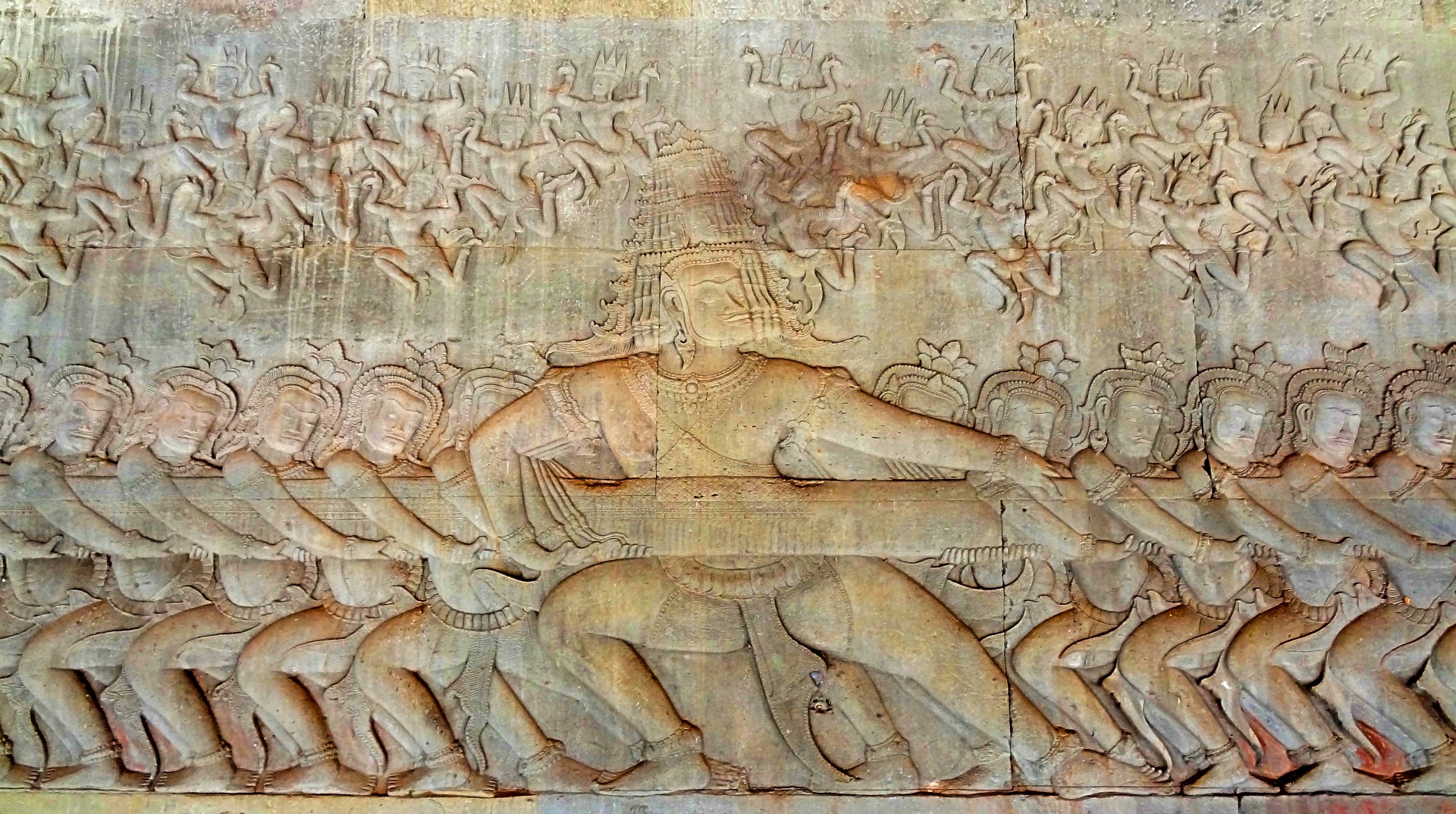
Asuras (Sanskrit: असुर) are a class of beings in Indian religions.[1] They are described as power-seeking beings related to the more benevolent Devas (also known as Suras) in Hinduism. In its Buddhist context, the word is translated as "titan" or "antigod".[2]
According to Hindu texts, the asuras are in constant fear of the devas.[3]: 2–6 Asuras are described in Indian texts as powerful superhuman demigods with good or bad qualities. In early Vedic literature, the good Asuras are called Adityas and are led by Varuna, while the malevolent ones are called Danavas and are led by Vritra.[4]: 4 In the earliest layer of Vedic texts, Agni, Indra and other gods are also called Asuras, in the sense of their being "lords" of their respective domains, knowledge and abilities. In later Vedic and post-Vedic texts, the benevolent gods are called Devas, while malevolent Asuras compete against these Devas and are considered "enemy of the gods".[4][5]
Asuras are part of Hinduism along with Yakshas (nature spirits), Rakshasas (fierce man-eating beings or demons), Bhutas (ghosts) and many more. Asuras have been featured in many cosmological theories and legends in Hinduism and Buddhism.[6][7][8]
Etymology
[edit]Traditional etymologies
[edit]Asura is a given name by Devas to other races collectively where Asura means not-sura (with sura being another name for Devas).
The 5th century Buddhist philosopher, Buddhaghosa explains that their name derives from the myth of their defeat at the hands of the god Śakra. According to the story, the asura were dispossessed of their state in Trāyastriṃśa because they became drunk and were thrown down Mount Sumeru. After this incident, they vowed never to drink sura again. In some Buddhist literature, they are sometimes referred to as pūrvadeva (Pāli: pubbadeva), meaning "ancient gods."[9]
Modern scholarship
[edit]There is a wide consensus in modern scholarship that the Old Indic term Asura is cognate with Old Iranian Ahura, a term desginating a group of supernatural beings which are in conflict with the Deavas.[10][11][12] Both Sanskrit असुर (asura) and Avestan 𐬀𐬵𐬎𐬭𐬀 (ahura) derive from the common Proto-Indo-Iranian hásuras, with the meaning lord.[13] According to Finnish Indologist Asko Parpola, the word *hásuras was also borrowed from the Proto-Indo-Iranian language into Proto-Uralic during an early period of contact, in the form *asera-, likewise with the meaning lord or prince.[14] The term is also etymologically related to Old Norse Æsir, indicating that the Indo-Iranian *hásuras has an even earlier Proto-Indo-European root.[15]
Monier-Williams traces the etymological roots of asura (असुर) to asu (असु), which means 'life of the spiritual world' or 'departed spirits'.[16]
Monier-Williams (1899) finds that the oldest verses of Vedic texts (the earliest Samhita layer), the word Asuras is used to refer to any spiritual, divine being, including both those with good or with bad intentions, and with constructive or with destructive inclinations or dispositions.[16] Whereas the late verses of the Samhita texts instead describe the Asuras as "evil spirits, demons, and opponents of the [sky] gods" [the devas]. In this use of asura it connotes chaos-creating, malevolent, evil faction, in the parts of Indo-Iranian mythology centered on the battle between good and evil.[16]
In Hindu literature
[edit]Rig Veda
[edit]Bhargava states the word, asura, including its variants, asurya and asura, occurs "88 times in the Rig Veda, 71 times in the singular number, 4 times in the dual, 10 times in the plural, and 3 times as the first member of a compound. In this, the feminine form, asuryaa, is included twice. The word, asurya, has been used 19 times as an abstract noun, while the abstract form asuratva occurs 24 times, 22 times in one hymn and twice each in two other hymns".[17]
Bhargava[17] gives a count of the word use for every Vedic deity: Asura is used as an adjective meaning "powerful" or "mighty". In the Rig Veda, two generous kings – as well as some priests – have been described as asuras. One hymn requests a son who is an asura. In nine hymns, Indra is described as asura. He is said to possess asurya 5 times, and once he is said to possess asuratva. Agni has total of 12 asura descriptions, Varuna has 10, Mitra has 8, and Rudra has 6.[17] Book 1 of the Rig Veda describes Savitr (Vedic solar deity) as an asura who is a "kind leader".[18]
हिरण्यहस्तो असुरः सुनीथः सुमृळीकः स्ववाँ यात्वर्वाङ् ।
अपसेधन्रक्षसो यातुधानानस्थाद्देवः प्रतिदोषं गृणानः ॥१०॥[19]
May he, gold-handed Asura, kind leader, come hither to us with his help and favour.
Driving off Raksasas and Yatudhanas, [he] the god is present, praised in hymns at evening.
– Translated by Ralph Griffith[18]
The golden-handed lord of good guidance, of good grace, of good help—let him drive in our direction.
Repelling demons and sorcerers, the god has taken his place facing evening, while being hymned.
– Translated by Stephanie W. Jamison, Joel P. Brereton[20]
— Rig Veda 1.35.10
Samaveda
[edit]In the Jaiminya (3.35.3) – one of three recensions of the SamaVeda – the term 'Asura' is stated to be derived from 'rests' (√ram) in the vital airs (asu), i.e. 'Asu' + 'ram' = 'Asuram' (Asura); this is in reference to the mind being 'asura[-like]'.[21]
Mahabharata
[edit]According to the Bhagavad Gita (16.6-16.7), all beings in the universe have both the divine qualities (daivi sampad) and the demonic qualities (asuri sampad) within each.[22][23] The sixteenth chapter of the Bhagavad Gita states that pure god-like saints are rare and pure demon-like evil are rare among human beings, and the bulk of humanity is multi-charactered with a few or many faults.[22] According to Jeaneane Fowler, the Gita states that desires, aversions, greed, needs, emotions in various forms "are facets of ordinary lives", and it is only when they turn to lust, hate, cravings, arrogance, conceit, anger, harshness, hypocrisy, cruelty and such negativity- and destruction-inclined that natural human inclinations metamorphose into something demonic (Asura).[22][23]
Brahmanda Purana
[edit]
In the Brahmanda Purana, it is stated the term 'Asura' was used for the Daityas due to their rejection of Varuni (Goddess of Wine) after she emerged from the Ocean of Milk (i.e. 'a-sura', meaning 'those who do not have Sura', that is, 'wine' or more generally 'liquor').[24][25] However, in other legends, the Asuras accept Varuni (see Kurma).
Vishnu Purana
[edit]According to the Vishnu Purana, during the Samudra Manthana or the "churning of the ocean", the daityas came to be known as asuras because they rejected Varuni, the goddess of sura "wine", while the devas accepted her and came to be known as suras.[26]
Shiva Purana
[edit]Alain Daniélou states that Asuras were initially good, virtuous and powerful in Indian mythology. However, their nature gradually changed and they came to represent evil, vice and abuse of power. In Shiva Purana, they evolved into anti-gods and had to be destroyed because they threatened the gods.[26][27]
The asuras (anti-gods) were depicted to have become proud, vain, to have stopped performing sacrifices, to violate sacred laws, not visit holy places, not cleanse themselves from sin, to be envious of devas, torturous of living beings, creating confusion in everything and challenging the devas.[26][27]
Alain Daniélou states that the concept of asuras evolved with changing socio-political dynamics in ancient India. Asuras gradually assimilated the demons, spirits, and ghosts worshipped by the enemies of Vedic people, and this created the myths of the malevolent asuras and the rakshasa. The allusions to the disastrous wars between the asuras and the suras, found in the Puranas and the epics, may be the conflict faced by people and migrants into ancient India.[27]
Context
[edit]Scholars have disagreed on the nature and evolution of the asura concept in ancient Indian literature. The most widely studied scholarly views on Asura concept are those of F.B.J. Kuiper, W. Norman Brown, Haug, von Bradke, Otto, Benveniste, Konow, Rajwade, Dandekar, Darmesteter, Bhandarkar, and Raja, Banerji-Sastri, Padmanabhayya, Skoeld, S.C. Roy, Kumaraswamy, Shamasastry, Przyluski, Schroeder, Burrows, Hillebrandt, Taraporewala, Lommel, Fausboll, Segerstedt, Thieme, Gerschevitch, Boyce, Macdonnell, Hermann Oldenberg, Geldner, Venkatesvaran, and Jan Gonda.[4]: 1–37
Kuiper calls Asuras a special group of gods in one of major Vedic theories of creation of the universe.[28] Their role changes only during and after the earth, sky, and living beings have been created. The sky world becomes that of Devas, the underworld becomes that of Asuras. The god Indra is the embodiment of good and represents the Devas, while the dragon Vrtra is the embodiment of evil and an Asura.[28] During this battle between good and evil, creation and destruction, some powerful Asuras side with the good and are called Devas, other powerful Asuras side with the evil and thereafter continue to be called Asuras. This is the first major dualism to emerge in the nature of everything in the Universe.[28][4]: 1–2 Hale (1999), in his review,[4] states that Kuiper's theory on Asura is plausible, but weak, because the Vedas never call Vrtra (the central character) an Asura, as the text does describe many other powerful beings.[4]: 3 Secondly, Rig Veda never explicitly classifies Asura as a "group of gods" states Hale, and this is a presumption of Kuiper.[4]: 3
Many scholars describe Asuras to be "lords" with different specialized knowledge, magical powers and special abilities, which only later choose to deploy these for good, constructive reasons or for evil, destructive reasons. The former become known as Asura in the sense of Devas, the later as Asura in the sense of demons. Kuiper, Brown, Otto and others are in this school; however, none of them provide an explanation and how, when and why Asura came ultimately to mean demon.[4]: 2–4, 10 Asuras are non-believers of God and believe in their own powers.[29]
Ananda Coomaraswamy suggested that Devas and Asuras can be best understood as being similar in concept to the Twelve Olympians and the titans of Greek mythology: Both are powerful, but have different orientations and inclinations – in Hindu mythology the Devas represent the powers of light and the Asuras represent the powers of darkness.[30][4]: 20 According to Coomaraswamy (1935), p. 374 "the titan [Asura] is potentially an angel [Deva], the angel still by nature a titan" in Hinduism.[31]
Indo-Aryan context
[edit]In the 19th century, Haug pioneered the idea that the term Asura is linguistically related to the Ahuras of Indo-Aryan people and pre-Zoroastrianism era. In both religions, Ahura of pre-Zoroastrianism (Asura of Indian religions), Vouruna (Varuna) and Daeva (Deva) are found, but their roles are on opposite sides.[4]: 3–8 That is, Ahura evolves to represent the good in pre-Zoroastrianism, while Asura evolves to represent the bad in Vedic religion; where Daeva evolves to represent the bad in pre-Zoroastrianism, while Deva evolves to represent the good in Vedic religion. These contrary roles have led some scholars to infer that there may have been wars between proto-Indo-European communities, and that adapted their gods and demons to reflect their social differences.[4]: 23–31 This idea was thoroughly researched and reviewed by Peter von Bradke in 1885.[32][4]: 5–8
The relationship between ahuras / asuras and daevas / devas in Indo-Aryan times, was discussed at length by F.B.J. Kuiper.[33] This theory and other Avesta-related hypotheses developed over the 20th century, are all now in question, particularly for lack of archaeological evidence.[34][4]: 5–8, 12, 15, 18–19, 37 Asko Parpola has re-opened this debate by presenting archaeological and linguistic evidence, but notes that the links may go earlier to Uralic languages roots.[35]
Relation to Germanic deities
[edit]Some scholars such as Asko Parpola suggest that the word Asura may be related to proto-Uralic and proto-Germanic history. The Aesir-Asura correspondence is the relation between Vedic Sanskrit Asura and Old Norse Æsir and Proto-Uralic *asera, all of which mean 'lord, powerful spirit, god'.[35][36] Parpola states that the correspondence extends beyond Asera / Asura, and extends to a host of parallels such as Inmar-Indra, Sampas-Stambha and many other elements of respective mythologies.[35]
Characteristics
[edit]In the earliest Vedic literature, all supernatural beings are called Devas[16][37][38][39] and Asuras.[4]: 5–11, 22, 99–102 A much-studied hymn of the Rig Veda states Devav asura (Asuras who have become Devas), and contrasts it with Asura adevah (Asuras who are not Devas).[28][41] Each Asura and Deva emerges from the same father (Prajapati), share the same residence (Loka), eat together the same food and drinks (Soma), and have innate potential, knowledge and special powers in Hindu mythology; the only thing that distinguishes "Asura who become Deva" from "Asura who remain Asura" is intent, action and choices they make in their mythic lives.[31][42]
"Asuras who remain Asura" share the character of powerful beings obsessed with their craving for ill-gotten Soma, and for wealth, ego, anger, unprincipled nature, force, and violence.[43][44] Further, in Hindu mythology, when they lose, miss, or don't get what they want (because they were distracted by their cravings) the "Asuras who remain Asuras" question, challenge, and attack the "Asuras who became Devas" to loot or extract a portion of what the Devas have and the Asuras do not.[43][44]
The hostility between the two groups is the source of extensive legends, tales, and literature in Hinduism; however, many texts discuss their hostility in neutral terms – without explicit moral connotations or condemnation.[42] Some of these tales constitute the background of major Hindu Epics and annual festivals, such as the story of Asura Ravana and Deva Rama in the Ramayana, and the legend of Asura Hiranyakashipu and Deva Vishnu as Narasimha,[42] the latter celebrated with the Hindu spring festival of Holika and Holi.[45]
In Buddhist mythology, while all the gods of the Kāmadhātu are subject to passions to some degree, the asuras above all are addicted to them, especially wrath, pride, envy, insincerity, falseness, boasting, and bellicosity. The asuras are said to experience a much more pleasurable life than humans, but they are plagued by envy for the devas, whom they can see just as animals perceive humans.[citation needed]
Symbolism
[edit]Edelmann and other scholars state that the dualistic concept of Asura and Deva in Hinduism is a form of symbolism found throughout its ancient and medieval literature.[46][47] In the Upanishads, for example, Devas and Asuras go to Prajāpati to understand what is Self (Atman, soul) and how to realize it. The first answer that Prajāpati gives is simplistic, which the Asuras accept and leave with, but the Devas led by Indra do not accept and question because Indra finds that he hasn't grasped its full significance and the given answer has inconsistencies.[48] Edelmann states that this symbolism embedded in the Upanishads is a reminder that one must struggle with presented ideas, learning is a process, and Deva nature emerges with effort.[48] Similar dichotomies are present in the Puranas literature of Hinduism, where god Indra (a Deva) and the antigod Virocana (an Asura) question a sage for insights into the knowledge of the self.[48] Virocana leaves with the first given answer, believing now he can use the knowledge as a weapon. In contrast, Indra keeps pressing the sage, churning the ideas, and learning about means to inner happiness and power. Edelmann suggests that the Deva-Asura dichotomies in Hindu mythology may be seen as "narrative depictions of tendencies within our selves".[48]
The god (Deva) and antigod (Asura), states Edelmann, are also symbolically the contradictory forces that motivate each individual and people, and thus Deva-Asura dichotomy is a spiritual concept rather than mere genealogical category or species of being.[49] In the Bhāgavata Purana, saints and gods are born in families of Asuras, such as Mahabali and Prahlada, conveying the symbolism that motivations, beliefs and actions rather than one's birth and family circumstances define whether one is Deva-like or Asura-like.[49]
Asuri
[edit]Asuri is the feminine of an adjective from asura and in later texts means 'belonging to or having to do with demons and spirits'.[50] Asuri parallels Asura in being "powerful beings", and in early Vedic texts includes all goddesses.[51] The term Asuri also means a Rakshasi in Indian texts.[52][4]: 120–133
The powers of an Asuri are projected into plants offering a remedy against leprosy.[53][54]
First, before all, the strong-winged Bird was born, thou wast the gall thereof.
Conquered in fight, the Asuri took then the shape and form of plants.
The Asuri made, first of all, this medicine for leprosy, this banisher of leprosy.
She banished leprosy, and gave one general colour to the skin.
— A charm against leprosy, Atharva Veda, Hymn 1.24, [55]
In Book 7, Asuri is a powerful female with the special knowledge of herbs, who uses that knowledge to seduce Deva Indra in Atharva Veda. A hymn invokes this special power in Asuri, and this hymn is stipulated for a woman as a charm to win over the lover she wants.[56]
I dig this Healing Herb that makes my lover look on me and weep,
That bids the parting friend return and kindly greets him as he comes.
This Herb wherewith the Asuri drew Indra downward from the Gods,
With this same Herb I draw thee close that I may be most dear to thee.
Thou art the peer of Soma, yea, thou art the equal of the Sun,
The peer of all the Gods art thou: therefore we call thee hitherward.
I am the speaker here, not thou: speak thou where the assembly meets.
Thou shalt be mine and only mine, and never mention other dames.
If thou art far away beyond the rivers, far away from men,
This Herb shall seem to bind thee fast and bring thee back my prisoner.
— A maiden's love-charm, Atharva Veda, Hymn 7.38, [56]
Similarly, in the Atharva Veda, all sorts of medical remedies and charms are projected as Asuri manifested in plants and animals.[4]: 120–133 Asuri Kalpa is an abhichara (craft) which contains various rites derived from special knowledge and magic of Asuri.[57][58]
Buddhism
[edit]
Asuras (Classical Tibetan: ལྷ་མིན, romanized: lha min; simplified Chinese: 阿修罗; traditional Chinese: 阿修羅; pinyin: āxiūluó; Japanese: 阿修羅, romanized: ashura, asura) are a type of supernatural beings (antigods, demigods, or titans) in traditional Buddhist cosmology and a realm of rebirth based on one's karma in current or past lives.[59] They are described in Buddhist texts as creatures who live in lower levels of mount Sumeru, obsessed with sensuous aspects of existence, living with jealousy, and endlessly engaged in wars against the creatures who are Devas (gods).[60] As Buddhism spread into East Asia and Southeast Asia, the Asura concept of Indian Buddhism expanded and integrated local pre-existing deities as a part of regional Buddhist pantheon.[60]
Asura realm
[edit]The asura realm is one of the realms in which one can be reborn as a result of experiencing the fruits of wholesome karma, while engaging in unwholesome karma. Generally, the desire realm is recognized as consisting of five realms and the realm of the asuras tends to be included among the deva realms, but the addition of the asuras in the six-world bhavacakra was created in Tibet at the authority of Je Tsongkhapa.
Deva-Asura War
[edit]The asuras were dispossessed of their state in Trāyastriṃśa because they became drunk and were thrown down Mount Sumeru by the bodhisatta, as mentioned in Jatakas. This led to ever lasting war between the Devas of Tavatimsa and Asuras.
Asurendra
[edit]In Buddhism, the leaders of the asuras are called asurendra (Pāli: Asurinda, 阿修羅王; lit. "Asura-lord"). There are several of these, as the asuras are broken into different tribes or factions. In Pali texts, names that are found include Vepacitti, Rāhu (Verocana), Pahārāda, Sambara, Bali, Sucitti, and Namucī. According to the Lotus Sutra, the four leaders of the asuras took refuge in the Buddha after hearing his sermon.
See also
[edit]References
[edit]- ^ A. Sanducci Ancient Scholars about the Turks and the Turkic Nations. World Scholarly Press 01.05.2022 p. 440
- ^ Robert Beer. The Handbook of Tibetan Buddhist Symbols Serindia Publications 2003 ISBN 978-1-932-47603-3 page 246
- ^ Cite error: The named reference
Hale-1998was invoked but never defined (see the help page). - ^ a b c d e f g h i j k l m n o p q Hale, Wash Edward (1999). Ásura in Early Vedic Religion. Motilal Barnarsidass. ISBN 978-81-208-0061-8.
- ^ Singoji, Umamaheshwar (2017). "Who were Asuras? India and Iran's ancient links". www.academia.edu.
- ^ Don Handelman (2013), One God, Two Goddesses, Three Studies of South Indian Cosmology, Brill Academic, ISBN 978-90-04-25615-6, pages 23–29
- ^ Wendy Doniger (1988), Textual Sources for the Study of Hinduism, Manchester University Press, ISBN 978-0-7190-1866-4, p. 67
- ^ Robert E. Buswell Jr; Donald S. Lopez Jr (2013). The Princeton Dictionary of Buddhism. Princeton University Press. p. 411. ISBN 978-1-4008-4805-8.
- ^ Malalasekera, G.P. (2007). "Asurā". Dictionary of Pali Proper Names. Motilal Banarsidass Publishers. ISBN 978-81-208-3020-2.
- ^ Hale, Wash Edward (1986). Ásura- in Early Vedic Religion. Motilal Banarsidass Publishers. p. 6. ISBN 978-81-208-0061-8. Retrieved 24 January 2021.
- ^ Masih, Y. (2000). A Comparative Study of Religions. Motilal Banarsidass Publ. p. 23. ISBN 978-81-208-0815-7. Retrieved 24 January 2021.
- ^ Boyce, Mary (1989). A History of Zoroastrianism: The Early Period. BRILL. p. 23. ISBN 978-90-04-08847-4. Retrieved 24 January 2021.
- ^ UESUGI, Heindio; CATT, Adam Alvah, eds. (2024). Old Avestan Dictionary. Asian and African Lexicon. Vol. 67. Research Institute for Languages and Cultures of Asia and Africa; Tokyo Language of Foreign Studies. pp. 14–15. ISBN 9784863375420.
- ^ Parpola, Asko (2015). The Roots of Hinduism: The early Aryans and the Indus civilization. Oxford University Press. pp. 114–116. ISBN 978-0-19-022692-3.
- ^ Kroonen, Guus (2013). Etymological Dictionary of Proto-Germanic. Leiden, Boston: Brill. p. 30. ISBN 978-90-04-18340-7.
- ^ a b c d Monier-Williams, Monier (1899). A Sanskrit-English Dictionary. Motilal Banarsidass. p. 121.
Etymologically and philologically arranged to cognate Indo-European languages
- ^ a b c P.L. Bhargava, Vedic Religion and Culture, South Asia Books, ISBN 978-81-246-0006-1
- ^ a b Mandala 1, Hymn 35 Ralph T Griffith, Wikisource
- ^ Rig Veda Sanskrit text, Wikisource
- ^ Stephanie Jamison (2015). The Rigveda – Earliest religious poetry of India. Oxford University Press. p. 142. ISBN 978-0-19-063339-4.
- ^ Oertel, Hanns (1896). The Jāiminīya or Talavakāra Upaniṣad Brāhmaṇa. Journal of the American Oriental Society; JSTOR. pp. 193.
- ^ a b c Jeaneane D Fowler (2012), The Bhagavad Gita, Sussex Academic Press, ISBN 978-1-84519-346-1, pages 253-262
- ^ a b Christopher K Chapple (2010), The Bhagavad Gita: Twenty-fifth–Anniversary Edition, State University of New York Press, ISBN 978-1-4384-2842-0, pages 610-629
- ^ G.V.Tagare. Brahmanda Purana - English Translation - Part 4 of 5. pp. 1063 (9.66-69).
- ^ "Sanskrit Dictionary for Spoken Sanskrit: 'Sura'". spokensanskrit.org. Retrieved 2019-12-14.
- ^ a b c Roshen Dalal (2011). Hinduism: An Alphabetical Guide, p.46. Penguin Books India. ISBN 0-14-341421-6 [1]
- ^ a b c Alain Daniélou (1991). The Myths and Gods of India: The Classic Work on Hindu Polytheism from the Princeton Bollingen Series, pp. 141–142. Inner Traditions / Bear & Co. ISBN 0-89281-354-7.
- ^ a b c d Kuiper, F.B.J. (1975). The Basic Concept of Vedic Religion. History of Religion. Vol. 15. pp. 108–112.
- ^ Bahadur, Om Lata (1996). The Book of Hindu Festivals and Ceremonies (3rd ed.). New Delhi, IN: UBS Publishers Distributors. p. 168. ISBN 81-86112-23-5.
- ^ Coomaraswamy, Ananda (1935). "Angel and titan: An essay in Vedic ontology". Journal of the American Oriental Society. 55 (4): 373–374. doi:10.2307/594758. JSTOR 594758.
- ^ a b Gier, Nicholas (1995). "Hindu titanism". Philosophy East and West. 45 (1): 73–96, esp. 76. doi:10.2307/1399510. JSTOR 1399510.
- ^ von Bradke, Peter (2010) [1885]. Dyaus Asuras, Ahura Mazda, und die Asuras (in German) (reprint ed.). Max Niemeyer (1885) / Nabu Press (2010). ISBN 978-1-141-63225-1.
- ^ Kuiper, F.B.J. (1983). Ancient Indian Cosmogony. Bombay, IN. ISBN 0-7069-1370-1.
{{cite book}}: CS1 maint: location missing publisher (link) - ^ Herrenschmidt, Clarisse; Kellens, Jean (1993). "*Daiva". Encyclopaedia Iranica. Vol. 6. Costa Mesa, CA: Mazda. pp. 599–602.
- ^ a b c Parpola, Asko (2015). The Roots of Hinduism: The early Aryans and the Indus civilization. Oxford University Press. pp. 66–67, 82–109. ISBN 978-0-19-022692-3.
- ^ Adams, Douglas (1997). "King". Encyclopedia of Indo-European Culture. Routledge. p. 330. ISBN 978-1-884964-98-5.
- ^ "Deva". Encyclopaedia Britannica – via britannica.com.
- ^ Coulter, Charles Russell; Turner, Patricia (4 July 2013). Encyclopedia of Ancient Deities. Routledge. p. 147. ISBN 978-1-135-96390-3 – via Google Books.
- ^ Williams, George (2008). A Handbook of Hindu Mythology. Oxford University Press. pp. 90, 112. ISBN 978-0-19-533261-2.
- ^ ऋग्वेदः मण्डल ८ [Rig Veda]. Rigveda. hymns 8.25.4, 8.96.9 – via Wikisource.
- ^ see Hale (1999).[4]: 1–2 Note that Hale translates this to "Asuras without the Asura-Devas" in his book (see page 3 for example).
The original Sanskrit text of hymns 8.25.4, 8.96.9 from the Rigveda is available on Wikisource.[40] - ^ a b c Bonnefoy, Yves; Doniger, Wendy (1993). Asian Mythologies. University of Chicago Press. pp. 52–53. ISBN 978-0-226-06456-7.
- ^ a b Gier, Nicholas (1995). "Hindu titanism". Philosophy East and West. 45 (1): 76–80. doi:10.2307/1399510. JSTOR 1399510.
- ^ a b Kramrisch, Stella; Burnier, Raymond (1986). The Hindu Temple. Vol. 1. Motilal Banarsidass. pp. 75–78. ISBN 978-81-208-0223-0.
- ^ Doniger, Wendy, ed. (2000). Merriam-Webster's Encyclopedia of World Religions. Merriam-Webster. p. 455. ISBN 978-0-87779-044-0.
- ^ Jonathan Edelmann (2013), Hindu Theology as Churning the Latent, Journal of the American Academy of Religion, Volume 81, Issue 2, pages 427-466
- ^ Doris Srinivasan (1997), Many Heads, Arms and Eyes: Origin, Meaning, and Form of Multiplicity in Indian Art, Brill Academic, ISBN 978-90-04-10758-8, pages 130-131
- ^ a b c d Jonathan Edelmann (2013), Hindu Theology as Churning the Latent, Journal of the American Academy of Religion, Volume 81, Issue 2, pages 439-441
- ^ a b Jonathan Edelmann (2013), Hindu Theology as Churning the Latent, Journal of the American Academy of Religion, Volume 81, Issue 2, pages 440-442
- ^ American Oriental Society (1852). Proceedings (American Oriental Society) 1874-1893, p.xv
- ^ Coburn, Thomas B. (1988). Devī-Māhātmya, p.200. Motilal Banarsidass Publications. ISBN 81-208-0557-7
- ^ Bodewitz, H. W. (1990). The Jyotiṣṭoma Ritual: Jaiminīya Brāhmaṇa I, 66-364, p.265. Volume 34 of Orientalia Rheno-traiectina. ISBN 90-04-09120-3
- ^ Shende, N.J. (1967). Kavi and kāvya in the Atharvaveda, p. 22. Issue 1 of Publications of the Centre of Advanced Study in Sanskrit, Centre of Advanced Study in Sanskrit, University of Poona
- ^ Garg, Gaṅgā Rām (1992). Encyclopaedia of the Hindu World: Ar-Az, p.751. Volume 3 of Encyclopaedia of the Hindu World. Concept Publishing Company. ISBN 81-7022-373-3
- ^ Hymns of the Atharva Veda, Ralph T. H. Griffith (Translator), Luzac and Co., London, pages 28-29
- ^ a b Hymns of the Atharva Veda, Ralph T.H. Griffith (Translator), Luzac and Co., London, page 344
- ^ Magoun, Herbert William (1889). The Āsurī-Kalpa: a witchcraft practice of the Atharva-Veda
- ^ Goudriaan, Teun & Gupta, Sanjukta (1981). Hindu Tantric and Śākta Literature, p.114. Otto Harrassowitz Verlag. ISBN 3-447-02091-1
- ^ Norman C. McClelland (2010). Encyclopedia of Reincarnation and Karma. McFarland. pp. 32–34, 136. ISBN 978-0-7864-5675-8.
- ^ a b Robert E. Buswell Jr.; Donald S. Lopez Jr. (2013). The Princeton Dictionary of Buddhism. Princeton University Press. p. 76. ISBN 978-1-4008-4805-8.
External links
[edit]
- The Basic Concept of Vedic Religion, FBJ Kuiper, History of Religions, Vol. 15, No. 2 (Nov., 1975), pages 107-120
- The Creation Myth of the Rig Veda, W Norman Brown, Journal of the American Oriental Society, Vol. 62, No. 2 (June, 1942), pages 85–98
- Asura Varuna, RN Dandekar, Annals of the Bhandarkar Oriental Research Institute, Vol. 21, No. 3/4 (1939–40), pages 157-191
- The Vedic Gods of Japan, S Kak (2004), (a discussion of Asuras in Japanese mythology)
Hindu deities and texts | ||
|---|---|---|
| Gods |  | |
| Goddesses | ||
| Deity groups | ||
| Texts (list) | ||
Asura
View on GrokipediaEtymology
Traditional Etymologies
In traditional Hindu mythology, the term Asura is often derived as a-sura, signifying "not a sura" or anti-Deva, based on legends depicting the Asuras as former divine beings who were defeated by Śakra (Indra) in cosmic battles, resulting in the loss of their heavenly status and relegation to a rival, demonic role. The Samaveda provides an early etymological interpretation of Asura as composed of asu (vital breath or life force) and ram (resting or delighting), portraying Asuras as entities rooted in the primal energies of the mind and vital airs that animate existence. In Buddhist traditions, Asuras are regarded as pūrvadeva (ancient gods), highlighting their origins as primordial deities who once shared divinity with the Devas but were displaced through rivalry and conflict, underscoring a narrative of fallen celestial primacy. (from G.P. Malalasekera's Dictionary of Pāli Proper Names) Puranic texts elaborate on this through specific myths, such as in the Brahmanda Purana, where during the churning of the ocean, the goddess Varuni (personifying sura or wine) emerges; the Devas accept her and become known as Suras, while the Asuras reject her, earning the name a-sura (those without sura, implying non-divine or abstinent from divine nectar).[4] A parallel account appears in the Vishnu Purana, reinforcing the etymology by describing the Asuras' refusal of Varuni as the origin of their designation, distinguishing them from the liquor-embracing gods.Modern Theories
Modern linguistic analysis traces the term "asura" to the Proto-Indo-Iranian *Hásuras, reconstructed as denoting a "lord" or "powerful one," which developed into the Sanskrit "asura" with initial connotations of might and divinity before acquiring more negative associations in later traditions. This root is linked to the Proto-Indo-European *h₂ḿ̥suros, derived from *h₂ems- ("to engender, beget"), reflecting concepts of vital force or spiritual power. Scholars such as F.B.J. Kuiper have highlighted connections between the Indo-Iranian *Hásuras and the Old Norse Æsir, the Germanic gods, positing a shared Proto-Indo-European antecedent *h₂ens-us or similar, meaning "lordly" or "divine being," which underscores a common mythological heritage across Indo-European languages. Kuiper's work emphasizes how this term originally signified authoritative deities in early Indo-Iranian contexts, with parallels in the ritual pantheons of both branches. The semantic evolution of "asura" from a positive epithet for powerful lords in Vedic texts to demonic figures in post-Vedic Hinduism is attributed to cultural and religious shifts, including the inversion of divine hierarchies during the transition from Vedic to epic traditions, where asuras became antagonists to the devas.[5] This change reflects broader Indo-Aryan mythological developments rather than a direct linguistic alteration, as the root retained its "lordly" essence in Iranian cognates like "ahura."[5] Additionally, Finnish Indologist Asko Parpola proposes links between Proto-Indo-Aryan *asura- ("lord") and Proto-Uralic *asera-/*asira- ("prince, lord"), suggesting early linguistic borrowing during interactions between Indo-Aryan speakers and Uralic groups around 2250–1600 BCE in the Volga-Urals region.[6] This connection implies broader Eurasian influences on the term's dissemination and semantic field, potentially via trade networks like Sejma-Turbino.[6]Historical Context
Indo-Iranian Origins
In Proto-Indo-Iranian society, the terms *ahura (later asura in Sanskrit and ahura in Avestan) and *daiva (deva in Sanskrit and daeva in Avestan) denoted two distinct classes of divine beings, with *ahuras representing lords or sovereign deities associated with cosmic order and *daivas embodying more elemental or natural forces.[7] This dual categorization reflected a shared religious framework among the Indo-Iranian peoples prior to their cultural divergence around the 2nd millennium BCE, as evidenced by textual parallels in early Vedic and pre-Zoroastrian Avestan traditions.[8] The Zoroastrian tradition marked a significant inversion of this paradigm, likely as part of religious reforms attributed to the prophet Zoroaster (Zarathustra; dates debated, often placed circa 1500–1000 BCE but ranging to 600 BCE), elevating the ahuras to benevolent status while demonizing the daevas as malevolent entities opposed to divine order.[8] In this reformed theology, Ahura Mazda emerged as the supreme benevolent deity, embodying wisdom and creation, in stark contrast to the chaotic forces represented by the daevas.[2] This shift is posited to stem from Zoroaster's emphasis on ethical dualism, transforming pre-existing Indo-Iranian concepts into a structured cosmology of good versus evil.[9] Avestan texts, particularly the Yasna, provide key evidence for this framework, portraying Ahura Mazda as the upholder of asha—the principle of truth, order, and righteousness—against druj (chaos and falsehood) often aligned with daevas.[10] For instance, Yasna 43-44 invokes Ahura Mazda's role in dispensing justice through asha, underscoring the ahuras' alignment with cosmic harmony.[8] Archaeological and textual hints from the pre-Zoroastrian Indo-Iranian pantheon, such as 14th-century BCE Mitanni treaties invoking deities like Mitra (an ahura) and Indra (a daiva), illustrate the coexistence of both classes as revered divinities before the Iranian schism.[8] These documents from northern Mesopotamia suggest a unified worship among Indo-Iranian groups, with no initial moral opposition between the categories.[2]Development in Indo-Aryan Traditions
In the early Vedic period, approximately 1500–1200 BCE, the term asura functioned primarily as an honorific title denoting power, sovereignty, and spiritual authority, applied to major deities without implying moral opposition to other gods. Gods such as Varuṇa, frequently invoked as the paradigmatic asura embodying cosmic order and omniscience, and Indra, described as asura in several hymns to highlight his martial prowess, exemplified this neutral or positive connotation. Similarly, Agni was titled asura for his role as the divine mediator of sacrifices, underscoring the word's association with inherent might rather than ethical duality. This usage reflected a worldview where asuras represented potent forces integral to the ritual and cosmic framework, akin to the lordly connotations inherited from Proto-Indo-Iranian contexts.[11] By the late Vedic period, around 1200–1000 BCE, the concept of asura underwent a significant transformation, shifting from a divine epithet to an oppositional category denoting adversaries of the devas. This evolution manifested in texts like the later layers of the Rigveda and the Atharvaveda, where asuras began to symbolize disruptive entities challenging the established order, marking the onset of a binary framework. Scholars attribute this change to possible socio-political tensions arising from interactions between Indo-Aryan settlers and indigenous populations in the Indian subcontinent, with asuras potentially embodying resistance or alternative cultural elements incorporated into Vedic narratives. The emerging Brahmanical orthodoxy further accentuated this dualism, recasting asuras as anti-cosmic forces antithetical to ritual purity and dharma by circa 1000 BCE, as seen in Brahmanical texts that emphasized devas as upholders of cosmic harmony. This portrayal aligned with the consolidation of priestly authority, where asuras were depicted as chaotic opponents to the structured Vedic sacrifice, reinforcing hierarchical social and religious norms. Scholarly interpretations, notably by Ananda K. Coomaraswamy, posit that asuras incorporated chthonic or pre-Aryan substrata into Vedic mythology, representing earthy, primordial powers that were gradually subordinated to the celestial devas in the Indo-Aryan synthesis. Coomaraswamy viewed this integration as a mythological reflection of cultural layering, where older, indigenous deities or spirits were reframed as titanic rivals to the incoming Aryan pantheon, preserving yet transforming pre-existing lore. This perspective highlights the adaptive nature of Indo-Aryan religious development, blending exogenous and endogenous elements into a cohesive cosmology.Comparative Mythology
In comparative mythology, the concept of Asura in Indian traditions shares linguistic and thematic roots with the Æsir of Germanic (particularly Norse) mythology, stemming from the Proto-Indo-European root *h₂ens- (or a derived form like *h₂ń̥suros), related to "spirit" or "life force," denoting powerful divine beings. This cognate relationship underscores a common ancestral framework where divine lords form rival clans; just as the Æsir, led by figures like Odin, engage in conflicts with the Vanir in Norse lore, the Asuras oppose the Devas in Indian narratives, representing competing groups of powerful supernatural beings vying for cosmic dominance.[12] Scholars have further paralleled Asuras with the Titans of Greek mythology, viewing both as primordial deities embodying raw, untamed power that challenges the ascendancy of a younger, more ordered pantheon. Ananda K. Coomaraswamy, in his analysis of Vedic ontology, explicitly equates Asuras with Titans, describing them as archetypal forces of potential divinity locked in generational strife, where the overthrow of these elder powers symbolizes the triumph of structured cosmic order over chaotic origins. This motif recurs across Indo-European traditions, highlighting Asuras not merely as antagonists but as essential counterparts in the eternal tension between creation and disruption. Possible Uralic influences on the Asura concept arise from early interactions between Indo-Aryan and Uralic-speaking peoples, with Finnish Indologist Asko Parpola tracing the term to the Proto-Uralic *asera- (or *asira-), meaning "lord," "prince," or "ruler spirit." This etymological borrowing suggests cross-cultural exchanges that shaped mythological ruler figures, evident in Finnish Kalevala folklore where antagonistic nature beings, such as the sorceress Louhi as mistress of the northern realm Pohjola, embody hostile, dominion-seeking entities that disrupt human and divine harmony through their commanding, otherworldly authority.[6] In broader theoretical frameworks of comparative mythology, Asuras serve as archetypes of chaos arrayed against order, akin to the Mesopotamian Tiamat—a primordial sea goddess of turbulent disorder slain by Marduk to forge the structured cosmos—or the Biblical fallen angels, celestial beings cast down for defying divine hierarchy and introducing discord into creation. These parallels emphasize Asuras' role in universal narratives of rebellion and renewal, where chaotic forces, though antagonistic, underpin the cyclical reestablishment of equilibrium.[1]Asuras in Hinduism
Vedic Literature
In the Rigveda, the term asura appears 88 times, predominantly as an adjective denoting "powerful" or "lordly," often applied to deities in a positive or reverential context.[13] This usage reflects an early Vedic worldview where asura signifies might and authority rather than inherent opposition to the gods. For instance, Indra is described as an asura in nine hymns, emphasizing his heroic strength, while Agni receives the epithet 12 times, highlighting his role as a potent divine force.[14] Similarly, Savitr, the solar deity, is portrayed as an asura who acts as a "kind leader" in Rigveda 1.35.10, guiding and protecting against malevolent spirits like rakṣasas and yātudhānas.[15] Vedic texts distinguish between benevolent asuras associated with the Adityas, led by Varuna as upholders of cosmic order (ṛta), and malevolent ones linked to the Danavas, exemplified by Vritra as a chaotic obstructer of waters and fertility. This duality lacks a rigid good-evil binary, as asuras embody varying degrees of power that can align with or challenge divine harmony, with both groups tracing roots to primordial forces.[14] The Samaveda extends this conceptualization by interpreting asura etymologically through asu, denoting vital breaths (prāṇa) or life force, positioning asuras as entities tied to the rhythms of breath, mental repose, and the maintenance of universal equilibrium during rituals. This ritualistic lens underscores asura as a principle of invigorating energy essential to sacrificial chants and cosmic balance. Certain hymns in the Rigveda depict asuras within creation narratives, such as Varuna invoked as the asura of the waters (asura danu), sovereign over flowing streams and the primordial ocean that births order from chaos. These portrayals emphasize asuras as foundational architects of the world, contrasting with their later evolution into more antagonistic figures in post-Vedic traditions.[14]Epic and Puranic Texts
In the epic Mahabharata, particularly in the Bhagavad Gita (chapter 16, verses 6–7), the asura nature is delineated as a set of inherent qualities that contrast with divine (daiva) attributes, encompassing traits such as arrogance, delusion, wrath, harshness, and ignorance, which bind individuals to repeated cycles of suffering. These asuric dispositions—marked by lust, anger, and ego—are portrayed not as exclusive to any class but as potentialities present in all beings, with the divine qualities like fearlessness, purity, and equanimity leading toward liberation. This framework underscores the internal moral dualism that influences human conduct amid the epic's narratives of conflict and dharma. The Vishnu Purana elaborates on the asuras' antagonistic role during the Samudra Manthana, the churning of the ocean, where the daityas (a subclass of asuras) reject Varuni, the goddess of wine emerging from the ocean, deeming her impure and thus forfeiting her boon of vitality and immortality. In contrast, the devas accept Varuni, attaining enhanced strength and longevity, which solidifies the asuras' demonic characterization and their exclusion from divine favors in subsequent cosmic battles. This episode highlights the asuras' growing opposition to the devas, driven by their refusal of integrative elements that symbolize harmony. The Shiva Purana depicts the asuras' transformation from initially virtuous beings to sinful adversaries, attributing their downfall to unchecked pride that incites repeated challenges against Shiva and the devas, as seen in tales of asura leaders like Tarakasura who conquer the gods through boons and austerity before facing divine retribution. Such narratives illustrate how asuric hubris disrupts cosmic order, prompting Shiva's interventions to restore balance through fierce confrontations. The text emphasizes pride as the catalyst for their moral decline, leading to epic wars where asuras deploy illusory powers and armies against the divine forces. According to the Brahmanda Purana, the etymological origin of "asura" stems from the asuras' refusal of sura (wine) during the ocean churning, marking them as "a-sura" (non-sura) and tying their identity to this act of rejection, which contrasts with the suras (devas) who embrace it and gain favor. This myth reinforces the narrative of division in the broader Samudra Manthana saga, portraying the asuras as inherently oppositional. In the Ramayana, Ravana exemplifies the asura archetype as the scholarly yet tyrannical king of Lanka, a devotee of Shiva who masters the Vedas and composes the Shiva Tandava Stotra, but whose ego and lust lead to the abduction of Sita and a devastating war with Rama. His rule over the rakshasas (a type of asuras) is depicted as oppressive, marked by conquests and defiance of the gods, culminating in his defeat as a cautionary tale of asuric overreach.Nature and Symbolism in Hinduism
Characteristics
In early Vedic literature, Asuras were portrayed as powerful demigods with specialized domains, such as Varuna's association with cosmic order and waters, reflecting a neutral or even benevolent aspect alongside their superhuman strength.[16] Over time, particularly in Puranic texts, this evolved into a more antagonistic role, where Asuras became craving-driven beings obsessed with acquiring amrita for immortality, amassing wealth, and challenging the Devas' dominance through relentless conflicts.[17] Physically, Asuras are often depicted as gigantic and formidable figures, exemplified by Hiranyakashipu, described in the Puranas as a towering, awe-inspiring entity radiating golden brilliance.[18] They frequently exhibit shape-shifting abilities to deceive or overpower foes, yet remain inherently mortal and susceptible to downfall despite their imposing forms.[17] Behaviorally, Asuras are marked by intense pride (ahamkara) and jealousy toward the Devas, fueling their ambitious pursuits and frequent disruptions of divine rituals.[16] This manifests in their practice of severe austerities to secure boons from gods like Brahma, granting temporary invincibility; for instance, Bali leveraged such boons to conquer the heavens before being humbled by Vishnu's Vamana avatar, while Andhaka's arrogance led him to assault Shiva after receiving a boon from Brahma that made him nearly immortal by regenerating from drops of his blood.[19][20] Asuras differ from Rakshasas primarily in scope and allegiance: Asuras serve as cosmic rivals to the Devas, often dwelling in the underworld and vying for universal control, whereas Rakshasas act as territorial, man-eating demons opposing humans on the earthly plane, though the categories occasionally overlap in later narratives.[21]Symbolic Interpretations
In Hindu philosophy, the Deva-Asura duality symbolizes the internal human struggle between dharma (cosmic order and righteousness) and adharma (chaos and moral disorder), representing not rigid species distinctions but choices in ethical conduct and spiritual orientation.[22] This interpretation underscores that Asuras are not inherently evil but embody tendencies toward materialism and ego-driven actions, contrasting with Devas' alignment with harmony and selflessness. A prominent example is Mahabali, a virtuous Asura king renowned for his adherence to dharma through just rule and generosity, illustrating how an Asura can embody positive qualities when guided by ethical principles rather than power lust.[23] Upanishadic texts further elucidate this symbolism through allegories of knowledge versus ignorance. In the Chandogya Upanishad, the Asura prince Virochana accepts Prajapati's initial teaching that the self is the body, reflecting ego-bound superficiality and material attachment, while the Deva Indra persists in inquiry, uncovering the true, immortal Atman beyond physical form.[24] This narrative symbolizes the Asura path as one of limited, sensory-bound understanding that perpetuates illusion (maya), in opposition to the Deva pursuit of deeper wisdom and liberation (moksha). Such stories highlight the ethical imperative for transcending ego to align with universal truth. In some interpretations of Puranic literature, Asuras are associated with tamas, the guna of inertia, darkness, and delusion, embodying forces that resist transformation and promote stagnation, in contrast to the sattva guna of purity and clarity attributed to Devas.[25] This thematic framework portrays Asuras as metaphors for the tamasic qualities within individuals—laziness, ignorance, and destructive impulses—that hinder spiritual progress, urging adherents to cultivate sattvic virtues for inner equilibrium. The Puranas thus use Asura narratives to philosophically map the human psyche's battle against base instincts. This symbolism manifests in festivals like Holi, where the defeat of the Asura Hiranyakashipu by Vishnu's Narasimha avatar represents the triumph of divine light (prakasha) over demonic darkness (tamas), celebrating the eradication of ego and tyranny in favor of devotion and renewal.[26] The bonfire ritual (Holika Dahan) specifically evokes this victory, symbolizing the burning away of adharma to usher in spring's vitality and moral clarity.Related Concepts in Hinduism
Asuri
In Hindu mythology, the term Asuri denotes the feminine counterpart of Asura, signifying a powerful female entity that can embody both divine and demonic qualities. In early Vedic literature, Asuri broadly included goddesses as potent beings associated with supernatural forces, reflecting a neutral or multifaceted role in the cosmic order. Over time, however, the connotation shifted toward "demonic female" or sorceress, particularly linking Asuris to Rakshasis—fierce, shape-shifting demonesses known for their antagonism toward gods and heroes. This evolution mirrors the broader dualism in Asura concepts, where initial ambiguity gave way to more adversarial portrayals in post-Vedic traditions.[13] The Atharva Veda provides key insights into the powers of Asuris, depicting them as skilled sorceresses wielding herbal and magical knowledge for healing and enchantment. In hymn 1.24, an Asuri is described as the originator of a leprosy remedy, using plant extracts to efface skin afflictions and restore vitality: "The Âsurî was the first to construct this remedy for leprosy, this effacer of leprous spots; with it may we remove thy leprosy spots." Similarly, hymn 7.38 invokes an Asuri's love charm, where she employs a potent herb to draw the god Indra from the divine assembly, illustrating their mastery over seductive incantations: "This Herb wherewith the Asuri drew Indra downward from the Gods, with this same Herb I draw thee close that I may be most dear to thee."[27] These references portray Asuris as pragmatic wielders of folk magic, blending benevolence in medicine with manipulative arts in romance.[28] In epic and Puranic texts, Asuris manifest as antagonistic figures, embodying vengeance, seduction, and destruction through their Rakshasi associations. A prominent example is Surpanakha, Ravana's sister in the Ramayana, who approaches Rama and Lakshmana with amorous intent, only to be disfigured in rejection; her ensuing rage incites Ravana's abduction of Sita, catalyzing the epic war.[29] Another is Putana from the Bhagavata Purana, a malevolent Rakshasi dispatched by Kamsa to poison the infant Krishna; disguising herself as a benevolent nurse, she smears her breast with toxin, but Krishna reverses her intent by sucking out her life force, granting her ironic liberation.[30] These narratives highlight Asuris as catalysts of conflict, their beauty masking lethal cunning.Asura Leaders and Figures
In Hindu mythology, Asuras are categorized into distinct lineages, with Daityas referring to the progeny of Diti, a daughter of Daksha and consort of the sage Kashyapa, known for their antagonism toward the Devas.[31] Danavas, similarly, descend from Danu, another daughter of Daksha and wife of Kashyapa, often portrayed as powerful oceanic beings allied with other Asura groups.[31] These classifications differentiate them from subgroups like the Kalakeyas, sons of the Danava Kalaka, and the Nivatakavachas, armored Asuras encountered in epic tales. Among the most prominent individual Asuras is Vritra, a serpentine figure in Vedic lore who obstructed cosmic waters, embodying drought and chaos until slain by Indra with his vajra, thereby liberating rivers and symbolizing the victory of fertility over aridity as detailed in Rigveda hymn 1.32.[32] This narrative underscores Vritra's role as an archetypal adversary in early Indo-Aryan cosmology. Hiranyakashipu, a Daitya king and son of Diti, exemplifies Asura ambition through his severe austerities that earned him near-invincibility from Brahma, yet his tyranny against Vishnu's devotees led to his demise by the Narasimha avatar; as Prahlada's father, he features centrally in Vaishnava narratives of devotion triumphing over hubris in the Bhagavata Purana's seventh canto.[33] Ravana, the ten-headed Rakshasa king of Lanka and a descendant of Pulastya, stands out as a complex Asura scholar and devotee of Shiva, whose abduction of Sita provoked his confrontation with Rama, highlighting themes of dharma versus adharma in the Valmiki Ramayana's Yuddha Kanda.[34] Mahabali, a benevolent Daitya ruler and grandson of Prahlada, gained dominion over the three worlds through devotion and sacrifice but was humbled when Vishnu, as the dwarf Vamana, reclaimed the realms in three strides during a yajna; subsequently ruling Patala, he is revered in Kerala’s Onam festival as a symbol of generosity in the Bhagavata Purana's eighth canto.[35]Asuras in Buddhism
The Asura Realm
In Buddhist cosmology, the Asura realm occupies a position below Mount Meru within the six realms of samsara, serving as the domain of jealous warrior-like beings known as asuras, who are driven primarily by envy toward the devas (gods).[36][37] These beings reside in caverns and on the slopes of Mount Meru, extending beneath the surrounding sea, where they experience a contentious existence marked by perpetual internal strife and rivalry.[36][37] The inhabitants of the Asura realm enjoy certain sensory pleasures, such as fine food and material abundance, yet their lives are overshadowed by constant warfare, resulting in comparatively short lifespans compared to those in higher realms.[38][36] Rebirth into this realm arises from karma rooted in anger, pride, jealousy, and aggression, perpetuating a cycle of paranoia and grudges among the asuras.[38][37] Positioned above the human, preta (hungry ghosts), animal, and naraka (hell) realms but below the deva realms, the Asura realm highlights the asuras' particular envy of the devas' longevity and heavenly comforts, fueling their discontent despite their own elevated status in samsara.[36][38] Buddhist texts such as the Abhidharmakośabhāṣya by Vasubandhu depict the Asura realm as a domain filled with dukkha (suffering), where material abundance fails to alleviate the torment of attachment and delusion.[37] Similarly, the Lotus Sutra portrays asuras as sentient beings enduring deep suffering amid desires, their cries of distress echoing from oceanic abodes, underscoring the realm's inherent unsatisfactoriness within the cycle of rebirth.[39]Conflicts with Devas
In Buddhist cosmology, the conflicts between Asuras and Devas originated with the Asuras' expulsion from the Trāyastriṃśa heaven, their original abode shared with the Devas. According to traditional accounts, the Asuras, overcome by intoxication during a revelry, became disorderly and were driven out by Sakka, the king of the Devas and equivalent to Indra, who led the Devas in reclaiming the realm. This event, detailed in Pali commentaries, marked the beginning of enduring enmity, with the Asuras relegated to a lower domain at the base of Mount Sumeru while harboring resentment toward their former heavenly neighbors.[40][41] The rivalry manifests in perpetual battles, where Asuras repeatedly attempt to invade the Deva realms by ascending the slopes of Mount Sumeru, only to be repelled each time by Sakka and his forces. These clashes, described in suttas such as the Deva Sutta, symbolize the cyclic nature of conflict driven by jealousy and desire for supremacy, with outcomes fluctuating—Asuras occasionally gaining temporary victories, forcing Devas to retreat, yet never achieving lasting dominion. The Asura realm's position, adjacent yet inferior to the Devas' heavens, fuels these incursions, underscoring the precariousness of celestial status.[42][43] Prominent among these events are the attacks by Rahu, an Asura chief, who periodically seizes the sun and moon Devas to cause eclipses as acts of vengeance. In the Candima Sutta, the moon deity Candimā invokes the Buddha's protection when swallowed by Rahu, prompting the Buddha to command Rahu's release, after which Rahu complies out of reverence. Similarly, the Sūtra of the Sun recounts the Buddha's intervention during a solar eclipse, liberating the sun deity through authoritative exhortation. These episodes highlight divine vulnerabilities and the Buddha's role in resolving cosmic disruptions. In Jātaka tales, the Buddha, in previous births as the Bodhisatta, further intervenes to pacify such wars, such as by advising Sakka on non-violent strategies that ensure Deva victories without unnecessary harm, as in narratives emphasizing wisdom over brute force.[41][44][45] Theologically, these conflicts stem from the Asuras' inherent arrogance and envy, qualities that perpetuate their strife and prevent enlightenment, reinforcing Buddhist doctrines on impermanence (anicca) and the futility of attachment to power or status. Asuras' pride leads to repeated defeats, illustrating how ego-driven pursuits yield only transient gains amid the inexorable cycle of samsara, urging practitioners toward detachment and ethical conduct.[46][47]Asura Leaders
In Buddhist mythology, Vepacitti stands as the archetypal king of the asuras, frequently depicted as a formidable leader who engages in conflicts with the devas led by Sakka. In the Vepacittisutta (SN 11.4), Vepacitti is captured during a battle and brought bound before Sakka in the assembly hall of the Tāvatiṃsa heaven, where he hurls insults at the deva king. Sakka responds with exemplary patience, refusing to retaliate and instead demonstrating the virtue of forbearance, which ultimately subdues Vepacitti's anger without violence. This narrative highlights Vepacitti's embodiment of redeemable pride, as his defeat through non-violent wisdom rather than force underscores themes of impermanence and restraint in Buddhist teachings.[48] Rahu serves as another prominent asura leader, renowned as the eclipse demon who periodically seizes the sun and moon deities, causing celestial eclipses. Adapted from earlier mythological origins involving the churning of the ocean, Rahu's role in Buddhism emphasizes vengeance and cosmic disruption, yet also illustrates submission to the Buddha's authority. In the Candimasutta (SN 2.9), Rahu captures the moon deity Candima, who invokes the Buddha's protection; the Buddha then commands Rahu to release his captive, threatening to shatter Rahu's head into seven pieces if he refuses, leading to immediate compliance. Similar accounts appear for the sun deity Suriya, portraying Rahu as a powerful but ultimately yielding asura chief whose actions are curtailed by dharmic intervention.[41] Other notable asurendras include Bali, depicted as a generous yet warlike ruler who conquers realms but shows potential for ethical governance, and Verocana (also known as Vemachitrin or Virocana in variant traditions), a chieftain associated with asura assemblies and conflicts. These figures often participate in broader wars against the devas, as detailed in related discourses, but their portrayals emphasize individual agency amid cosmic strife.[39] A key conversion motif in Buddhist texts involves asura leaders achieving partial redemption or enlightenment, diverging from more irreconcilable oppositions in other traditions. In the Lotus Sutra (chapter 1), four prominent asura kings—Balin (Bali), Kharaskandha, Vemachitrin (Vepacitti), and Rahu—along with their retinues, are present at the Buddha's assembly on Vulture Peak, bowing in reverence. This signifies their shift from belligerence to guardianship and illustrates the universal potential for all beings, including asuras, to attain awakening. This theme of redeemable conflict permeates asura narratives, portraying leaders not as eternally adversarial but as capable of profound spiritual turning points.[39]Asuras in Other Traditions
In Jainism
In Jain cosmology, Asuras are classified as the Asurakumāras, one of the ten subclasses of bhavanavāsin devas, who are residential celestial beings dwelling in magnificent palaces within the middle world (Madhyaloka).[49][50] These intermediary entities occupy abodes scattered across the continental regions of the human realm, positioning them between humans and higher heavenly beings while sharing the terrestrial space.[51] As part of the lower orders of devas, Asurakumāras embody a demonic temperament, often depicted as dark-skinned, princely youths with immense physical strength who are known as fiendish youths due to their enjoyment of violence and encouragement of fights among infernal beings, causing misery.[49][52] Despite their aggressive and malevolent traits, such as encouraging conflicts and symbolizing unchecked passions, they possess souls (jīvas) capable of accruing merit through ethical conduct and progressing toward spiritual liberation (moksha), aligning with Jainism's universal doctrine of karmic evolution for all sentient beings.[53][54] Key figures among the Asurakumāras include their indras, or lords, such as Camara (also known as Chamar) and Vairocana (or Bali), who lead these beings and occasionally feature in narratives of celestial hierarchy and rivalry.[55] These leaders represent the organized structure of Asura society, with Camara noted for his commanding presence and association with thunderous might. Conflicts involving Asuras mirror broader deva-asura tensions seen in Indian traditions but are framed within Jainism's karmic lens, where such disputes arise from accumulated karma and serve as cycles of retribution rather than eternal cosmic battles.[56] For instance, Asurakumāras may oppose higher devas out of envy or territorial instincts, yet these encounters underscore the transient nature of worldly attachments and the potential for redemption through non-violence (ahimsa). In Jain texts like the Trishashti Shalaka Purusha Charita by Hemacandra, Asuras appear as antagonistic forces opposing the tīrthaṅkaras, embodying the internal passions—such as anger and pride—that aspirants must overcome to attain enlightenment.[57] These depictions portray Asuras not as irredeemable evils but as symbolic obstacles in the path of spiritual progress, often submitting or converting upon witnessing the tīrthaṅkaras' omniscience, thereby illustrating the triumph of jain ethical principles over base instincts. Their sacred emblem, the aśvattha tree, further ties them to earthly cycles, reinforcing their role in the layered Jain universe where all entities contribute to the moral education of souls.[49]In Zoroastrianism
In Zoroastrianism, the term Ahura designates a class of benevolent deities inherited from prehistoric Indo-Iranian religion, with Ahura Mazda, the "Wise Lord," as the supreme creator and embodiment of truth (asha) and cosmic order.[58] Ahura Mazda stands in opposition to Angra Mainyu, the destructive spirit representing chaos (druj) and falsehood, in a cosmic dualism where good creation battles evil corruption. This framework positions the Ahuras as forces of light, life, and righteousness, actively engaged in maintaining the world's harmony against destructive influences. A significant role reversal distinguishes Zoroastrian theology from its Vedic counterparts: while pre-Zoroastrian Ahuras were neutral or powerful beings akin to the Vedic Asuras, Zoroaster reformed them into exclusively good entities, demonizing the Daevas—cognates of the Vedic Devas—as false gods associated with war, lust, and deception.[10] This inversion reflects Zoroaster's ethical dualism, elevating Ahura Mazda and his divine cohort while condemning polytheistic worship of the Daevas as misguided.[8] The primary texts articulating this concept are found in the Avesta, particularly the Gathas, the oldest hymns attributed to Zoroaster himself, which praise Ahura Mazda and his Amesha Spentas—the "Holy Immortals" or benevolent aspects of divine attributes like good mind, truth, and immortality—as instruments of good opposing the chaotic Daevas.[59] In these metrical chants, the Amesha Spentas function as archangels or emanations aiding creation and moral order, contrasting sharply with the adversarial Daevas depicted as sources of strife and moral corruption.[60] Historically, Zoroaster's teachings, dated by scholars to around 1500–1000 BCE based on linguistic and cultural evidence, introduced this dualistic inversion of the Indo-Iranian pantheon, fundamentally shaping Zoroastrianism as the state religion of the Achaemenid Persian Empire and influencing subsequent Iranian spiritual traditions.[61] This reform emphasized monotheistic devotion to Ahura Mazda, promoting ethical choices aligned with asha to aid the ultimate triumph of good over chaos.[62]References
- https://en.wikisource.org/wiki/The_Heart_of_Jainism/Chapter_14