Hubbry Logo
Mixed layerMixed layerMain
Open search
Mixed layer
Community hub
Mixed layer
logo
8 pages, 0 posts
0 subscribers
Be the first to start a discussion here.
Mixed layer
Mixed layer
from Wikipedia
Depth of Mixed Layer versus temperature, along with relationship to different months of the year
Depth of Mixed Layer versus the month of the year, along with relationship to temperature

The oceanic or limnological mixed layer is a layer in which active turbulence has homogenized some range of depths. The surface mixed layer is a layer where this turbulence is generated by winds, surface heat fluxes, or processes such as evaporation or sea ice formation which result in an increase in salinity. The atmospheric mixed layer is a zone having nearly constant potential temperature and specific humidity with height. The depth of the atmospheric mixed layer is known as the mixing height. Turbulence typically plays a role in the formation of fluid mixed layers.

Oceanic mixed layer

[edit]

Importance of the mixed layer

[edit]

The mixed layer plays an important role in the physical climate. Because the specific heat of ocean water is much larger than that of air, the top 2.5 m of the ocean holds as much heat as the entire atmosphere above it. Thus the heat required to change a mixed layer of 2.5 m by 1 °C would be sufficient to raise the temperature of the atmosphere by 1 °C. The depth of the mixed layer is thus very important for determining the temperature range in oceanic and coastal regions. In addition, the heat stored within the oceanic mixed layer provides a source for heat that drives global variability such as El Niño.

The mixed layer is also important as its depth determines the average level of light seen by marine organisms. In very deep mixed layers, the tiny marine organisms known as phytoplankton are unable to get enough light to maintain their metabolism. The deepening of the mixed layer in the wintertime in the North Atlantic is therefore associated with a strong decrease in surface chlorophyll a. However, this deep mixing also replenishes near-surface nutrient stocks. Thus when the mixed layer becomes shallow in the spring, and light levels increase, there is often a concomitant increase of phytoplankton biomass, known as the "spring bloom".

Oceanic mixed layer formation

[edit]

There are three primary sources of energy for driving turbulent mixing within the open-ocean mixed layer. The first is the ocean waves, which act in two ways. The first is the generation of turbulence near the ocean surface, which acts to stir light water downwards.[1] Although this process injects a great deal of energy into the upper few meters, most of it dissipates relatively rapidly.[2] If ocean currents vary with depth, waves can interact with them to drive the process known as Langmuir circulation, large eddies that stir down to depths of tens of meters.[3][4] The second is wind-driven currents, which create layers in which there are velocity shears. When these shears reach sufficient magnitude, they can eat into stratified fluid. This process is often described and modelled as an example of Kelvin-Helmholtz instability, though other processes may play a role as well. Finally, if cooling, addition of brine from freezing sea ice, or evaporation at the surface causes the surface density to increase, convection will occur. The deepest mixed layers (exceeding 2000 m in regions such as the Labrador Sea) are formed through this final process, which is a form of Rayleigh–Taylor instability. Early models of the mixed layer such as those of Mellor and Durbin included the final two processes. In coastal zones, large velocities due to tides may also play an important role in establishing the mixed layer.

The mixed layer is characterized by being nearly uniform in properties such as temperature and salinity throughout the layer. Velocities, however, may exhibit significant shears within the mixed layer. The bottom of the mixed layer is characterized by a gradient, where the water properties change. Oceanographers use various definitions of the number to use as the mixed layer depth at any given time, based on making measurements of physical properties of the water. Often, an abrupt temperature change called a thermocline occurs to mark the bottom of the mixed layer; sometimes there may be an abrupt salinity change called a halocline that occurs as well. The combined influence of temperature and salinity changes results in an abrupt density change, or pycnocline. Additionally, sharp gradients in nutrients (nutricline) and oxygen (oxycline) and a maximum in chlorophyll concentration are often co-located with the base of the seasonal mixed layer.

Oceanic mixed layer depth determination

[edit]
Mixed layer depth climatology for boreal winter(upper image) and boreal summer(lower image).

The depth of the mixed layer is often determined by hydrography—making measurements of water properties. Two criteria often used to determine the mixed layer depth are temperature and sigma-t (density) change from a reference value (usually the surface measurement). The temperature criterion used in Levitus[5] (1982) defines the mixed layer as the depth at which the temperature change from the surface temperature is 0.5 °C. However, work done by Kara et. al. (2000) suggest that the temperature difference is closer to .8  °C.[6] The sigma-t (density) criterion used in Levitus[5] uses the depth at which a change from the surface sigma-t of 0.125 has occurred. Neither criterion implies that active mixing is occurring to the mixed layer depth at all times. Rather, the mixed layer depth estimated from hydrography is a measure of the depth to which mixing occurs over the course of a few weeks.

An example of barrier layer thickness for an Argo profile taken January 31, 2002 in the tropical Indian Ocean. The red line is the density profile, black line is temperature, and the blue line is salinity. One mixed layer depth, DT-02, is defined as the depth at which the surface temperature cools by 0.2°C (black dashed line). The density defined mixed layer, Dsigma, is 40 m (red dashed line) and is defined as the surface density plus the density difference brought about by the temperature increment of 0.2°C. Above Dsigma the water is both isothermal and isohaline. The difference between DT-02 minus Dsigma is the barrier layer thickness (blue arrows on the figure) [1].

Barrier layer thickness

[edit]

The barrier layer thickness (BLT) is a layer of water separating the well-mixed surface layer from the thermocline.[7] A more precise definition would be the difference between mixed layer depth (MLD) calculated from temperature minus the mixed layer depth calculated using density. The first reference to this difference as the barrier layer was in a paper describing observations in the western Pacific as part of the Western Equatorial Pacific Ocean Circulation Study.[8] In regions where the barrier layer is present, stratification is stable because of strong buoyancy forcing associated with a fresh (i.e. more buoyant) water mass sitting on top of the water column.

In the past, a typical criterion for MLD was the depth at which the surface temperature cools by some change in temperature from surface values. For example, Levitus[5] used 0.5 °C. In the example to the right, 0.2 °C is used to define the MLD (i.e. DT-02 in the Figure). Prior to the abundant subsurface salinity available from Argo, this was the main methodology for calculating the oceanic MLD. More recently, a density criterion has been used to define the MLD. The density-derived MLD is defined as the depth where the density increases from the surface value due to a prescribed temperature decrease of some value (e.g. 0.2 °C) from the surface value while maintaining constant surface salinity value. (i.e. DT-02 - Dsigma).

BLT regimes

[edit]

Large values of the BLT are typically found in the equatorial regions and can be as high as 50 m. Above the barrier layer, the well mixed layer may be due to local precipitation exceeding evaporation (e.g. in the western Pacific), monsoon related river runoff (e.g. in the northern Indian Ocean), or advection of salty water subducted in the subtropics (found in all subtropical ocean gyres). Barrier layer formation in the subtropics is associated with seasonal change in the mixed layer depth, a sharper gradient in sea surface salinity (SSS) than normal, and subduction across this SSS front.[9] In particular, the barrier layer is formed in winter season in the equatorward flank of subtropical salinity maxima. During early winter, the atmosphere cools the surface and strong wind and negative buoyancy forcing mixes temperature to a deep layer. At this same time, fresh surface salinity is advected from the rainy regions in the tropics. The deep temperature layer along with strong stratification in the salinity gives the conditions for barrier layer formation.[10]

For the western Pacific, the mechanism for barrier layer formation is different. Along the equator, the eastern edge of the warm pool (typically 28 °C isotherm - see SST plot in the western Pacific) is a demarcation region between warm fresh water to the west and cold, salty, upwelled water in the central Pacific. A barrier layer is formed in the isothermal layer when salty water is subducted (i.e. a denser water mass moves below another) from the east into the warm pool due to local convergence or warm fresh water overrides denser water to the east. Here, weak winds, heavy precipitation, eastward advection of low salinity water, westward subduction of salty water and downwelling equatorial Kelvin or Rossby waves are factors that contribute to deep BLT formation.[11]
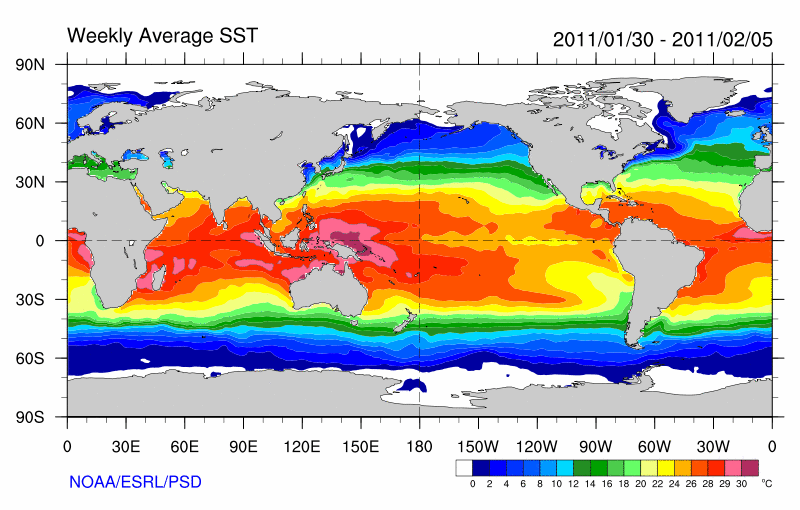
Importance of BLT

[edit]

Prior to El Nino, the warm pool stores heat and is confined to the far western Pacific. During the El Nino, the warm pool migrates eastward along with the concomitant precipitation and current anomalies. The fetch of the westerlies is increased during this time, reinforcing the event. Using data from the ship of opportunity and Tropical Atmosphere – Ocean (TAO) moorings in the western Pacific, the east and west migration of the warm pool was tracked over 1992-2000 using sea surface salinity (SSS), sea surface temperature (SST), currents, and subsurface data from Conductivity, temperature, depth taken on various research cruises.[12] This work showed that during westward flow, the BLT in the western Pacific along the equator (138oE-145oE, 2oN-2oS) was between 18 m – 35 m corresponding with warm SST and serving as an efficient storage mechanism for heat. Barrier layer formation is driven by westward (i.e. converging and subducting) currents along the equator near the eastern edge of the salinity front that defines the warm pool. These westward currents are driven by downwelling Rossby waves and represent either a westward advection of BLT or a preferential deepening of the deeper thermocline versus the shallower halocline due to Rossby wave dynamics (i.e. these waves favor vertical stretching of the upper water column). During El Nino, westerly winds drive the warm pool eastward allowing fresh water to ride on top of the local colder/saltier/denser water to the east. Using coupled, atmospheric/ocean models and tuning the mixing to eliminate BLT for one year prior to El Nino, it was shown that the heat buildup associated with barrier layer is a requirement for big El Nino.[13] It has been shown that there is a tight relationship between SSS and SST in the western Pacific and the barrier layer is instrumental in maintaining heat and momentum in the warm pool within the salinity stratified layer.[14] Later work, including Argo drifters, confirm the relationship between eastward migration of the warm pool during El Nino and barrier layer heat storage in the western Pacific.[15] The main impact of barrier layer is to maintain a shallow mixed layer allowing an enhanced air-sea coupled response. In addition, BLT is the key factor in establishing the mean state that is perturbed during El Nino/La Niña[16]

Limnological mixed layer formation

[edit]

Formation of a mixed layer in a lake is similar to that in the ocean, but mixing is more likely to occur in lakes solely due to the molecular properties of water. Water changes density as it changes temperature. In lakes, temperature structure is complicated by the fact that fresh water is heaviest at 3.98 °C (degrees Celsius). Thus in lakes where the surface gets very cold, the mixed layer briefly extends all the way to the bottom in the spring, as surface warms as well as in the fall, as the surface cools. This overturning is often important for maintaining the oxygenation of very deep lakes.

The study of limnology encompasses all inland water bodies, including bodies of water with salt in them. In saline lakes and seas (such as the Caspian Sea), mixed layer formation generally behaves similarly to the ocean.

Atmospheric mixed layer formation

[edit]

The atmospheric mixed layer results from convective air motions, typically seen towards the middle of the day when air at the surface is warmed and rises. It is thus mixed by Rayleigh–Taylor instability. The standard procedure for determining the mixed layer depth is to examine the profile of potential temperature, the temperature which the air would have if it were brought to the pressure found at the surface without gaining or losing heat. As such an increase of pressure involves compressing the air, the potential temperature is higher than the in-situ temperature, with the difference increasing as one goes higher in the atmosphere. The atmospheric mixed layer is defined as a layer of (approximately) constant potential temperature, or a layer in which the temperature falls at a rate of approximately 10 °C/km, provided it is free of clouds. Such a layer may have gradients in the humidity, though. As is the case with the ocean mixed layer, velocities will not be constant throughout the atmospheric mixed layer.

References

[edit]
[edit]

Further reading

[edit]
Revisions and contributorsEdit on WikipediaRead on Wikipedia
from Grokipedia
The mixed layer is a layer in a thermally stratified in which turbulent mixing produces nearly uniform values of , (or ), and near the surface. This concept applies across various environments, including , lakes, and the atmosphere. In , it refers to the uppermost zone of the ocean where , , and are nearly uniform due to intense turbulent mixing driven by surface , breaking waves, and convective processes such as heat loss or . This layer typically extends from the sea surface to a depth of 10 to 200 meters, though it can vary significantly from just a few meters during calm, warm periods to over 300 meters in stormy winter conditions. The formation of the oceanic mixed layer results from mechanical and thermodynamic forcing at the air-sea interface. generates shear and that stirs the , while surface heating or cooling influences and ; for instance, winter cooling promotes deeper mixing by increasing differences that drive overturning. and further modulate , enhancing or inhibiting stratification. The base of the mixed layer is often defined by a temperature drop of about 0.5°C to 1°C from the surface or a increase, marking the transition to the where stratification strengthens and mixing diminishes. This layer plays a critical role in global climate dynamics by mediating exchanges of , , gases, and nutrients between the atmosphere and interior. It absorbs a significant portion of atmospheric through , influencing and carbon cycling over timescales of 10 to 100 years. Seasonal deepening of the mixed layer in winter facilitates nutrient , supporting blooms and marine productivity upon restratification in spring. Variations in mixed layer depth also affect circulation patterns and storage, with implications for phenomena like El Niño-Southern Oscillation. In , a similar mixed layer forms in lakes due to mixing and stratification, influencing freshwater ecosystems. In , an analogous mixed layer exists within the , characterized by vigorous daytime turbulence that homogenizes temperature and humidity vertically, typically reaching heights of 1 to 2 kilometers under convective conditions. However, the term "mixed layer" most commonly denotes the oceanic context in geophysical literature.

Overview and General Concepts

Definition and Characteristics

The mixed layer refers to the uppermost zone in a body or the atmosphere where induced by mechanical and forcing creates a nearly homogeneous distribution of physical properties, such as , in aquatic systems, or potential and specific in the atmosphere. This layer forms the interface between the surface and deeper regions, with its uniformity arising from vigorous vertical mixing that erodes gradients in and other properties. In oceanic contexts, it is often the primary example in marine science, serving as a foundational for understanding upper dynamics. Key characteristics of the mixed layer include its vertical homogeneity in properties like potential temperature and , which minimizes density gradients within the layer, and its demarcation below by a transition zone of stable stratification, such as a (temperature-based), (salinity-based), or inversion layer. The depth of this layer varies significantly across environments, typically ranging from 10 to 200 meters in oceanic settings, 100 to 2000 meters in the atmospheric , and 5 to 50 meters in freshwater lakes, depending on forcing intensity and ambient conditions. The primary drivers of mixed layer formation and maintenance are , which generates shear and mechanical ; fluxes from net surface heating, cooling, , or ; and convective overturning triggered by surface cooling or brine rejection in winter. These processes sustain mixing until balanced by restorative stratification forces. The concept of the mixed layer was first systematically conceptualized in by Sverdrup et al. in their seminal 1942 text The Oceans, where it was described as a well-mixed surface zone influenced by wind and thermal effects. This idea was extended to atmospheric and limnological contexts during the mid-20th century, as meteorologists formalized the convective and limnologists refined models of epilimnetic mixing in stratified lakes.

Universal Importance Across Environments

The mixed layer in stratified fluid systems, whether oceanic, atmospheric, or limnological, functions as a dynamic interface that facilitates the vertical exchange of , , and nutrients between the surface and underlying layers. In oceanic contexts, this layer modulates turbulent fluxes driven by and , enabling the redistribution of and from the atmosphere into the ocean interior. Similarly, in the atmospheric , turbulent mixing transfers from surface winds to higher altitudes, while in lake epilimnia, it homogenizes and circulates dissolved substances like oxygen and trace elements. These exchanges are fundamental to maintaining system stability and driving large-scale circulation patterns across environments. In terms of relevance, the mixed layer significantly influences the global energy balance by regulating surface fluxes of and moisture, with its acting to dampen short-term variability at the air-water or air-land interface. For instance, the ocean's , with the mixed layer playing a key role in initial absorption and vertical distribution, accounts for over 90% of global excess uptake since 1971 and thereby modulating fluctuations that feedback into . This buffering effect extends to atmospheric and limnological settings, where enhanced stratification under warming conditions alters flux rates, potentially amplifying regional sensitivities. In coupled models, accurate representation of mixed layer processes is essential, as biases in vertical mixing contribute to uncertainties in uptake projections, such as a 10% variability in future ocean warming estimates. The oceanic mixed layer's role is particularly evident in modulating events like the El Niño-Southern Oscillation through anomalies. Ecologically, mixed layers exert control over primary productivity by entraining nutrients from subsurface reservoirs into sunlit surface zones, fostering biogeochemical cycles that sustain food webs. In oceans and lakes, this nutrient supports growth, which forms the base of aquatic and marine ecosystems, while in the atmospheric , it influences and distributions that affect formation and . Feedback loops arise as within the mixed layer, such as algal blooms, modifies local density gradients and mixing intensity, thereby influencing and oxygen levels. Climate-driven changes, including reduced mixing depths, are projected to decrease supply and by 4–11% in upper layers by the end of the century under high-emission scenarios, with analogous impacts on lake productivity through altered thermal structures. Observational and modeling challenges stem from the mixed layer's uniformity, which hinders techniques like satellite altimetry or that rely on gradients for detection. This homogeneity complicates measurements and parameterizations in numerical models, where subgrid-scale must be approximated to capture fluxes accurately. In coupled ocean-atmosphere models used for IPCC assessments, refined mixed layer schemes, such as those incorporating eddy-induced transports, are vital for simulating variability, as evidenced by their role in reducing biases in global heat and carbon budgets.

Oceanic Mixed Layer

Formation Processes

The oceanic mixed layer forms through turbulent mixing processes that homogenize temperature, salinity, and velocity in the upper ocean, primarily driven by mechanical and thermodynamic forcings at the surface. Wind stress at the air-sea interface generates shear turbulence by transferring momentum to the water column, creating velocity gradients that promote vertical mixing. This shear is quantified by the surface wind stress τ=ρCdUU\tau = \rho C_d |U| U, where ρ\rho is the water density, CdC_d is the drag coefficient, and UU is the near-surface wind velocity. Surface buoyancy loss, through evaporative cooling or net radiative heat loss, destabilizes the water column and induces convective overturning, where denser fluid sinks and entrains underlying water, further deepening and homogenizing the layer. These processes exhibit strong seasonal and diurnal variability. In winter, enhanced surface cooling intensifies , leading to a deepening of the mixed layer as turbulent plumes penetrate deeper into the ; for instance, in the North Atlantic, winter mixed layers can exceed 500 meters in subpolar regions due to this mechanism. Conversely, in summer, solar heating establishes a stable surface stratification, shallowing the layer to tens of meters and reducing , while diurnal cycles cause temporary deepening during daytime events or nighttime cooling. The dynamics of these mixing processes are captured in the turbulent kinetic energy (TKE) budget, which balances production, , and terms. A key production term arises from wind-induced shear, expressed as the shear production (uz)2+(vz)2\left( \frac{\partial u}{\partial z} \right)^2 + \left( \frac{\partial v}{\partial z} \right)^2, where uu and vv are horizontal velocity components and zz is the vertical coordinate; this term reflects the conversion of mean from into that sustains the mixed layer. Surface gravity waves contribute to mixed layer formation by breaking and injecting , while Langmuir turbulence—arising from the interaction of wind-driven currents with wave-induced —enhances vertical mixing through organized counter-rotating cells that extend throughout the layer. These cells can increase effective diffusivity by factors of 2–10 compared to shear alone, particularly under moderate winds, amplifying the impact of both and .

Depth Determination Methods

The oceanic mixed layer depth (MLD) is determined through a combination of observational criteria applied to vertical profiles of temperature and density, ensuring consistency across datasets. A standard temperature-based criterion identifies the MLD as the depth where the potential temperature decreases by 0.5°C relative to the surface value, a threshold that captures the transition from well-mixed conditions to stratification and has been used in global climatologies. An alternative, finer-resolution criterion sets the MLD at the depth of a 0.2°C temperature difference from a reference value at 10 m depth, as developed by de Boyer Montégut et al. (2004) using extensive profile data to produce a global climatology. For density-based definitions, which account for salinity effects, the MLD is defined as the depth where potential density increases by 0.03 kg/m³ from the near-surface reference, providing a robust measure in regions with significant haline influences. These thresholds are selected to reflect the physical boundary where turbulence homogenizes properties, though slight variations in criteria can lead to differences of 10-20 m in estimated depths depending on local stratification. Observational techniques rely on in situ profiling to acquire the necessary and for applying these criteria. Shipboard conductivity-temperature-depth (CTD) sensors offer high-vertical-resolution measurements during research cruises, allowing precise MLD calculations along transects and in targeted regions like coastal or frontal zones. The float program, with approximately 4,000 active instruments as of 2025, provides near-global coverage through autonomous drifting profilers that measure to 2,000 m every 10 days, enabling automated MLD estimation via algorithms that process and profiles for threshold detection. These floats have generated millions of profiles, supporting monthly climatologies with uncertainties typically below 10 m in well-sampled areas. Complementing direct methods, satellite altimetry derives proxy estimates of MLD by observing sea surface height anomalies, which correlate with upper-ocean density gradients when integrated with empirical models or reanalysis products. Such approaches extend spatial coverage but require calibration against in situ to achieve accuracies of 20-50 m. Theoretical and numerical modeling of MLD employs bulk parameterizations that simulate the layer's evolution based on surface forcing and stratification. The Kraus-Turner (1967) entrainment model, a foundational one-dimensional framework, predicts MLD changes through the turbulent budget at the base of the layer, leading to the entrainment equation: hdhdt=Δbwebzh \frac{dh}{dt} = \frac{\Delta b \, w_e}{\frac{\partial b}{\partial z}} where hh represents the MLD, Δb\Delta b is the jump across the interface, wew_e is the entrainment velocity driven by and surface cooling, and bz\frac{\partial b}{\partial z} is the in the below. This equation balances energy inputs to compute deepening rates, with wew_e often parameterized as proportional to the cube of the friction velocity from surface stresses. Such bulk formulas are integrated into global ocean models like HYCOM or , reproducing observed MLD variability with root-mean-square errors of 20-30 m when forced by reanalysis winds and heat fluxes. MLD determination reveals pronounced regional variability tied to atmospheric forcing patterns. In subtropical gyres, MLDs typically range from 50-100 m year-round due to moderate , whereas in the Southern Ocean's storm tracks, intense extratropical cyclones drive deeper mixing, with winter MLDs often exceeding 150-200 m and suppressing seasonal restratification. This latitudinal contrast underscores the role of storm frequency and intensity in modulating global MLD distributions, as evidenced by Argo-derived climatologies showing mean depths 50-100 m greater in high-latitude storm-prone zones compared to equatorial regions.

Role in Ocean Circulation and Climate

The oceanic mixed layer plays a pivotal role in large-scale circulation by facilitating , the process through which surface waters are transferred into the stratified interior, thereby ventilating the upper and contributing to gyre dynamics and . In subtropical gyres, such as the North Atlantic, occurs primarily during the seasonal cycle, with fluid entrained into the mixed layer during winter cooling and subducted in spring and summer as the layer shoals due to input. This process feeds intermediate waters, with annual subduction rates ranging from 50–100 m yr⁻¹ in the North Atlantic subtropical gyre, enhanced by Ekman pumping and lateral across the sloping base of the mixed layer. In the formation of (NADW), deep convection within the mixed layer during winter preconditions waters for , linking surface processes to the global thermohaline overturning circulation and transporting properties like heat and nutrients into the interior. Variations in mixed layer depth (MLD) significantly influence climate modes such as the El Niño-Southern Oscillation (ENSO) and the (IOD) by modulating upper-ocean heat storage and (SST) anomalies. During canonical El Niño events, anomalous deepening of the MLD reduces vertical mixing and entrainment of cooler subsurface waters, amplifying SST warming in the eastern Pacific and sustaining heat content anomalies that feedback into atmospheric teleconnections. This MLD feedback contributes to up to 20% of the SST anomaly amplitude, as shown in hindcast simulations using regional ocean models forced by reanalysis data from 1961–2016. For the IOD, shoaling of the MLD in the western during positive phases enhances surface warming through reduced heat loss to deeper layers, intensifying dipole SST contrasts and influencing variability. The mixed layer integrates into the ocean as a dynamic for CO₂ uptake, where air-sea rates are governed by its depth and ventilation processes. Acting as the immediate interface with the atmosphere, the mixed layer absorbs CO₂ driven by a difference (ΔpCO₂) of about 7 µatm globally, with fluxes calculated as F = k × s × ΔpCO₂, where gas transfer velocity k scales with and is modulated by MLD thickness—shallower layers promote faster equilibration and higher uptake via biological drawdown. Deeper MLDs enhance ventilation of (DIC) to the subsurface, facilitating export of 22–44% of absorbed anthropogenic CO₂ to intermediate and deep waters, particularly in coastal and high-latitude regions where and biology amplify the sink strength to 0.25 GtC yr⁻¹ in coastal zones alone. Observational and model-based evidence underscores the mixed layer's climatic imprint, with satellite-derived MLD anomalies correlating strongly with SST fluctuations in coupled models. In CMIP6 simulations, MLD biases in deep-water formation regions, such as the North Atlantic, lead to erroneous SST patterns, with eddy-rich models showing shallower winter MLDs and reduced biases compared to low-resolution counterparts, highlighting the role of mesoscale processes in realistic heat transport. These anomalies, derived from floats and satellite altimetry proxies, reveal interannual MLD-SST couplings that amplify variability in modes like ENSO, as validated against historical observations.

Barrier Layer Thickness

The barrier layer thickness (BLT) is defined as the vertical distance between the base of the mixed layer depth (MLD) and the isothermal layer depth (ILD), arising when stratification causes the ILD to exceed the MLD, thereby creating a stable layer that separates the well-mixed surface from the below. This structure forms because horizontal freshwater inputs or vertical gradients reduce surface without corresponding changes, preventing full vertical mixing down to the . The presence of the barrier layer alters upper-ocean dynamics by limiting the exchange of properties across the pycnocline. Barrier layers manifest in distinct regimes influenced by regional hydrographic conditions. In salt-stratified regimes, riverine freshwater plumes, such as those from the , cap the surface with low-salinity water, deepening the isothermal layer while keeping the density-based mixed layer shallow. Temperature-inverted regimes occur in regions like the western Pacific warm pool, where intense rainfall or diurnal warming creates subsurface temperature inversions atop a , enhancing stability. Double-diffusive regimes involve thermohaline instabilities, such as salt fingers within haloclines, where warmer, saltier water overlies cooler, fresher water, facilitating selective salt transport without vigorous mixing. The is calculated as BLT = ILD - MLD, with the ILD determined as the depth where drops by 0.5°C relative to the sea surface , a criterion chosen for its robustness in capturing the onset of the across diverse profiles. This metric highlights how effects decouple and profiles; the resulting layer reduces turbulent entrainment of subsurface cold water into the mixed layer, which suppresses cooling and sustains warmer sea surface temperatures (SSTs). Globally, barrier layers are most prominent in tropical and subtropical oceans, where they can reach thicknesses of up to 50 m in the western Pacific warm pool due to persistent rainfall and weak winds. float observations and climatological datasets from the World Ocean Atlas reveal their widespread distribution in low-latitude regions, covering approximately 10-20% of the global oceans, with higher frequencies in areas influenced by monsoons, river outflows, and equatorial currents.

Limnological Mixed Layer

Formation in Freshwater Systems

In freshwater systems such as lakes and reservoirs, the formation of the mixed layer is primarily driven by processes, as density variations are dominated by rather than . Solar radiation heats the surface waters during warmer months, creating a warm that floats atop cooler, denser hypolimnetic waters, establishing stratification. This surface heating promotes the initial development of a distinct mixed layer, where homogenizes and within the upper layer. Wind-induced mixing plays a crucial role in eroding this stratification, particularly in larger basins with sufficient fetch, by generating shear and that deepen the mixed layer and distribute downward. In temperate regions, seasonal cooling during autumn and winter further drives full overturn, or complete circulation (holomixis), as surface waters lose to the atmosphere, increasing and triggering convective mixing that can extend throughout the . These processes contrast with oceanic systems by lacking gradients, making the primary control. Lake mixing patterns vary by type, influenced by and . Dimictic lakes, common in mid-latitude temperate zones, undergo two annual mixing periods: spring and fall turnovers, when isothermal conditions allow complete circulation, as observed in systems like Harp Lake, Ontario. Monomictic lakes, such as deep temperate lakes in warmer climates, experience one mixing event per year, often during winter or summer depending on cover and regime. The stability of stratification is quantified by the buoyancy frequency N2=gρρzN^2 = -\frac{g}{\rho} \frac{\partial \rho}{\partial z}, where gg is , ρ\rho is water density (primarily temperature-dependent in freshwater), and zz is depth; low N2N^2 values indicate regions prone to mixing. Additional influences include river inflows, which introduce cooler or warmer masses that disrupt existing stratification and enhance vertical mixing, and ice cover in polar or high-latitude lakes, which suppresses wind-driven during winter but initiates mixing upon melt. For example, in the , autumn and winter cooling leads to seasonal deepening of the mixed layer to approximately 100 m before ice formation, facilitating extensive circulation in these dimictic systems.

Depth and Stability Factors

In limnological systems, the depth of the mixed layer, often referred to as the during summer stratification, is typically determined by identifying the base of the metalimnion through thresholds. A common criterion defines the onset where the reaches approximately 0.1°C/m, marking the transition from the well-mixed surface layer to the stratified subsurface waters. In temperate lakes, summer depths generally range from 5 to 20 meters, varying with lake size and environmental conditions, as observed in systems like Lake (around 5 m) and (15-20 m). Stability of the mixed layer in freshwater systems is quantified using metrics such as the Brunt-Väisälä frequency (N²), which measures the strength of stratification by assessing the energy required to overcome gradients for vertical mixing. This frequency highlights how stable layers resist , with values spanning several orders of magnitude across lakes depending on thermal and profiles. Key physical factors influencing depth and stability include —the unobstructed distance over which wind acts on the lake surface—and lake morphometry, such as basin shape and area. In fetch-limited small lakes, shorter fetch (e.g., less than 500 m) results in shallower mixed layers (8-9 m) due to reduced wind-induced mixing, whereas larger lakes with extended fetch (e.g., over 50 km) promote deeper layers (10-20 m) through enhanced wave action and . Observational methods for determining mixed layer depth and stability rely on in situ and remote techniques tailored to freshwater environments. Thermistor chains, consisting of multiple temperature sensors deployed vertically (e.g., at 1-2 m intervals), provide high-resolution profiles to detect gradients and track layer boundaries in real time, as implemented in dimictic lakes like Toolik Lake, Alaska. Echo sounders, including acoustic Doppler current profilers, identify the thermocline by detecting echo-reflecting layers caused by density contrasts, enabling ecosystem-scale analysis when combined with thermistor data. Additionally, remote sensing of lake surface color via satellite-derived water clarity (e.g., Secchi depth proxies) serves as an indirect measure of surface heating rates, influencing mixed layer development through variations in light penetration and absorptance. Climate variability significantly modulates mixed layer depth and stability in limnological systems, particularly in high-latitude regions. In lakes, such as in northern , warming trends from 1961 to 2020 have led to increased surface temperatures (+0.25°C per decade) and comparable warming at 5-10 m depths (+0.27 to +0.29°C per decade), indicating potential deepening of the alongside strengthened overall stratification. These changes, driven by earlier ice-off and prolonged open-water periods, exemplify broader 1970s-2020s patterns where regional warming alters thermal structures, with depths responding to enhanced heat inputs and variable wind regimes.

Ecological and Hydrological Impacts

In limnological systems, the epilimnion's mixing processes play a crucial role in dynamics by resuspending sediments from the lake bottom, which releases and other essential nutrients into the upper , thereby fueling growth. This resuspension is particularly pronounced during periods of increased wind-driven , enhancing availability for and potentially leading to algal blooms in productive lakes. Conversely, during thermal stratification, the hypolimnion becomes isolated, promoting anoxic conditions that limit oxygen replenishment and trap nutrients in deeper sediments, exacerbating internal loading when mixing resumes. The mixed layer significantly influences lake biodiversity, particularly fish habitats, by creating vertical temperature gradients that provide refugia for cold-water species in the cooler hypolimnion below the . In stratified conditions, the warmer supports warm-water fish, while the stable deeper layers offer thermal protection for species like , maintaining community diversity. Seasonal turnover events, typically in fall and spring, mix the to oxygenate hypolimnetic depths, averting widespread anoxia and associated fish kills that can occur when oxygen levels drop below 3 ppm during prolonged stratification. For instance, incomplete mixing in dimictic lakes can lead to hypoxic zones, stressing fish populations and altering trophic interactions. Hydrologically, the mixed layer depth affects rates by influencing and balance; shallower mixed layers in summer promote warmer surface waters, increasing and , while deeper layers cool the surface and reduce these rates by 5-8% in typical dimictic lakes. In reservoirs, variations in mixed layer depth also modulate exchange, with deeper layers enhancing inflow near shorelines by altering hydraulic gradients and capturing more subsurface flow, thereby influencing overall water budgets and recharge dynamics. These interactions are critical for water resource management, as they control solute transport between surface and systems. Human-induced intensifies these impacts by altering mixed layer dynamics through enhanced algal production, which absorbs solar radiation and strengthens surface heating, often leading to more stable stratification and shallower mixed layers that limit vertical exchange. In eutrophic conditions, this can deepen hypoxia in the hypolimnion, promoting release and perpetuating bloom cycles. A prominent case is in the 1970s, where excessive from agricultural runoff and triggered massive algal blooms, degrading and prompting the 1972 Great Lakes Water Quality Agreement, which mandated over 50% reductions through detergent bans and improved , successfully curbing by the 1980s.

Atmospheric Mixed Layer

Formation Mechanisms

The atmospheric mixed layer forms through turbulent processes initiated by interactions between the surface and the overlying air, primarily driven by surface heating from solar radiation and mechanical mixing due to over . Solar radiation warms the ground, creating buoyant thermals—upward-rising parcels of warm air—that generate convective and promote vertical mixing near the surface. , arising from friction between the surface and faster-moving air aloft, produces mechanical that enhances this mixing, particularly in regions with variable . These drivers combine to erode layers aloft and homogenize temperature, humidity, and momentum within the layer. The development follows a diurnal cycle tied to solar forcing: during the day, the layer grows as flux from the surface intensifies, reaching depths of around 1 km by late afternoon under clear conditions; at night, reduced heating leads to stabilization, causing the active mixed layer to collapse while leaving a neutrally stratified residual layer above a shallow stable of tens to hundreds of meters. This cycle typically begins about 30 minutes after sunrise with initial plumes and ends with decay about 30 minutes before sunset. Distinct types of mixed layers emerge based on dominant forcing: the convective (CBL) prevails under clear skies with strong from surface heating, producing deep, well-mixed conditions; shear-driven layers form in neutrally stratified atmospheres where provides the primary without significant . Clouds influence formation by shading the surface and reducing solar heating, thereby limiting convective growth, while aerosols modify radiative fluxes through and absorption, potentially stabilizing or destabilizing the layer depending on their . Mechanical mixing from shares similarities with mechanisms in oceanic mixed layer formation.

Depth and Turbulence Dynamics

The depth of the atmospheric mixed layer, often referred to as the planetary boundary layer height, can be estimated using techniques such as acoustic sounding with , which detects echoes from refractive index gradients caused by fluctuations in turbulent regions. Similarly, systems measure profiles to identify the layer top where decreases sharply due to reduced particle concentrations above the mixed layer. These methods provide real-time vertical profiles, with effective for detecting thermal structures up to several kilometers and offering higher resolution for aerosol-laden atmospheres. A key thermodynamic criterion for determining the mixed layer top involves the bulk , defined as Rib=ΔΘghΘu2Ri_b = \frac{\Delta \Theta g h}{\Theta u_*^2}, where ΔΘ\Delta \Theta is the potential difference across height hh, gg is , Θ\Theta is the mean potential , and uu_* is the friction velocity. The layer top is typically marked where Rib>0.25Ri_b > 0.25, indicating the transition from turbulent to stable stratification that suppresses vertical mixing. This threshold-based approach is widely applied in and model data to delineate the entrainment zone. Turbulence within the mixed layer is characterized by eddy diffusivity KulK \sim u_* l, where ll represents the mixing scale, which varies with height and stability to parameterize vertical of , , and scalars. The mixing ll is often limited by the layer depth or effects, ensuring realistic rates in convective conditions. Turbulent structures span scales from small eddies on the order of centimeters, responsible for local , to large reaching kilometers, which drive bulk mixing and entrainment. Surface roughness significantly influences mixed layer depth, with urban environments featuring higher roughness lengths that enhance mechanical turbulence and lead to deeper layers compared to smoother rural surfaces. For instance, increased drag from buildings and infrastructure promotes stronger vertical mixing, elevating the layer top by 20-50% over rural areas under similar synoptic conditions. Additionally, subsidence in high-pressure systems acts to cap layer growth by imposing a stable inversion that limits entrainment, often reducing daytime depths by hundreds of meters. Observational data from flux tower networks like FLUXNET, which measure surface es driving development over , indicate typical mixed layer depths of 500-1500 m during convective periods in mid-latitude regions. These towers capture the evolution through heat and momentum es, revealing seasonal variations where summer depths often exceed 1000 m due to stronger insolation. Such measurements validate model parameterizations and highlight the layer's response to heterogeneity.

Influence on Weather and Air Quality

The atmospheric mixed layer plays a critical role in local weather patterns by facilitating the upward transport of moisture from the surface, which enhances the formation of cumulus clouds. During daytime convective conditions, the turbulent mixing within the layer entrains moist air, promoting cloud development at the layer's top where it interfaces with drier air aloft. This process is particularly evident in regions with sufficient surface heating, leading to increased cloud cover and potential for precipitation in fair-weather scenarios. The mixed layer also influences and nocturnal dynamics. In coastal areas, the daytime growth of the mixed layer through solar ing contrasts with cooler marine air, driving sea breeze circulations that advect moist, air inland and modulate local temperatures and winds. At night, the collapse of the mixed layer often results in nocturnal inversions, where a layer forms near the surface, trapping and to foster development under calm, clear conditions. These inversions limit vertical mixing, allowing to saturate the air and initiate , especially in valleys or basins. Regarding air quality, the depth of the atmospheric mixed layer significantly affects dispersion. Shallow mixed layers, often occurring under stable conditions like inversions, confine pollutants near the surface, reducing dilution and elevating concentrations— as seen in the , where persistent shallow layers contribute to formation by trapping vehicular and industrial emissions. Conversely, deeper convective mixed layers promote vertical mixing and entrainment of cleaner free-tropospheric air, leading to greater dilution and improved air quality during periods of strong solar heating. This dilution effect is vital in urban environments, where deeper layers can reduce surface-level particulate matter by factors of 2–3 compared to shallow ones. In , the mixed layer is parameterized in numerical models such as the Weather Research and Forecasting (WRF) model through schemes that simulate turbulent fluxes and layer growth. These schemes, including nonlocal mixing options like YSU or ACM2, account for entrainment and surface interactions to predict mixed layer evolution, improving forecasts of near-surface winds, temperatures, and pollutant transport. The mixed layer's dynamics also interact with , where enhanced surface heating in cities deepens the layer during the day but can intensify nocturnal stability, exacerbating heat and pollution retention in built environments. Accurate representation of these processes in models enhances predictions of urban heat island intensity, which can raise nighttime temperatures by 2–5°C in major cities. A notable case is the 2010 Moscow heatwave, where suppressed mixed layer depths—often limited to below 500 m due to persistent anticyclonic conditions and soil dryness—exacerbated poor air quality by trapping from widespread wildfires. This shallow mixing confined aerosols and pollutants near the surface, contributing to elevated PM10 levels exceeding 300 μg/m³ and approximately 11,000 excess deaths from combined heat and pollution effects. Satellite observations of aerosol optical depth (AOD) during the event revealed peaks above 2.0 over , confirming the widespread smoke plume and its linkage to limited vertical dispersion in the .

References

Add your contribution
Related Hubs
User Avatar
No comments yet.