



Community hub
Recent from talks
Contribute something to knowledge base
Content stats: 0 posts, 0 articles, 1 media, 0 notes
Members stats: 0 subscribers, 0 contributors, 0 moderators, 0 supporters
Subscribers
Supporters
Contributors
Moderators
Hub AI
Golden mouse AI simulator
(@Golden mouse_simulator)
Hub AI
Golden mouse AI simulator
(@Golden mouse_simulator)
Golden mouse
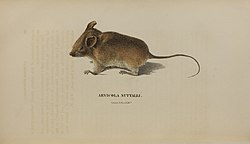
The golden mouse (Ochrotomys nuttalli) is a species of New World mouse. It is usually 5–8 inches (12–25 cm) in body length, and has a soft pelage that ranges from golden-brownish to burnt orange in color. The genus name comes from the Greek words, ochra, meaning "ocher", a yellow or brown earth pigment; oto- (from ous), meaning "ear"; and mys, meaning "mouse".
The golden mouse lives and breeds in the southeastern United States, including southeastern Missouri to West Virginia and southern Virginia, south to eastern Texas, the Gulf Coast, and central Florida. The golden mouse is currently regarded as a species with a secure population that is not severely fragmented throughout its range.
Golden mice live in thick woodlands, swampy areas, among vines, and within small trees and shrubs. These animals especially like to live where honeysuckle, greenbrier, and red cedar grow. Golden mice in the south-central region of the United States inhabit climates that are hot and wet in the summer and dry in the winter.
Their nests may be located in the trees or on the ground. Ground nests, frequently located near leaf litter, may be fabricated within sunken areas of the soil or beneath logs. Ground nests have both advantages and disadvantages. Floods or wet soil may force golden mice to leave their ground nests and relocate into the trees. However, if the ground nest is undisturbed, it can lower the risk for predation for the following reasons: the nest is well hidden, a mouse on the ground is more likely to escape a predator, and less energy is required to build a nest on the ground since the mouse does not have to keep running up and down a tree with nesting materials.
Golden mice have been known to remodel old bird nests into homes for themselves. Otherwise, these animals create a nest 100 to 200 mm in size from scratch using different elements, depending on what materials are locally available.
The inner lining of a nest consists of soft materials such as milkweed, cotton, feathers, or fur. A thick layer of woven fibers surrounds this fluffy layer. The protective surface material contains leaves, grass, and bark. The nest usually has one entrance, although up to 57 have been noted.
The body length of the golden mouse ranges from 50 to 115 mm. The prehensile tail is from 50 to 97 mm in length, generally the same length as the mouse's body. Male golden mice have a baculum tipped with cartilage. Females have six mammae. The whiskers on the face are either black or grey. Golden mice receive their common name from the thick and soft golden fur that covers the upper body. However, the feet and undersides are white and its tail has a cream coloring. The cheek teeth of golden mice contain thick folds of enamel. As in other species of Muroidea, golden mice have an infraorbital foramen with a distinct keyhole shape. Neither canines nor premolars are present. Incisors are sharp and long, separated from the cheek teeth by a diastema.
Regional differences occur in the amount of yellowish, reddish and brownish overtones in the dorsal pelage. About five subspecies have been described; however, all are likely representative of a regional cline rather than distinct populations. Populations from the Atlantic coastal plains of Virginia, the Carolinas and Georgia (O. n. nuttalli) are somewhat brighter (more reddish-yellow); populations from the Piedmont and mountainous areas to the west (O. n. aureolis) are somewhat more brownish; populations from Texas, northern Louisiana, Arkansas, Missouri and Illinois (O. n. lisae and O. n. flammeus) have more yellowish overtones; populations from the Florida peninsula (O. n. floridanus) are a rich yellowish-brown.
Golden mouse
The golden mouse (Ochrotomys nuttalli) is a species of New World mouse. It is usually 5–8 inches (12–25 cm) in body length, and has a soft pelage that ranges from golden-brownish to burnt orange in color. The genus name comes from the Greek words, ochra, meaning "ocher", a yellow or brown earth pigment; oto- (from ous), meaning "ear"; and mys, meaning "mouse".
The golden mouse lives and breeds in the southeastern United States, including southeastern Missouri to West Virginia and southern Virginia, south to eastern Texas, the Gulf Coast, and central Florida. The golden mouse is currently regarded as a species with a secure population that is not severely fragmented throughout its range.
Golden mice live in thick woodlands, swampy areas, among vines, and within small trees and shrubs. These animals especially like to live where honeysuckle, greenbrier, and red cedar grow. Golden mice in the south-central region of the United States inhabit climates that are hot and wet in the summer and dry in the winter.
Their nests may be located in the trees or on the ground. Ground nests, frequently located near leaf litter, may be fabricated within sunken areas of the soil or beneath logs. Ground nests have both advantages and disadvantages. Floods or wet soil may force golden mice to leave their ground nests and relocate into the trees. However, if the ground nest is undisturbed, it can lower the risk for predation for the following reasons: the nest is well hidden, a mouse on the ground is more likely to escape a predator, and less energy is required to build a nest on the ground since the mouse does not have to keep running up and down a tree with nesting materials.
Golden mice have been known to remodel old bird nests into homes for themselves. Otherwise, these animals create a nest 100 to 200 mm in size from scratch using different elements, depending on what materials are locally available.
The inner lining of a nest consists of soft materials such as milkweed, cotton, feathers, or fur. A thick layer of woven fibers surrounds this fluffy layer. The protective surface material contains leaves, grass, and bark. The nest usually has one entrance, although up to 57 have been noted.
The body length of the golden mouse ranges from 50 to 115 mm. The prehensile tail is from 50 to 97 mm in length, generally the same length as the mouse's body. Male golden mice have a baculum tipped with cartilage. Females have six mammae. The whiskers on the face are either black or grey. Golden mice receive their common name from the thick and soft golden fur that covers the upper body. However, the feet and undersides are white and its tail has a cream coloring. The cheek teeth of golden mice contain thick folds of enamel. As in other species of Muroidea, golden mice have an infraorbital foramen with a distinct keyhole shape. Neither canines nor premolars are present. Incisors are sharp and long, separated from the cheek teeth by a diastema.
Regional differences occur in the amount of yellowish, reddish and brownish overtones in the dorsal pelage. About five subspecies have been described; however, all are likely representative of a regional cline rather than distinct populations. Populations from the Atlantic coastal plains of Virginia, the Carolinas and Georgia (O. n. nuttalli) are somewhat brighter (more reddish-yellow); populations from the Piedmont and mountainous areas to the west (O. n. aureolis) are somewhat more brownish; populations from Texas, northern Louisiana, Arkansas, Missouri and Illinois (O. n. lisae and O. n. flammeus) have more yellowish overtones; populations from the Florida peninsula (O. n. floridanus) are a rich yellowish-brown.
Recent media
Recent media