Hubbry Logo
OfrendaOfrendaMain
Open search
Ofrenda
Community hub
Ofrenda
logo
8 pages, 0 posts
0 subscribers
Be the first to start a discussion here.
Ofrenda
Ofrenda
from Wikipedia
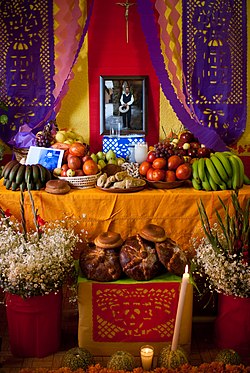
Pan de muerto altar commemorating a deceased man in Milpa Alta, México DF

An ofrenda (Spanish: "offering") is the offering placed in a home altar during the annual and traditionally Mexican Día de los Muertos celebration. An ofrenda, which may be quite large and elaborate, is usually created by the family members of a person who has died and is intended to welcome the deceased to the altar setting.

Background

[edit]

This display coincides with the Día de Muertos, which is a tradition some believe originated with the Aztecs, though others dispute this.[1] The Aztec culture considered souls to continuously live and enter different realms when a body would die. This view the Aztecs held was commingled with the Christian beliefs that the soul is eternal (whether it be in heaven, purgatory, or hell) during the Spanish conquest of the Aztec Empire when the two cultures were merged. The ofrenda is presented in one's home in order to commemorate the souls of loved ones in the family.

Regional variations

[edit]
Ofrenda in Balboa Park, 2024

Different regions create their ofrendas in different ways. Some examples of these regional variances are in Oaxaca, Michoacan, Veracruz, Puebla, and Mexico City. In the state of Oaxaca, ofrendas are usually decorated with paper mache decorations called alebrijes. They are usually colourful and help to bring life into the ofrenda. Ofrendas in Michoacan can be adorned with sugar skulls and papel picado. Marigold petals, called cempasuchil, are also used to add colour and fragrance to the ofrenda. In the coastal region of Veracruz, seashells, fish, and seaweed are often added to ofrendas to represent the significance of the sea in the lives of the local communities. Veracruz also has the Guinness World Record for Largest Day of the Dead ofrenda.[2] The culinary heritage of Puebla plays a big role in the decoration of the ofrendas in the region. Traditional foods such as mole poblano, a flavourful sauce, are commonly used in ofrendas. In large cities like Mexico City, ofrendas can be influenced by both modern and traditional items. The urban setting facilitates a dynamic fusion of historical homage and present-day creative expression, showcasing the city's cultural evolution.

Components of the offering

[edit]

A common format for an ofrenda contains three levels or tiers. The topmost tier identifies the dead person who is being invited to the altar, frequently with photos of the deceased, along with images of various saints, statuettes of the Virgin Mary, crucifixes, etc. which are positioned in a retablo which forms the back of the altar;[3] on the second tier are things placed to encourage the dead to feel at home and welcome: the deceased person's favorite food items might go here, including such things as mole, candy, pan dulce, and especially a sweet bread called pan de muerto. For deceased adults, the ofrenda might include a bottle or poured shot glasses of tequila or mezcal, while if the deceased is a child a favorite toy might be placed here. The bottom-most tier almost always contains lit candles, and might also have a washbasin, mirror, soap, and a towel so that the spirit of the deceased can see and refresh themselves upon arrival at the altar. Throughout the altar are placed calaveras (decorated candied skulls made from compressed sugar) and bright orange and yellow marigolds (cempazuchitl), an Aztec flower of the dead. According to cultural descriptions of the celebration, the smell from the Marigolds helps guide the dead to the ofrenda, and the petals are often picked and spread in a pathway to lead the way.[4] Ofrendas are constructed in the home as well as in village cemeteries and churches.[5][6]

The ofrenda typically features types of decorations that are representative of the four elements.[7] For example, candles are lit on the table to symbolize the element of fire. Papel picado represents the element air because it is so light weight, you can see how the wind moves it. Since food is solid and is grown in the ground, it represents the element earth. The element of water is represented by the glasses of water.[8] It is thought that because the journey to the land of the living is a long one, water is left out to satisfy the thirst of those who made the journey.[9] Incense from the resin of copal trees are also used in the offering in order to produce smells that will scare away evil spirits.[1]

In culture

[edit]

A non-fiction children's book called Day of the Dead: A Mexican-American Celebration was written by Diane Hoyt-Goldsmith.[10] The book is about a Mexican-American family celebrating the Day of the Dead (Día de los Muertos) in California and is focused on two young twins in the family. The twins help the family create an ofrenda for their loved ones, as well as a larger ofrenda for their community.[10]

An ofrenda forms a central plot theme in the 2017 animated film Coco.[11]

Another animated film that showcases ofrendas is The Book of Life. The movie incorporates colorful and vibrant ofrendas as part of the visual representation of the Day of the Dead celebration.[12]

The James Bond film Spectre includes a scene set during the Day of the Dead celebration in Mexico City, featuring elaborate ofrendas and traditional costumes.[13]

In Season 15 of Grey's Anatomy, the family of a patient build an ofrenda in her hospital room to mark the Día de los Muertos. The episode contains several other references to the holiday, including many of the doctors meditating on dead loved ones and multiple appearances of marigolds.[14]

On episode 1 of season 3 of the TV series Breaking Bad includes a scene showing Mexican characters crawling towards a shrine of Santa Muerte.[15]

In the 1998 PC adventure game Grim Fandango, which is set in the Land of the Dead during the Day of the Dead, one of the supporting characters is named Olivia Ofrenda. The game is also largely based around Mexican folklore and traditions such as the Día de Muertos, as well as some Aztec mythology.

In Season 2, Episode 18 of Vampirina, featured on Disney Junior, Vampirina learns about Día de los Muertos and how to construct an ofrenda.[16]

Rooms for the Dead, a labyrinth of over 25 altars are featured each year at the Yerba Buena Center in the San Francisco. The display was curated and created in 1972 by artist and activist Rene Yanez.[17]

In the game Cyberpunk 2077, an ofrenda is held as part of an optional mission.[citation needed]

References

[edit]
Revisions and contributorsEdit on WikipediaRead on Wikipedia
from Grokipedia
An ofrenda is a traditional altar assembled in Mexican homes and public spaces during the Día de los Muertos (Day of the Dead) celebration on November 1 and 2 to honor deceased loved ones and guide their spirits back to the world of the living. These altars, often multi-tiered to symbolize heaven, earth, and the underworld, feature symbolic items such as photographs of the departed, their favorite foods and beverages, and personal belongings to evoke their presence and provide comfort during the annual reunion. The tradition of the ofrenda traces its roots to pre-Hispanic Indigenous cultures, including the Aztecs, who honored the goddess Mictecacihuatl—ruler of the underworld—through rituals involving offerings to maintain a reciprocal bond between the living and the dead. Following the Spanish conquest in the 16th century, these practices syncretized with Catholic All Saints' Day and All Souls' Day observances, evolving into the contemporary form observed today across Mexico and Latinx communities worldwide. Ofrendas are typically prepared several days in advance, with November 1 dedicated to deceased children (los angelitos) and November 2 to adults, reflecting a cultural view of death as a continuation of life rather than an end. Central elements of an ofrenda include vibrant cempasúchil (marigold) flowers, whose scent and orange petals are believed to attract and guide souls from the afterlife, a practice rooted in Aztec ceremonies. Candles or copal incense provide light and purification to illuminate the path and cleanse the space, while pan de muerto—a sweet bread shaped like bones or skulls—along with sugar skulls inscribed with names, offer sustenance and symbolize the cyclical nature of life and death. Additional items like papel picado (perforated tissue paper) represent the winds that aid the spirits' journey, and water quenches their thirst after the long voyage. Religious icons, such as crosses or images of saints, highlight the blend of Indigenous and Christian influences. Beyond private homes, larger ofrendas appear in cemeteries, schools, and community events, fostering communal vigils that may include music, storytelling, or feasts to celebrate the deceased's memory. This practice underscores Día de los Muertos as a UNESCO-recognized Intangible Cultural Heritage, emphasizing joy, remembrance, and the enduring connection between generations in Mexican and Latin American cultures.

Etymology and Historical Origins

Etymology

The term "ofrenda" in Spanish derives from the medieval Latin offerenda, which is the gerundive form of the verb offerre, meaning "to offer" or "to present," composed of the prefix ob- (indicating direction toward) and ferre ("to carry" or "to bring"). This Latin root entered the Spanish language through Old Spanish during the medieval period, where it denoted a gift or tribute dedicated to a deity, often in religious contexts, as seen in early Iberian Christian texts adapting Roman and Visigothic traditions. In the colonial context of New Spain, the word "ofrenda" evolved to encompass indigenous ritual practices, as documented in 16th-century Spanish chronicles that described Mesoamerican customs to European audiences. One of the earliest recorded uses appears in Bernardino de Sahagún's Historia general de las cosas de Nueva España (completed around 1577), where "ofrenda" refers to Aztec offerings of incense and copal in temple rituals, bridging European terminology with native traditions. This adaptation reflects the linguistic fusion during evangelization, applying the Spanish term to pre-Hispanic acts of devotion. Although "ofrenda" itself is not a Nahuatl word, its usage in Mexican Spanish was influenced by Aztec conceptual frameworks for ritual giving, such as the term tlamacazqui (meaning "giver of things" or priest responsible for offerings) and nextlahualli (denoting blood or sacrificial offerings to deities). These Nahuatl expressions highlight the indigenous emphasis on reciprocal exchanges with the divine, which colonial writers like Sahagún translated and interpreted through the lens of "ofrenda" to convey similar ideas of tribute and propitiation.

Pre-Columbian Roots

The practice of ofrenda, or ritual offerings, in Mesoamerican cultures predates European contact and was integral to honoring deities and ancestors across various indigenous societies, including the Aztecs, Maya, and earlier groups like those at Teotihuacan. In Aztec traditions, offerings formed part of reciprocal exchanges with the dead, particularly during the month of Miccailhuitontli, where items were presented to underworld deities such as Mictecacihuatl and Mictlantecuhtli to ensure blessings and regeneration. Similarly, among the Maya, ancestor veneration involved burying the deceased beneath house floors or in residential platforms, accompanied by offerings like precious stones placed in the mouth to capture the soul, jade, ceramics, and food items, a custom dating back to the Early Preclassic period (c. 2000–1000 B.C.) and continuing through the Middle Preclassic (c. 1000–400 B.C.) and into the Classic era (A.D. 250–900). These rituals underscored the belief that ancestors mediated between the living and cosmic forces, with offerings sustaining familial and spiritual continuity. Archaeological evidence from Teotihuacan, a major urban center flourishing from approximately 100 B.C. to A.D. 650, reveals extensive burial practices that included offerings, highlighting the deep roots of such customs in central Mexico. Thousands of burials, primarily in residential contexts under house floors, have been excavated, with many containing grave goods ranging from simple pottery to elaborate stucco-painted vessels, shell ornaments, and ceramic figures, reflecting social status, gender roles, and ritual significance. These interments, often in simple graves within apartment compounds, demonstrate how offerings accompanied the dead to facilitate their transition and ongoing veneration, as seen in sites like Zacuala and La Ventilla. Analysis of these remains and artifacts indicates a multiethnic society where mortuary practices varied, including termination rituals with human and animal remains, underscoring offerings' role in maintaining cosmic balance. A prominent example of pre-Columbian offering rituals is the Aztec festival of Tlacaxipehualiztli, held in the second month of the calendar (March 4–23), dedicated to Xipe Totec, the god of spring, agriculture, and renewal. During this event, known as the "flaying of men," war captives were sacrificed in gladiatorial combats on a stone, their skins flayed and worn by priests impersonating the deity, symbolizing rebirth and fertility. Additional material offerings included maize ears, amaranth seed figures shaped like coyotes, butterfly nets, and fish banners, presented in processions and dances to invoke agricultural abundance and honor the god. These ceremonies combined human and symbolic sacrifices to ensure the earth's renewal, exemplifying the intensity of Mesoamerican devotion to divine forces through tangible gifts.

Colonial and Post-Colonial Evolution

During the Spanish colonial period in the 16th to 18th centuries, ofrenda traditions emerged through syncretism, merging indigenous Mesoamerican practices of ancestor veneration—such as offerings of food, flowers, and incense to guide souls—with Catholic observances of All Saints' Day on November 1 and All Souls' Day on November 2. This blending shifted indigenous rituals honoring the dead, held during the late summer months such as the Aztec Miccailhuitontli festival, to the early November Catholic calendar, allowing communities to maintain core elements like communal feasts and altars while adapting to missionary oversight. Franciscan missionaries played a pivotal role in this process; arriving in the 1520s, they documented and sometimes incorporated indigenous death rituals to facilitate conversion, as seen in Fray Toribio de Benavente (Motolinía)'s 1537 account of native people bringing flowers, incense, and food to churches on All Saints' Day, effectively transforming pre-Hispanic altars into hybrid ofrendas. Similarly, Fray Bernardino de Sahagún's Florentine Codex (compiled 1575–1577) detailed Aztec mortuary customs, including offerings to aid the deceased's journey, which informed missionary efforts to reinterpret these as compatible with purgatory prayers, though outright suppression often failed, fostering resilient syncretic practices. In the post-colonial era, ofrenda traditions experienced revival and formalization amid Mexico's independence movements and the indigenismo ideology of the 19th and 20th centuries, embedding them in national identity. Following independence in 1821, cultural nationalists drew on indigenous heritage to counter European influences, but it was the post-Mexican Revolution period (1920s onward) that amplified ofrendas through government-backed indigenismo, with the Education Ministry promoting public altars in schools and museums to celebrate mestizo roots and unify the nation. Under President Lázaro Cárdenas (1934–1940), policies emphasizing indigenous integration elevated Day of the Dead rituals, including ofrendas, as symbols of cultural resilience and national pride, transforming private home altars into widespread expressions of "mexicanidad." By the late 20th century, federal initiatives in the 1980s further revived ofrendas in northern regions, countering U.S. Halloween influences by supporting community altars as focal points of heritage preservation.

Cultural and Religious Significance

Role in Indigenous Beliefs

In indigenous Mexican worldviews, particularly among the Nahua peoples, the ofrenda serves as a vital bridge between the living and the dead within an animistic framework, where souls are believed to inhabit multiple planes and actively influence the earthly realm. Pre-Columbian Nahua rituals, such as the Miccailhuitontli festival honoring deceased children and the Hueymiccailhuitl for all ancestors, involved offerings of food, incense, and symbolic items to invite souls back from the underworld, fostering a reciprocal exchange that sustains cosmic harmony. These practices reflect animistic beliefs in the interconnectedness of all life forces, with the dead providing ongoing guidance, protection, and prosperity to the living in matters of family, health, and agriculture. The communal dimension of ofrendas in Nahua communities reinforces social bonds, especially during death rites and harvest seasons, by emphasizing collective reciprocity with ancestors. In these rituals, families and villages prepare shared altars laden with maize, fruits, and copal incense, offering the first harvest yields to ensure ancestral favor and bountiful future crops, thereby strengthening community ties and affirming roles within the group. This shared labor and feasting not only honors the deceased but also perpetuates cultural continuity, as participants engage in vigils that unite the living in a spiritual community dedicated to mutual support and remembrance. Among contemporary indigenous groups like the Purépecha of Michoacán, ofrendas maintain non-Catholic elements rooted in pre-Hispanic animism, particularly through associations with natural symbols of ancestral return. The Purépecha view monarch butterflies, arriving during late October, as manifestations of deceased souls visiting the living, with ofrendas incorporating marigolds and native foods to guide and welcome these spirits, preserving pre-Hispanic elements in a syncretic tradition. These practices preserve indigenous beliefs in the dead's active role in ecological and familial cycles, ensuring ancestral guidance for community well-being amid ongoing cultural revitalization efforts.

Integration with Catholicism

The integration of ofrenda practices with Catholicism began during the Spanish conquest in the 16th century, when the Catholic Church strategically aligned indigenous death rituals with the Christian feasts of All Saints' Day on November 1 and All Souls' Day on November 2. Unable to eradicate pre-existing Mesoamerican festivals honoring the dead, missionaries promoted this temporal overlap to supplant pagan observances, fostering a syncretic tradition that infused native customs with Catholic doctrines of the afterlife and intercession for souls. This merger transformed ofrendas into altars that incorporated Christian symbols, such as crucifixes and images of the Virgin of Guadalupe, alongside indigenous elements, creating a unified expression of remembrance during these holy days. By the 20th century, the Catholic Church in Mexico officially tolerated and endorsed ofrendas as compatible elements of folk piety, provided they reinforced Christian teachings on death as a passage to eternal life. Priests integrated altar-building with liturgical observances of All Saints' and All Souls' Days, viewing the tradition as a means to honor the deceased through prayer and respect for life. This stance, articulated by clergy such as Father Alan Camargo, affirmed that ofrendas "don’t clash with the Christian faith as long as we discover the importance of respect for life and also respect for death," solidifying their role within Mexican Catholicism.

Symbolism in Death and Remembrance

In the ofrenda tradition, marigolds, known as cempasúchil in Nahuatl, hold profound symbolic value as guides for the spirits of the deceased during Día de los Muertos. Their bright orange petals and strong, musky scent are believed to attract and lead souls from the afterlife back to the earthly realm, forming paths to family altars much like the sun's rays piercing through darkness. This floral element also embodies the fragility and transience of life, mirroring the ephemeral nature of human existence in pre-Hispanic Mesoamerican beliefs where flowers represented the brevity of beauty and vitality. Rooted in Aztec rituals, the cempasúchil's role underscores a cultural affirmation of death as a continuation rather than an end, inviting the departed to partake in communal remembrance. Candles serve as luminous beacons on the ofrenda, symbolizing the fire element among the four cardinal forces of nature—fire, water, earth, and air—that sustain life and facilitate the souls' journey. Arranged often in a cross shape to denote the four cardinal directions, they provide a lighted path to dispel the shadows of death and illuminate the return of spirits to their loved ones' homes. This fiery representation not only honors the warmth of familial bonds but also evokes purification and renewal, drawing from indigenous cosmologies where fire signified transformation and the eternal cycle of life and death. In this context, each flame flickering on the altar reinforces the belief that light bridges the divide between the living and the dead, fostering a space of solace and connection. Photographs and personal belongings placed on the ofrenda act as tangible anchors for collective memory, personalizing the tribute to evoke the unique stories, personalities, and legacies of the departed. These items—ranging from favorite clothing or toys to cherished heirlooms—serve to summon the essence of the individual, allowing families to relive shared moments and affirm the enduring presence of the soul through visual and tactile reminders. By incorporating such mementos, the ofrenda transforms into a narrative space that combats oblivion, emphasizing remembrance as an active process of storytelling and emotional continuity in Mexican cultural practices. This symbolic layering ensures that the altar not only honors the dead but also strengthens intergenerational bonds among the living.

Components and Preparation

Essential Elements

An ofrenda, the traditional altar assembled during Día de los Muertos, incorporates several core items that serve practical and welcoming functions for the returning spirits. Photographs of the deceased are placed prominently to identify and invite specific loved ones, evoking their memory and presence during the reunion. Cempasúchil (marigold) flowers, with their bright orange petals and strong scent, are scattered to form a path guiding souls to the altar, a tradition rooted in pre-Hispanic beliefs that the flower's aroma attracts the spirits from the afterlife. Candles, often arranged in the shape of a cross or path, represent fire and provide light to illuminate the spirits' journey, warding off darkness and symbolizing hope and the soul's purity. Among these, copal incense, derived from the resin of the copal tree, is burned to release a fragrant smoke that purifies the space and attracts the souls to the altar. This aromatic element is essential for cleansing the environment and guiding the deceased through their journey. Sugar skulls (calaveras de azúcar), molded from sugar and decorated with colorful icing, often inscribed with the names of the deceased, symbolize the sweetness of life and serve as playful offerings to delight the spirits. Pan de muerto, a sweet, anise-flavored bread often shaped with bone-like knobs or a skull atop a round loaf, provides sustenance for the spirits, symbolizing the earth's offerings and ensuring they are nourished during their visit. This baked good is placed prominently to honor the deceased's needs for food after their long voyage from the afterlife. Salt is arranged in small dishes or a cross formation to preserve the soul's integrity and purify it against corruption during the ritual period. It also allows the spirits to season their ethereal meals, maintaining a sense of normalcy and hospitality. Water, typically presented in simple clay vessels or pitchers, quenches the thirst of the arriving souls, who are believed to be parched from their arduous journey across realms. This element underscores the altar's role in providing refreshment and supporting the purity of life. Papel picado, vibrant tissue paper banners intricately cut with designs and hung overhead, represents the wind and infuses the ofrenda with a festive atmosphere, their fluttering movement welcoming the spirits. The perforations in the paper facilitate the passage of souls, while colors like black for death and purple for mourning add layers of celebratory joy.

Arrangement and Setup Process

The arrangement of an ofrenda typically features a multi-tiered altar structure, most commonly with three levels to represent key aspects of the spiritual journey. The bottom level corresponds to the earth and soul guides, where items like marigold petals are scattered to form a path directing the spirits to the altar, along with candles to illuminate their way and water in a pitcher for refreshment after their journey. The middle level embodies wind or air, incorporating elements such as papel picado banners that flutter to symbolize the breath of life and facilitate the souls' passage. The top level signifies heaven and the divine, reserved for photographs of the deceased, personal mementos, and religious icons like crosses or saints' images. Setup begins by selecting a stable table or surface in a prominent home location, draping it with a colorful tablecloth such as a serape, and constructing the tiers using stacked boxes or crates concealed beneath the cloth for a seamless appearance. Core items are then positioned level by level: earthy and guiding elements on the bottom, airy decorations and daily sustenance like bread or fruit in the middle, and heavenly tributes on top, with copal incense lit throughout to purify the space and attract the spirits. This layered placement ensures the altar serves as a balanced, inviting portal between worlds. The process aligns with the Day of the Dead calendar, commencing as early as October 28 with initial placements like a single candle and white flowers to welcome souls of those lost to tragedy, gradually expanding through October 31, and reaching its peak on November 1 for deceased children and November 2 for adults. Dismantling occurs after November 2, though regional or familial customs may extend it to November 6 or beyond to prolong the communal remembrance. Maintenance rituals during the display period focus on sustaining the altar's vitality, such as daily refreshing of water in the pitcher to quench the spirits' thirst and replacing wilted marigolds or perishable foods to keep offerings fresh and appealing. These acts reinforce the ongoing hospitality toward visiting souls until the altar's removal.

Variations in Materials by Region

In Oaxaca, ofrendas frequently feature barro negro, a traditional black clay pottery crafted without a wheel and fired to a glossy finish, used for items like skulls, candelabras, and figurines that adorn the altar and evoke ancient Zapotec craftsmanship from communities such as San Bartolo Coyotepec. Amate paper, derived from the bark of wild fig or mulberry trees and produced in villages like San Pablito in Puebla, serves as a sustainable alternative to imported tissue or fabrics, often cut into decorative banners or used for folk art panels on the altar to represent wind and cultural continuity. In Michoacán, the ofrenda emphasizes petate mats woven from palm fibers, placed at the base of the altar to provide a symbolic resting spot for visiting souls and reflecting indigenous weaving traditions. Fresh tejocotes, small native fruits harvested seasonally, are commonly arranged in stacks or syrup-preserved forms on the altar, highlighting regional agricultural abundance and serving as offerings tied to pre-Hispanic rituals. Distinctions between urban and rural practices arise from resource availability, with rural areas favoring natural, locally sourced elements like fresh marigolds and handmade items, while urban centers such as Mexico City often incorporate synthetic flowers and plastic decorations for durability and convenience in market-sold ofrenda components.

Regional and Modern Practices

Mexican Traditions

In Pátzcuaro, Michoacán, one of the most iconic regional traditions during Día de los Muertos involves lake vigils centered around Lake Pátzcuaro, where families gather in cemeteries to maintain all-night watches illuminated by thousands of candles, believed to guide returning souls to their earthly homes. A hallmark of these observances is the procession of candlelit boats launched from the shores on the night of November 1 to 2, laden with offerings such as marigold flowers (cempasúchil), copal incense, traditional breads, fruits, and personal items favored by the deceased, which are ferried to islands like Janitzio to honor the Purépecha ancestors who originated these rituals. This practice, deeply embedded in Purépecha cosmology, symbolizes the bridge between the living and the dead, with the flickering lights on the water creating a spectral pathway for spirits. In Mixtec areas of Guerrero, such as the Montaña region, ofrenda altars incorporate distinctive indigenous elements reflecting local spiritual beliefs in protection and healing. These altars, often set up in homes or cemeteries, complement standard components like marigolds and food with these symbolic additions, emphasizing the Mixtec emphasis on communal renewal and the interconnectedness of life, death, and nature. Such variations highlight how Mixtec communities adapt ofrendas to preserve pre-Hispanic practices amid Catholic influences. Nationally, Día de los Muertos observances in Mexico feature public ofrendas in cemeteries that gained prominence in the 20th century, evolving from private family rituals into widespread communal events promoted by post-revolutionary governments to foster national identity and cultural unity. By the mid-1900s, these public displays—adorned with elaborate altars, candlelit graves, and shared feasts—became standard across urban and rural panteones, encouraging collective vigils and processions that drew from indigenous roots while reinforcing Mexico's syncretic heritage. This shift, accelerated through state-sponsored education and media in the 1920s and 1930s, transformed cemetery ofrendas into vibrant public spectacles, sustaining the holiday's role in communal remembrance.

Adaptations in the United States and Beyond

In the United States, ofrenda practices evolved significantly during the 1970s as part of the Chicano movement, where Mexican American activists and artists repurposed the tradition for cultural reclamation and political expression. Public ofrendas were erected at community events, art exhibits, and processions to honor deceased ancestors while asserting indigenous Mexican heritage against assimilation pressures. These altars became tools for identity-building, often incorporating photos of fallen activists and symbolic items like marigolds to link personal remembrance with broader social justice themes. In educational settings, such as schools in Chicano communities, ofrendas were integrated into curricula and student-led activities to educate youth about their roots and foster cultural pride, transforming private rituals into communal teachable moments. Additionally, ofrendas served as forms of protest during rallies, commemorating victims of discrimination and violence to highlight ongoing struggles within the Chicano rights movement. In Europe, particularly in Spain and the United Kingdom, ofrenda traditions have been adapted since the 2000s into simplified forms that incorporate local materials, such as native flowers like chrysanthemums or roses in place of hard-to-source marigolds, to suit multicultural festivals and diaspora communities. In Spain, events hosted by institutions like Casa de México in Madrid feature community-built altars that blend Mexican symbolism with Spanish floral arrangements, emphasizing remembrance amid urban celebrations. Similarly, in the UK, festivals at venues like the Horniman Museum include workshops for creating adapted ofrendas using accessible European blooms, tying the practice to broader themes of diversity and grief in multicultural gatherings. These versions maintain core elements like candles and photos but scale down elaborate setups to fit public spaces and limited resources, promoting cultural exchange without diluting the ritual's intent. The global dissemination of ofrenda practices accelerated following UNESCO's 2008 inscription of Día de los Muertos as an Intangible Cultural Heritage of Humanity, inspiring adaptations in non-Latin countries like Australia and Japan. In Australia, community events such as those at Federation Square in Melbourne feature ofrendas adorned with local native flowers alongside traditional items, drawing diverse participants to honor the dead in hybrid festivals that echo Mexican roots. In Japan, Mexican expatriate communities and cultural organizations host Día de los Muertos gatherings with ofrendas that sometimes fuse elements of the indigenous Obon festival, using lanterns and local incense to guide spirits, as seen in Tokyo events featuring La Catrina iconography. This UNESCO recognition has facilitated such cross-cultural integrations, expanding ofrendas beyond diaspora groups to wider audiences interested in global remembrance traditions.

Contemporary Cultural Representations

In contemporary media, the ofrenda has gained widespread visibility through film, particularly Disney-Pixar's Coco (2017), which centers family altars as a bridge between the living and the dead during Día de los Muertos. The film depicts ofrendas laden with marigold flowers, photos, candles, food, and papel picado, emphasizing their role in remembrance and cultural continuity, as Miguel's family prepares one to welcome ancestral spirits. This portrayal not only highlights the tradition's joyful essence but has significantly boosted global awareness, earning praise for countering stereotypes of Mexican culture by showcasing its vibrancy and depth, with the movie grossing over $800 million worldwide and inspiring non-Mexican audiences to explore authentic Day of the Dead practices. Frida Kahlo's enduring influence on Mexican identity and folk art themes of mortality and heritage has shaped modern ofrenda installations, where her legacy is often honored through dedicated altars that blend personal symbolism with traditional elements. For instance, the Anahuacalli Museum in Mexico City created a 2019 ofrenda celebrating Kahlo and Diego Rivera's love story, incorporating flowers, photos, and artifacts evocative of her life's motifs. Similarly, the Detroit Institute of Arts featured ofrendas in 2017 themed around Kahlo, integrating her portraits and revolutionary symbols to evoke remembrance. Since 2010, the Smithsonian Institution has hosted prominent exhibits amplifying this artistic evolution, such as Sandra Cisneros's 2014 "A Room of Her Own" ofrenda at the National Museum of American History, which personalized an altar with cempasúchil flowers, sugar skulls, and familial mementos to honor her mother. More recently, the 2023 Smithsonian Folklife Festival's "Santos & Ofrendas" highlighted contemporary Latinx altars, including Amalia Mesa-Bains's updated installation for Dolores Del Río, featuring layered offerings that reflect evolving cultural narratives. In social movements, ofrendas have emerged as powerful tools for activism, particularly in migrant rights advocacy during the 2020s, transforming personal remembrance into public calls for justice. In El Paso and Juárez, the Border Network for Human Rights erected 2024 vigils with towering skeleton puppets and ofrendas reciting names of over 5,400 migrants lost since 2014, protesting deadly border policies. Tucson’s Coalición de Derechos Humanos has held annual processions since the early 2000s, intensified in the 2020s with desert-inspired altars grieving Sonoran Desert deaths to demand reform. In San Ysidro, artist Nanzi Muro's 2024 ofrenda near the border wall displayed found items like backpacks and water bottles alongside marigolds and calaveras, humanizing the 500+ annual migrant fatalities and critiquing restrictive immigration measures. These installations, rooted in Chicano activism traditions, foster community resilience amid raid fears, as seen in Los Angeles prayer events and Minneapolis student altars honoring border victims.

References

Add your contribution
Related Hubs
User Avatar
No comments yet.