Hubbry Logo
Classical elementClassical elementMain
Open search
Classical element
Community hub
Classical element
logo
8 pages, 0 posts
0 subscribers
Be the first to start a discussion here.
Classical element
Classical element
from Wikipedia

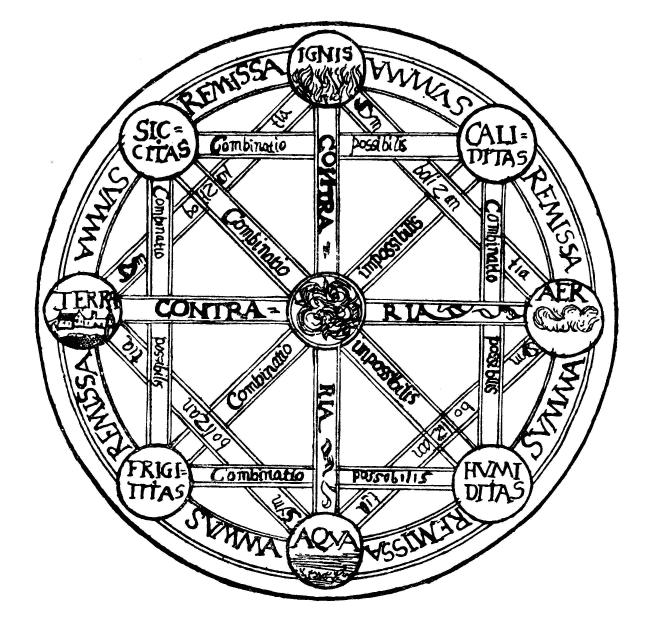
Leibniz representation of universe resulting by combination of Aristotle four elements
Rococo set of personification figurines of the Four Elements, 1760s, Chelsea porcelain

The classical elements typically refer to earth, water, fire, air, and (later) aether which were proposed to explain the nature and complexity of all matter in terms of simpler substances.[1][2] Ancient cultures in Greece, Angola, Tibet, India, and Mali had similar lists which sometimes referred, in local languages, to "air" as "wind", and to "aether" as "space".

The concept of five classical elements in the traditional Meitei religion (Sanamahism)

These different cultures and even individual philosophers had widely varying explanations concerning their attributes and how they related to observable phenomena as well as cosmology. Sometimes these theories overlapped with mythology and were personified in deities. Some of these interpretations included atomism (the idea of very small, indivisible portions of matter), but other interpretations considered the elements to be divisible into infinitely small pieces without changing their nature.

While the classification of the material world among the ancient Indians, Hellenistic Egyptians, and ancient Greeks into air, earth, fire, and water was more philosophical; scientists of the Middle Ages used practical, experimental observation to classify materials.[3] In Europe, the ancient Greek concept, devised by Empedocles, evolved into the systematic classifications of Aristotle and Hippocrates. This evolved slightly into the medieval system,[citation needed] and eventually became the object of experimental verification in the 17th century, at the start of the Scientific Revolution.[4]

Modern science does not support the classical elements to classify types of substances. Atomic theory classifies atoms into more than a hundred chemical elements such as oxygen, iron, and mercury, which may form chemical compounds and mixtures. The modern categories roughly corresponding to the classical elements are the states of matter produced under different temperatures and pressures. Solid, liquid, gas, and plasma share many attributes with the corresponding classical elements of earth, water, air, and fire, but these states describe the similar behaviour of different types of atoms at similar energy levels, not the characteristic behaviour of certain atoms or substances.

Hellenistic philosophy

[edit]

Aristotelian elements and qualities
Four classical elements

Empedoclean elements

🜂    fire  · 🜁 air    
🜄 water  · 🜃 earth

The ancient Greek concept of four basic elements, these being earth (γῆ ), water (ὕδωρ hýdōr), air (ἀήρ aḗr), and fire (πῦρ pŷr), dates from pre-Socratic times and persisted throughout the Middle Ages and into the Early modern period, deeply influencing European thought and culture.[5]

Pre-Socratic elements

[edit]

Primordal element

[edit]
The four classical elements of Empedocles and Aristotle illustrated with a burning log. The log releases all four elements as it is destroyed.

The classical elements were first proposed independently by several early Pre-Socratic philosophers.[6] Greek philosophers had debated which substance was the arche ("first principle"), or primordial element from which everything else was made. Thales (c. 626/623 – c. 548/545 BC) believed that water was this principle. Anaximander (c. 610 – c. 546 BC) argued that the primordial substance was not any of the known substances, but could be transformed into them, and they into each other.[7][5] Anaximenes (c. 586 – c. 526 BC) favoured air, and Heraclitus (fl.c. 500 BC) championed fire.[8]

Fire, earth, air, and water

[edit]

The Greek philosopher Empedocles (c. 450 BC) was the first to propose the four classical elements as a set: fire, earth, air, and water.[9] He called them the four "roots" (ῥιζώματα, rhizōmata). Empedocles also proved (at least to his own satisfaction) that air was a separate substance by observing that a bucket inverted in water did not become filled with water, a pocket of air remaining trapped inside.[10]

Fire, earth, air, and water have become the most popular set of classical elements in modern interpretations. One such version was provided by Robert Boyle in The Sceptical Chymist, which was published in 1661 in the form of a dialogue between five characters. Themistius, the Aristotelian of the party, says:[11]

If You but consider a piece of green-Wood burning in a Chimney, You will readily discern in the disbanded parts of it the four Elements, of which we teach It and other mixt bodies to be compos'd. The fire discovers it self in the flame ... the smoke by ascending to the top of the chimney, and there readily vanishing into air ... manifests to what Element it belongs and gladly returnes. The water ... boyling and hissing at the ends of the burning Wood betrayes it self ... and the ashes by their weight, their firiness, and their dryness, put it past doubt that they belong to the Element of Earth.

Humorism (Hippocrates)

[edit]
An engraving of Hippocrates by Peter Paul Rubens, 1638
Hippocrates

According to Galen, these elements were used by Hippocrates (c. 460 – c. 370 BC) in describing the human body with an association with the four humours: yellow bile (fire), black bile (earth), blood (air), and phlegm (water). Medical care was primarily about helping the patient stay in or return to their own personal natural balanced state.[12]

Plato

[edit]
Head bust of Plato
Plato

Plato (428/423 – 348/347 BC) seems to have been the first to use the term "element (στοιχεῖον, stoicheîon)" in reference to air, fire, earth, and water.[13] The ancient Greek word for element, stoicheion (from stoicheo, "to line up") meant "smallest division (of a sun-dial), a syllable", as the composing unit of an alphabet it could denote a letter and the smallest unit from which a word is formed.

Aristotle

[edit]
Statue at the Aristotle University of Thessaloniki
Aristotle

In On the Heavens (350 BC), Aristotle defines "element" in general:[14][15]

An element, we take it, is a body into which other bodies may be analysed, present in them potentially or in actuality (which of these, is still disputable), and not itself divisible into bodies different in form. That, or something like it, is what all men in every case mean by element.[16]

— Aristotle, On the Heavens, Book III, Chapter III

In his On Generation and Corruption,[17][18] Aristotle related each of the four elements to two of the four sensible qualities:

  • Fire is both hot and dry.
  • Air is both hot and wet (for air is like vapour, ἀτμὶς).
  • Water is both cold and wet.
  • Earth is both cold and dry.

A classic diagram has one square inscribed in the other, with the corners of one being the classical elements, and the corners of the other being the properties. The opposite corner is the opposite of these properties, "hot – cold" and "dry – wet".

Aether

[edit]

Aristotle added a fifth element, aether (αἰθήρ aither), as the quintessence, reasoning that whereas fire, earth, air, and water were earthly and corruptible, since no changes had been perceived in the heavenly regions, the stars cannot be made out of any of the four elements but must be made of a different, unchangeable, heavenly substance.[19] It had previously been believed by pre-Socratics such as Empedocles and Anaxagoras that aether, the name applied to the material of heavenly bodies, was a form of fire. Aristotle himself did not use the term aether for the fifth element, and strongly criticised the pre-Socratics for associating the term with fire. He preferred a number of other terms indicating eternal movement, thus emphasising the evidence for his discovery of a new element.[20] These five elements have been associated since Plato's Timaeus with the five platonic solids. Earth was associated with the cube, air with the octahedron, water with the icosahedron, and fire with the tetrahedron. Of the fifth Platonic solid, the dodecahedron, Plato obscurely remarked, "...the god used [it] for arranging the constellations on the whole heaven". Aristotle added a fifth element, aither (aether in Latin, "ether" in English) and postulated that the heavens were made of this element, but he had no interest in matching it with Plato's fifth solid.[21]

Neo-Platonism

[edit]

The Neoplatonic philosopher Proclus rejected Aristotle's theory relating the elements to the sensible qualities hot, cold, wet, and dry. He maintained that each of the elements has three properties. Fire is sharp (ὀξυτητα), subtle (λεπτομερειαν), and mobile (εὐκινησιαν) while its opposite, earth, is blunt (αμβλυτητα), dense (παχυμερειαν), and immobile (ακινησιαν[22]); they are joined by the intermediate elements, air and water, in the following fashion:[23]

Fire Sharp Subtle Mobile
Air Blunt Subtle Mobile
Water Blunt Dense Mobile
Earth Blunt Dense Immobile

Hermeticism

[edit]

A text written in Egypt in Hellenistic or Roman times called the Kore Kosmou ("Virgin of the World") ascribed to Hermes Trismegistus (associated with the Egyptian god Thoth), names the four elements fire, water, air, and earth. As described in this book:

And Isis answer made: Of living things, my son, some are made friends with fire, and some with water, some with air, and some with earth, and some with two or three of these, and some with all. And, on the contrary, again some are made enemies of fire, and some of water, some of earth, and some of air, and some of two of them, and some of three, and some of all. For instance, son, the locust and all flies flee fire; the eagle and the hawk and all high-flying birds flee water; fish, air and earth; the snake avoids the open air. Whereas snakes and all creeping things love earth; all swimming things love water; winged things, air, of which they are the citizens; while those that fly still higher love the fire and have the habitat near it. Not that some of the animals as well do not love fire; for instance salamanders, for they even have their homes in it. It is because one or another of the elements doth form their bodies' outer envelope. Each soul, accordingly, while it is in its body is weighted and constricted by these four.[24]

Ancient Indian philosophy

[edit]

Hinduism

[edit]

The system of five elements are found in Vedas, especially Ayurveda, the pancha mahabhuta, or "five great elements", of Hinduism are:

  1. bhūmi or pṛthvī (earth),[25]
  2. āpas or jala (water),
  3. agní or tejas (fire),
  4. vāyu, vyāna, or vāta (air or wind)
  5. ākāśa, vyom, or śūnya (space or zero) or (aether or void).[26]

They further suggest that all of creation, including the human body, is made of these five essential elements and that upon death, the human body dissolves into these five elements of nature, thereby balancing the cycle of nature.[27]

The five elements are associated with the five senses, and act as the gross medium for the experience of sensations. The basest element, earth, created using all the other elements, can be perceived by all five senses — (i) hearing, (ii) touch, (iii) sight, (iv) taste, and (v) smell. The next higher element, water, has no odour but can be heard, felt, seen and tasted. Next comes fire, which can be heard, felt and seen. Air can be heard and felt. "Akasha" (aether) is beyond the senses of smell, taste, sight, and touch; it being accessible to the sense of hearing alone.[28][29][30]

Buddhism

[edit]

Buddhism has had a variety of thought about the five elements and their existence and relevance, some of which continue to this day.

In the Pali literature, the mahabhuta ("great elements") or catudhatu ("four elements") are earth, water, fire and air. In early Buddhism, the four elements are a basis for understanding suffering and for liberating oneself from suffering. The earliest Buddhist texts explain that the four primary material elements are solidity, fluidity, temperature, and mobility, characterised as earth, water, fire, and air, respectively.[31]

The Buddha's teaching regarding the four elements is to be understood as the base of all observation of real sensations rather than as a philosophy. The four properties are cohesion (water), solidity or inertia (earth), expansion or vibration (air) and heat or energy content (fire). He promulgated a categorisation of mind and matter as composed of eight types of "kalapas" of which the four elements are primary and a secondary group of four are colour, smell, taste, and nutriment which are derivative from the four primaries.[32][a][33]

Thanissaro Bhikkhu (1997) renders an extract of Shakyamuni Buddha's from Pali into English thus:

Just as a skilled butcher or his apprentice, having killed a cow, would sit at a crossroads cutting it up into pieces, the monk contemplates this very body — however it stands, however it is disposed — in terms of properties: 'In this body there is the earth property, the liquid property, the fire property, & the wind property.'[34]

Tibetan Buddhist medical literature speaks of the pañca mahābhūta (five elements) or "elemental properties":[35] earth, water, fire, wind, and space.[35] The concept was extensively used in traditional Tibetan medicine.[36][37][35] Tibetan Buddhist theology, tantra traditions, and "astrological texts" also spoke of them making up the "environment, [human] bodies," and at the smallest or "subtlest" level of existence, parts of thought and the mind.[35] Also at the subtlest level of existence, the elements exist as "pure natures represented by the five female buddhas", Ākāśadhātviśvarī, Buddhalocanā, Mamakī, Pāṇḍarāvasinī, and Samayatārā, and these pure natures "manifest as the physical properties of earth (solidity), water (fluidity), fire (heat and light), wind (movement and energy), and" the expanse of space.[35] These natures exist as all "qualities" that are in the physical world and take forms in it.[35]

Ancient African philosophy

[edit]

Central Africa

[edit]
The Bakongo Cosmogram

In traditional Bakongo religion, the five elements are incorporated into the Kongo cosmogram. This sacred symbol also depicts the physical world (Nseke), the spiritual world of the ancestors (Mpémba), the Kalûnga line that runs between the two worlds, the circular void that originally formed the two worlds (mbûngi), and the path of the sun. Each element correlates to a period in the life cycle, which the Bakongo people also equate to the four cardinal directions. According to their cosmology, all living things go through this cycle.[38]

  • Aether represents mbûngi, the circular void that begot the universe.
  • Air (South) represents musoni, the period of conception that takes place during spring.
  • Fire (East) represent kala, the period of birth that takes place during summer.
  • Earth (North) represents tukula, the period of maturity that takes place during fall.
  • Water (West) represents luvemba, the period of death that takes place during winter

West Africa

[edit]

In traditional Bambara spirituality, the Supreme God created four additional essences of himself during creation. Together, these five essences of the deity correlate with the five classical elements.[39][40]

  • Koni is the thought and void (aether).
  • Bemba (also called Pemba) is the god of the sky and air.
  • Nyale (also called Koroni Koundyé) is the goddess of fire.
  • Faro is the androgynous god of water.
  • Ndomadyiri is the god and master of the earth.

Post-classical history

[edit]

Alchemy

[edit]
Seventeenth century alchemical emblem showing the four Classical elements in the corners of the image, alongside the tria prima on the central triangle

The elemental system used in medieval alchemy was developed primarily by the anonymous authors of the Arabic works attributed to Pseudo Apollonius of Tyana.[41] This system consisted of the four classical elements of air, earth, fire, and water, in addition to a new theory called the sulphur-mercury theory of metals, which was based on two elements: sulphur, characterising the principle of combustibility, "the stone which burns"; and mercury, characterising the principle of metallic properties. They were seen by early alchemists as idealised expressions of irreducible components of the universe[42] and are of larger consideration within philosophical alchemy.

The three metallic principles—sulphur to flammability or combustion, mercury to volatility and stability, and salt to solidity—became the tria prima of the Swiss alchemist Paracelsus. He reasoned that Aristotle's four element theory appeared in bodies as three principles. Paracelsus saw these principles as fundamental and justified them by recourse to the description of how wood burns in fire. Mercury included the cohesive principle, so that when it left in smoke the wood fell apart. Smoke described the volatility (the mercurial principle), the heat-giving flames described flammability (sulphur), and the remnant ash described solidity (salt).[43]

Chinese

[edit]

Chinese traditional concepts adopt a set of elements called the 五行 (wuxing, literally "five phases"). These five are Metal or Gold (金 Jīn), Wood (木 ), Water (水 Shuǐ), Fire (火 Huǒ), and Earth or Soil (土 ).[44] These can be linked to Taiji, Yinyang, Four Symbols, Bagua, Hexagram and I Ching.

Japanese

[edit]

Japanese traditions use a set of elements called the 五大 (godai, literally "five great"). These five are earth, water, fire, wind/air, and void. These came from Indian Vastu shastra philosophy and Buddhist beliefs; in addition, the classical Chinese elements (五行, wu xing) are also prominent in Japanese culture, especially to the influential Neo-Confucianists during the medieval Edo period.[45]

  • Earth (地 Chi) represented rocks and stability.
  • Water (水 Sui) represented fluidity and adaptability.
  • Fire (火 Ka) represented life and energy.
  • Wind (風 Fuu) represented movement and expansion.
  • Void (空 Kuu) or Sky/Heaven represented spirit and creative energy.

Medieval Aristotelian philosophy

[edit]

The Islamic philosophers al-Kindi, Avicenna and Fakhr al-Din al-Razi followed Aristotle in connecting the four elements with the four natures heat and cold (the active force), and dryness and moisture (the recipients).[46]

Medicine Wheel

[edit]

The medicine wheel symbol is a modern invention attributed to Native American peoples dating to approximately 1972, with the following descriptions and associations being a later addition. The associations with the classical elements are not grounded in traditional Indigenous teachings and the symbol has not been adopted by all Indigenous American nations.[47][48][49][50][51]

  • Earth (South) represents the youth cycle, summer, the Indigenous race, and cedar medicine.
  • Fire (East) represents the birth cycle, spring, the Asian race, and tobacco medicine.
  • Wind/Air (North) represents the elder cycle, winter, the European race, and sweetgrass medicine.
  • Water (West) represents the adulthood cycle, autumn, the African race, and sage medicine.

Modern history

[edit]

Artus Wolffort, The Four Elements, before 1641

Chemical element

[edit]

The Aristotelian tradition and medieval alchemy eventually gave rise to modern chemistry, scientific theories and new taxonomies. By the time of Antoine Lavoisier, for example, a list of elements would no longer refer to classical elements.[52] Some modern scientists see a parallel between the classical elements and the four states of matter: solid, liquid, gas and weakly ionized plasma.[53]

Modern science recognises classes of elementary particles which have no substructure (or rather, particles that are not made of other particles) and composite particles having substructure (particles made of other particles).

Western astrology

[edit]

🜂
Fire
🜁
Air
🜄
Water
🜃
Earth
The four elements and commonly associated colours

Western astrology uses the four classical elements in connection with astrological charts and horoscopes. The twelve signs of the zodiac are divided into the four elements: Fire signs are Aries, Leo and Sagittarius, Earth signs are Taurus, Virgo and Capricorn, Air signs are Gemini, Libra and Aquarius, and Water signs are Cancer, Scorpio, and Pisces.[54]

Criticism

[edit]

The Dutch historian of science Eduard Jan Dijksterhuis writes that the theory of the classical elements "was bound to exercise a really harmful influence. As is now clear, Aristotle, by adopting this theory as the basis of his interpretation of nature and by never losing faith in it, took a course which promised few opportunities and many dangers for science."[55] Bertrand Russell says that Aristotle's thinking became imbued with almost biblical authority in later centuries. So much so that "Ever since the beginning of the seventeenth century, almost every serious intellectual advance has had to begin with an attack on some Aristotelian doctrine".[56]

See also

[edit]

Notes

[edit]

References

[edit]
[edit]
Revisions and contributorsEdit on WikipediaRead on Wikipedia
from Grokipedia
In ancient Greek philosophy, the classical elements refer to the foundational substances believed to constitute all matter and natural phenomena, primarily comprising earth, water, air, and fire, with a fifth element, aether, sometimes included for celestial bodies. This concept originated with the pre-Socratic philosopher Empedocles in the 5th century BCE, who described these as eternal "roots" (rhizomata) that mix and separate under the opposing cosmic forces of Love (philia), which unites them, and Strife (neikos), which divides them, thereby explaining the creation, change, and cycles of the universe without positing ultimate destruction. Empedocles' theory marked a shift from earlier elemental ideas, such as those of earlier thinkers like Thales (who emphasized water) or Anaximenes (air), by establishing a pluralistic framework of four indestructible elements as the basis for all composite bodies, including living organisms and cosmic structures. Aristotle, in the 4th century BCE, refined and systematized this doctrine in works like On Generation and Corruption and On the Heavens, portraying the four sublunary elements not as static particles but as transformable forms arising from a prime matter imbued with two pairs of primary qualities: hot/cold and dry/moist. Thus, fire is hot and dry, air hot and moist, water cold and moist, and earth cold and dry; natural change occurs through the alteration of these qualities, allowing elements to convert into one another in a continuous cycle, such as fire turning to air by acquiring moisture while retaining heat. Aristotle critiqued Empedocles' view of elements as unchanging aggregates, instead emphasizing their role as "originative sources" for the generation and corruption of perceptible bodies, while introducing aether as an incorruptible fifth element composed of a unique fifth quality, enabling the eternal, uniform circular motion of the heavens and stars, distinct from the rectilinear motions of the earthly elements. Plato, in his Timaeus, also engaged with the four elements, associating them with geometric solids—tetrahedron for fire, octahedron for air, icosahedron for water, and cube for earth—further integrating them into a cosmological model where they derive from an ideal realm of forms. These elemental theories profoundly influenced subsequent Western thought, extending beyond into (e.g., Hippocratic humoral linking elements to bodily fluids), , , and early science, where they symbolized balance, transformation, and the interconnectedness of the until challenged by modern atomic theory. The classical elements thus encapsulate a perennial quest to understand the material world's unity and diversity through simple, observable principles.

Overview

Core Concept

In ancient philosophies, the classical elements are defined as the archetypal substances—earth, water, air, fire, and sometimes a fifth element known as aether—that constitute the fundamental principles of the universe, embodying states of , inherent qualities, or cosmic forces underlying all natural phenomena. These elements were conceived not as discrete particles but as eternal, indivisible from which the diversity of the world arises through combination and transformation. Each classical element possesses distinct qualitative attributes that define its essential character and interactions: earth is solid, cold, and dry, representing stability and inertia; water is liquid, cold, and wet, symbolizing cohesion and fluidity; air is gaseous, hot, and wet, embodying motion and adaptability; and fire is energetic, hot, and dry, denoting expansion and transformation. Aether, when included, is often regarded as a pure, subtle substance filling the heavens, beyond the tangible qualities of the other four. These properties emphasize sensory and perceptual experiences rather than measurable quantities, serving as a framework for understanding balance and change in nature. The classical elements differ fundamentally from modern chemical elements, which are empirical entities identified through , , and laboratory isolation, numbering over 100 distinct substances. In contrast, the classical system is philosophical and metaphysical, prioritizing symbolic representations of universal principles over verifiable composition or reactivity. The English term "element" originates from the Greek stoicheion (στοιχεῖον), which initially denoted a letter of the or a basic unit in a sequential arrangement, evolving to signify the irreducible foundational components of in philosophical .

Historical Significance

The concept of classical elements evolved from mythological explanations of the natural world to systematic philosophical frameworks around the 5th century BCE, marking a pivotal shift toward rational inquiry into the composition of reality. In ancient societies, these elements—earth, water, air, fire, and later aether—served as foundational building blocks for cosmology, positing a structured universe governed by material principles rather than divine whims alone. This framework influenced metaphysics by exploring the nature of being and change through elemental interactions, while in ethics, elements symbolized human qualities such as stability (earth) or passion (fire), guiding moral and temperamental balances in social conduct. In medicine, the classical elements profoundly shaped humoral theory, which dominated Western practice for over two millennia until the . Originating in the 5th-4th centuries BCE, this theory linked health to the equilibrium of four bodily fluids—blood (air), phlegm (water), yellow bile (fire), and black bile (earth)—with imbalances causing disease through environmental or lifestyle disruptions. Treatments emphasized restoring harmony via diet, exercise, or evacuation, prioritizing empirical observation over supernatural causes and laying groundwork for patient-centered diagnostics. The elements provided a for and , extending their influence into predictive and transformative practices from antiquity through the . In , elements associated with zodiac signs and planetary forces to interpret human affairs and cosmic events, integrating with earthly phenomena. adopted elemental transmutations as metaphors for spiritual purification and material conversion, such as lead to , fostering early experimental methods that bridged and proto-science until the . Symbolically, classical elements permeated and , representing natural forces, emotions, and human temperaments across cultures. In , such as Shakespeare's works, humoral imbalances drawn from elemental qualities depicted character psyches—e.g., choleric fueling in —enriching dramatic explorations of personality and conflict. This enduring symbolism extended to , where elements evoked cosmic order and seasonal cycles, influencing thematic depth in and well into .

Ancient Western Traditions

Pre-Socratic Greek Philosophy

The Pre-Socratic philosophers, active primarily in the 6th and 5th centuries BCE, sought to identify the fundamental substance or principle (arche) underlying the , laying the groundwork for later elemental theories by proposing monistic views of a single primordial material from which all things derive. These early Ionian thinkers shifted from mythological explanations to rational inquiries into nature's composition, often positing an infinite, divine substance that undergoes transformation to produce the diversity of the world. Their ideas, preserved through fragments and later accounts by and others, emphasized processes like and rather than discrete elements, influencing the eventual pluralistic framework of four classical elements. Thales of Miletus, traditionally regarded as the first Greek philosopher around 585 BCE, proposed water as the arche, the originating and sustaining substance of all matter. He observed that moisture is essential for life and that the Earth floats on water like a disk, suggesting water's role in generating earth, air, and other forms through evaporation and precipitation. Thales' view integrated natural processes, such as the Nile's flooding, to argue for water's primacy, marking a departure from anthropomorphic gods toward a materialist cosmology. Building on Thales, Anaximenes of Miletus (c. 546 BCE) identified air as the infinite arche, a boundless and eternal substance that transforms into other materials through rarefaction (becoming fire) and condensation (forming wind, clouds, water, earth, and stones). This mechanic-like process allowed air to explain the cosmos's unity and change without invoking separate origins, portraying the soul and divine breath (pneuma) as manifestations of the same airy principle. Anaximenes' theory provided a more dynamic model than Thales', emphasizing quantitative alterations in density to account for qualitative differences in nature. Heraclitus of Ephesus (c. 500 BCE) elevated as the arche, symbolizing constant flux and the underlying , or rational order governing transformation. He described as kindling itself through measure and extinguishing itself through measure, with all things exchanging for like for goods, underscoring a world in perpetual strife and unity where opposites coexist. Unlike the static infinity of air or water, Heraclitus' embodied and becoming, asserting that "this world-order is the same of all, neither created nor destroyed, but ever was, is, and will be, an ever-living ." Xenophanes of Colophon (c. 570–478 BCE) critiqued anthropomorphic while proposing a mixture of as the fundamental substances, evidenced by fossils in quarries and the sea's role in depositing sediments that form land. He viewed the as rooted in and gradually dissolving back into it, with living beings arising from a moistening of earth by sun and rain, offering a cyclical, dual-substance model that avoided monism's extremes. This perspective influenced later pluralists by highlighting composite origins over singular primacy. These monistic and early dualistic theories gradually gave way to pluralistic conceptions in the 5th century BCE, culminating in of Acragas (c. 494–434 BCE), who introduced four eternal "roots" — , air, fire, and water — as indestructible building blocks of reality, combined and separated by the opposing forces of (attraction and unity) and Strife (separation and conflict). rejected generation and destruction, insisting these roots mix in varying proportions to form all compounds, such as from equal parts of the four, driven by cosmic cycles where periodically unifies the sphere and Strife disperses it into chaos. This system resolved the monists' challenges in explaining change while preserving multiplicity, establishing the foundational four-element schema for subsequent Greek philosophy.

Platonic and Aristotelian Systems

In Plato's dialogue Timaeus, composed around 360 BCE, the classical elements are conceptualized as geometric forms derived from fundamental triangles, forming the basis of the physical world's composition. The four elements correspond to specific Platonic solids: to the , with its sharp edges symbolizing sharpness and ; to the , representing stability; air to the , embodying lightness; and to the , approximating a for fluidity. These solids are constructed from two types of right-angled triangles—the isosceles and the half-equilateral—allowing for the transformation of elements by rearranging their triangular components, such as multiple tetrahedra combining into an to convert into air. further posits a fifth element, the , associated with the and the divine, inscribed with "the whole in a manner" to encompass the universe's order. Aristotle, in his treatise On Generation and Corruption (circa 350 BCE), refined this elemental theory by defining the four elements—earth, water, air, and fire—not through geometry but via pairs of primary qualities: hot and cold, wet and dry. Earth is cold and dry, water cold and wet, air hot and wet, and fire hot and dry; elemental change occurs through the alteration of these qualities rather than the recombination of particles, enabling natural processes like evaporation (water to air by adding heat) without requiring transmutation of substance. This qualitative framework explains generation and corruption in the sublunary realm, where elements mix to form compounds and revert through opposed qualities. Central to Aristotle's cosmology is the introduction of aether as the fifth element, distinct from the terrestrial four, described as eternal, unchangeable, and the material of the . Unlike the sublunary elements, which move naturally toward their places ( downward, upward), aether possesses only , filling the heavens beyond the and ensuring the uniform, perpetual rotation of stars and . This establishes a hierarchical : the changeable, elemental world below the lunar sphere contrasts with the incorruptible, aetherial superlunary realm, influencing later astronomical models.

Hellenistic Extensions

In the Hellenistic period, the classical elements were integrated into medical theory through Hippocratic humorism, a framework developed in the 5th and 4th centuries BCE within the Hippocratic Corpus. This system posited that the human body was composed of four humors—blood, phlegm, yellow bile, and black bile—each corresponding to one of the four elements and associated with specific seasons to maintain health through balance. Blood, linked to air and spring, represented a hot and moist temperament; phlegm, tied to water and winter, embodied cold and moist qualities; yellow bile, associated with fire and summer, signified hot and dry attributes; and black bile, connected to earth and autumn, indicated cold and dry properties. Imbalances among these humors, influenced by seasonal changes or diet, were believed to cause disease, with treatments aimed at restoring equilibrium via purgatives, diet, or environmental adjustments. Stoic philosophy, emerging in the late 4th century BCE with and developed through the Hellenistic era, reinterpreted the elements in terms of active and passive principles to explain the cosmos's rational order. Fire and air were classified as active elements, embodying the dynamic, rational force of —a fiery breath or vital spirit that permeates all matter and animates the universe as the vehicle of divine reason (). In contrast, earth and water served as passive elements, providing the inert substrate shaped by into coherent bodies, from simple mixtures to complex organisms. This dualism underscored Stoic materialism, where the active principle unifies and differentiates the passive, ensuring cosmic harmony without invoking separate supernatural entities. Neo-Platonism, founded by Plotinus in the 3rd century CE, positioned the classical elements as the lowest manifestations in a hierarchical emanation from the One, the ultimate transcendent source of all reality. The sensible world, including earth, water, air, and fire, arises indirectly through successive hypostases: the One overflows into the Intellect (Nous), which generates the Soul, and the World Soul in turn produces the material realm where elements form as soulless bodies requiring animation by soul for vitality. These elements represent multiplicity and change, far removed from the unity of higher realms, with fire holding a superior position as the subtlest and most ideal among them. Aether, the fifth element, served as a divine intermediary composing the eternal heavenly bodies, distinguishing the incorruptible celestial sphere from the mutable terrestrial elements and bridging the sensible and intelligible orders. Hermeticism, flourishing in the 2nd and 3rd centuries CE, synthesized Greek philosophical concepts with Egyptian mysticism in texts like the , portraying the elements as instruments for spiritual ascent toward divine unity. In the (Treatise I), Poimandres, the Divine Mind, reveals to Hermes the process of creation: a boundless light descends as the , igniting fire that rises, followed by air from a watery substance born of shadow and darkness, with earth and water solidifying below to form the . This material world serves as a realm for the soul's descent into matter and subsequent ascent, guided by Nous, by relinquishing the powers and vices associated with planetary spheres during purification. This ascent, guided by Nous (divine mind), transforms the practitioner from bodily entanglement to reunion with the All, blending Platonic emanation and Stoic cosmology with Egyptian notions of Thoth-Hermes as revealer of hidden wisdom. The elements thus function not merely as physical constituents but as symbolic stages in , enabling the soul's purification and return to the divine source.

Ancient Eastern Traditions

Indian Philosophies

In ancient Indian philosophies, the concept of the five great elements, known as Pancha Mahabhuta, forms a foundational framework for understanding the composition of the universe, matter, and human experience. These elements— (ether or space), (air), (fire), Ap or Jala (water), and (earth)—are regarded as the primary building blocks from which all physical phenomena arise, each associated with specific sensory perceptions: sound for , touch for , sight for , taste for Ap, and smell for . This system posits that the gross material world emerges from these subtle essences, influencing not only cosmology but also and across various traditions. The origins of the Pancha Mahabhuta trace back to Vedic literature around 1500 BCE, with early allusions in the to the elemental forces as integral to cosmic creation and natural order. The concept evolved more systematically in the (c. 800–200 BCE), where these elements are described as subtle essences (sukshma bhutas) that underpin the manifest world and human senses, as elaborated in texts like the , which links them to the process of creation from a singular . In these philosophical developments, the elements are not merely physical but represent interconnected principles of existence, emphasizing their role in the cycle of formation and dissolution. In Samkhya philosophy, one of the six orthodox schools of Indian thought, the Pancha Mahabhuta are viewed as manifestations of the tamas-guna (the principle of inertia and stability) within prakriti (primordial nature). These gross elements evolve sequentially from the five tanmatras (subtle potentials or rudimentary sensory qualities): shabda tanmatra (sound) produces Akasha, sparsha tanmatra (touch) produces Vayu, rupa tanmatra (form) produces Agni, rasa tanmatra (taste) produces Ap, and gandha tanmatra (smell) produces Prithvi. This evolutionary process, detailed in foundational texts like the Samkhya Karika attributed to Ishvara Krishna (c. 4th century CE), underscores a dualistic ontology where the elements serve as the material counterparts to consciousness (purusha), facilitating the perception of the world without implying eternal substances. The Pancha Mahabhuta integrate deeply into , the traditional Indian system of medicine, where they form the basis for the three doshas (bio-energetic principles) that govern bodily functions and health. primarily derives from and , embodying movement and lightness; from and Ap, representing transformation and metabolism; and Kapha dosha from Ap and Prithvi, signifying structure and cohesion. As outlined in classical Ayurvedic compendia like the (c. 2nd century BCE–2nd century CE), imbalances in these elemental combinations disrupt physiological harmony, guiding diagnostic and therapeutic practices to restore equilibrium through diet, herbs, and lifestyle. This elemental framework thus provides a holistic model for understanding individual constitution (prakriti) and disease etiology. Buddhist philosophy, emerging around the 5th century BCE, adapts the Mahabhuta concept in its traditions, particularly in schools, as four impermanent aggregates—earth (solidity), water (cohesion), fire (temperature), and air (motion)—that constitute physical form (rupa) without including as a substantive element. These elements are analyzed in texts like the Abhidhammattha Sangaha (c. 8th–12th century CE) as transient dharmas (phenomena) arising dependently, rejecting any notion of eternal or independent substances in favor of a doctrine of (shunyata) and interdependence. This perspective supports meditative practices, such as contemplation of the elements, to cultivate into the non-self (anatta) and the conditioned nature of existence.

Chinese Wu Xing System

The Wu Xing, or Five Phases, system in ancient conceptualizes , , , metal, and not as static material elements but as dynamic phases representing processes of transformation and change in the natural world and human affairs. Emerging during the (c. 403–221 BCE), this framework was systematized by the philosopher (c. 305–240 BCE) of the Yin-Yang School at the Jixia Academy in the state of . Zou Yan integrated the phases with yin-yang dualism to explain cosmic cycles, historical patterns, and the interdependence of phenomena, emphasizing their role in rather than fixed substances. Central to the Wu Xing are two interactive cycles that maintain balance in the : the generating cycle (sheng), where each phase nurtures the next—wood produces (as fuel), produces earth (as ash), earth produces metal (as ore), metal produces (as condensation), and produces wood (as nourishment)—and the overcoming cycle (ke), where each phase controls another to prevent dominance—wood parts earth, earth absorbs , extinguishes , melts metal, and metal cuts wood. These cycles illustrate a holistic cosmology where arises from mutual support and restraint, influencing seasonal changes, planetary movements, and . The system found early application in through the (Yellow Emperor's Inner Canon, c. BCE), which links the phases to human physiology: to the liver and (growth and flexibility), to the heart and (circulation and warmth), to the and (digestion and stability), metal to the lungs and (respiration and refinement), and to the kidneys and (storage and fluid balance). In , practitioners use these correspondences to stimulate meridians and restore flow, treating imbalances such as excessive "" causing inflammation. Beyond , Wu Xing informed (), where phases guide spatial arrangements to harmonize environmental energies, such as aligning structures with directional correspondences (e.g., in the north for prosperity). In imperial rituals, rulers invoked the phases to legitimize dynasties via the "Theory of Five Virtues," associating each regime with a phase's cycle—e.g., the claimed succession from Qin's "" phase—ensuring cosmic and political harmony through rituals like sacrifices and color symbolism. Unlike the Greek classical elements, which emphasize static substances as building blocks of matter, the Wu Xing framework is inherently process-oriented, focusing on qualitative transformations and relational dynamics to model change and equilibrium in the universe. This distinction highlights Wu Xing's emphasis on cyclical evolution over material permanence.

Japanese Adaptations

The Japanese adaptation of classical elemental concepts drew heavily from Chinese Wu Xing through the transmission of and Taoist cosmology, integrating these with indigenous animism to form distinct systems like Godai and . This syncretism began in the 6th-7th centuries with the arrival of Chinese influences via Korea, but flourished in the 8th century through esoteric , particularly Shingon, founded by (774–835 CE) after his studies in Tang . Kūkai's teachings, derived from sutras like the Mahāvairocana Sūtra, framed the elements as constituents of the cosmic body of Dainichi Nyorai, the central Buddha, emphasizing their interpenetration and role in enlightenment. Central to this adaptation is the Godai (five great elements) system, which posits (chi, stability and solidity), (sui, fluidity and cohesion), (ka, expansion and transformation), wind/air (fu, movement and diffusion), and void (ku, and potentiality). Transmitted via Buddhist channels around the , Godai served as a philosophical foundation in Shingon and traditions, symbolizing the building blocks of reality and the path to realizing non-duality. In Shinto contexts, these elements aligned with (spirits) and natural forces, fostering rituals that harmonized human activity with the . Unlike the generative and conquest cycles of Wu Xing, Godai prioritizes holistic interdependence, with void (ku) embodying Buddhist —emptiness as the ground of all phenomena—rather than a material phase like metal. This substitution reflects Japan's deeper infusion of Mahāyāna Buddhist metaphysics, diminishing emphasis on metallic rigidity in favor of transcendent spaciousness. Onmyōdō (the way of ), active from the 7th to 19th centuries, represented a more practical adaptation of Wu Xing, institutionalizing its five phases (earth, water, fire, wood, metal) within Japan's bureaucratic and esoteric frameworks. Formalized under the legal codes by the 10th century and overseen by clans like the Abe and Kamo, Onmyōdō employed elemental correspondences for state functions, including through (tenmon) and oracle methods (bokusen) to predict auspicious timings. Calendrical science (rekidō) used Wu Xing to align imperial rituals with cosmic rhythms, while directional taboos (kataimi) guided and , such as orienting buildings to mitigate elemental imbalances akin to . Though rooted in Chinese , Onmyōdō evolved uniquely by incorporating deities and Buddhist mantras, creating a syncretic divinatory art that influenced court life until its suppression in the . These elemental systems permeated Japanese culture, notably in martial arts where Godai informed strategic postures and adaptability. For instance, Miyamoto Musashi's Gorin no Sho (, ca. 1645) structures its five scrolls around the elements—earth for foundational principles, for fluid techniques, fire for combative intensity, wind for tactical analysis, and void for intuitive mastery—drawing on to teach holistic strategy beyond rigid forms. In festivals, elemental symbolism underscored seasonal transitions, as seen in the five seasonal observances (Gosekku), which invoked Wu Xing-like cycles to mark changes: the spring Doll's Festival () evoking wood's growth, summer's Boys' Day () with fire's vigor through koi streamers, and autumn's Moon Viewing () honoring 's harvest, blending calendrics with reverence for nature's elemental flux.

Other Ancient Traditions

African Elemental Frameworks

In Central African traditions, particularly among Bantu-speaking peoples such as the Kongo, elemental frameworks are embedded in cosmological diagrams known as the yowa or dikenga, which represent the cyclical of existence through four directional elements: air (musoni, associated with the east and dawn/conception), (kala, linked to the south and midday/birth), (tukula, tied to the west and afternoon/maturity), and (luvemba, connected to the north and night/death). These elements are not merely physical substances but manifestations of the vital force called mpungu, the supreme creative energy emanating from Nzambi Mpungu, the high , which animates creation myths where the emerges from a primordial void filled by and to form the . totems, often animals or natural symbols aligned with these elements, serve as ancestral guardians that reinforce social structures and ritual practices, ensuring harmony between human lineages and cosmic forces in Kongo society. In West African Yoruba traditions, concepts are personified through s, divine spirits integral to the system, which maintains dynamic balance among natural forces for personal and communal well-being. , the of thunder, , and , embodies virility and justice, wielding elemental power to punish imbalance and restore order through rituals involving drums and red offerings. , governing rivers, fresh waters, and , represents sweetness and emotional flow, consulted in for healing and prosperity via honey and brass symbols that invoke watery harmony. These interact in a relational network, where by babalawos interprets their elemental influences to guide sacrifices and avert cosmic disequilibrium. Among the Dogon people of Mali, elemental frameworks center on water as the primordial medium from which creation unfolds, tied to the Nommo—amphibious ancestral spirits. In Dogon cosmogony, Amma, the creator god, forms the world from a vibrating cosmic egg immersed in watery chaos, with subsequent elements like fire (symbolizing transformative energy), air (as expansive breath), and earth (as structured solidity) emerging to organize the universe. The Nommo, fish-like beings who sacrifice themselves to fertilize the earth with water, embody these elements as life-sustaining forces, ritually reenacted in sigui ceremonies to align human society with cosmic cycles. Across these African frameworks, elements function less as abstract substances and more as living ancestral spirits or potent forces that mediate between the visible world and the divine, emphasizing relational vitality over static categories. This animistic perspective is preserved through oral transmission by griots in West and , who recite cosmogonic narratives, praise songs, and totemic genealogies to invoke elemental harmony and ancestral guidance in community rituals.

Indigenous American Perspectives

In Indigenous American traditions, particularly among Plains tribes, the Medicine Wheel serves as a foundational holistic framework representing the interconnectedness of life, health, and the natural world. This circular symbol, constructed physically from stones in pre-contact archaeological sites across the northern Plains, embodies balance and cycles such as the seasons, stages of life, and directions. The four cardinal directions are associated with specific elements: west with water, symbolizing introspection and purification; north with air, representing endurance and clarity; east with fire, denoting enlightenment and renewal; and south with earth, signifying growth and abundance. These elements are arranged in a non-hierarchical circle to promote healing, where harmony among them reflects overall well-being. Variations in the exist across tribes, adapting to local cosmologies while maintaining relational principles. Among the Lakota, a Plains people, the framework expands to seven directions by incorporating above (Father Sky, for spiritual vision), below (Mother Earth, for grounding), and the center (self or all creation), emphasizing a multidimensional balance beyond the four primary directions. Each direction links to animals as messengers—such as the eagle for the east and buffalo for the north—and colors, like red for the north and black for the west, fostering teachings on interconnected responsibilities. In cosmology of the Southwest, the of emergence similarly integrate elemental guardians; successive worlds align with (stability in the first), water (fluidity in the second), (transformation in the third), and air (ethereal balance in the fourth current world), overseen by figures like Maasaw as earth's caretaker to guide harmonious migration and renewal. These elemental views underscore a relational cosmology, where elements are not isolated forces but interwoven with living beings, colors, and natural phenomena to sustain ecological and spiritual equilibrium. For instance, in Plains traditions, the elements connect to animal clans and seasonal shifts, teaching that disruption in one affects the whole, prioritizing collective harmony over individual dominance. Oral histories reinforce this through creation narratives, such as the Navajo , which recounts through four underworlds into the present Glittering World, where elemental forces like wind, rain, and earth must align in hózhǫ́—beauty and balance—to enable human flourishing and prevent chaos. This emphasis on relational harmony, evident in stories of ancestral beings achieving unity amid discord, guides ethical living and ceremonial practices across diverse Indigenous American contexts.

Post-Classical Developments

Alchemical Transformations

In Greco-Egyptian alchemy, (c. 300 CE) laid foundational interpretations of classical elements as components of , viewing them as the raw substrate for transmutative processes that blended material and spiritual dimensions. He conceptualized , often identified as black lead, as a base reduced to its essential form through operations like extraction of volatile (spirit) from fixed bodies, enabling the transmutation of metals by altering their qualities and colors. This approach reinterpreted the four Aristotelian elements—earth, air, fire, and water—not merely as static building blocks but as dynamic forces involved in the liberation of divine sparks trapped in matter, influenced by Gnostic dualism where elements were tied to cosmic fate. During the , (c. 8th century) advanced alchemical theory by integrating classical elements with a sulfur-mercury framework, positing that all metals arise from the union of (representing combustibility and dryness, akin to fire and earth qualities) and mercury (representing volatility and fusibility, akin to air and water qualities). This sulfur-mercury theory derived from Aristotelian elemental qualities—hot, cold, wet, dry—serving as the basis for balancing proportions to achieve transmutation toward gold or the , a universal solvent and capable of rejuvenation and immortality. 's emphasis on experimental manipulation of these principles to harmonize elemental opposites marked a shift toward systematic aimed at both material perfection and philosophical insight into nature's balances. In 16th-century European , (1493–1541) further transformed classical elements into the tria prima— (fire, soul, combustibility), mercury (air and water, spirit, volatility), and salt (earth, body, fixity)—as spagyric principles essential for iatrochemistry, the application of alchemical processes to medicine. Spagyria involved separating these principles from substances through dissolution and distillation, purifying them individually, and recombining them to create potent remedies that restored elemental harmony in the body, rejecting Galenic humors in favor of chemical extraction for treating diseases as imbalances of these primes. This method positioned the elements not as inert but as active agents in therapeutic transmutation, influencing the transition from mystical to empirical . Alchemical operations symbolized elemental transformations as stages of both physical and spiritual purification, with each process invoking a classical element to enact change in the . Calcination, governed by , reduced substances to through intense , symbolizing the destruction of ego or impurities to reveal essential truths. Dissolution followed with , dissolving the calcined remains into a state to integrate opposites and foster emotional release or of rigid forms. Separation, often linked to air, involved to isolate pure essences from mixtures, clarifying volatile from fixed components. Conjunction united these under earth-like , forming a new compound as the or philosophical , representing balanced elemental reunion. These stages, culminating in and exaltation, mirrored the cyclical interplay of elements in achieving the , a for inner enlightenment through material analogy.

Medieval Scholasticism

In the 11th and 12th centuries, Islamic philosophers such as (Ibn Sina) and (Ibn Rushd) played a pivotal role in refining and preserving Aristotelian theories of the classical elements, which were then transmitted to through Latin translations, particularly in centers like Toledo and . , in works like his Shifa (), elaborated on Aristotle's elemental theory by integrating it with Neoplatonic and Islamic cosmological principles, emphasizing the elements' qualities (hot, cold, wet, dry) as active principles derived from a single celestial influence, while refining the concept of elemental mixture to avoid mere juxtaposition. , as a commentator on Aristotle's De Caelo (), critiqued and clarified the sublunary elements' corruptibility and natural motions, arguing for their subordination to the eternal celestial realm, which helped resolve perceived inconsistencies in Aristotle's physics. These refinements were disseminated via translations by figures like Gerard of Cremona around 1150–1180, enabling European scholastics to access a more systematic Aristotelian corpus. By the 13th century, Aristotelian elemental theory was integrated into Christian medieval philosophy and incorporated into university curricula as part of natural philosophy, often studied alongside the quadrivium's astronomical components. In texts like Aristotle's De Caelo, the four elements (earth, water, air, fire) were examined for their rectilinear motions and qualitative changes, influencing fields such as optics—where elemental transparency and refraction were analyzed—and meteorology, which explained atmospheric phenomena through elemental interactions. This adoption occurred in arts faculties at universities like Paris and Oxford, where Aristotle's natural works formed the core of the scientia naturalis curriculum from the 1250s onward, subordinated to theological oversight to align with Christian doctrine. Thomas Aquinas (1225–1274) synthesized these ideas in his , portraying the classical elements as hylomorphic compounds—unified substances of prime (potentiality) and (actuality)—that serve as building blocks of the created world but remain entirely subordinate to divine creation and providence. In I, q. 66–71, Aquinas describes the elements' formation on the third day of creation as direct acts of , not eternal or self-subsistent, with their potentialities actualized through divine will rather than independent necessity. This hylomorphic framework emphasized the elements' role in composite beings, such as the composed of the four elements in balanced mixture ( I, q. 91, a. 3), while rejecting any pantheistic implications by affirming God's transcendence over elemental . Medieval scholastics engaged in debates over the corruptibility of the sublunary elements versus the eternity of the celestial aether in the Ptolemaic-Aristotelian system, reconciling these with . Drawing from De Caelo, thinkers like Aquinas argued that the elements are inherently corruptible due to their contrariety and natural decay, contrasting with the incorruptible, eternal aether of the heavens, which moves in perfect circles ( I, q. 68, a. 4). However, figures such as challenged this by positing a "double truth" (philosophical vs. theological), prompting condemnations in 1277 at that affirmed the potential corruptibility of all creation, including celestial bodies, under God's omnipotence. These discussions highlighted tensions between Aristotelian cosmology and biblical renewal of the cosmos, ultimately reinforcing the elements' contingency.

Renaissance Revivals

During the , the classical elements experienced a significant revival through humanistic and lenses, particularly in the works of Florentine scholars who sought to harmonize with contemporary intellectual pursuits. , founder of the in around 1462 under the patronage of , played a pivotal role in this resurgence by translating and commenting on Plato's Timaeus, which posits the elements as fundamental building blocks of the cosmos ordered by divine reason. In his commentary on Plato's Timaeus and treatises like De triplici vita (1489), Ficino integrated the four elements—earth, water, air, and fire—into a concept of harmonia mundi, envisioning the universe as a musical where elemental qualities corresponded to planetary influences and astrological forces. This framework extended to practical applications, such as , where Ficino prescribed melodies attuned to specific elements to restore bodily and spiritual equilibrium, linking elemental imbalances to astrological disruptions. Heinrich Cornelius Agrippa's , published in 1533, further syncretized classical elements with ism, presenting them as vehicles for magical operations. Agrippa structured his treatise into natural, celestial, and divine magic, with Book I detailing the elements as carriers of virtues that could be harnessed through correspondences with spirits, planets, and talismans. For instance, he associated with intellectual illumination and salamanders as its elemental spirits, advising practitioners to inscribe talismans during favorable astrological alignments to invoke these forces for healing or . This work drew on Ficino's while expanding it into a comprehensive system, influencing later esoteric traditions by emphasizing the elements' role in bridging the material and spiritual realms. Giordano Bruno, in the late 16th century, advanced this revival through his hermetic cosmology, which transcended traditional Aristotelian boundaries by extending the classical elements across an infinite universe. In dialogues like De l'infinito, universo e mondi (1584), Bruno argued that the elements were not confined to the but permeated all worlds, manifesting in endless variations and supporting his vision of a homogeneous, divine cosmos without hierarchical divisions. This pantheistic extension portrayed the elements as active principles of God's , challenging geocentric models and inspiring a more dynamic understanding of nature. The Renaissance revival of classical elements also permeated artistic and scientific endeavors, as seen in Leonardo da Vinci's interdisciplinary studies during the late 15th and early 16th centuries. Leonardo explored the elements in his anatomical drawings and engineering designs, viewing the human body as a microcosm governed by elemental forces; for example, he dissected cadavers to trace how air (breath) and water (fluids) interacted with earth (solids) and fire (vital heat) in physiological processes. In engineering, he applied these principles to inventions like hydraulic machines, where water and air dynamics mimicked elemental flows to achieve mechanical harmony, as detailed in his notebooks. Such integrations exemplified the era's humanistic synthesis, blending occult philosophy with empirical observation to elevate the elements from abstract concepts to tools for innovation.

Modern Interpretations

Scientific Correlations

In Robert Boyle's 1661 work , he critiqued the traditional Aristotelian doctrine of the four classical elements—earth, water, air, and fire—as inadequate for explaining and transformations. Boyle argued that these elements were not fundamental principles but rather complex mixtures, and he advocated instead for a corpuscular theory positing that matter consists of minute, indivisible particles varying in shape, size, and motion to account for observed properties. This shift marked a pivotal move toward empirical investigation in chemistry, laying groundwork for modern atomic theory by emphasizing experimentation over qualitative elemental assumptions. Building on such critiques, Antoine Lavoisier in 1789 introduced a systematic nomenclature in his Traité Élémentaire de Chimie, listing 33 substances as simple elements and replacing the qualitative classical elements with quantifiable chemical ones. Lavoisier's framework demoted earth, water, air, and fire from elemental status to compounds or principles, while elevating newly identified substances like oxygen, which he named for its role in acidification and combustion. Notably, Lavoisier drew an analogy between oxygen and the classical element of fire, viewing it as the active principle underlying combustion and respiration, thereby bridging ancient notions with emerging quantitative chemistry. This nomenclature standardized chemical terminology and facilitated the transition from alchemical speculation to precise elemental analysis. Dmitri Mendeleev's 1869 periodic table represented an indirect legacy of classical elemental thinking by organizing the known chemical elements into groups based on recurring properties, such as reactivity and physical state, which echoed qualitative distinctions like the solidity of "." For instance, the table's placement of metals in specific columns highlighted their shared metallic luster and conductivity, reminiscent of the classical earth's association with durable, terrestrial substances, though Mendeleev's system was grounded in atomic weights and valency rather than philosophical qualities. This arrangement predicted undiscovered elements and their properties, solidifying the periodic law as a cornerstone of chemistry and further distancing from the four-element paradigm. In 19th-century physics, investigations into electromagnetic phenomena included studies of electrical discharges in rarefied gases, such as William Crookes' work on cathode rays in the 1870s, which revealed glowing, ionized gases. These observations contributed to the later concept of plasma as a fourth state of matter beyond solid, liquid, and gas, sometimes analogized to a dynamic, luminous state akin to fire. These developments illustrated how electromagnetic interactions could unify disparate material states, influencing formulations of plasma physics in the 20th century.

Cultural and Esoteric Uses

In , the classical four elements—fire, earth, air, and water—are assigned to groups of three zodiac signs each, influencing interpretations of personality traits and behavioral tendencies. Fire signs (Aries, Leo, Sagittarius) are associated with passion, energy, and initiative; earth signs (Taurus, Virgo, Capricorn) with practicality, stability, and reliability; air signs (Gemini, Libra, Aquarius) with intellect, communication, and adaptability; and water signs (Cancer, Scorpio, Pisces) with emotion, intuition, and . These elemental associations, rooted in Hellenistic traditions, continue to shape modern horoscopes and self-analysis tools, where individuals use their sun sign's element to explore core characteristics. In 20th-century Neopaganism and , the classical elements serve as foundational symbols in spiritual practices, particularly during rituals that natural forces for balance and protection. Practitioners often perform "calling the quarters," a ceremonial addressing the elements at the four cardinal directions—air in the east, in the south, in the west, and in the north—to create and align energies. Ritual tools correspond to these elements, such as the (a ceremonial knife) representing air for directing intention and intellect in some traditions, while other implements like the (), (), and () facilitate elemental harmony in spellwork and ceremonies; note that correspondences can vary across Wiccan traditions (e.g., sometimes associated with ). This framework, emphasizing interconnectedness with , underscores Wiccan ethics of ecological reverence and personal empowerment through elemental . The classical elements appear as symbolic motifs in modern literature and film, representing themes of balance, conflict, and human potential. In the 2005 animated series Avatar: The Last Airbender, characters manipulate the four elements through "bending" arts—air for freedom and evasion, water for adaptability and healing, earth for resilience and defense, and fire for power and transformation—mirroring philosophical ideas of elemental harmony amid societal discord. This narrative structure draws on classical elemental symbolism to explore personal growth and ethical dilemmas, influencing subsequent media like fantasy novels and video games that use elements to denote character archetypes and plot progression. In , the classical earth element finds metaphorical expression through the principle, which portrays the as a self-regulating, living entity akin to an sustaining life's conditions. Proposed by , this concept inspires ecological activism by framing human impacts on and as disruptions to a holistic earthly balance, encouraging sustainable practices that honor the interconnected web of life. Such elemental metaphors extend to broader movements, where earth symbolizes nurturing stability, urging collective responsibility for in advocacy for conservation and policy reform.

Contemporary Critiques

In the 20th century, the advent of atomic theory fundamentally invalidated the classical elements as a scientific framework for understanding , reducing , , air, and to mere metaphors rather than fundamental substances. John Dalton's atomic theory, formalized in 1808, posited that all consists of indivisible atoms of various types, leading to the identification of numerous chemical elements in the periodic table, which rendered the ancient quadripartite system obsolete for classifying substances. This shift was further emphasized by , which describes in terms of probabilistic wave functions and subatomic particles, further highlighting the limitations of the classical elements' qualitative framework. Cultural critiques of the classical elements underscore their Eurocentric bias, as the term "classical" privileges Greco-Roman frameworks while marginalizing diverse non-Western elemental systems, such as the five elements (, , , metal, ) in or the varied cosmologies in African and Indigenous American traditions. This labeling perpetuates a hierarchical view of , where Western interpretations dominate encyclopedic and academic narratives, often leading to incomplete representations of global elemental thought until recent updates in scholarly resources. For instance, pre-2020s coverage in major references frequently overlooked Indigenous perspectives, reinforcing colonial legacies of erasure. Feminist and postcolonial analyses further challenge the classical elements by exposing their gendered and imperial underpinnings, such as the association of water with femininity and passivity in Aristotelian thought, which mirrors broader patriarchal structures linking women to matter and men to form. These associations, rooted in ancient Greek philosophy, have been critiqued for perpetuating gender binaries that subordinate female attributes to male rationality, influencing subsequent Western esoteric and scientific discourses. Postcolonial scholars highlight how European colonial expansions imposed these elemental models on indigenous knowledge systems, suppressing local cosmologies—like Native American views of elements as relational kin rather than hierarchical substances—and framing them as primitive to justify domination. This imposition continues to marginalize non-Western elemental frameworks in global environmental and philosophical discussions. Philosophically, postmodern deconstructions, particularly Jacques Derrida's, treat concepts of as linguistic constructs rather than universal truths, revealing them as products of binary oppositions that defer meaning indefinitely through . Derrida's critique of as a metaphysical category argues that its apparent stability masks instabilities in and representation, rendering such foundational ideas non-foundational in contemporary .

References

Add your contribution
Related Hubs
User Avatar
No comments yet.