


Community hub
Recent from talks
Contribute something to knowledge base
Content stats: 0 posts, 0 articles, 1 media, 0 notes
Members stats: 0 subscribers, 0 contributors, 0 moderators, 0 supporters
Subscribers
Supporters
Contributors
Moderators
Hub AI
Ogmore Castle AI simulator
(@Ogmore Castle_simulator)
Hub AI
Ogmore Castle AI simulator
(@Ogmore Castle_simulator)
Ogmore Castle
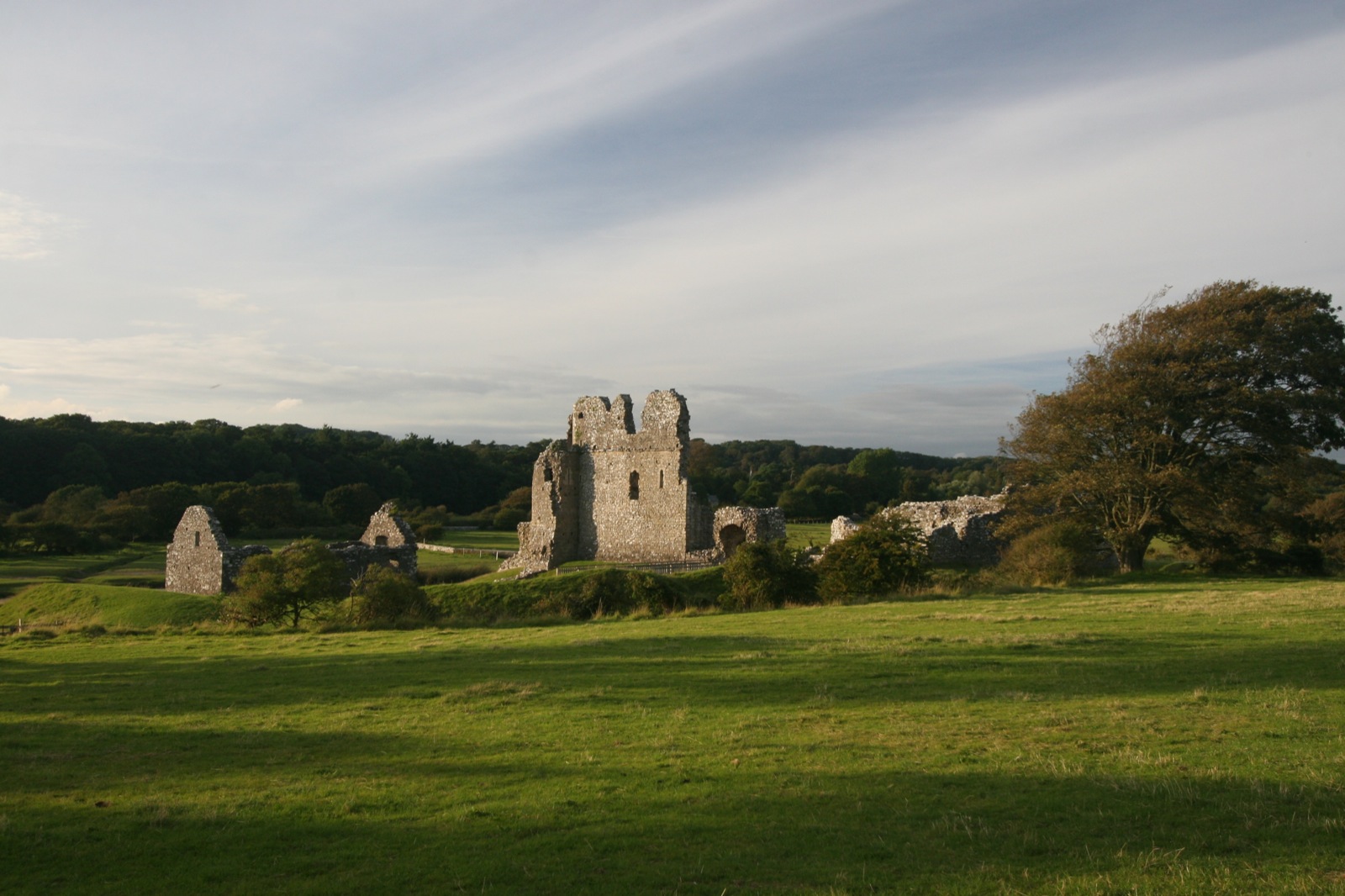
Ogmore Castle (Welsh: Castell Ogwr) is a Grade I listed castle ruin located near the village of Ogmore in the Vale of Glamorgan, Wales, east of Ogmore-by-Sea, and south of the town of Bridgend. It is situated on the south bank of the Ewenny River and the east bank of the River Ogmore.
Its construction might have begun in 1106. Ogmore was one of three castles built in the area in the early 12th century, the others being Coity Castle and Newcastle Castle. It was in use until the 19th century for a range of purposes, including a court of justice and a prison, but is now a substantial set of remains and a local landmark.
Ogmore Castle is owned by the Duchy of Lancaster and managed by Cadw (Welsh Historic Monuments). Admission is free, with access at all reasonable times.
When John Leland wrote his Itinerary, he referred to this fortress as "Ogor Castelle". The name comes from the nearby river, the River Ogmore (Welsh: Afon Ogwr).
Construction of Ogmore Castle might have started around 1106, its foundation predating the Norman conquest. In Caradoc of Llancarfan's The historie of Cambria, now called Wales: a part of the most famous yland of Brytaine, Caradoc wrote that the manor and castle were given to William de Londres, one of the legendary Twelve Knights of Glamorgan, by Robert Fitzhamon, the Norman conqueror of Glamorgan. In 1116, William de Londres was forced to abandon the castle when the Welsh appeared in force. His butler, Arnold, is credited with protecting the castle from the Welsh attack during the absence of William de Londres, and for this, he was knighted Sir Arnold Butler, also receiving the castle and manor of Dunraven as reward.
According to the custom of the times, the founding of a religious institution followed the acquisition of power. William de Londres, or his descendant John, built Ewenny Abbey 1 mile (1.6 km) from the castle. Also nearby was a religious place appended to Ogmore Castle by Morris de Londres or his descendant John, in 1141; Ewenny Priory is 2 miles (3.2 km) from Ogmore Castle. Because Thomas' heiress, his daughter Hawyse de Londres, had married into the Chaworth family of Kidwelly, the lands passed jure uxoris in 1298 to Henry, 3rd Earl of Lancaster, husband of Maud de Chaworth, and ownership remains in the hands of the Duchy of Lancaster to this day.
The earthworks were steeply banked and oval in shape, enclosing an area of 164 feet (50 m) in length by 115 feet (35 m) in width. The inner ward was flat and constructed of timber structures. After completion of the ringwork, the building material was stone. The windows were round-headed with Sutton stone ashlar. The first-floor great hall had an ornate fireplace.
William's son Maurice is credited with building the oblong keep; it is perhaps the oldest Norman keep in Glamorgan. Situated north of the main gateway, the keep was the first masonry building and was probably built in the 1120s. It is both the castle's tallest surviving building, and one of the oldest buildings in South Wales. Though only three of the original walls survive, their structure is characterized by irregularly shaped field stones, glacial pebbles, Lias limestone slabs, and brown mortar. Thomas de Londres replaced a timber palisade with a stone wall in around 1200.
Ogmore Castle
Ogmore Castle (Welsh: Castell Ogwr) is a Grade I listed castle ruin located near the village of Ogmore in the Vale of Glamorgan, Wales, east of Ogmore-by-Sea, and south of the town of Bridgend. It is situated on the south bank of the Ewenny River and the east bank of the River Ogmore.
Its construction might have begun in 1106. Ogmore was one of three castles built in the area in the early 12th century, the others being Coity Castle and Newcastle Castle. It was in use until the 19th century for a range of purposes, including a court of justice and a prison, but is now a substantial set of remains and a local landmark.
Ogmore Castle is owned by the Duchy of Lancaster and managed by Cadw (Welsh Historic Monuments). Admission is free, with access at all reasonable times.
When John Leland wrote his Itinerary, he referred to this fortress as "Ogor Castelle". The name comes from the nearby river, the River Ogmore (Welsh: Afon Ogwr).
Construction of Ogmore Castle might have started around 1106, its foundation predating the Norman conquest. In Caradoc of Llancarfan's The historie of Cambria, now called Wales: a part of the most famous yland of Brytaine, Caradoc wrote that the manor and castle were given to William de Londres, one of the legendary Twelve Knights of Glamorgan, by Robert Fitzhamon, the Norman conqueror of Glamorgan. In 1116, William de Londres was forced to abandon the castle when the Welsh appeared in force. His butler, Arnold, is credited with protecting the castle from the Welsh attack during the absence of William de Londres, and for this, he was knighted Sir Arnold Butler, also receiving the castle and manor of Dunraven as reward.
According to the custom of the times, the founding of a religious institution followed the acquisition of power. William de Londres, or his descendant John, built Ewenny Abbey 1 mile (1.6 km) from the castle. Also nearby was a religious place appended to Ogmore Castle by Morris de Londres or his descendant John, in 1141; Ewenny Priory is 2 miles (3.2 km) from Ogmore Castle. Because Thomas' heiress, his daughter Hawyse de Londres, had married into the Chaworth family of Kidwelly, the lands passed jure uxoris in 1298 to Henry, 3rd Earl of Lancaster, husband of Maud de Chaworth, and ownership remains in the hands of the Duchy of Lancaster to this day.
The earthworks were steeply banked and oval in shape, enclosing an area of 164 feet (50 m) in length by 115 feet (35 m) in width. The inner ward was flat and constructed of timber structures. After completion of the ringwork, the building material was stone. The windows were round-headed with Sutton stone ashlar. The first-floor great hall had an ornate fireplace.
William's son Maurice is credited with building the oblong keep; it is perhaps the oldest Norman keep in Glamorgan. Situated north of the main gateway, the keep was the first masonry building and was probably built in the 1120s. It is both the castle's tallest surviving building, and one of the oldest buildings in South Wales. Though only three of the original walls survive, their structure is characterized by irregularly shaped field stones, glacial pebbles, Lias limestone slabs, and brown mortar. Thomas de Londres replaced a timber palisade with a stone wall in around 1200.
Recent media
Recent media