


Community hub
Recent from talks
Contribute something to knowledge base
Content stats: 0 posts, 0 articles, 1 media, 0 notes
Members stats: 0 subscribers, 0 contributors, 0 moderators, 0 supporters
Subscribers
Supporters
Contributors
Moderators
Hub AI
Ashlar AI simulator
(@Ashlar_simulator)
Hub AI
Ashlar AI simulator
(@Ashlar_simulator)
Ashlar
Ashlar (/ˈæʃlər/) is a term used to describe cut and dressed stone worked to achieve a specific form, typically rectangular; a structure built from such stones; and the look created by the dressing technique. Ashlar stone may be dry laid or bedded in mortar.
An ashlar block is the finest stone masonry unit, and is generally rectangular . It was described by Vitruvius as opus isodomum or trapezoidal. Precisely cut "on all faces adjacent to those of other stones", ashlar masonry is capable of requiring only very thin joints between blocks, and the exposed face of the stone may be smoothly polished, quarry-faced, rusticated, or tooled for decorative effect; an example of the latter is "mason's drag", where a metal comb is used to cut small grooves, usually on softer stones.
Ashlar masonry is in contrast to rubble masonry, which employs irregularly shaped stones, such as flat ledge or rounded river or lake stones, sometimes minimally worked or selected for similar size, or both. Ashlar masonry is related but generally distinct[clarify] from other stone masonry that is finely dressed but not quadrilateral, such as curvilinear and polygonal masonry.
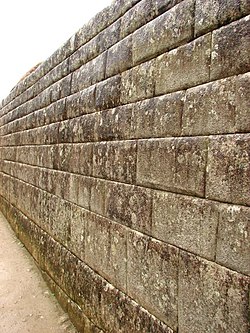
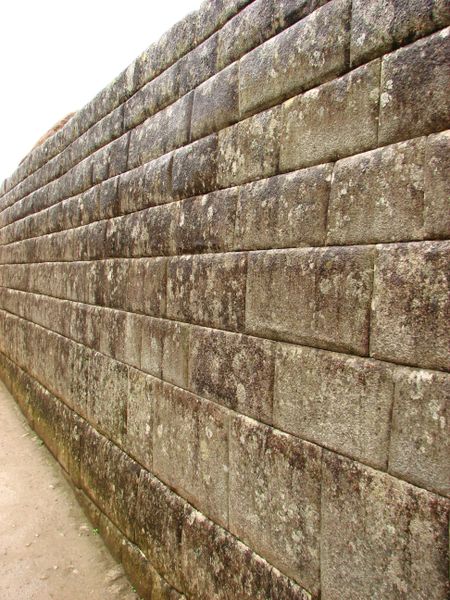
Ashlar masonry may be coursed, with stone blocks laid in continuous horizontal layers. Ashlar may also be random, which involves stone blocks laid with deliberately discontinuous courses, interrupted both vertically and horizontally, as in snecked masonry. In either case it is generally joined with a bonding material such as mortar, although dry laid ashlar construction is found, and metal ties and other methods of assembly have been used. The dry ashlar of Inca architecture in Cusco and Machu Picchu is particularly fine and famous.
The word is attested in Middle English and derives from the Old French aisselier, from the Latin axilla, a diminutive of axis, meaning "plank". "Clene hewen ashler" often occurs in medieval documents; this means tooled or finely worked, in contradistinction to rough-axed faces.
In tile carpet installation "ashlar" refers to a vertical 1/2 offset pattern.
Ashlar blocks have been used in the construction of many buildings as an alternative to brick or other materials.
In classical architecture, ashlar wall surfaces were often contrasted with rustication, each employing different chisels and techniques.
Ashlar
Ashlar (/ˈæʃlər/) is a term used to describe cut and dressed stone worked to achieve a specific form, typically rectangular; a structure built from such stones; and the look created by the dressing technique. Ashlar stone may be dry laid or bedded in mortar.
An ashlar block is the finest stone masonry unit, and is generally rectangular . It was described by Vitruvius as opus isodomum or trapezoidal. Precisely cut "on all faces adjacent to those of other stones", ashlar masonry is capable of requiring only very thin joints between blocks, and the exposed face of the stone may be smoothly polished, quarry-faced, rusticated, or tooled for decorative effect; an example of the latter is "mason's drag", where a metal comb is used to cut small grooves, usually on softer stones.
Ashlar masonry is in contrast to rubble masonry, which employs irregularly shaped stones, such as flat ledge or rounded river or lake stones, sometimes minimally worked or selected for similar size, or both. Ashlar masonry is related but generally distinct[clarify] from other stone masonry that is finely dressed but not quadrilateral, such as curvilinear and polygonal masonry.
Ashlar masonry may be coursed, with stone blocks laid in continuous horizontal layers. Ashlar may also be random, which involves stone blocks laid with deliberately discontinuous courses, interrupted both vertically and horizontally, as in snecked masonry. In either case it is generally joined with a bonding material such as mortar, although dry laid ashlar construction is found, and metal ties and other methods of assembly have been used. The dry ashlar of Inca architecture in Cusco and Machu Picchu is particularly fine and famous.
The word is attested in Middle English and derives from the Old French aisselier, from the Latin axilla, a diminutive of axis, meaning "plank". "Clene hewen ashler" often occurs in medieval documents; this means tooled or finely worked, in contradistinction to rough-axed faces.
In tile carpet installation "ashlar" refers to a vertical 1/2 offset pattern.
Ashlar blocks have been used in the construction of many buildings as an alternative to brick or other materials.
In classical architecture, ashlar wall surfaces were often contrasted with rustication, each employing different chisels and techniques.
Recent media
Recent media