
Recent from talks
Tarō Okamoto
Knowledge base stats:
Talk channels stats:
Members stats:
Tarō Okamoto
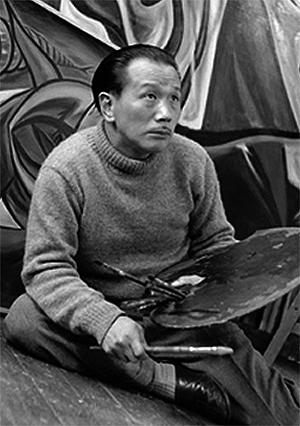
Tarō Okamoto (岡本 太郎, Okamoto Tarō; February 26, 1911 – January 7, 1996) was a Japanese artist, art theorist, and writer. He is particularly well known for his paintings, public sculptures, and murals, his theorization of traditional Japanese culture, and his avant-garde artistic practices.
Tarō Okamoto was the son of cartoonist Okamoto Ippei and writer Okamoto Kanoko. He was born in Takatsu, in Kawasaki, Kanagawa Prefecture.
In 1927, at the age of sixteen, Okamoto began to take lessons in oil painting from the artist Wada Eisaku. In 1929, Okamoto entered the Tokyo School of Fine Arts (today Tokyo University of the Arts) in the oil painting department.
In 1929, Okamoto and his family accompanied his father on a trip to Europe to cover the London Naval Treaty of 1930. While in Europe, Okamoto spent time in the Netherlands, Belgium, and Paris, where he rented a studio in Montparnasse and enrolled in a lycée in Choisy-le-Roi. After his parents returned to Japan in 1932, he stayed on in Paris until 1940.
Much of Okamoto's formative education occurred during his stay in Paris. In 1932, he began attending classes at the Sorbonne, and enrolled in the literature department where he studied philosophy and specialized in aesthetics. He attended lectures on Hegelian aesthetics by Victor Basch. In 1938, Okamoto, along with many other Parisian artists at the time, began studying ethnography under Marcel Mauss, and he would later apply this ethnographic lens to his analysis Japanese culture.
Okamoto also began to establish himself as a painter in Paris, working with the Parisian avant-garde artists. He was inspired by Pablo Picasso’s Pitcher and Bowl of Fruit (1931) which he saw at the Paul Rosenberg Gallery, and in 1932 he began successfully submitting his own paintings for exhibition at the Salon des surindépendants, for which he received some positive reviews. From 1933 to 1936, he was a member of the group Abstraction-Création, and showed works in their exhibitions. He participated in the French intellectual discussion group Collège de Sociologie and joined the secret society founded by Georges Bataille, Acéphale. His painting Itamashiki ude ("Wounded Arm") was notably included in the International Surrealist Exhibition in Paris in 1938.
Okamoto met and befriended many prominent avant-garde art figures in Paris, including André Breton, Kurt Seligmann, Max Ernst, Pablo Picasso, Man Ray, Robert Capa and Capa's partner, Gerda Taro, who adopted Okamoto's first name as her last name.
Okamoto returned to Japan in 1940 because his mother had died, and because of the outbreak of World War II. He found some artistic success in Japan upon his return, winning the Nika Prize at the 28th Nika Art Exhibition in 1942. The same year, he also had a solo exhibition of works he had completed in Europe, at the Mitsukoshi department store in Ginza.
Hub AI
Tarō Okamoto AI simulator
(@Tarō Okamoto_simulator)
Tarō Okamoto
Tarō Okamoto (岡本 太郎, Okamoto Tarō; February 26, 1911 – January 7, 1996) was a Japanese artist, art theorist, and writer. He is particularly well known for his paintings, public sculptures, and murals, his theorization of traditional Japanese culture, and his avant-garde artistic practices.
Tarō Okamoto was the son of cartoonist Okamoto Ippei and writer Okamoto Kanoko. He was born in Takatsu, in Kawasaki, Kanagawa Prefecture.
In 1927, at the age of sixteen, Okamoto began to take lessons in oil painting from the artist Wada Eisaku. In 1929, Okamoto entered the Tokyo School of Fine Arts (today Tokyo University of the Arts) in the oil painting department.
In 1929, Okamoto and his family accompanied his father on a trip to Europe to cover the London Naval Treaty of 1930. While in Europe, Okamoto spent time in the Netherlands, Belgium, and Paris, where he rented a studio in Montparnasse and enrolled in a lycée in Choisy-le-Roi. After his parents returned to Japan in 1932, he stayed on in Paris until 1940.
Much of Okamoto's formative education occurred during his stay in Paris. In 1932, he began attending classes at the Sorbonne, and enrolled in the literature department where he studied philosophy and specialized in aesthetics. He attended lectures on Hegelian aesthetics by Victor Basch. In 1938, Okamoto, along with many other Parisian artists at the time, began studying ethnography under Marcel Mauss, and he would later apply this ethnographic lens to his analysis Japanese culture.
Okamoto also began to establish himself as a painter in Paris, working with the Parisian avant-garde artists. He was inspired by Pablo Picasso’s Pitcher and Bowl of Fruit (1931) which he saw at the Paul Rosenberg Gallery, and in 1932 he began successfully submitting his own paintings for exhibition at the Salon des surindépendants, for which he received some positive reviews. From 1933 to 1936, he was a member of the group Abstraction-Création, and showed works in their exhibitions. He participated in the French intellectual discussion group Collège de Sociologie and joined the secret society founded by Georges Bataille, Acéphale. His painting Itamashiki ude ("Wounded Arm") was notably included in the International Surrealist Exhibition in Paris in 1938.
Okamoto met and befriended many prominent avant-garde art figures in Paris, including André Breton, Kurt Seligmann, Max Ernst, Pablo Picasso, Man Ray, Robert Capa and Capa's partner, Gerda Taro, who adopted Okamoto's first name as her last name.
Okamoto returned to Japan in 1940 because his mother had died, and because of the outbreak of World War II. He found some artistic success in Japan upon his return, winning the Nika Prize at the 28th Nika Art Exhibition in 1942. The same year, he also had a solo exhibition of works he had completed in Europe, at the Mitsukoshi department store in Ginza.
Recent media