


Community hub
Recent from talks
Contribute something to knowledge base
Content stats: 0 posts, 0 articles, 1 media, 0 notes
Members stats: 0 subscribers, 0 contributors, 0 moderators, 0 supporters
Subscribers
Supporters
Contributors
Moderators
Golden Age of Radio
The Golden Age of Radio, also known as the old-time radio (OTR) era, was an era of radio in the United States where it was the dominant electronic home entertainment medium. It began with the birth of commercial radio broadcasting in the early 1920s and lasted through the 1950s, when television superseded radio as the medium of choice for scripted programming, variety and dramatic shows.
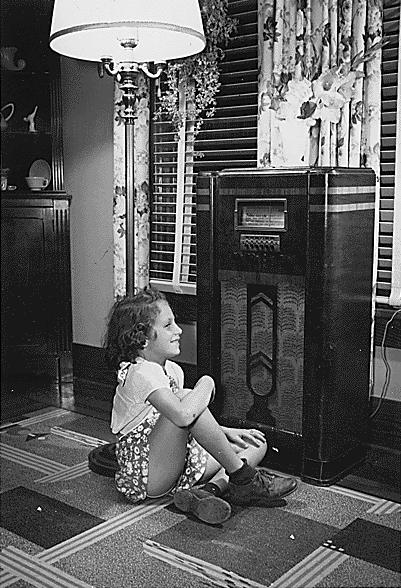
Radio was the first broadcast medium, and during this period people regularly tuned in to their favorite radio programs, and families gathered to listen to the home radio in the evening. According to a 1947 C. E. Hooper survey, 82 out of 100 Americans were found to be radio listeners. A variety of new entertainment formats and genres were created for the new medium, many of which later migrated to television: radio plays, mystery serials, soap operas, quiz shows, talent shows, daytime and evening variety hours, situation comedies, play-by-play sports, children's shows, cooking shows, and more.
In the 1950s, television surpassed radio as the most popular broadcast medium, and commercial radio programming shifted to narrower formats of news, talk, sports and music. Religious broadcasters, listener-supported public radio and college stations provide their own distinctive formats.
During the first three decades of radio, from 1887 to about 1920, the technology of transmitting sound was undeveloped; the information-carrying ability of radio waves was the same as a telegraph; the radio signal could be either on or off. Radio communication was by wireless telegraphy; at the sending end, an operator tapped on a switch which caused the radio transmitter to produce a series of pulses of radio waves which spelled out text messages in Morse code. At the receiver these sounded like beeps, requiring an operator who knew Morse code to translate them back to text. This type of radio was used exclusively for person-to-person text communication for commercial, diplomatic and military purposes and hobbyists; broadcasting did not exist.
The broadcasts of live drama, comedy, music and news that characterize the Golden Age of Radio had a precedent in the Théâtrophone, commercially introduced in Paris in 1890 and available as late as 1932. It allowed subscribers to eavesdrop on live stage performances and hear news reports by means of a network of telephone lines. The development of radio eliminated the wires and subscription charges from this concept.
Between 1900 and 1920 the first technology for transmitting sound by radio was developed, AM (amplitude modulation), and AM broadcasting sprang up around 1920.
On Christmas Eve 1906, Reginald Fessenden is said to have broadcast the first radio program, consisting of some violin playing and passages from the Bible. While Fessenden's role as an inventor and early radio experimenter is not in dispute, several contemporary radio researchers have questioned whether the Christmas Eve broadcast took place, or whether the date was, in fact, several weeks earlier. The first apparent published reference to the event was made in 1928 by H. P. Davis, Vice President of Westinghouse, in a lecture given at Harvard University. In 1932 Fessenden cited the Christmas Eve 1906 broadcast event in a letter he wrote to Vice President S. M. Kinter of Westinghouse. Fessenden's wife Helen recounts the broadcast in her book Fessenden: Builder of Tomorrows (1940), eight years after Fessenden's death. The issue of whether the 1906 Fessenden broadcast actually happened is discussed in Donna Halper's article "In Search of the Truth About Fessenden" and also in James O'Neal's essays. An annotated argument supporting Fessenden as the world's first radio broadcaster was offered in 2006 by Dr. John S. Belrose, Radioscientist Emeritus at the Communications Research Centre Canada, in his essay "Fessenden's 1906 Christmas Eve broadcast."
It was not until after the Titanic catastrophe in 1912 that radio for mass communication came into vogue, inspired first by the work of amateur ("ham") radio operators. Radio was especially important during World War I as it was vital for air and naval operations. World War I brought about major developments in radio, superseding the Morse code of the wireless telegraph with the vocal communication of the wireless telephone, through advancements in vacuum tube technology and the introduction of the transceiver.
Golden Age of Radio
The Golden Age of Radio, also known as the old-time radio (OTR) era, was an era of radio in the United States where it was the dominant electronic home entertainment medium. It began with the birth of commercial radio broadcasting in the early 1920s and lasted through the 1950s, when television superseded radio as the medium of choice for scripted programming, variety and dramatic shows.
Radio was the first broadcast medium, and during this period people regularly tuned in to their favorite radio programs, and families gathered to listen to the home radio in the evening. According to a 1947 C. E. Hooper survey, 82 out of 100 Americans were found to be radio listeners. A variety of new entertainment formats and genres were created for the new medium, many of which later migrated to television: radio plays, mystery serials, soap operas, quiz shows, talent shows, daytime and evening variety hours, situation comedies, play-by-play sports, children's shows, cooking shows, and more.
In the 1950s, television surpassed radio as the most popular broadcast medium, and commercial radio programming shifted to narrower formats of news, talk, sports and music. Religious broadcasters, listener-supported public radio and college stations provide their own distinctive formats.
During the first three decades of radio, from 1887 to about 1920, the technology of transmitting sound was undeveloped; the information-carrying ability of radio waves was the same as a telegraph; the radio signal could be either on or off. Radio communication was by wireless telegraphy; at the sending end, an operator tapped on a switch which caused the radio transmitter to produce a series of pulses of radio waves which spelled out text messages in Morse code. At the receiver these sounded like beeps, requiring an operator who knew Morse code to translate them back to text. This type of radio was used exclusively for person-to-person text communication for commercial, diplomatic and military purposes and hobbyists; broadcasting did not exist.
The broadcasts of live drama, comedy, music and news that characterize the Golden Age of Radio had a precedent in the Théâtrophone, commercially introduced in Paris in 1890 and available as late as 1932. It allowed subscribers to eavesdrop on live stage performances and hear news reports by means of a network of telephone lines. The development of radio eliminated the wires and subscription charges from this concept.
Between 1900 and 1920 the first technology for transmitting sound by radio was developed, AM (amplitude modulation), and AM broadcasting sprang up around 1920.
On Christmas Eve 1906, Reginald Fessenden is said to have broadcast the first radio program, consisting of some violin playing and passages from the Bible. While Fessenden's role as an inventor and early radio experimenter is not in dispute, several contemporary radio researchers have questioned whether the Christmas Eve broadcast took place, or whether the date was, in fact, several weeks earlier. The first apparent published reference to the event was made in 1928 by H. P. Davis, Vice President of Westinghouse, in a lecture given at Harvard University. In 1932 Fessenden cited the Christmas Eve 1906 broadcast event in a letter he wrote to Vice President S. M. Kinter of Westinghouse. Fessenden's wife Helen recounts the broadcast in her book Fessenden: Builder of Tomorrows (1940), eight years after Fessenden's death. The issue of whether the 1906 Fessenden broadcast actually happened is discussed in Donna Halper's article "In Search of the Truth About Fessenden" and also in James O'Neal's essays. An annotated argument supporting Fessenden as the world's first radio broadcaster was offered in 2006 by Dr. John S. Belrose, Radioscientist Emeritus at the Communications Research Centre Canada, in his essay "Fessenden's 1906 Christmas Eve broadcast."
It was not until after the Titanic catastrophe in 1912 that radio for mass communication came into vogue, inspired first by the work of amateur ("ham") radio operators. Radio was especially important during World War I as it was vital for air and naval operations. World War I brought about major developments in radio, superseding the Morse code of the wireless telegraph with the vocal communication of the wireless telephone, through advancements in vacuum tube technology and the introduction of the transceiver.
Recent media
Recent media