.jpg/250px-Solidago_rigida_(4991314459).jpg)


.jpg/1500px-Solidago_rigida_(4991314459).jpg)
Community hub
Recent from talks
Contribute something
Nothing was collected or created yet.
Solidago rigida
View on Wikipedia
| Solidago rigida | |
|---|---|
.jpg)
| |
| S. rigida subsp. humilis | |
Scientific classification 
| |
| Kingdom: | Plantae |
| Clade: | Tracheophytes |
| Clade: | Angiosperms |
| Clade: | Eudicots |
| Clade: | Asterids |
| Order: | Asterales |
| Family: | Asteraceae |
| Genus: | Solidago |
| Section: | S. sect. Ptarmicoidei |
| Species: | S. rigida
|
| Binomial name | |
| Solidago rigida L. 1753
| |
| Synonyms[1] | |
|
Synonymy
| |

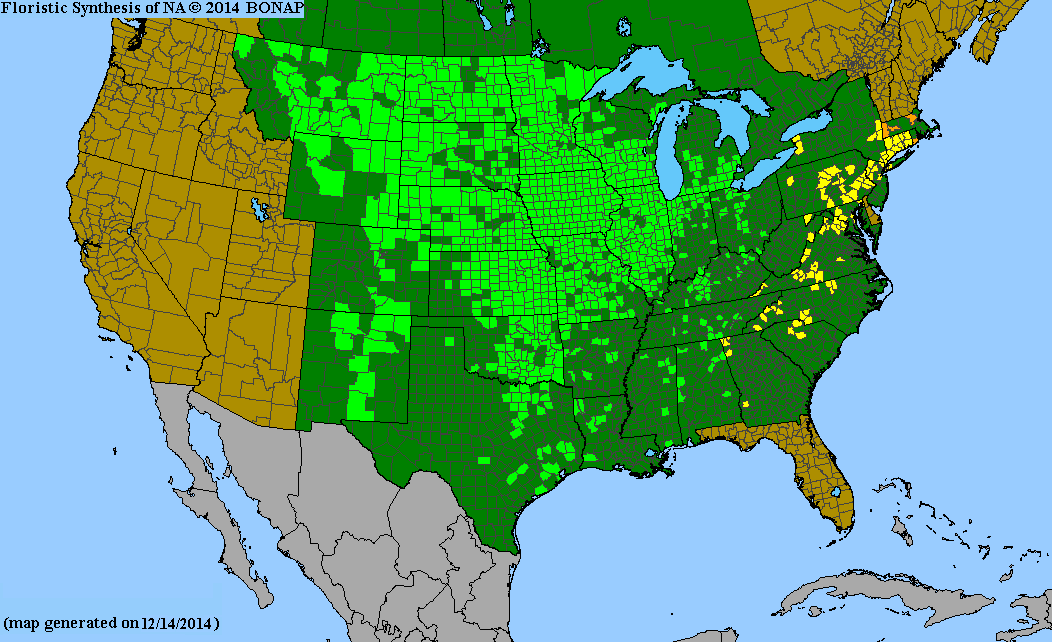
Solidago rigida, known by the common names stiff goldenrod and stiff-leaved goldenrod, is a North American plant species in the family Asteraceae. It has a widespread distribution in Canada and the United States, where it is found primarily east of the Rocky Mountains.[2] It is typically found in open, dry areas associated with calcareous or sandy soil. Habitats include prairies, savannas, and glades.[3]
Description
[edit]Soliadgo rigida is a tall, leafy perennial. Its leathery leaves are large for a goldenrod, reaching 3–6 cm (1+1⁄4–2+1⁄4 in) wide and 8–20 cm (3+1⁄4–7+3⁄4 in) long. It produces heads of yellow flowers in the late summer and fall.[3] Its fruit is a wind-dispersed achene.
Galls
[edit]This species is host to the following insect induced galls:
- Asphondylia s-rigida-bud-rosette-gall
- Asteromyia carbonifera (Osten Sacken, 1862)
- Gnorimoschema gibsoniella Busck, 1915
- Calycomyza solidaginis Kaltenbach, 1869[4]
Subspecies
[edit]- Solidago rigida subsp. glabrata (E.L.Braun) S.B.Heard & Semple – southeastern + south-central U.S.
- Solidago rigida subsp. humilis (Porter) S.B.Heard & Semple – central + western Canada, central + western United States as far west as the Rocky Mountains
- Solidago rigida subsp. rigida – Ontario, central + eastern U.S.
-
 Subspecies glabrata has hairless outer phyllaries, and a less pubescent stem and leaves

Conservation
[edit]This species is considered by NatureServe to be globally "secure" (G5), which is the lowest level of conservation concern assigned.[5] However, it is known to be rare on the local level, due to its declining grassland habitat. It is listed as endangered in Connecticut,[6] New Jersey and Pennsylvania. It is listed as endangered and extirpated in Maryland, as threatened in New York, and as historical in Rhode Island.[7]
Native American ethnobotany
[edit]The Ojibwe use a decoction of root as an enema,[8] and take an infusion of the root to treat "stoppage of urine".[9] The Meskwaki make the flowers into a lotion and use them on bee stings and for swollen faces.[10]
References
[edit]- ^ a b "Solidago rigida". The Global Compositae Checklist (GCC) – via The Plant List. Note that this website has been superseded by World Flora Online
- ^ Kartesz, John T. (2014). "Solidago rigida". County-level distribution map from the North American Plant Atlas (NAPA). Biota of North America Program (BONAP). Retrieved 23 January 2018.
- ^ a b c Semple, John C.; Cook, Rachel E. (2006). "Solidago rigida". In Flora of North America Editorial Committee (ed.). Flora of North America North of Mexico (FNA). Vol. 20. New York and Oxford: Oxford University Press – via eFloras.org, Missouri Botanical Garden, St. Louis, MO & Harvard University Herbaria, Cambridge, MA.
- ^ Kaltenbach, J.H. (1869). "Die deutschen Phytophagen aus der Klasse der Insekten [concl.]". Verh. Naturh. Ver. Preuss. Rheinl. 26 (3, 6): 106–224.
- ^ Oligoneuron rigidum NatureServe
- ^ "Connecticut's Endangered, Threatened and Special Concern Species 2015". State of Connecticut Department of Energy and Environmental Protection Bureau of Natural Resources. Retrieved 19 January 2018. (Note: This list is newer than the one used by plants.usda.gov and is more up-to-date.)
- ^ NRCS. "Oligoneuron rigidum". PLANTS Database. United States Department of Agriculture (USDA). Retrieved 19 January 2018.
- ^ Densmore, Frances, 1928, Uses of Plants by the Chippewa Indians, SI-BAE Annual Report #44:273-379, page 364 (Note: This source comes from the Native American ethnobotany database (http://naeb.brit.org/) which lists the plant as Oligoneuron rigidum var. rigidum. Accessed 19 January 2018
- ^ Densmore, Frances, 1928, Uses of Plants by the Chippewa Indians, SI-BAE Annual Report #44:273-379, page 348 (Note: This source comes from the Native American ethnobotany database (http://naeb.brit.org/) which lists the plant as Oligoneuron rigidum var. rigidum. Accessed 19 January 2018
- ^ Smith, Huron H., 1928, Ethnobotany of the Meskwaki Indians, Bulletin of the Public Museum of the City of Milwaukee 4:175-326, page 217218 (Note: This source comes from the Native American ethnobotany database (http://naeb.brit.org/) which lists the plant as Oligoneuron rigidum var. rigidum. Accessed 19 January 2018