Hubbry Logo
OlinguitoOlinguitoMain
Open search
Olinguito
Community hub
Olinguito
logo
8 pages, 0 posts
0 subscribers
Be the first to start a discussion here.
Olinguito
Olinguito
from Wikipedia

Olinguito
Scientific classification Edit this classification
Kingdom: Animalia
Phylum: Chordata
Class: Mammalia
Order: Carnivora
Family: Procyonidae
Genus: Bassaricyon
Species:
B. neblina
Binomial name
Bassaricyon neblina
Helgen, Pinto, Kays, Helgen, Tsuchiya, Quinn, Wilson & Maldonado, 2013[2]

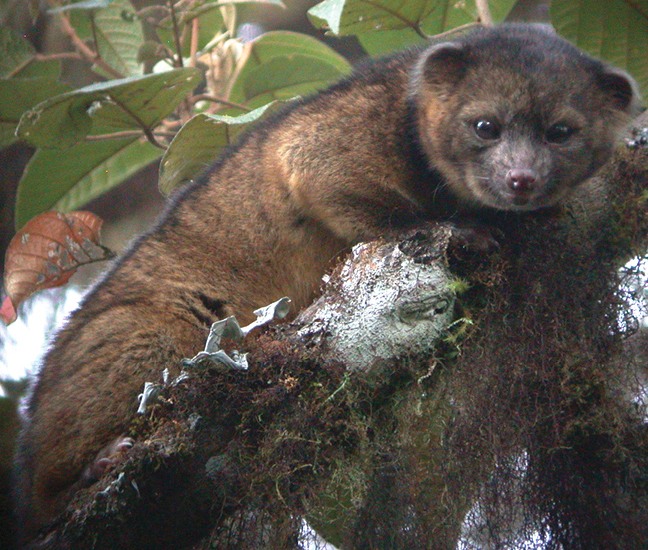
The olinguito /lɪŋˈɡt/[3] (Bassaricyon neblina) is a mammal of the raccoon family Procyonidae that lives in montane forests in the Andes of western Colombia and Ecuador. It was classified as belonging to a new species in 2013. The specific name neblina is Spanish for fog or mist, referring to the cloud forest habitat of the olinguito.[2]

On 22 May 2014, the International Institute for Species Exploration declared the olinguito as one of the "Top 10 New Species of 2014" among species discovered in 2013. It is the first new carnivoran mammal described in the Western Hemisphere in 35 years.[4][5]

Description

[edit]

The olinguito is distinct from the other species within the genus, popularly known as "olingos", and also from the kinkajou (kinkajous resemble olingos, but are not closely related).[2][6] Its average weight is 900 grams (2 lb), making it the smallest procyonid.[3][7][8] The animal is an omnivorous frugivore[9] that eats mainly fruits (such as figs), but also insects and nectar; this diet results in feces the size of small blueberries.[8][10] The olinguito is thought to be solitary, nocturnal[9]: 29:30  and moderately reclusive. Olinguitos appear to be strictly arboreal.[2][9] They have a single pair of mammae, and probably produce a single offspring at a time.[2][8][9]

Distribution and habitat

[edit]

Specimens of the species have been identified from the Andean cloud forest stretching from western Colombia to Ecuador, at elevations of 1,500 to 3,000 metres (4,900 to 9,800 ft), which is the highest known range of any member of the genus Bassaricyon.[8][11][12] Its discovery was confirmed in the wild[2][7] and announced on 15 August 2013.[7][9] The species is not considered to be immediately at risk,[7] but it is estimated that over 40 percent of the animal's potential range has been deforested.[7][10]

Discovery

[edit]
Bassaricyon neblina, illustrated by Nancy Halliday, 2013

Its discovery was announced on 15 August 2013 by Kristofer Helgen, curator of mammals at the Smithsonian National Museum of Natural History, Ecuadorian biologist Miguel Pinto, olingo expert Roland Kays of the North Carolina Museum of Natural Sciences and collaborators.[7][9][11][13][14][15] Helgen discovered specimens of the species in storage at The Field Museum in Chicago and used DNA testing to confirm a new species.[8] In 1923 a small pool of olinguitos were collected by researchers in Ecuador. However, they were misidentified by the researchers who mistook them for their relative, the kinkajou as the distinct species share common characteristics.

The researchers who identified the species were unable to discover any local names specific to it.[9]

The discovery was the first identification of a new mammal species of the order Carnivora[note 1][9] in the Americas in 35 years.[7][9] Olinguitos were regularly seen and even publicly exhibited decades before they were recognized as members of a new species. The animal had previously been confused with its taxonomic cousins, the olingos. One such example was Ringerl, an olinguito who lived in the National Zoo in Washington, D.C., for a year and also toured many other zoos.[9][16] Researchers unsuccessfully tried to breed her with olingos, not realizing she was a different species.[9] Ringerl died in 1976 at the Bronx Zoo.[3][17]

Taxonomic evaluation

[edit]
Distribution of sampled Bassaricyon neblina subspecies

The olinguito is smaller than the other species in the genus Bassaricyon.[7] Its body (head to rump) is approximately 355 mm (14.0 in) long, and its tail 335–424 mm (13.2–16.7 in) long.[2] It is also much furrier and has a shorter tail and smaller ears than others that share its genus.[16] The olinguito is found in the northern Andes at altitudes between 1,500 and 2,750 metres (4,920 and 9,020 ft)[2] above sea level, which is much higher than the habitats for other olingos.[10]

Based on morphological distinctions, four olinguito subspecies have been described: the nominate Bassaricyon neblina neblina, and B. n. osborni, B. n. hershkovitzi, and B. n. ruber.[2] Each of these subspecies, though, were found to have a dental formula characteristic of other members of the family Procyonidae.[18]

Dentition
3.1.4.2
3.1.4.2

Comparison of DNA from two olinguito subspecies to other olingo and related species was carried out on the basis of genetic dissimilarity derived from Kimura modeling of differences in base-pair composition of mitochondrial cytochrome b. The genetic divergence between olinguitos and other olingos makes olinguitos a basal sister lineage to the rest of the genus, and is equivalent to differences between species which have been assigned to separate subgenera or genera.[2] This split apparently occurred about 3.5 million years ago, suggesting that the earliest diversification of the genus took place in northwestern South America shortly after the ancestors of olingos first invaded the continent from Central America as part of the Great American Interchange.[2]

Conservation

[edit]

The olinguito may be at risk due to deforestation and urbanization. ("The researchers reporting its discovery estimated that 42% of suitable historic olinguito habitat had already been converted to agriculture or urban areas and an additional 21% remained in natural but largely unforested conditions…") Since the natural habitat of the olinguito is at higher elevations, its "cloud forest habitat" would need to be protected to optimize the species's probability of survival. As of now, no strict efforts are known to be in place in order to reduce habitat destruction.[19]

Notes

[edit]

References

[edit]
[edit]
Revisions and contributorsEdit on WikipediaRead on Wikipedia
from Grokipedia
The olinguito (Bassaricyon neblina) is a small, arboreal carnivoran mammal belonging to the raccoon family Procyonidae, distinguished as the smallest species in its genus and endemic to the montane cloud forests of the Andes in western Colombia and Ecuador. Weighing approximately 0.9 kilograms and measuring up to 91 centimeters in total length, it features dense woolly fur in shades of orange-brown, large eyes adapted for nocturnal vision, and a long bushy tail aiding in balance among tree canopies. Primarily frugivorous with occasional insectivory, the olinguito inhabits elevations between 1,530 and 2,740 meters, where it remains elusive due to its strictly nocturnal and tree-dwelling habits. Formally described in 2013 following a taxonomic revision of the olingo genus Bassaricyon, the species was identified through re-examination of museum specimens dating back to the 1920s, which had been misclassified as lowland olingos (B. gabbii), and confirmed by genetic, morphological, and vocalization analyses. This discovery marked the first new carnivoran species recognized in the Western Hemisphere in over three decades, highlighting gaps in Neotropical biodiversity knowledge despite extensive prior collections. Four subspecies are currently recognized, distributed across distinct Andean localities separated by valleys, reflecting geographic isolation. The olinguito's range has been narrowed by habitat fragmentation, with an estimated 42% of potential forest converted to agriculture or urban use, prompting its classification as Near Threatened by the IUCN owing to ongoing deforestation threats despite protected areas covering parts of its distribution. Conservation efforts emphasize preserving cloud forest connectivity, as the species' low population density and specialized ecology render it vulnerable to edge effects and human encroachment.

Taxonomy and Phylogeny

Historical Misidentification and Discovery

Museum specimens of the olinguito (Bassaricyon neblina) were collected as early as 1898, including examples such as AMNH 14185, but were consistently misidentified as other olingo species, particularly Bassaricyon gabbii, due to superficial external resemblances that masked underlying morphological distinctions. These errors persisted for over a century, with specimens labeled variably as B. medius or B. gabbii in taxonomic literature, such as works by Allen (1912) and Anthony (1923), reflecting a reliance on limited comparative data rather than detailed cranial and dental analyses. Live individuals fared similarly; at least one olinguito from Colombia was exhibited in U.S. zoos during the 1960s and 1970s, frequently transferred between institutions like the Bronx Zoo—where it died in 1976—because it refused to breed with presumed conspecific B. gabbii, a behavioral clue overlooked amid assumptions of intraspecific variation. The recognition of B. neblina as a distinct species stemmed from systematic re-examination of museum holdings initiated by Kristofer Helgen of the Smithsonian National Museum of Natural History, who scrutinized over 95% of global olingo specimens—incorporating more than 115 into morphometric studies—to identify consistent differences, including smaller cranial dimensions, reduced auditory bullae, and proportionally larger molars relative to B. gabbii. These variances, coupled with distinctions in pelage density and tail length, indicated a separate evolutionary lineage rather than clinal variation, challenging prior taxonomic lumping based on inadequate sampling. Field verification confirmed the findings: between 2006 and 2009, researchers captured and observed live olinguitos in Ecuador's cloud forests, including at Otonga Reserve (00°41’S, 79°00’W) during July–August 2006 expeditions, documenting traits like woolly fur and arboreal habits that aligned with museum evidence but diverged from lowland olingos. The species was formally announced on August 15, 2013, marking the first new carnivoran mammal identified in the Western Hemisphere since 1978 and underscoring how museum reappraisal and targeted fieldwork can resolve long-standing misclassifications through direct empirical comparison.

Formal Description and Etymology

The olinguito (Bassaricyon neblina) was formally described as a new species of procyonid carnivoran on August 15, 2013, in the peer-reviewed journal ZooKeys (volume 324, pages 1–83). The description, authored by Helgen et al., established it as distinct from previously recognized olingo species within the genus Bassaricyon, based on examination of museum specimens collected primarily from Andean cloud forests. The specific epithet neblina derives from the Spanish word for "fog" or "mist," alluding to the species' endemic occurrence in misty montane cloud forests of the northern Andes. This nomenclature highlights the habitat's characteristic persistent fog, which influences the local ecosystem and the animal's adaptations. Morphologically, B. neblina is diagnosed by its smaller cranial dimensions compared to congeners, with condylobasal skull lengths averaging 74.5 mm in males and 75.1 mm in females, reduced auditory bullae, and a broader postdental palate. Externally, it features denser, longer pelage that is tan to reddish-brown with black tips, a bushier and shorter tail (mean length 390 mm) with reduced banding, and an overall body mass averaging 872 g, marking it as the smallest species in the family Procyonidae. These traits distinguish it from species like B. gabbii, which exhibit larger skulls, sparser fur, and longer, more banded tails. Genetic analysis of cytochrome b sequences from tissue samples of museum specimens confirmed B. neblina's monophyly within Procyonidae, revealing nucleotide divergences of 9.6–11.3% from other Bassaricyon species, indicative of a distinct evolutionary lineage diverging approximately 3.5 million years ago. This molecular evidence corroborated the morphological delimitations, supporting its recognition as a separate species rather than a variant of known olingos.

Subspecies and Phylogenetic Relations

The olinguito (Bassaricyon neblina) is distinguished by four subspecies, recognized primarily on the basis of geographic isolation across the northern Andes and subtle morphological variations in pelage coloration, cranial dimensions, and body size. These include the nominate subspecies B. n. neblina, distributed in the western Andes of northern Ecuador; B. n. osborni, found in the western Andes of Colombia from the departments of Chocó to Cauca; B. n. hershkovitzi, occurring in the central and eastern Andes of Colombia; and B. n. ruber, restricted to the northernmost Andes in Colombia near the border with Venezuela. These distinctions were established through examination of museum specimens, with differences such as darker, fluffier fur in high-elevation populations and slightly larger skulls in northern forms, though genetic data indicate low inter-subspecies divergence consistent with recent isolation. Phylogenetically, B. neblina forms the sister lineage to the clade comprising the three lowland olingo species (B. gabbii, B. alleni, and B. medius), a relationship corroborated by analyses of mitochondrial cytochrome b sequences and nuclear loci such as CHRNA1, which show B. neblina diverging basal to the lowland group within the genus Bassaricyon. This basal position aligns with its endemicity to Andean cloud forests, where tectonic uplift during the Miocene-Pliocene likely drove vicariance from ancestral lowland populations, resulting in adaptations to montane environments without evidence of gene flow or hybridization despite parapatric distributions with lowland congeners. As the smallest member of Bassaricyon and the Procyonidae family, with adults weighing 0.9–1.5 kg, B. neblina underscores the genus's diversification within the procyonid radiation, distinct from kinkajous (Potos) and other subfamilies. Recent mitogenome studies affirm this topology, with no conflicting placements across concatenated datasets.

Physical Characteristics

Morphology and Size

The olinguito (Bassaricyon neblina) measures 325–400 mm in head-body length, with a tail of 335–424 mm, and weighs 750–1065 g, rendering it smaller overall than congeners such as B. gabbii. These dimensions derive from measurements of museum specimens and captive individuals, highlighting its compact build relative to lowland olingos. External morphology includes dense, woolly fur measuring 30–40 mm in length, with black-tipped guard hairs over a tan to orange-reddish-brown undercoat, varying by subspecies from least rufous in B. n. neblina to more reddish in B. n. ruber. The head features a rounded profile, blunter muzzle, large eyes often ringed in pale cream, and short, rounded ears fringed in buff or golden fur. Limbs are pentadactyl, terminating in sharp, curved claws, with hindfoot lengths of 60–86 mm; upper forelimbs display golden-orange pelage with gray bases and dark tips. Cranially, the olinguito exhibits smaller auditory bullae and a broadened postdental palate with lateral flanges compared to other Bassaricyon, alongside more massive molars (M1, m1) bearing bulbous cusps. The dental formula follows the procyonid standard of 3/3, 1/1, 4/4, 2/2. Subspecies show subtle cranial distinctions, such as narrower skulls in B. n. neblina and B. n. hershkovitzi versus wider in B. n. osborni.

Adaptations for Arboreal Life

The olinguito (Bassaricyon neblina) possesses an elongated body with short limbs, enabling agile navigation through the branched architecture of cloud forest canopies. This configuration supports adept leaping between trees, a behavior observed in field records from high-elevation Andean forests. A bushy tail exceeding head-body length by approximately 10% functions as a counterbalance, facilitating stability on narrow branches and during directional reversals in the treetops. Large eyes enhance visual acuity in low-light conditions, critical for nocturnal activity within the dim understory of montane forests. Dentition includes bulbous-cusped premolars and molars adapted for processing soft arboreal foods, alongside shearing carnassials characteristic of procyonids, permitting opportunistic intake of invertebrates or small vertebrates encountered in the canopy. Scent glands in both sexes support territorial marking, essential for maintaining spatial boundaries in visually obstructed arboreal territories.

Distribution and Habitat

Geographic Range

The olinguito (Bassaricyon neblina) is endemic to the western Andean cloud forests of Colombia and Ecuador, with confirmed specimens and field observations limited to montane elevations ranging from 1,500 to 2,800 meters above sea level. Documented localities include the Chocó and Antioquia departments in Colombia, and the Pichincha Province in Ecuador, among other northern Andean sites. Populations are fragmented by deep river valleys and topographic barriers inherent to the Andean cordilleras, restricting gene flow and dispersal between isolated patches. The species is divided into four subspecies, each associated with specific highland localities: B. n. neblina in central Ecuador, B. n. gaumeri in northern Ecuador, B. n. andinus in southern Colombian departments, and B. n. tamandinus in northern Colombian sites. These distributions reflect adaptation to localized cloud forest conditions, with no verified records from lower elevations, eastern Andean slopes, or non-forested habitats. Ecological niche modeling based on museum specimens and environmental variables, conducted in 2013, projected a historic extent of occurrence reduced by approximately 42% due to conversion of suitable habitat to agriculture and urban development. While all extant records derive from cloud forest ecosystems, remote and unsurveyed Andean pockets may support undetected subpopulations, as suggested by predictive modeling beyond confirmed sites.

Habitat Preferences and Requirements

The olinguito (Bassaricyon neblina) exhibits a strict preference for humid montane cloud forests in the northern Andes, where it occupies elevations ranging from 1,500 to 2,750 meters above sea level, with records concentrated around a mean of 2,100 meters. These forests provide the dense, epiphyte-laden canopies essential for the species' arboreal lifestyle, enabling shelter in tree cavities and foliage while supporting frugivory through abundant fruit availability in the upper strata. The olinguito avoids ground-level habitats and shows no records in lowland or high-elevation páramo zones beyond this range, reflecting physiological adaptations to the stable, misty microclimate of mid-to-upper canopy layers. Climatic requirements include high annual precipitation exceeding 2,000 mm, often reaching 4,000 mm in optimal northern Andean montane ecoregions, coupled with cool temperatures typically between 10°C and 20°C and low seasonal variation in the wettest quarters. Bioclimatic modeling indicates that suitability declines with increased temperature variability or drier conditions, underscoring the species' dependence on persistent cloud immersion for humidity and epiphyte proliferation, which in turn sustain its food web position. Field surveys confirm intolerance to deforested or fragmented landscapes, with absences in altered areas despite proximity to suitable intact forests, likely due to disrupted canopy connectivity and reduced prey resources. This habitat fidelity positions the olinguito as an indicator of pristine cloud forest integrity, vulnerable to edge effects from habitat loss.

Ecology and Behavior

Activity Patterns and Sociality

The olinguito (Bassaricyon neblina) exhibits strictly nocturnal activity patterns, remaining active from dusk through dawn in its arboreal cloud forest habitat. Camera-trap records from the Munchique region of Colombia confirm nighttime activity, with individuals documented at hours such as 2:00 a.m., consistent with field notes from Ecuador's Otonga Reserve. During the day, it rests in tree cavities or dense foliage, minimizing exposure in the high-elevation canopy where it navigates via leaps between branches. Socially, the olinguito is largely solitary, with scant field observations indicating minimal interactions beyond presumed mother-offspring pairs during early development. No evidence of group living, cooperative foraging, or territorial defense in pairs has been recorded in wild populations, aligning with its frugivorous, canopy-restricted lifestyle that reduces encounter rates. Captive studies of a female specimen ("Ringerl") exhibited scent marking and occasional aggression toward conspecifics, suggesting chemical signals play a role in individual spacing, though vocalizations remain undescribed in detail for wild individuals. Overall, behavioral data derive from limited sources, including rare camera traps and historical zoo records, underscoring the species' elusive nature.

Diet and Foraging Strategies

The olinguito (Bassaricyon neblina) maintains a primarily frugivorous diet, with fruits forming the core of its trophic niche as evidenced by direct observations of individuals feeding on guavas (Psidium spp.) in Andean cloud forests. Stomach contents from related Bassaricyon species, such as B. medius containing bananas and soft fruits, support this pattern of fruit dominance across the genus, though specific scat analyses for B. neblina remain unavailable due to the species' rarity and elusive nature. Opportunistic consumption of insects, nectar from flowers, and small vertebrates occurs but appears secondary, contrasting with more carnivorous tendencies in some procyonids; no records indicate predation on mammals, aligning with its arboreal, low-energy foraging lifestyle. Foraging strategies emphasize nocturnal, solitary traversal of cloud forest canopies, involving deliberate movement along branches and adept leaping between trees to access fruiting individuals, as observed in Ecuador's Otonga Reserve. Seasonal fruit scarcity may prompt shifts toward insects or nectar, inferred from genus-wide behaviors in B. gabbii relying on balsa tree nectar during dry periods, though direct data for B. neblina are limited. Unlike opportunistic crop raiders in lowland congeners, B. neblina shows no evidence of large-scale agricultural incursions, likely constrained by its high-elevation habitat and specialized fruit preferences including figs (Ficus spp.).

Reproduction and Development

The reproductive biology of the Bassaricyon neblina remains poorly documented due to the species' recent scientific description in 2013 and its strictly arboreal, nocturnal habits, which limit field observations. As of 2023, significant gaps persist despite some field sightings. No direct data exist on breeding seasonality, mating systems, or gestation length specific to the olinguito, though related olingo species (Bassaricyon spp.) exhibit polyestrous cycles potentially allowing year-round reproduction in stable environments. Females produce a single offspring per litter, as inferred from captive records of congeners and the olinguito's morphology, including a single pair of mammary glands. Maternal care is provided solely by females, with no evidence of paternal involvement; young are altricial and likely born in elevated tree nests or dens, consistent with the genus' arboreal adaptations. Developmental milestones, such as weaning age and age at sexual maturity, have not been observed in wild or captive B. neblina, though parallels with Bassaricyon gabbii suggest weaning around 5–6 weeks and maturity at 1–2 years. Documented observations of a female with a dependent young exist from field photos taken in 2007, prior to formal recognition, though details on birth and early development remain limited.

Conservation Status

Current Threats and Population Estimates

The olinguito (Bassaricyon neblina) is classified as Near Threatened on the IUCN Red List, with its population trend decreasing due to ongoing habitat loss and fragmentation in the Andean cloud forests of Colombia and Ecuador. Primary threats include deforestation driven by agricultural expansion, illegal logging, and mining activities, which have converted approximately 42% of its historic habitat to farmland or urban areas since the mid-20th century. These pressures are exacerbated by the species' restricted elevational range (1,500–2,750 m), limiting its ability to shift in response to disturbance. Population estimates for the olinguito remain imprecise, as no comprehensive censuses have been conducted; however, ecological niche modeling based on occurrence records and assumed densities yields an estimate of approximately 533 mature individuals across its global range of about 30,000 km² of suitable habitat. Habitat fragmentation poses additional risks by reducing genetic viability and increasing vulnerability to stochastic events, though direct evidence of inbreeding depression is lacking. Climate change may further threaten the species through potential upslope habitat shifts, but empirical data on its impacts are limited to projections rather than observed effects. Invasive species do not appear to constitute a significant threat based on available records.

Conservation Efforts and Future Outlook

The olinguito inhabits portions of protected areas in its range, including Ecuador's Neblina Reserve, established to create ecological corridors linking fragmented cloud forests and where individuals have been sighted as recently as June 2024. Broader initiatives by organizations such as the World Land Trust emphasize restoration of cloud forest remnants, which indirectly support the species by addressing habitat fragmentation, though no olinguito-specific recovery programs have been implemented since its 2013 description. Ongoing research priorities include expanded field surveys to refine population estimates and genetic monitoring to evaluate subspecies viability across its Andean distribution, as current data remain limited by the species' elusive nature and historical under-sampling. While ecotourism in protected cloud forests could generate funding for enforcement, it carries risks of increased human disturbance without strict regulation. The olinguito's near-threatened status persists without evidence of population stabilization or recovery, hinging on rigorous deforestation controls that have proven uneven in enforcement across Colombia and Ecuador. Causal factors like agricultural expansion indicate continued habitat contraction absent verifiable policy impacts, rendering long-term viability uncertain despite reserve protections.
Add your contribution
Related Hubs
User Avatar
No comments yet.