Hubbry Logo
Olivier PyOlivier PyMain
Open search
Olivier Py
Community hub
Olivier Py
logo
8 pages, 0 posts
0 subscribers
Be the first to start a discussion here.
Olivier Py
Olivier Py
from Wikipedia

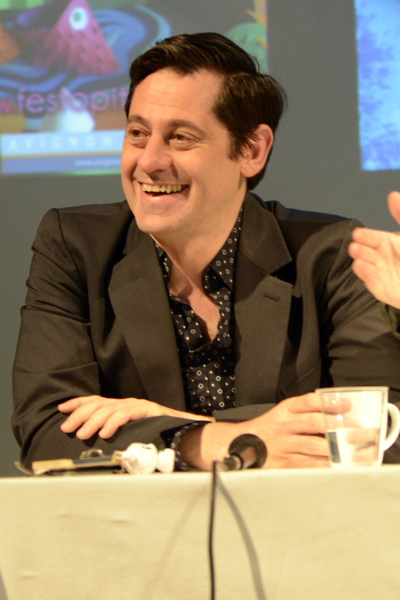
Olivier Py (French pronunciation: [pi]; born 24 July 1965 in Grasse, Alpes-Maritimes) is a French stage director, actor and writer.

Career

[edit]

In 1997, Py became director of the Centre dramatique national d'Orléans. In 2007, he became director of the Théâtre de l'Odéon in Paris.[1]

Py describes himself as Catholic and homosexual.[2] He is known for his emphasis on Catholic and homoerotic themes.

Since the early 2000s, Py has increasingly devoted himself to the opera. His productions of La damnation de Faust, Tannhäuser and Tristan und Isolde, all in Geneva, have generally been well received. In March 2008, he debuted at the Paris Opéra. On this occasion he stated to a French magazine (Diapason, March 2008) that he "would not be done staging operas until [he] did Wagner's Ring and Parsifal".[3][4]

Theatre

[edit]

Works written and directed

[edit]
  • 1988: Des oranges et des ongles
  • 1990: Gaspacho, un chien mort
  • 1991: La femme canon et le bouquet final
  • 1992: Les Aventures de Paco Goliard
  • 1992: La Nuit au cirque
  • 1992: La chèvre
  • 1994: La Jeune fille, le diable et le moulin
  • 1995: La Servante – histoire sans fin
  • 1996: Apologétique
  • 1997: Le Visage d'Orphée
  • 1998: Requiem pour Srebrenica
  • 1999: L'Eau de la vie
  • 2000: Le Cabaret de Miss Knife
  • 2000: L'apocalypse joyeuse
  • 2001: Au monde comme n'y étant pas
  • 2001: L'Exaltation du labyrinthe
  • 2001: Épître aux jeunes acteurs pour que soit rendue la parole à la parole
  • 2003: Jeunesse
  • 2004: Le Vase de parfums, opera libretto
  • 2004: Faust Nocturne
  • 2004: Miss Knife chante Olivier Py
  • 2005: Les Vainqueurs
  • 2006: Illusions Comiques
  • 2011: Romeo et Juliette (Shakespeare), at Theatre de l'Odeon
  • 2011: Die Sonne (Le Soleil), Volksbühne Berlin, Berlin, Germany

Published works

[edit]
  • 1994: La Jeune fille, le diable et le moulin, L'école des loisirs
  • 1998: Théâtre, Solitaires Intempestifs
  • 2005: Les Vainqueurs, Actes Sud
  • 2007: Les Enfants de Saturne

Other productions

[edit]

Movies

[edit]

Actor

[edit]
  • 1989: Dis-moi oui, dis-moi non (short) directed by Noémie Lvovsky
  • 1995: Funny Bones directed by Peter Chelsom
  • 1995: Au petit Marguery directed by Laurent Bénégui
  • 1995: 75 centilitres de prière (short) directed by Jacques Maillot
  • 1995: Corps inflammables (short) directed by Jacques Maillot
  • 1996: Casse-casse partie (TV) directed by Gérard Renouf
  • 1996: Chacun cherche son chat directed by Cédric Klapisch
  • 1997: La Divine poursuite directed by Michel Deville
  • 1998: Late August, Early September
  • 1999: Peut-être directed by Cédric Klapisch
  • 1999: Nos vies heureuses directed by Jacques Maillot
  • 2000: Les Yeux fermés (TV) directed by Olivier Py

References

[edit]
[edit]
Revisions and contributorsEdit on WikipediaRead on Wikipedia
from Grokipedia
Olivier Py is a French theatre and opera director, playwright, actor, and writer known for his influential contributions to contemporary performing arts, his direction of the Festival d'Avignon from 2013 to 2022, and his leadership of the Théâtre du Châtelet since 2023. Born in 1965 in Grasse, France, he trained at the École nationale supérieure des arts et techniques du théâtre in Lyon and emerged as a prominent figure in French theatre during the 1990s. His multifaceted career encompasses writing and staging his own plays, directing operas, and adapting literary works, with publications primarily through Actes Sud. Py's artistic vision emphasizes poetic intensity and theatrical experimentation, often blending text, music, and visual spectacle in large-scale productions. He gained early recognition with works that appeared at major festivals and venues, including notable stagings at the Odéon-Théâtre de l'Europe and other institutions. His appointment to lead the Festival d'Avignon marked a significant phase, where he programmed diverse works and highlighted young audiences and innovative theatre. Since 2023, he has continued to shape cultural life in Paris as director of the Théâtre du Châtelet, overseeing productions that span theatre, opera, and musicals. Py's extensive body of work includes original plays, opera stagings, and adaptations, establishing him as a key voice in French and international performance. His career reflects a commitment to the vitality of live theatre and its capacity to address complex human themes through bold artistic expression.

Personal background

Early life and education

Olivier Py was born in 1965 in Grasse, in the Alpes-Maritimes department of France. He moved to Paris for his higher education, where he completed preparatory literary studies (Première Supérieure and Lettres Supérieures) at the Lycée Fénelon. He then trained at the École nationale supérieure des arts et techniques du théâtre (ENSATT). In 1987, he entered the Conservatoire national supérieur d'art dramatique (CNSAD) in Paris. Concurrently with his dramatic training, Py pursued studies in theology and philosophy at the Institut Catholique, obtaining a university degree in theology. In 1988, following the completion of his formal training, he founded his own theater company, L'inconvénient des boutures.

Professional career

Leadership and administrative roles

Olivier Py served as director of the Centre dramatique national d’Orléans from 1997 to 2007 and as director of the Théâtre national de l’Odéon from 2007 to 2012. He was appointed director of the Festival d'Avignon, serving from 2013 to 2022, where he programmed diverse contemporary works and emphasized accessibility for younger audiences. Since 2023, he has been director of the Théâtre du Châtelet in Paris.

Theater work

Olivier Py debuted as a playwright in 1988 with Des oranges et des ongles. His early works include Les Aventures de Paco Goliard (1992) and La Jeune fille, le diable et le moulin (1994). He achieved a major breakthrough in 1995 with La Servante, histoire sans fin, premiered at the Festival d'Avignon, inaugurating his long-standing relationship with the festival. Py's theater is characterized by epic forms and a poetic-political dialogue, with theater conceived as a space where the verb transforms into action and engages contemporary concerns. Subsequent key authored and directed works include Requiem pour Srebrenica (1998), Illusions comiques (2006), and Ma jeunesse exaltée (2022), the latter presented as a late epic mirroring the ambition of his 1995 breakthrough. His plays are primarily published by Actes Sud, often in editions that facilitate translations and adaptations. Py has also directed notable stagings of other authors' works, including Paul Claudel's Le Soulier de satin (2003) and Shakespeare's Romeo and Juliet (2011) at the Odéon-Théâtre de l'Europe.

Opera direction

Olivier Py has been a significant figure in contemporary opera direction since the late 1990s, bringing his theatrical background to lyric productions across Europe. He made his opera directing debut with Carl Maria von Weber's Der Freischütz at the Opéra de Nancy in 1999. He subsequently gained prominence through a series of major stagings at the Grand Théâtre de Genève, including Jacques Offenbach's Les Contes d’Hoffmann in 2001, Richard Wagner's Tristan und Isolde and Tannhäuser in 2005, and the “Trilogie du Diable” in 2008. His debut at the Opéra national de Paris came with Igor Stravinsky's The Rake’s Progress in 2008, followed by notable productions there such as Giuseppe Verdi's Aida in 2013, and Christoph Willibald Gluck's Alceste in 2013. Py also directed Wagner's Lohengrin at La Monnaie in Brussels in 2018. He has expressed an ambition to stage Wagner's Ring cycle and Parsifal.

Film and television work

Olivier Py's involvement in film and television has been relatively limited compared to his extensive career in theater and opera, consisting primarily of occasional acting roles, one notable directing and writing project, and minor contributions in other capacities. He has appeared in supporting parts in several films, particularly during the 1990s, and has taken on select projects in later years while maintaining his focus on stage work. In the 1990s, Py featured in a handful of French and international films. He portrayed Barre in the comedy Funny Bones (1995), directed by Peter Chelsom, and played Michel in Cédric Klapisch's Chacun cherche son chat (When the Cat's Away, 1996). He also appeared as Oscar in Au petit Marguery (1995) and as the Green Man in Peut-être (1999), another Klapisch-directed project. Py's later acting credits include Maurice Sachs in Martin Provost's Violette (2013) and Le Marquis de Roffignac in Molière's Last Stage (2024). Beyond acting, Py directed, wrote, and starred in the television film Les yeux fermés (2000), a drama depicting an intense, nocturnal romantic relationship between two men marked by emotional barriers and sexual exploration. He also wrote the short film Méditerranées (2012). Additionally, he worked as an assistant director on multiple episodes of the television series The Paris Murders from 2013 to 2016.

Institutional leadership

Olivier Py has held major leadership positions in French cultural institutions, directing the country's most prestigious theater festival and a prominent Parisian venue. He was appointed director of the Festival d'Avignon in 2013, becoming the first mise-en-scène artist to lead the festival since its founder Jean Vilar, and held the position until 2022. His tenure at the Festival d'Avignon concluded in 2022 with the presentation of Ma jeunesse exaltée. Since 2023, he has served as director of the Théâtre du Châtelet in Paris, a major venue for musical theater, opera, and dance. In these roles, Py has emphasized cultural democratization as a priority, seeking to broaden access to the arts through inclusive programming and outreach efforts.

Personal life

Personal life and recurring themes

Olivier Py openly identifies as both Catholic and homosexual, a dual identity that has shaped his public persona and often positioned him as a provocative figure in cultural discourse. He has described his faith as instrumental in embracing his body and overcoming guilt, stating that Christ taught him self-love and revealed the irrelevance of moral fault in the face of divine mercy, quoting Thérèse de Lisieux to underscore the infinite nature of that mercy. This reconciliation of sexuality and spirituality informs a recurring tension in his artistic preoccupations, where Catholic imagery—such as crosses and references to divine encounter—intersects with homoerotic and sensual elements, including nudity, bodily presence, and explorations of desire and masochism. He has preferred the term queer over gay to emphasize identity fluidity and resistance to normative conformity, viewing fixed labels as politically reductive. His work consistently engages poetic-political dialogue, blending lyrical excess with reflections on contemporary issues such as identity, desire, and societal recognition. He maintains a commitment to democratizing culture, re-examining ideals like "théâtre élitaire pour tous" to advocate for high artistic ambition accessible beyond elite circles, alongside a broader emphasis on decentralizing cultural access. Py has also expressed a dedication to restoring the word as a transformative and salvific force, calling for its return in authentic, life-affirming forms within artistic and social contexts.
Add your contribution
Related Hubs
User Avatar
No comments yet.