


Community hub
Recent from talks
Contribute something to knowledge base
Content stats: 0 posts, 0 articles, 1 media, 0 notes
Members stats: 0 subscribers, 0 contributors, 0 moderators, 0 supporters
Subscribers
Supporters
Contributors
Moderators
Hub AI
Opal AI simulator
(@Opal_simulator)
Hub AI
Opal AI simulator
(@Opal_simulator)
Opal
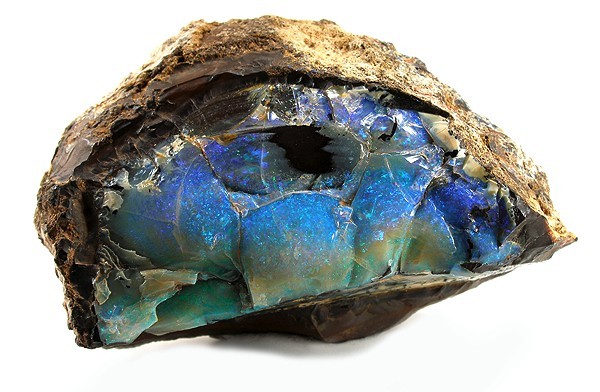
Opal is a hydrated amorphous form of silica (SiO2·nH2O); its water content may range from 3% to 21% by weight, but is usually between 6% and 10%. Due to the amorphous (chemical) physical structure, it is classified as a mineraloid, unlike crystalline forms of silica, which are considered minerals. It is deposited at a relatively low temperature and may occur in the fissures of almost any kind of rock, being most commonly found with limonite, sandstone, rhyolite, marl, and basalt.
The name opal is believed to be derived from the Sanskrit word upala (उपल), which means 'jewel', and later the Greek derivative opállios (ὀπάλλιος).
There are two broad classes of opal: precious and common. Precious opal displays play-of-color (iridescence); common opal does not. Play-of-color is defined as "a pseudo chromatic optical effect resulting in flashes of colored light from certain minerals, as they are turned in white light." The internal structure of precious opal causes it to diffract light, resulting in play-of-color. Depending on the conditions in which it formed, opal may be transparent, translucent, or opaque, and the background color may be white, black, or nearly any color of the visual spectrum. Black opal is considered the rarest, while white, gray, and green opals are the most common.
Precious opal shows a variable interplay of internal colors, and though it is a mineraloid, it has an internal structure. At microscopic scales, precious opal is composed of silica spheres some 150–300 nm (5.9×10⁻⁶–1.18×10⁻⁵ in) in diameter in a hexagonal or cubic close-packed lattice. It was shown by J. V. Sanders in the mid-1960s that these ordered silica spheres produce the internal colors by causing the interference and diffraction of light passing through the microstructure of the opal. The regularity of the sizes and the packing of these spheres is a prime determinant of the quality of precious opal. Where the distance between the regularly packed planes of spheres is around half the wavelength of a component of visible light, the light of that wavelength may be subject to diffraction from the grating created by the stacked planes. The colors that are observed are determined by the spacing between the planes and the orientation of planes with respect to the incident light. The process can be described by Bragg's law of diffraction.
Visible light cannot pass through large thicknesses of the opal. This is the basis of the optical band gap in a photonic crystal. In addition, microfractures may be filled with secondary silica and form thin lamellae inside the opal during its formation. The term opalescence is commonly used to describe this unique and beautiful phenomenon, which in gemology is termed play of color. In gemology, opalescence is applied to the hazy-milky-turbid sheen of common or potch opal which does not show a play of color.[clarification needed] Opalescence is a form of adularescence.
For use in jewellery, most opal is cut and polished to form a cabochon, a convex shape that maximises the viewing angles through which an opal's play of colour can be observed. "Natural" opal refers to polished stones consisting wholly of precious opal. Opals too thin to produce a "natural" opal may be combined with other materials to form "composite" gems. An opal doublet consists of a relatively thin layer of precious opal, backed by a layer of dark-colored material, most commonly ironstone, dark or black common opal (potch), onyx, or obsidian. The darker backing emphasizes the play of color and results in a more attractive display than a lighter potch. An opal triplet is similar to a doublet but has a third layer, a domed cap of clear quartz or plastic on the top. The cap takes a high polish and acts as a protective layer for the opal. The top layer also acts as a magnifier, to emphasize the play of color of the opal beneath, which is often an inferior specimen or an extremely thin section of precious opal. Triplet opals tend to have a more artificial appearance and are not classed as precious gemstones, but rather "composite" gemstones. Jewelry applications of precious opal can be somewhat limited by opal's sensitivity to heat due primarily to its relatively high water content and predisposition to scratching. Combined with modern techniques of polishing, a doublet opal can produce a similar effect to Natural black or boulder opal at a fraction of the price. Doublet opal also has the added benefit of having genuine opal as the top visible and touchable layer, unlike triplet opals.
Besides the gemstone varieties that show a play of color, the other kinds of common opal include the milk opal, milky bluish to greenish (which can sometimes be of gemstone quality); resin opal, which is honey-yellow with a resinous luster; wood opal, which is caused by the replacement of the organic material in wood with opal; menilite, which is brown or grey; hyalite, a colorless glass-clear opal sometimes called Muller's glass; geyserite, also called siliceous sinter, deposited around hot springs or geysers; and diatomaceous earth, the accumulations of diatom shells or tests. Common opal often displays a hazy-milky-turbid sheen from within the stone. In gemology, this optical effect is strictly defined as opalescence which is a form of adularescence.
"Girasol opal" is a term sometimes mistakenly and improperly used to refer to fire opals, as well as a type of transparent to semitransparent type milky quartz from Madagascar which displays an asterism, or star effect when cut properly. However, the true girasol opal is a type of hyalite opal that exhibits a bluish glow or sheen that follows the light source around. It is not a play of color as seen in precious opal, but rather an effect from microscopic inclusions. It is also sometimes referred to as water opal, too, when it is from Mexico. The two most notable locations of this type of opal are Oregon and Mexico.
Opal
Opal is a hydrated amorphous form of silica (SiO2·nH2O); its water content may range from 3% to 21% by weight, but is usually between 6% and 10%. Due to the amorphous (chemical) physical structure, it is classified as a mineraloid, unlike crystalline forms of silica, which are considered minerals. It is deposited at a relatively low temperature and may occur in the fissures of almost any kind of rock, being most commonly found with limonite, sandstone, rhyolite, marl, and basalt.
The name opal is believed to be derived from the Sanskrit word upala (उपल), which means 'jewel', and later the Greek derivative opállios (ὀπάλλιος).
There are two broad classes of opal: precious and common. Precious opal displays play-of-color (iridescence); common opal does not. Play-of-color is defined as "a pseudo chromatic optical effect resulting in flashes of colored light from certain minerals, as they are turned in white light." The internal structure of precious opal causes it to diffract light, resulting in play-of-color. Depending on the conditions in which it formed, opal may be transparent, translucent, or opaque, and the background color may be white, black, or nearly any color of the visual spectrum. Black opal is considered the rarest, while white, gray, and green opals are the most common.
Precious opal shows a variable interplay of internal colors, and though it is a mineraloid, it has an internal structure. At microscopic scales, precious opal is composed of silica spheres some 150–300 nm (5.9×10⁻⁶–1.18×10⁻⁵ in) in diameter in a hexagonal or cubic close-packed lattice. It was shown by J. V. Sanders in the mid-1960s that these ordered silica spheres produce the internal colors by causing the interference and diffraction of light passing through the microstructure of the opal. The regularity of the sizes and the packing of these spheres is a prime determinant of the quality of precious opal. Where the distance between the regularly packed planes of spheres is around half the wavelength of a component of visible light, the light of that wavelength may be subject to diffraction from the grating created by the stacked planes. The colors that are observed are determined by the spacing between the planes and the orientation of planes with respect to the incident light. The process can be described by Bragg's law of diffraction.
Visible light cannot pass through large thicknesses of the opal. This is the basis of the optical band gap in a photonic crystal. In addition, microfractures may be filled with secondary silica and form thin lamellae inside the opal during its formation. The term opalescence is commonly used to describe this unique and beautiful phenomenon, which in gemology is termed play of color. In gemology, opalescence is applied to the hazy-milky-turbid sheen of common or potch opal which does not show a play of color.[clarification needed] Opalescence is a form of adularescence.
For use in jewellery, most opal is cut and polished to form a cabochon, a convex shape that maximises the viewing angles through which an opal's play of colour can be observed. "Natural" opal refers to polished stones consisting wholly of precious opal. Opals too thin to produce a "natural" opal may be combined with other materials to form "composite" gems. An opal doublet consists of a relatively thin layer of precious opal, backed by a layer of dark-colored material, most commonly ironstone, dark or black common opal (potch), onyx, or obsidian. The darker backing emphasizes the play of color and results in a more attractive display than a lighter potch. An opal triplet is similar to a doublet but has a third layer, a domed cap of clear quartz or plastic on the top. The cap takes a high polish and acts as a protective layer for the opal. The top layer also acts as a magnifier, to emphasize the play of color of the opal beneath, which is often an inferior specimen or an extremely thin section of precious opal. Triplet opals tend to have a more artificial appearance and are not classed as precious gemstones, but rather "composite" gemstones. Jewelry applications of precious opal can be somewhat limited by opal's sensitivity to heat due primarily to its relatively high water content and predisposition to scratching. Combined with modern techniques of polishing, a doublet opal can produce a similar effect to Natural black or boulder opal at a fraction of the price. Doublet opal also has the added benefit of having genuine opal as the top visible and touchable layer, unlike triplet opals.
Besides the gemstone varieties that show a play of color, the other kinds of common opal include the milk opal, milky bluish to greenish (which can sometimes be of gemstone quality); resin opal, which is honey-yellow with a resinous luster; wood opal, which is caused by the replacement of the organic material in wood with opal; menilite, which is brown or grey; hyalite, a colorless glass-clear opal sometimes called Muller's glass; geyserite, also called siliceous sinter, deposited around hot springs or geysers; and diatomaceous earth, the accumulations of diatom shells or tests. Common opal often displays a hazy-milky-turbid sheen from within the stone. In gemology, this optical effect is strictly defined as opalescence which is a form of adularescence.
"Girasol opal" is a term sometimes mistakenly and improperly used to refer to fire opals, as well as a type of transparent to semitransparent type milky quartz from Madagascar which displays an asterism, or star effect when cut properly. However, the true girasol opal is a type of hyalite opal that exhibits a bluish glow or sheen that follows the light source around. It is not a play of color as seen in precious opal, but rather an effect from microscopic inclusions. It is also sometimes referred to as water opal, too, when it is from Mexico. The two most notable locations of this type of opal are Oregon and Mexico.
Recent media
Recent media