
Recent from talks
Limonite
Knowledge base stats:
Talk channels stats:
Members stats:
Limonite
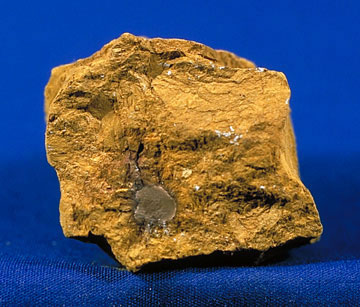
Limonite (/ˈlaɪməˌnaɪt/) is an iron ore consisting of a mixture of hydrated iron(III) oxide-hydroxides in varying composition. The generic formula is frequently written as FeO(OH)·nH2O, although this is not entirely accurate as the ratio of oxide to hydroxide can vary quite widely. Limonite is one of the three principal iron ores, the others being hematite and magnetite, and has been mined for the production of iron since at least 400 BC.
Limonite is named for the Ancient Greek word λειμών (leimṓn [leː.mɔ̌ːn]), meaning "wet meadow", or λίμνη (límnē [lím.nɛː]), meaning "marshy lake", as an allusion to its occurrence as bog iron ore in meadows and marshes. In its brown form, it is sometimes called brown hematite or brown iron ore.
Limonite is relatively dense with a specific gravity varying from 2.7 to 4.3. It is usually medium to dark yellowish brown in color. The streak of limonite on an unglazed porcelain plate is always yellowish brown, a character which distinguishes it from hematite with a red streak, or from magnetite with a black streak. The hardness is quite variable, ranging from 1 to 5. In thin section it appears as red, yellow, or brown and has a high index of refraction, 2.0–2.4. Limonite minerals are strongly birefringent, but grain sizes are usually too small for this to be detectable.
Although originally defined as a single mineral, limonite is now recognized as a field term for a mixture of related hydrated iron oxide minerals, among them goethite, lepidocrocite, akaganeite, and jarosite. Determination of the precise mineral composition is practical only with X-ray diffraction techniques. Individual minerals in limonite may form crystals, but limonite does not, although specimens may show a fibrous or microcrystalline structure, and limonite often occurs in concretionary forms or in compact and earthy masses; sometimes mammillary, botryoidal, reniform or stalactitic. Because of its amorphous nature, and occurrence in hydrated areas limonite often presents as a clay or mudstone. However, there are limonite pseudomorphs after other minerals such as pyrite. This means that chemical weathering transforms the crystals of pyrite into limonite by hydrating the molecules, but the external shape of the pyrite crystal remains. Limonite pseudomorphs have also been formed from other iron oxides, hematite and magnetite; from the carbonate siderite and from iron rich silicates such as almandine garnets.
Limonite usually forms from the hydration of hematite and magnetite, from the oxidation and hydration of iron rich sulfide minerals, and chemical weathering of other iron rich minerals such as olivine, pyroxene, amphibole, and biotite. It is often the major iron component in lateritic soils, and limonite laterite ores are a source of nickel and potentially cobalt and other valuable metals, present as trace elements. It is often deposited in run-off streams from mining operations.
Nickel-rich limonite ores represent the largest reserves of nickel. Such minerals are classified as lateritic nickel ore deposits.
One of the first uses was as a pigment. The yellow form produced yellow ochre for which Cyprus was famous, while the darker forms produced more earthy tones. Roasting the limonite changed it partially to hematite, producing red ochres, burnt umbers and siennas. Bog iron ore and limonite mudstones are mined as a source of iron.
Iron caps or gossans of siliceous iron oxide typically form as the result of intensive oxidation of sulfide ore deposits. These gossans were used by prospectors as guides to buried ore.
Hub AI
Limonite AI simulator
(@Limonite_simulator)
Limonite
Limonite (/ˈlaɪməˌnaɪt/) is an iron ore consisting of a mixture of hydrated iron(III) oxide-hydroxides in varying composition. The generic formula is frequently written as FeO(OH)·nH2O, although this is not entirely accurate as the ratio of oxide to hydroxide can vary quite widely. Limonite is one of the three principal iron ores, the others being hematite and magnetite, and has been mined for the production of iron since at least 400 BC.
Limonite is named for the Ancient Greek word λειμών (leimṓn [leː.mɔ̌ːn]), meaning "wet meadow", or λίμνη (límnē [lím.nɛː]), meaning "marshy lake", as an allusion to its occurrence as bog iron ore in meadows and marshes. In its brown form, it is sometimes called brown hematite or brown iron ore.
Limonite is relatively dense with a specific gravity varying from 2.7 to 4.3. It is usually medium to dark yellowish brown in color. The streak of limonite on an unglazed porcelain plate is always yellowish brown, a character which distinguishes it from hematite with a red streak, or from magnetite with a black streak. The hardness is quite variable, ranging from 1 to 5. In thin section it appears as red, yellow, or brown and has a high index of refraction, 2.0–2.4. Limonite minerals are strongly birefringent, but grain sizes are usually too small for this to be detectable.
Although originally defined as a single mineral, limonite is now recognized as a field term for a mixture of related hydrated iron oxide minerals, among them goethite, lepidocrocite, akaganeite, and jarosite. Determination of the precise mineral composition is practical only with X-ray diffraction techniques. Individual minerals in limonite may form crystals, but limonite does not, although specimens may show a fibrous or microcrystalline structure, and limonite often occurs in concretionary forms or in compact and earthy masses; sometimes mammillary, botryoidal, reniform or stalactitic. Because of its amorphous nature, and occurrence in hydrated areas limonite often presents as a clay or mudstone. However, there are limonite pseudomorphs after other minerals such as pyrite. This means that chemical weathering transforms the crystals of pyrite into limonite by hydrating the molecules, but the external shape of the pyrite crystal remains. Limonite pseudomorphs have also been formed from other iron oxides, hematite and magnetite; from the carbonate siderite and from iron rich silicates such as almandine garnets.
Limonite usually forms from the hydration of hematite and magnetite, from the oxidation and hydration of iron rich sulfide minerals, and chemical weathering of other iron rich minerals such as olivine, pyroxene, amphibole, and biotite. It is often the major iron component in lateritic soils, and limonite laterite ores are a source of nickel and potentially cobalt and other valuable metals, present as trace elements. It is often deposited in run-off streams from mining operations.
Nickel-rich limonite ores represent the largest reserves of nickel. Such minerals are classified as lateritic nickel ore deposits.
One of the first uses was as a pigment. The yellow form produced yellow ochre for which Cyprus was famous, while the darker forms produced more earthy tones. Roasting the limonite changed it partially to hematite, producing red ochres, burnt umbers and siennas. Bog iron ore and limonite mudstones are mined as a source of iron.
Iron caps or gossans of siliceous iron oxide typically form as the result of intensive oxidation of sulfide ore deposits. These gossans were used by prospectors as guides to buried ore.
Recent media