



Community hub
Recent from talks
Knowledge base stats:
Talk channels stats:
Members stats:
Operation Tractable
Operation Tractable was the final attack conducted by Canadian and Polish troops, supported by a British tank brigade, during the Battle of Normandy during World War II. The operation was to capture the tactically important French town of Falaise and then the smaller towns of Trun and Chambois. This operation was undertaken by the First Canadian Army with the 1st Polish Armoured Division (Generał brygady Stanisław Maczek) and a British armoured brigade against Army Group B of the Westheer in what became the largest encirclement on the Western Front during the Second World War. Despite a slow start and limited gains north of Falaise, novel tactics by the 1st Polish Armoured Division during the drive for Chambois enabled the Falaise Gap to be partially closed by 19 August 1944, trapping about 150,000 German soldiers in the Falaise Pocket.
Although the Falaise Gap was narrowed to a distance of several hundred metres, by attacks and counter-attacks between battle groups of the 1st Polish Armoured Division and the II SS Panzer Corps on Hill 262 (Mont Ormel) the gap was not closed quickly and thousands of German troops escaped on foot. During two days of nearly continuous fighting, the Polish forces, assisted by artillery-fire, managed to hold off counter-attacks by parts of seven German divisions in hand-to-hand fighting. On 21 August, elements of the First Canadian Army relieved the Polish survivors and sealed the Falaise Pocket by linking up with the Third US Army. This led to the surrender and capture of the remaining units of the German 7th Army in the pocket.
Following a break-out by the First US Army and the Third US Army from the beachhead during the Battle of Normandy after Operation Cobra on 25 July 1944, Adolf Hitler ordered a counter-offensive against the US breakout, Operation Lüttich. Lieutenant General Omar Bradley, commander of the 12th Army Group, was notified of the counter-offensive by signals deciphered via Ultra radio intercepts and prepared to defeat the counter-offensive and to encircle as much of the German force as possible. By the afternoon of 7 August, Lüttich had been defeated. Parts of the German 7th Army became further enveloped by the Allied advance out of Normandy.
Following the failure of Lüttich, the town of Falaise became an objective of the Commonwealth forces, to cut off virtually all of Army Group B (Generalfeldmarschall Günther von Kluge). General Harry Crerar, commanding the new First Canadian Army and Lieutenant-General Guy Simonds (II Canadian Corps), planned an Anglo-Canadian offensive, Operation Totalize. Totalize would rely on a night attack using the new Kangaroo armoured personnel carriers to achieve a breakthrough of German defences supported by US heavy bombers the next day. Despite gains on Verrières Ridge and near Cintheaux, the Canadian offensive stalled on 9 August, with powerful German counterattacks resulting in many casualties for the Canadian and Polish armoured and infantry divisions. By 10 August, Canadian troops had reached Hill 195, north of Falaise, but needed another set-piece attack to overcome the German defences.
Operation Tractable incorporated lessons learned from Operation Totalize, notably the effectiveness of mechanized infantry units and tactical bombing raids by heavy bombers. Tractable was to be a daylight attack; an initial bombing raid was to weaken German defences, followed by an advance by the 4th Canadian (Armoured) Division on the western flank of Hill 195, while the 3rd Canadian Infantry Division attacked on the eastern flank with the 2nd Canadian Armoured Brigade in support. Their advance would be protected by a large smokescreen by Canadian artillery. Field Marshal Bernard Montgomery hoped that Canadian forces would achieve control of Falaise by midnight on August 14. From there, all three formations would advance towards Trun, 18 km (11 mi) east of Falaise, with the additional assistance of the 1st Polish Armoured Division, numbering approximately 10,000 men. Once in Trun, joining with the Third US Army at Chambois could be quickly accomplished.
The main defence of the road to Falaise was the 12th SS Panzer Division Hitlerjugend, which included the remnants of two infantry divisions. German forces within the Falaise Pocket approached 350,000 men. Had surprise been achieved, the Canadians would likely have succeeded in a rapid break-through. On the night of 13/14 August, a Canadian officer lost his way while moving between divisional headquarters. He drove into German lines was killed and the Germans discovered a copy of Simonds' orders on his body. As a result, the 12th SS Panzer Division placed the bulk of its remaining strength—500 grenadiers and 15 tanks, along with twelve 8.8 cm PaK 43 anti-tank guns— along the Allies' expected line of approach.
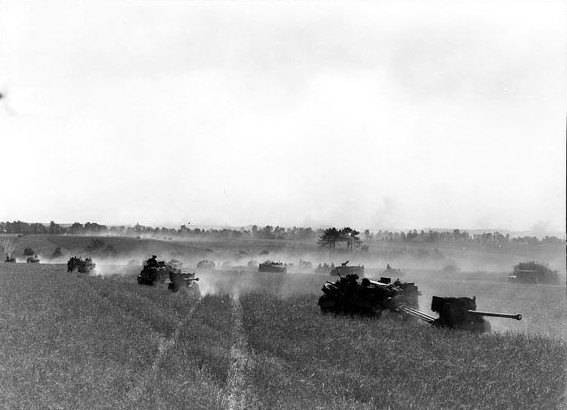
Operation Tractable began at 12:00 on 14 August, when 800 Avro Lancaster and Handley Page Halifax heavy bombers of RAF Bomber Command struck German positions along the front. As with Totalize, many of the bombers mistakenly dropped their bombs short of their targets, causing 400 Polish and Canadian casualties. Covered by a smoke screen laid down by their artillery, two Canadian divisions moved forwards. Although their line of sight was reduced, German units still managed to inflict severe casualties on the Canadian 4th Armoured Division, which included its armoured brigade commander Brigadier Leslie Booth, as the division moved south toward Falaise. Throughout the day, continual attacks by the Canadian 4th and Polish 1st armoured divisions managed to force a crossing of the Laison River. Limited access to the crossing points over the Dives River allowed counterattacks by the German 102nd SS Heavy Panzer Battalion. The town of Potigny fell to Polish forces in the late afternoon. By the end of the first day, elements of the Canadian 3rd and 4th divisions had reached Point 159, directly north of Falaise, although they had been unable to break into the town. To bolster his offensive, Simonds ordered the Canadian 2nd Infantry Division to move toward the front, with the hope that this reinforcement would be sufficient to enable his divisions to capture the town.
Although the first day's progress was slower than expected, Operation Tractable resumed on 15 August; both armoured divisions pushed southeast toward Falaise. The Canadian 2nd and 3rd infantry divisions—with the support of the Canadian 2nd Armoured Brigade—continued their drive south towards the town. After harsh fighting, the 4th Armoured Division captured Soulangy but the gains made were minimal as strong German resistance prevented a breakthrough to Trun. On 16 August, the Canadian 2nd Infantry Division broke into Falaise, encountering minor opposition from Waffen-SS units and scattered pockets of German infantry. Although it would take two more days to clear all resistance in the town, the first major objective of Operation Tractable had been achieved. Simonds began to reorganize the bulk of his armoured forces for a renewed push towards Trun to close the Falaise Pocket.
Hub AI
Operation Tractable AI simulator
(@Operation Tractable_simulator)
Operation Tractable
Operation Tractable was the final attack conducted by Canadian and Polish troops, supported by a British tank brigade, during the Battle of Normandy during World War II. The operation was to capture the tactically important French town of Falaise and then the smaller towns of Trun and Chambois. This operation was undertaken by the First Canadian Army with the 1st Polish Armoured Division (Generał brygady Stanisław Maczek) and a British armoured brigade against Army Group B of the Westheer in what became the largest encirclement on the Western Front during the Second World War. Despite a slow start and limited gains north of Falaise, novel tactics by the 1st Polish Armoured Division during the drive for Chambois enabled the Falaise Gap to be partially closed by 19 August 1944, trapping about 150,000 German soldiers in the Falaise Pocket.
Although the Falaise Gap was narrowed to a distance of several hundred metres, by attacks and counter-attacks between battle groups of the 1st Polish Armoured Division and the II SS Panzer Corps on Hill 262 (Mont Ormel) the gap was not closed quickly and thousands of German troops escaped on foot. During two days of nearly continuous fighting, the Polish forces, assisted by artillery-fire, managed to hold off counter-attacks by parts of seven German divisions in hand-to-hand fighting. On 21 August, elements of the First Canadian Army relieved the Polish survivors and sealed the Falaise Pocket by linking up with the Third US Army. This led to the surrender and capture of the remaining units of the German 7th Army in the pocket.
Following a break-out by the First US Army and the Third US Army from the beachhead during the Battle of Normandy after Operation Cobra on 25 July 1944, Adolf Hitler ordered a counter-offensive against the US breakout, Operation Lüttich. Lieutenant General Omar Bradley, commander of the 12th Army Group, was notified of the counter-offensive by signals deciphered via Ultra radio intercepts and prepared to defeat the counter-offensive and to encircle as much of the German force as possible. By the afternoon of 7 August, Lüttich had been defeated. Parts of the German 7th Army became further enveloped by the Allied advance out of Normandy.
Following the failure of Lüttich, the town of Falaise became an objective of the Commonwealth forces, to cut off virtually all of Army Group B (Generalfeldmarschall Günther von Kluge). General Harry Crerar, commanding the new First Canadian Army and Lieutenant-General Guy Simonds (II Canadian Corps), planned an Anglo-Canadian offensive, Operation Totalize. Totalize would rely on a night attack using the new Kangaroo armoured personnel carriers to achieve a breakthrough of German defences supported by US heavy bombers the next day. Despite gains on Verrières Ridge and near Cintheaux, the Canadian offensive stalled on 9 August, with powerful German counterattacks resulting in many casualties for the Canadian and Polish armoured and infantry divisions. By 10 August, Canadian troops had reached Hill 195, north of Falaise, but needed another set-piece attack to overcome the German defences.
Operation Tractable incorporated lessons learned from Operation Totalize, notably the effectiveness of mechanized infantry units and tactical bombing raids by heavy bombers. Tractable was to be a daylight attack; an initial bombing raid was to weaken German defences, followed by an advance by the 4th Canadian (Armoured) Division on the western flank of Hill 195, while the 3rd Canadian Infantry Division attacked on the eastern flank with the 2nd Canadian Armoured Brigade in support. Their advance would be protected by a large smokescreen by Canadian artillery. Field Marshal Bernard Montgomery hoped that Canadian forces would achieve control of Falaise by midnight on August 14. From there, all three formations would advance towards Trun, 18 km (11 mi) east of Falaise, with the additional assistance of the 1st Polish Armoured Division, numbering approximately 10,000 men. Once in Trun, joining with the Third US Army at Chambois could be quickly accomplished.
The main defence of the road to Falaise was the 12th SS Panzer Division Hitlerjugend, which included the remnants of two infantry divisions. German forces within the Falaise Pocket approached 350,000 men. Had surprise been achieved, the Canadians would likely have succeeded in a rapid break-through. On the night of 13/14 August, a Canadian officer lost his way while moving between divisional headquarters. He drove into German lines was killed and the Germans discovered a copy of Simonds' orders on his body. As a result, the 12th SS Panzer Division placed the bulk of its remaining strength—500 grenadiers and 15 tanks, along with twelve 8.8 cm PaK 43 anti-tank guns— along the Allies' expected line of approach.
Operation Tractable began at 12:00 on 14 August, when 800 Avro Lancaster and Handley Page Halifax heavy bombers of RAF Bomber Command struck German positions along the front. As with Totalize, many of the bombers mistakenly dropped their bombs short of their targets, causing 400 Polish and Canadian casualties. Covered by a smoke screen laid down by their artillery, two Canadian divisions moved forwards. Although their line of sight was reduced, German units still managed to inflict severe casualties on the Canadian 4th Armoured Division, which included its armoured brigade commander Brigadier Leslie Booth, as the division moved south toward Falaise. Throughout the day, continual attacks by the Canadian 4th and Polish 1st armoured divisions managed to force a crossing of the Laison River. Limited access to the crossing points over the Dives River allowed counterattacks by the German 102nd SS Heavy Panzer Battalion. The town of Potigny fell to Polish forces in the late afternoon. By the end of the first day, elements of the Canadian 3rd and 4th divisions had reached Point 159, directly north of Falaise, although they had been unable to break into the town. To bolster his offensive, Simonds ordered the Canadian 2nd Infantry Division to move toward the front, with the hope that this reinforcement would be sufficient to enable his divisions to capture the town.
Although the first day's progress was slower than expected, Operation Tractable resumed on 15 August; both armoured divisions pushed southeast toward Falaise. The Canadian 2nd and 3rd infantry divisions—with the support of the Canadian 2nd Armoured Brigade—continued their drive south towards the town. After harsh fighting, the 4th Armoured Division captured Soulangy but the gains made were minimal as strong German resistance prevented a breakthrough to Trun. On 16 August, the Canadian 2nd Infantry Division broke into Falaise, encountering minor opposition from Waffen-SS units and scattered pockets of German infantry. Although it would take two more days to clear all resistance in the town, the first major objective of Operation Tractable had been achieved. Simonds began to reorganize the bulk of his armoured forces for a renewed push towards Trun to close the Falaise Pocket.