Hubbry Logo
search
logo
1831059

Operation Tractable

logo
Community Hub0 Subscribers
Read side by side
from Wikipedia

Operation Tractable
Part of Operation Overlord

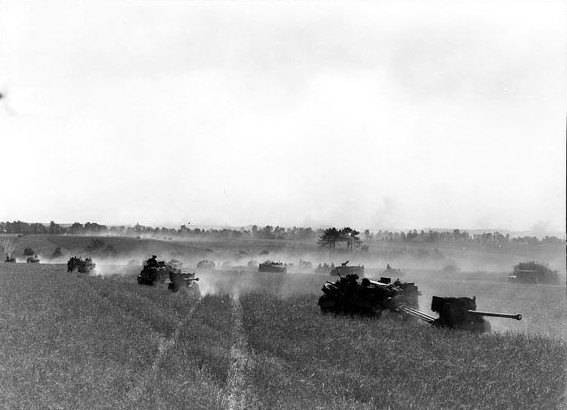
Canadian forces moving toward Falaise on 14 August 1944
Date14–21 August 1944
Location
North of Falaise, Normandy, France
48°53′34″N 0°11′31″W / 48.89278°N 0.19194°W / 48.89278; -0.19194
Result Allied victory
Belligerents
Canada
Poland Poland
United Kingdom[1]
 Germany
Commanders and leaders
Canada Harry Crerar
Canada Guy Simonds
Poland Stanisław Maczek
Nazi Germany Walter Model
Nazi Germany Kurt Meyer
Strength
2 infantry divisions
2 armoured divisions
1 armoured brigade
1 tank brigade[1]
1 SS panzer division
2 infantry divisions
Casualties and losses
Canada:
5,500 casualties
Poland:
325 killed
1,002 wounded
114 missing
2,000 killed
5,000 captured
55 tanks destroyed
152 armoured vehicles destroyed
44 guns destroyed
Map

Operation Tractable was the final attack conducted by Canadian and Polish troops, supported by a British tank brigade, during the Battle of Normandy during World War II. The operation was to capture the tactically important French town of Falaise and then the smaller towns of Trun and Chambois. This operation was undertaken by the First Canadian Army with the 1st Polish Armoured Division (Generał brygady Stanisław Maczek) and a British armoured brigade against Army Group B of the Westheer in what became the largest encirclement on the Western Front during the Second World War. Despite a slow start and limited gains north of Falaise, novel tactics by the 1st Polish Armoured Division during the drive for Chambois enabled the Falaise Gap to be partially closed by 19 August 1944, trapping about 150,000 German soldiers in the Falaise Pocket.

Although the Falaise Gap was narrowed to a distance of several hundred metres, by attacks and counter-attacks between battle groups of the 1st Polish Armoured Division and the II SS Panzer Corps on Hill 262 (Mont Ormel) the gap was not closed quickly and thousands of German troops escaped on foot. During two days of nearly continuous fighting, the Polish forces, assisted by artillery-fire, managed to hold off counter-attacks by parts of seven German divisions in hand-to-hand fighting. On 21 August, elements of the First Canadian Army relieved the Polish survivors and sealed the Falaise Pocket by linking up with the Third US Army. This led to the surrender and capture of the remaining units of the German 7th Army in the pocket.

Background

[edit]

Following a break-out by the First US Army and the Third US Army from the beachhead during the Battle of Normandy after Operation Cobra on 25 July 1944, Adolf Hitler ordered a counter-offensive against the US breakout, Operation Lüttich. Lieutenant General Omar Bradley, commander of the 12th Army Group, was notified of the counter-offensive by signals deciphered via Ultra radio intercepts and prepared to defeat the counter-offensive and to encircle as much of the German force as possible.[2] By the afternoon of 7 August, Lüttich had been defeated. Parts of the German 7th Army became further enveloped by the Allied advance out of Normandy.[2]

Following the failure of Lüttich, the town of Falaise became an objective of the Commonwealth forces, to cut off virtually all of Army Group B (Generalfeldmarschall Günther von Kluge).[3] General Harry Crerar, commanding the new First Canadian Army and Lieutenant-General Guy Simonds (II Canadian Corps), planned an Anglo-Canadian offensive, Operation Totalize.[4] Totalize would rely on a night attack using the new Kangaroo armoured personnel carriers to achieve a breakthrough of German defences supported by US heavy bombers the next day. Despite gains on Verrières Ridge and near Cintheaux, the Canadian offensive stalled on 9 August, with powerful German counterattacks resulting in many casualties for the Canadian and Polish armoured and infantry divisions.[5] By 10 August, Canadian troops had reached Hill 195, north of Falaise, but needed another set-piece attack to overcome the German defences.[5]

Prelude

[edit]

Tactics

[edit]
Allied gains during the Canadian offensives of Operations Totalize and Tractable
[image reference needed]

Operation Tractable incorporated lessons learned from Operation Totalize, notably the effectiveness of mechanized infantry units and tactical bombing raids by heavy bombers.[6] Tractable was to be a daylight attack; an initial bombing raid was to weaken German defences, followed by an advance by the 4th Canadian (Armoured) Division on the western flank of Hill 195, while the 3rd Canadian Infantry Division attacked on the eastern flank with the 2nd Canadian Armoured Brigade in support. Their advance would be protected by a large smokescreen by Canadian artillery.[6] Field Marshal Bernard Montgomery hoped that Canadian forces would achieve control of Falaise by midnight on August 14. From there, all three formations would advance towards Trun, 18 km (11 mi) east of Falaise, with the additional assistance of the 1st Polish Armoured Division, numbering approximately 10,000 men.[7] Once in Trun, joining with the Third US Army at Chambois could be quickly accomplished.[8]

The main defence of the road to Falaise was the 12th SS Panzer Division Hitlerjugend, which included the remnants of two infantry divisions. German forces within the Falaise Pocket approached 350,000 men.[9] Had surprise been achieved, the Canadians would likely have succeeded in a rapid break-through.[10] On the night of 13/14 August, a Canadian officer lost his way while moving between divisional headquarters. He drove into German lines was killed and the Germans discovered a copy of Simonds' orders on his body.[6] As a result, the 12th SS Panzer Division placed the bulk of its remaining strength—500 grenadiers and 15 tanks, along with twelve 8.8 cm PaK 43 anti-tank guns— along the Allies' expected line of approach.[11][6]

Battle

[edit]

Initial drive for Falaise

[edit]
Canadian infantry from les fusiliers Mont-Royale with armour support from the Sherbrooke Fusilier Regiment advance cautiously through the streets of Falaise, encountering only light scattered resistance

Operation Tractable began at 12:00 on 14 August, when 800 Avro Lancaster and Handley Page Halifax heavy bombers of RAF Bomber Command struck German positions along the front.[6] As with Totalize, many of the bombers mistakenly dropped their bombs short of their targets, causing 400 Polish and Canadian casualties.[6] Covered by a smoke screen laid down by their artillery, two Canadian divisions moved forwards.[6] Although their line of sight was reduced, German units still managed to inflict severe casualties on the Canadian 4th Armoured Division, which included its armoured brigade commander Brigadier Leslie Booth, as the division moved south toward Falaise.[6] Throughout the day, continual attacks by the Canadian 4th and Polish 1st armoured divisions managed to force a crossing of the Laison River. Limited access to the crossing points over the Dives River allowed counterattacks by the German 102nd SS Heavy Panzer Battalion.[6] The town of Potigny fell to Polish forces in the late afternoon.[12] By the end of the first day, elements of the Canadian 3rd and 4th divisions had reached Point 159, directly north of Falaise, although they had been unable to break into the town. To bolster his offensive, Simonds ordered the Canadian 2nd Infantry Division to move toward the front, with the hope that this reinforcement would be sufficient to enable his divisions to capture the town.[13]

Although the first day's progress was slower than expected, Operation Tractable resumed on 15 August; both armoured divisions pushed southeast toward Falaise.[14] The Canadian 2nd and 3rd infantry divisions—with the support of the Canadian 2nd Armoured Brigade—continued their drive south towards the town.[15] After harsh fighting, the 4th Armoured Division captured Soulangy but the gains made were minimal as strong German resistance prevented a breakthrough to Trun.[16] On 16 August, the Canadian 2nd Infantry Division broke into Falaise, encountering minor opposition from Waffen-SS units and scattered pockets of German infantry.[13] Although it would take two more days to clear all resistance in the town, the first major objective of Operation Tractable had been achieved. Simonds began to reorganize the bulk of his armoured forces for a renewed push towards Trun to close the Falaise Pocket.[14]

16–19 August

[edit]

Drives for Trun and Chambois

[edit]

The drive for Trun by Polish and Canadian armoured divisions began on 16 August, with preliminary attacks in preparation for an assault against Trun and Chambois. On 17 August, both armoured divisions of the Canadian 1st Army advanced.[6] By early afternoon, the Polish 1st Armoured Division had outflanked the 12th SS Panzer Division, enabling several Polish formations to both reach the 4th Armoured Division's objectives and significantly expand the bridgehead northwest of Trun.[17] Stanisław Maczek—the Polish divisional commander—split his forces into three battlegroups each of an armoured regiment and an infantry battalion.[18][a] One of these struck southwest, cutting off Trun and establishing itself on the high ground dominating the town and the Dives river valley, allowing for a powerful assault by the Canadian 4th Armoured Division on Trun. The town was liberated on the morning of 18 August.[19]

As Canadian and Polish forces liberated Trun, Maczek's second armoured battlegroup manoeuvred southeast, capturing Champeaux and anchoring future attacks against Chambois across a 10 km (6 mi) front.[17] At its closest, the front was 6 km (4 mi) from forces of the US V Corps in the town. By the evening of 18 August, all of Maczek's battlegroups had established themselves directly north of Chambois (one outside of the town, one near Vimoutiers and one at the foot of Hill 262).[20][b] With reinforcements quickly arriving from the 4th Canadian 4th Armoured Division, Maczek was in an ideal position to close the gap the following day. The presence of the Polish Armoured Division also alerted Generalfeldmarshall Walther Model of the need to keep the pocket open.[21]

Closing the gap

[edit]

Early on 19 August, Simonds met with his divisional commanders to plan the closing of the gap. The 4th Canadian Armoured Division would attack toward Chambois, on the western flank of two battlegroups of the 1st Polish Armoured Division.[21] Two additional Polish battlegroups would strike eastward, securing Hill 262 to cover the eastern flanks of the assault.[16] The 2nd and 3rd Canadian infantry divisions would continue their grinding attacks against the northern extremities of the Falaise Pocket, inflicting heavy casualties on the exhausted remains of the 12th SS Panzer Division.[19] The assault began almost immediately after the meeting, with one battlegroup of the 1st Polish Armoured Division advancing toward Chambois and "Currie Task Force" of the 4th Armoured Division covering their advance. Simultaneously, two Polish battlegroups moved for Hill 262. Despite determined German resistance, Battlegroup Zgorzelski was able to secure Point 137, directly west of Hill 262.[22] By early afternoon, Battlegroup Stefanowicz had captured the hill, annihilating a German infantry company in the process. Polish casualties accounted for nearly 50 per cent of those sustained by the 1st Canadian Army.[23]

By late afternoon of 19 August, Canadian and Polish forces had linked with the US 80th US Division and 90th US Division already in the town. The Falaise Gap had been closed, trapping Model's forces. As the link occurred, the II SS Panzer Corps had begun its counterattack against Polish forces on Hill 262, to reopen the pocket.[24] With American and Canadian forces facing German counterattacks in their sectors, the Poles had to defend against two veteran Panzer divisions to keep the gap closed.[citation needed]

20 August

[edit]

St. Lambert-sur-Dives and Hill 117

[edit]
German counterattacks against Canadian-Polish positions on 20 August 20, 1944

On the morning of 20 August, the 2nd SS Division Das Reich and the 9th SS Panzer Division Hohenstaufen, attacked Polish positions on Hill 262.[24] At the same time, the 16th Infantry Division and the 12th SS Panzer Division attacked American and Canadian forces from within the pocket, opening small channels through Allied positions. By mid-morning, 2,000 survivors of the German 2nd Parachute Division had managed to breach Canadian positions along the Dives River and at Point 117.[25] Around noon, several units of the 10th SS Panzer Division Frundsberg, 12th SS Panzer Division and the 116th Panzer Division managed to break through these weakened positions.[26]

By mid-afternoon, reinforcements from an armoured battlegroup formed from the South Alberta Regiment and the Argyll and Sutherland Highlanders of Canada under Major David Vivian Currie managed to reach St. Lambert-sur-Dives. Over the next 36 hours, the battlegroup repulsed almost continual attacks by German forces, destroying seven German tanks, twelve 88 mm (3.46 in) anti-tank guns and forty vehicles. Currie's battlegroup was able to inflict nearly 2,000 casualties on the German forces, including 300 killed and 1,100 captured.[27] By the evening of 20 August, the Germans had exhausted their attack against St. Lambert-sur-Dives; the surviving members of the LXXXIV Corps (General Otto Elfeldt) surrendered to Canadian and American forces near Chambois.[15] For his actions at St. Lambert-sur-Dives, Currie was awarded the Victoria Cross, the only Canadian so honoured for service in the Normandy Campaign.[27]

Hill 262 (Mont Ormel)

[edit]
Polish infantry moving towards cover on Mont Ormel, 20 August 1944

While Currie's force stalled German forces outside of St. Lambert, two battlegroups of Maczek's Polish 1st Armoured Division were engaged in a protracted battle with two well-trained SS Panzer divisions. Throughout the night of the 19th, Polish forces had entrenched themselves along the south, southwest and northeastern lines of approach to Hill 262.[28] Directly southwest of Mont Ormel, German units moved along the road as the Poles inflicted heavy casualties on German forces moving towards Mont Ormel with a well-coordinated artillery barrage.[26] The Polish infantry and armour were supported by the guns of the 58th Battery, 4th Medium Regiment, 2nd Canadian Army Group Royal Artillery (AGRA) and assisted by the artillery observer, Pierre Sévigny.[29] Sévigny's assistance was crucial in defending Hill 262 and he later received the Virtuti Militari (Poland's highest military decoration) for his exertions during the battle.[30]

From the northeast, the 2nd SS Panzer Division planned an attack against the four infantry battalions and two armoured regiments of the 1st Polish Armoured Division dug in on Hill 262.[26] The 9th SS Panzer Division would attack from the north, while simultaneously preventing Canadian units from reinforcing the Poles. Having managed to break out of the Falaise Pocket, the 10th SS, 12th SS and 116th Panzer divisions would then attack Hill 262 from the southwest. If this obstacle could be cleared, German units could begin withdrawing from the Falaise Pocket.[31]

The first attack against Polish positions was by the "Der Führer Regiment" of the 2nd SS Panzer Division. The Podhale Rifles battalion was able to repel the attack but used much of its ammunition in doing so.[32] The second attack was devastating to the dwindling armoured forces of the Polish battlegroups. A German tank, positioned on Point 239 (northeast of Mont Ormel), was able to destroy five Sherman tanks within two minutes.[25] The 3rd Parachute Division—along with an armoured regiment of the 1st SS Panzer Division—attacked Mont Ormel from inside the Falaise Pocket. This attack was repulsed by the artillery, which "massacred" German infantry and armour closing in on their positions.[33]

As the assault from the southwest ran out of momentum, the 2nd SS Panzer Division resumed its attack on the northeast of the ridge. Since Polish units were now concentrated on the southern edges of the position, the 2nd SS Panzer Division was able to force a path through to the 3rd Parachute Division by noon, opening a gap in the pocket.[33] By mid-afternoon, close to 10,000 German troops had escaped through the corridor.[33] Despite being overwhelmed by counterattacks, Polish forces continued to hold the high ground on Mont Ormel, which they referred to as the "Mace" (Maczuga), inflicting many casualties on the German forces escaping through the gap by artillery fire.[34] Generaloberst Paul Hausser, commander of the 7th Army, ordered the positions to be "eliminated".[33] Substantial forces, including the 352nd Infantry Division and several battlegroups from the 2nd SS Panzer Division inflicted many casualties on the 8th and 9th battalions of the 1st Polish Armoured Division, the counterattack was defeated. The battle cost the Poles most of their ammunition, leaving them in a precarious position.[34]

At 19:00 on 20 August, a 20-minute ceasefire was arranged to allow German forces to evacuate a large convoy of medical vehicles. Immediately following the passage of the vehicles, the fighting resumed and intensified. The Germans were incapable of dislodging the Polish forces, the defenders had reached the point of exhaustion.[25] With little ammunition left, the Poles were forced to watch as the remnants of the XLVII Panzer Corps escaped from the pocket. Despite this, Polish artillery continued to bombard every German unit that entered the evacuation corridor. Stefanowicz—commander of the Polish battlegroups on Hill 262—said,

Gentlemen. Everything is lost. I do not believe [the] Canadians will manage to help us. We have only 110 men left, with 50 rounds per gun and 5 rounds per tank ... Fight to the end! To surrender to the SS is senseless, you know it well. Gentlemen! Good luck—tonight, we will die for Poland and civilization. We will fight to the last platoon, to the last tank, then to the last man.[35]

21 August

[edit]
German forces surrendering in St. Lambert-sur-Dives on 21 August 1944

Night was welcomed by the German and Polish forces surrounding Mont Ormel. Fighting was sporadic, as both sides avoided contact with one another. Frequent Polish artillery barrages interrupted German attempts to retreat from the sector.[34] In the morning, German attacks on the position resumed. Although not as well-coordinated as on the day before, the attack managed to reach the last of the Polish defenders on Mont Ormel.[36] As the remaining Polish forces repelled the assault, their tanks used the last of their ammunition.[36]

At approximately 12:00, the SS remnants launched a final assault on the positions of the 9th Battalion and were defeated at point-blank range. The two battlegroups of the 1st Polish Armoured Division had survived the onslaught, despite being surrounded by German forces for three days. Reynolds and McGilvray place the Polish losses on the Maczuga at 351 killed and wounded and 11 tanks lost and Jarymowycz gives 325 killed, 1,002 wounded and 114 missing, approximately 20 percent of the division's combat strength.[37][38][26] Within an hour, the Canadian Grenadier Guards managed to link up with the last of Stefanowicz's men.[16] By late afternoon, the remains of the 2nd SS Panzer Division and the 9th SS Panzer Division had begun their retreat to the Seine River.[39] The Falaise Gap had been closed, with a large number of German forces still trapped inside.[40]

Aftermath

[edit]

Analysis

[edit]

By the evening of 21 August 1944, most of the German forces in the Falaise Pocket had surrendered.[15] Nearly all of the German formations that had caused significant damage to the Canadians throughout the Normandy campaign had been destroyed. The Panzer Lehr Division and the 9th SS Panzer Division existed in name only.[41] The 12th SS Panzer Division had lost 94 percent of its armour, nearly all of its field-guns and 70 percent of its vehicles. Several German units, notably the 2nd SS Panzer Division and the 12th SS Panzer Division had managed to escape east toward the Seine River, less most of their motorized equipment. Conservative estimates for the number of German soldiers captured in the Falaise Pocket approach 50,000, although some estimates put total German losses in the pocket as high as 200,000.[42][39] By 23 August, the remainder of the 7th Army had entrenched itself along the Seine River to defend Paris.[41] Simultaneously, elements of Army Group G including the 15th Army and the 5th Panzer Army moved to engage American forces in the south. In the following week, elements of the First Canadian Army attacked the Germans on the Seine to break through to the Channel Ports.[43] On the evening of 23 August, French and American troops entered Paris.[44]

Casualties

[edit]
German equipment destroyed near Mont Ormel

Due to the successive offensives of early August, exact Canadian casualties for Tractable are not known. Losses during Totalize and Tractable are put at 5,500 men.[45] German casualties during Operation Tractable are also uncertain; approximate figures can be found for casualties within the Falaise Pocket but not for the Canadian operations during Tractable. After the Falaise Pocket, the German 7th Army was severely depleted, having lost from 50,000 to 200,000 men, over 200 tanks, 1,000 guns and 5,000 other vehicles.[41] In the fighting around Hill 262, the Germans lost 2,000 men killed, 5,000 taken prisoner, 55 tanks, 152 other armoured vehicles and 44 guns.[37] Polish casualties for Operation Tractable (until 22 August) are 1,441 men, of whom 325 were killed (including 21 officers), 1,002 wounded (35 officers) and 114 missing, which includes 263 men lost before the Chambois and Ormel actions from 14 to 18 August.[37][24]

Battle honours

[edit]

In the British and Commonwealth system of battle honours, participation in Operation Tractable (included as part of the honour Falaise for service from 7 to 22 August) was recognized in 1957, 1958 and 1959 by the award of the battle honours Laison (or "The Laison" for Canadian units) for service from 14 to 17 August, Chambois from 18 to 22 August and St Lambert-sur-Dives from 19 to 22 August.[46]

Notes

[edit]

Citations

[edit]
  1. ^ a b Fortin, p. 68
  2. ^ a b Van der Vat, p. 163
  3. ^ D'Este, p. 404
  4. ^ Zuehlke, p. 168
  5. ^ a b Bercuson, p. 230
  6. ^ a b c d e f g h i j Bercuson, p. 231
  7. ^ McGilvray, p. 52
  8. ^ D'Este, p. 429
  9. ^ Bercuson, p. 229
  10. ^ D'Este, p. 430
  11. ^ Wilmot, p. 419
  12. ^ "Operation Tractable". Memorial Mont-Ormel. Archived from the original on 2008-06-17. Retrieved 2008-05-28.
  13. ^ a b Copp. p. 104
  14. ^ a b Jarymowycz, p. 188
  15. ^ a b c Van der Vat, p. 169
  16. ^ a b c Bercuson, p. 232
  17. ^ a b c Jarymowycz, p. 192
  18. ^ Stacey, p. 260
  19. ^ a b Zuehlke, p. 169
  20. ^ Stacey, p. 261
  21. ^ a b c Jarymowycz, p. 193
  22. ^ "Closing the Falaise Gap". Memorial Mont-Ormel. Archived from the original on 2009-03-22. Retrieved 2008-06-30.
  23. ^ Jarymowycz, p. 195. By the night of 18 August, Polish fatalities totaled 263, while Canadian fatalities totaled 284
  24. ^ a b c Jarymowycz, p. 195
  25. ^ a b c "2nd SS Panzer Corps counterattack". Memorial Mont-Ormel. Archived from the original on 2009-03-22. Retrieved 2008-06-13.
  26. ^ a b c d Jarymowycz, p. 196
  27. ^ a b "David Vivian Currie's Victoria Cross". Veteran Affairs Canada. Archived from the original on 2009-07-20. Retrieved 2008-06-30.
  28. ^ D'Este, p. 456
  29. ^ "The Royal Regiment of Canadian Artillery". Archived from the original on 2010-01-30.
  30. ^ Dillon, Jim (March 22, 2004). "A Polish Battle, Normandy 1944 (Translated from the French)". BBC. Retrieved August 28, 2025.
  31. ^ Fey, p. 175
  32. ^ Jarymowycz, p. 197
  33. ^ a b c d Van der Vat, p. 168
  34. ^ a b c D'Este, p. 458
  35. ^ Jarymowycz, p. 201
  36. ^ a b "The End of the German 7th Army". Memorial Mont-Ormel. Archived from the original on 2009-03-22. Retrieved 2008-06-13.
  37. ^ a b c McGilvray, p. 54
  38. ^ Reynolds, p. 280
  39. ^ a b Bercuson, p. 233
  40. ^ Fey, p. 176
  41. ^ a b c Keegan, p. 410
  42. ^ D'Este, p. 455
  43. ^ Copp, p. 106
  44. ^ Keegan, p. 414
  45. ^ Jarymowycz, p. 203
  46. ^ Rodger, 2003, p. 248

References

[edit]
[edit]
Revisions and contributorsEdit on WikipediaRead on Wikipedia
from Grokipedia
Operation Tractable was a major Allied offensive launched on 14 August 1944 during the Battle of Normandy in World War II, aimed at capturing the town of Falaise and closing the Falaise Gap to encircle and destroy retreating German forces from Army Group B.[1] Conducted by the First Canadian Army under Lieutenant-General Harry Crerar, the operation involved II Canadian Corps—comprising the 2nd and 3rd Canadian Infantry Divisions and the 4th Canadian Armoured Division—alongside the 1st Polish Armoured Division and elements of the British 1st Corps, including the 51st (Highland) Division and the 79th Armoured Division.[1] The assault began with a massive bombardment by 800 RAF heavy bombers and artillery from the 4th Medium Regiment Royal Canadian Artillery, targeting German positions east of Caen, though it resulted in tragic friendly fire incidents from short bombing, causing 65 Canadian and 42 Polish killed, 241 Canadian wounded, and numerous missing.[1] Despite fierce resistance from the German Seventh Army and elements of the Fifth Panzer Army, including the 12th SS Panzer Division, Canadian and Polish forces crossed the Laison River on 14 August and advanced toward Falaise. On 16 August, elements of the 2nd Canadian Infantry Division under Major-General Charles Foulkes entered Falaise, securing the town by 17 August after house-to-house fighting, while Polish forces pushed towards Chambois to link with advancing U.S. XV Corps near Argentan.[1] The operation culminated on 21 August when the Falaise Pocket was fully sealed, trapping an estimated 50,000 German soldiers from multiple divisions and resulting in approximately 10,000 to 15,000 killed and 50,000 captured, though around 20,000 to 50,000 managed to escape eastward.[1] Allied casualties were significant; for example, from 16–18 August, Canadians suffered 77 killed and 209 wounded, and Poles 72 killed and 191 wounded, while overall Canadian losses for the broader Normandy breakout from 8–21 August totaled 1,479 killed or died of wounds, 4,023 wounded or injured, and 177 taken prisoner.[1] Operation Tractable marked the decisive phase of the Normandy campaign, shattering German defenses and enabling the Allied liberation of northern France, though it highlighted challenges like coordination issues between ground and air forces.[1]

Background

Normandy Campaign Context

The Allied invasion of Normandy commenced on 6 June 1944, designated D-Day, when over 156,000 troops from the United States, United Kingdom, Canada, and other Allied nations executed amphibious landings across five beaches—Utah, Omaha, Gold, Juno, and Sword—spanning approximately 50 miles of coastline.[2] Codenamed Operation Overlord, this assault targeted the German-occupied coast to secure a foothold in Western Europe, thereby opening a second front to relieve pressure on the Soviet Union and accelerate the defeat of Nazi Germany.[3] Despite intense opposition from the fortified Atlantic Wall, including coastal batteries, minefields, and the unexpected presence of the German 352nd Infantry Division, the Allies established viable beachheads by the end of the day, though casualties exceeded 10,000, with the heaviest losses at Omaha Beach where advances stalled amid cliffs and enfilading fire.[3] Canadian forces of the 3rd Infantry Division landed at Juno Beach, overcoming strongpoints at Courseulles-sur-Mer and Bernières-sur-Mer to push farther inland than adjacent sectors, linking with British troops and capturing initial objectives despite 961 casualties.[1] In the weeks following D-Day, Allied progress stalled amid the bocage landscape of Normandy's interior, a network of earthen hedgerows, sunken lanes, and small fields that favored defenders by limiting visibility, mobility, and artillery observation.[3] German forces, including static divisions like the 716th Infantry and elite units such as the 12th SS Panzer Division, exploited this terrain for ambushes and counterattacks, inflicting heavy attrition on advancing Allied infantry and armor, which often advanced only yards per day in brutal, close-quarters combat.[1] The beachhead expanded gradually, with 18 divisions ashore by mid-June, but logistical strains—exacerbated by the destruction of the artificial Mulberry harbor at Omaha Beach during a gale from 19-22 June—hampered buildup, while key objectives proved elusive.[2] U.S. forces captured the port of Cherbourg on 27 June after fierce fighting in the Cotentin Peninsula, and Anglo-Canadian troops secured Caen on 20 July following operations like Epsom and Goodwood, yet the overall advance remained confined to a shallow lodgment area roughly 20 miles deep.[3] To shatter this deadlock, Lieutenant General Omar Bradley's U.S. First Army initiated Operation Cobra on 25 July 1944 near Saint-Lô, commencing with a massive aerial bombardment of 3,000 aircraft that cratered German positions and disrupted command, followed by infantry and armored thrusts that ruptured the defensive lines held by Panzer Group West.[2] Over the next week, through 31 July, Allied forces exploited the breach, advancing rapidly across the less-defended open terrain south and west, capturing Coutances on 28 July and reaching the Avranches gap to outflank German positions.[3] This breakout relieved mounting pressure on eastern sectors, including Canadian fronts, and shifted the campaign's momentum decisively.[1] Strategically, Cobra enabled the Allies under Supreme Commander General Dwight D. Eisenhower to pursue the encirclement and destruction of German Army Group B, trapping its forces west of the Seine River and preventing an orderly retreat to defensive lines in eastern France.[2]

Operation Totalize and German Response

Operation Totalize was launched on the night of 7–8 August 1944 by II Canadian Corps of the First Canadian Army, under the command of Lieutenant-General Guy Simonds, with the primary objective of breaking through German defenses south of Caen to capture the town of Falaise and accelerate the collapse of German forces in Normandy. The operation employed innovative tactics for the campaign, including a night assault without a prolonged preliminary artillery bombardment, guided by radar beams, searchlights, and tracer fire to direct advancing columns. Infantry from the 2nd Canadian Infantry Division and 51st (Highland) Division were transported in converted armored personnel carriers known as Kangaroos—repurposed American M7 Priest self-propelled guns—to protect them during the advance and enable rapid movement across open terrain. This marked one of the first large-scale uses of such mechanized infantry tactics in the Normandy campaign, following the broader Allied breakout initiated by Operation Cobra earlier in July.[4][5] The initial phase achieved significant success, with assault columns advancing approximately three miles by dawn on 8 August and capturing key positions including the villages of Rocquancourt, Cintheaux, and Verrières Ridge, as well as disrupting elements of the German 89th Infantry Division. However, the advance stalled short of Falaise due to fierce resistance from the 12th SS Panzer Division Hitlerjugend, which mounted effective counterattacks with Panther tanks, and a tragic incident of friendly fire during a heavy bombing raid by the United States Army Air Forces on 8 August, which killed around 315 Allied troops and disrupted momentum. By 11 August, after secondary objectives were pursued with heavy bomber support, the operation had advanced about nine miles but failed to reach Falaise, resulting in over 1,200 Anglo-Canadian casualties and the loss of 146 tanks, while inflicting more than 3,000 German casualties.[4][5][6] In response to the mounting Allied pressure, the Germans initiated Operation Lüttich, a counteroffensive launched on 7 August 1944 near Mortain, ordered by Adolf Hitler and commanded by Field Marshal Günther von Kluge of Army Group B, with the aim of recapturing Avranches to split the British and American forces and halt the Allied advance. Involving four panzer divisions from the 5th Panzer Army under General Heinrich Eberbach, the attack targeted the narrow Allied corridor but was swiftly repelled by the U.S. 30th Infantry Division, supported by overwhelming Allied air superiority that destroyed or immobilized much of the German armor. The operation failed by 11 August due to poor coordination, delayed reinforcements, and relentless Allied air and ground resistance, leaving the German 7th Army under General Paul Hausser exposed on its western flank.[7][6] The failure of Lüttich prompted a disorganized German retreat eastward toward the Falaise-Argentan area, creating the conditions for the Falaise Pocket as Allied forces maneuvered to encircle the retreating units. Elements of the German 7th Army and 5th Panzer Army, totaling around 60,000 troops, became trapped in the narrowing gap between advancing Canadian, Polish, and American formations, setting the stage for the subsequent Allied efforts to close the pocket and destroy the bulk of the German forces in Normandy.[7][6]

Prelude

Allied Planning and Objectives

Operation Tractable was conceived as a continuation of the Allied offensive in Normandy following the partial success of Operation Totalize, with planners addressing the navigation and coordination challenges of the prior night assault by opting for a daylight operation.[8] The primary objective was to capture the town of Falaise, a key German defensive position, before advancing southeast to Trun and Chambois to link up with advancing U.S. Third Army elements near Argentan, thereby sealing the Falaise Gap and trapping retreating German forces.[9] Under the overall command of Lieutenant-General Harry Crerar's First Canadian Army, the operation was led by Lieutenant-General Guy Simonds' II Canadian Corps, which coordinated the main assault while integrating support from adjacent formations.[8] Tactical planning emphasized innovative measures to maximize surprise and protect advancing forces, including a massive aerial bombardment by RAF Bomber Command—comprising medium bombers at the start and heavy bombers two hours later—to soften German defenses without a preliminary artillery barrage.[8] To conceal armored columns from enemy observation, the assault incorporated extensive smokescreens generated by artillery and vehicles.[9] Infantry mobility was improved through the use of "Kangaroo" armored personnel carriers, converted from self-propelled guns, allowing troops to keep pace with tanks and reduce exposure to fire.[8] The operation was scheduled to launch on 14 August 1944 at noon, with the immediate goal of reaching Falaise by midnight to enable rapid exploitation toward the southeast.[10] Contingency plans focused on swift follow-through to the Argentan-Chambois line once Falaise fell, aiming to close the gap before German forces could fully withdraw.[8]

Opposing Forces and Preparations

The Allied forces committed to Operation Tractable were primarily drawn from the II Canadian Corps, commanded by Lieutenant-General Guy G. Simonds, as part of the First Canadian Army under General H. D. G. Crerar. The corps included the 4th Canadian Armoured Division, which formed the left column of the advance supported by the 8th Infantry Brigade; the 3rd Canadian Infantry Division, comprising the right column with the 2nd Canadian Armoured Brigade; elements of the 2nd Canadian Infantry Division for subsidiary operations west of Falaise; and the 1st Polish Armoured Division, which relieved the 3rd Division and exploited toward the southeast. Air support was provided by over 880 RAF aircraft, including 73 medium bombers (45 Mitchells and 28 Bostons) from No. 2 Group of the 2nd Tactical Air Force for the initial strikes and 811 heavy bombers (417 Lancasters, 352 Halifaxes, and 42 Mosquitoes) from Bomber Command to soften German defenses along the axis of advance.[8] Opposing the Canadians were depleted but determined German units from the 1st SS Panzer Corps, part of Army Group B under Field Marshal Günther von Kluge until his replacement by Field Marshal Walter Model on 17 August. Key formations included elements of the 12th SS Panzer Division "Hitlerjugend," which held critical positions despite being reduced to approximately 500 men and 15 armored vehicles; the 9th SS Panzer Division "Hohenstaufen" and 116th Panzer Division "Windhund," which reinforced the sector after earlier redeployments; and infantry divisions such as the 85th, 89th, and 271st, positioned to contest the Laison River valley. These forces were integrated into a defensive line anchored by the remnants of the 7th Army and 5th Panzer Army, with overall coordination by Panzer Group Eberbach.[8] German preparations emphasized rapid fortification of the Falaise approaches following the capture of sensitive Allied documents on 13 August, which included orders from Lieutenant-General Simonds detailing the impending assault. This intelligence windfall allowed the Germans to adjust their defenses, concentrating anti-tank and 88 mm flak guns along the high ground of the Laison valley and integrating divisional artillery for massed fire support. Additional measures involved mining key routes and establishing layered anti-tank obstacles, particularly on the approaches from Verrières Ridge, where earlier battles had left entrenched positions that were hastily reinforced to channel Allied armor into kill zones.[8] Intelligence played a pivotal role in shaping the pre-battle dynamics, with the Germans gaining foreknowledge of the attack's timing and axis through the captured 2nd Canadian Infantry Division papers, enabling them to bolster forward positions in anticipation of the assault. Conversely, Allied assessments underestimated the 12th SS Panzer Division's residual combat effectiveness, assuming it was near collapse after prior engagements, which led to insufficient provisions for potential counterattacks from its Panther tanks and infantry remnants. This miscalculation, combined with the Germans' proactive use of captured intelligence, set the stage for fierce resistance despite the Wehrmacht's overall exhaustion in Normandy.[8]

Battle

Opening Assault and Advance to Falaise (14–15 August)

Operation Tractable commenced at noon on 14 August 1944, with a heavy aerial bombardment by over 800 RAF bombers targeting five areas north of the Laison River starting around 11:40 a.m. to suppress German artillery positions held primarily by the 12th SS Panzer Division Hitlerjugend.[11][12] The attack, however, resulted in tragic friendly fire incidents when 77 aircraft, including 44 from No. 6 Group RCAF, mistakenly bombed Allied forward positions due to confusion over yellow target markers conflicting with army recognition flares, killing approximately 65 Canadian and Polish troops, wounding 241, and leaving 91 missing.[11] Despite these setbacks, the bombardment largely achieved its objective of neutralizing German guns, allowing the ground assault to proceed under a planned smokescreen laid by artillery from 11:25 a.m.[10] The initial thrust involved the 4th Canadian Armoured Division and the 1st Polish Armoured Division advancing southeast in columns of infantry-carrying "Kangaroo" APCs and tanks, crossing the start line between Soignolles and Estrées-la-Campagne.[11] By mid-afternoon, the 4th Canadian Armoured Division reached the Laison River at 2:30 p.m. and Olendon by 3:30 p.m., while the 3rd Canadian Infantry Division, supporting the effort, crossed the river and secured the slopes of Taessily by evening; the Poles, operating to the east, pushed toward Vendeuvre and Jort, establishing initial positions despite resistance from German elements.[11][13] Progress was hampered by blown bridges, traffic congestion in the narrow corridors, and minefields cleared by specialized Flail tanks, causing delays that prevented a rapid breakthrough.[11] During the night of 14–15 August, Allied forces consolidated their gains through reorganization and patrols around Olendon and Perronnes, facing sporadic German probes but no major engagements.[11] On 15 August, the 4th Canadian Armoured Division renewed the advance, with the Canadian Scottish Regiment supported by the 1st Hussars capturing the key high ground at Point 159 northeast of Falaise after intense fighting that cost 130 casualties, though German counterattacks involving Tiger tanks from the 12th SS Panzer Division threatened to dislodge them.[12] Meanwhile, the 1st Polish Armoured Division overcame opposition from two German divisions to secure a bridgehead at Jort and advance to Morteaux-Coulibœuf, capturing prisoners and destroying retreating armor.[13][10] These efforts brought Allied forces to within two miles of Falaise's outskirts by evening, but darkness, ongoing resistance including anti-tank fire near Versainville, and logistical strains from the previous day's chaos forced a halt short of entering the town.[10]

Capture of Falaise (16 August)

On 16 August 1944, following the initial advances of the previous day that had positioned Allied forces on the outskirts of Falaise, the 2nd Canadian Infantry Division launched a renewed assault on the town as part of Operation Tractable. Supported by elements of the 2nd Canadian Armoured Brigade, including tanks that provided crucial fire support against entrenched positions, the division's 6th Infantry Brigade—comprising the South Saskatchewan Regiment and Queen's Own Cameron Highlanders of Canada—pushed into Falaise from the north and west. This effort overcame defenses held by remnants of the 12th SS Panzer Division "Hitlerjugend," which, though depleted to about 15 tanks and 500 infantrymen, mounted fierce resistance with anti-tank guns and small arms from the town's ruins.[8][14][12] The fighting devolved into intense house-to-house combat, with Canadian infantry clearing bombed-out buildings and navigating rubble-strewn streets amid sniper fire and booby traps. Flanking maneuvers by supporting armored units, such as the Sherbrooke Fusiliers Regiment from the 2nd Canadian Armoured Brigade, helped disrupt German rearguards on the eastern approaches, destroying several anti-tank positions and preventing reinforcements from bolstering the defenders. By late afternoon, the town center had fallen, though pockets of 12th SS resistance persisted in the southern sectors until the following day.[8][15][12] With Falaise secured, the surviving German forces began a hasty withdrawal eastward toward the narrowing Falaise Gap, abandoning heavy equipment in their retreat. This victory marked the operation's first major objective achieved, severing a key road link and opening the route for Allied exploitation toward Trun and Chambois, thereby tightening the encirclement of the German Seventh Army. The capture inflicted significant losses on the 12th SS, with over 100 killed and numerous prisoners taken, while Canadian casualties in the assault numbered around 200.[8][14][15]

Drives to Trun and Chambois (17–19 August)

Following the capture of Falaise on 16 August, which provided a secure base for further exploitation, Allied forces under the First Canadian Army pressed eastward to link up with advancing U.S. units and seal the emerging Falaise-Argentan gap.[8] On 17 August, the 4th Canadian Armoured Division crossed the Dives River at Couliboeuf and advanced toward Trun, while the 1st Polish Armoured Division, commanded by Major General Stanisław Maczek, pushed southeast along parallel routes towards Trun and Chambois, disrupting German retreat columns in the area.[16][10] These efforts faced stiff resistance from elements of the German Seventh Army, but the Allies gained ground amid chaotic conditions marked by dust storms and intense artillery fire.[8] By 18 August, the 4th Canadian Armoured Division, including the South Alberta Regiment, captured Trun after overcoming defensive positions held by remnants of the 12th SS Panzer Division Hitlerjugend, narrowing the German escape corridor to approximately 16 kilometers.[16][10] Concurrently, Polish forces from the 10th Mounted Rifle Regiment and 2nd Armoured Regiment advanced to within a kilometer of Chambois, seizing key high ground such as Hills 258 and 137, though supply lines were stretched thin and units endured heavy casualties from German anti-tank fire.[14][10] To the south, the U.S. 90th Infantry Division, part of XV Corps under the Third Army, pushed northward from Argentan, capturing Hill 137 and coordinating with Polish elements to threaten the southern flank of the pocket.[16] These converging advances temporarily isolated trapped German formations, but the 9th SS Panzer Division "Hohenstaufen," committed from the II SS Panzer Corps, launched probing counterattacks around Trun to maintain an escape route through the Dives Valley.[10][6] On 19 August, Polish battle groups entered the ruins of Chambois at around 11:00 a.m., linking up with the 2nd Battalion of the U.S. 359th Infantry Regiment from the 90th Division by evening, an event that theoretically closed the gap at 7:20 p.m.[8][16] Heavy street fighting ensued in Chambois amid collapsing buildings and sniper fire, as the 9th SS Panzer Division counterattacked fiercely to reopen the corridor, exploiting the town's narrow streets and using assault guns to dislodge Allied positions.[6][10] Despite these efforts, the linkage held precariously, with Polish forces also securing Hill 262 (Mont Ormel) to overlook the escape routes. By the end of the day, the gap had narrowed to about 8 kilometers between Trun and Chambois, trapping an estimated 100,000 German troops from the Fifth Panzer and Seventh Armies, though a partially viable route via St. Lambert-sur-Dives and Moissy allowed ongoing breakouts under cover of darkness and smoke.[16][6][8]

Closing and Defense of the Gap (20–21 August)

On 20 August, elements of the 4th Canadian Armoured Division, under the command of Major David Vivian Currie of the South Alberta Regiment of Reconnaissance, continued to defend the vital crossroads at St. Lambert-sur-Dives against repeated German counterattacks aimed at breaking through the narrowing Falaise pocket.[17] Currie's force, consisting of approximately 12 tanks and 60 infantrymen from the Argyll and Sutherland Highlanders of Canada, repelled assaults by German panzers and infantry throughout the day, destroying seven enemy tanks and 40 vehicles while inflicting heavy casualties.[17] For his leadership in holding this position against overwhelming odds, Currie was awarded the Victoria Cross, the only such honour bestowed on a Canadian during the Normandy campaign.[18] Simultaneously, the Polish 1st Armoured Division, commanded by Generał brygady Stanisław Maczek, mounted a desperate defense of Hill 262 (known as Mont Ormel or "Maczuga" to the Poles) after seizing the ridge the previous night.[19] On 20 August, Polish forces repelled multiple assaults from the 2nd SS Panzer Division "Das Reich" and 9th SS Panzer Division, including a major attack at 3:00 p.m. involving panzers, despite severe ammunition shortages that limited tanks to five rounds each and artillery to 50 shells per gun.[13] The defenders, isolated and low on supplies after a failed airdrop, used close-quarters combat and precise artillery fire to target German columns in the "Corridor of Death" below the hill, capturing around 800 prisoners while holding the high ground that overlooked the escape route.[13] By 21 August, the Polish position on Hill 262 was nearing collapse due to exhaustion and dwindling resources, with only about 110 men fit for duty in one key sector.[13] Units of the 4th Canadian Armoured Division, including the Algonquin Regiment, advanced to relieve the Poles around 1:00 p.m., clearing German resistance with a bayonet charge and linking positions to secure the ridge.[19] Final German attempts to break out, including assaults by the 12th SS Panzer Division, failed as the pocket collapsed under Allied pressure, with the gap between Trun and Chambois fully closed by evening.[13] This closure ended organized German resistance in the Falaise area, trapping the bulk of the 7th Army and 5th Panzer Army.[19]

Aftermath

Destruction of Trapped German Forces

By 21 August 1944, the closure of the Falaise pocket had resulted in the mass surrender of approximately 50,000 German troops, with the total number of encircled forces estimated at around 150,000 prior to the final sealing of the gap.[20][21] These surrenders marked the culmination of intense Allied pressure, as trapped units faced relentless artillery, air strikes, and ground assaults that left them with few options but capitulation. The defensive actions at Hill 262, held by Polish armored forces, played a critical role in containing the pocket and facilitating these outcomes.[22] Key German formations suffered devastating losses, rendering many combat-ineffective. The 12th SS Panzer Division "Hitlerjugend," which had entered Normandy with over 20,000 men and 150 tanks, was reduced to just 300 personnel and 10 tanks by late August, representing a near-total destruction of its fighting capability.[22] Similarly, the 9th SS Panzer Division dwindled to about 460 men, supported by only 20-25 tanks and 20 guns, while the Panzer Lehr Division had been virtually annihilated earlier in the campaign and ceased to function as a cohesive unit within the pocket.[22] These reductions left the elite Waffen-SS and panzer divisions at a fraction of their original strength, with surviving elements scattered or absorbed into ad hoc Kampfgruppen. Despite the encirclement, an estimated 20,000 to 40,000 German troops managed to escape through the narrowing gap before its full closure, primarily non-combat personnel who abandoned most heavy equipment and retreated eastward toward the Seine River.[23] This breakout, though limited, allowed a remnant of the Seventh Army and Panzer Group Eberbach to evade complete annihilation, though at the cost of nearly all their armored vehicles and artillery.[23] With the pocket secured, Allied forces rapidly consolidated their positions and initiated pursuit operations toward the Seine, liberating towns such as Vernon and Louviers in the process.[20] This advance exploited the German collapse, enabling the First Canadian Army and flanking formations to press the retreating enemy without significant opposition in the immediate aftermath.[22]

Casualties and Losses

The Allied forces suffered significant casualties during Operation Tractable, with the Canadian II Corps bearing the brunt of the losses. Canadian units incurred approximately 5,500 casualties in the combined operations of Totalize and Tractable from August 8 to 21, including around 1,300 killed, with overall losses of 1,470 killed, 4,023 wounded, and 177 missing or captured across the three involved divisions.[14][10] The 1st Polish Armoured Division recorded 1,441 casualties, comprising 325 killed, 1,002 wounded, and 114 missing, representing about 20% of its effective strength and largely stemming from intense fighting around Mont Ormel (Hill 262).[14][10] U.S. involvement was minimal, primarily limited to supporting actions from the south with no significant independent casualties reported for Tractable.[10] German losses in the Falaise Pocket, accelerated by Tractable's advance, were catastrophic, with estimates of around 10,000 killed overall during the encirclement phase.[24] Approximately 50,000 German soldiers were captured immediately as the gap closed, though total encircled personnel estimated at 100,000 to 200,000, of whom 20,000–50,000 escaped eastward.[24][14] Equipment destruction was extensive, including over 300 tanks and assault guns, more than 1,000 vehicles, 250 artillery pieces, and 5,000 assorted motor transport abandoned or destroyed, crippling mobile operations.[14][6] Historical estimates for German losses vary widely due to incomplete records, chaotic retreats, and differing methodologies in postwar analyses, with captured figures ranging from 40,000 to 50,000.[25][24] Allied casualties were exacerbated by friendly fire incidents, particularly during the opening bombardment on August 14, when errant RAF and U.S. bomber strikes caused around 300–400 casualties, including approximately 150 killed among Canadian and Polish troops.[26][27] These material impacts represented roughly 50% of the German tank strength committed to Normandy, severely degrading their armored capabilities for subsequent campaigns.[28]

Strategic Analysis and Legacy

Operation Tractable played a pivotal role in the Normandy campaign by facilitating the Allied encirclement and destruction of significant German forces in the Falaise Pocket, which accelerated the liberation of northern France and compelled the Wehrmacht's retreat across the Seine River toward the German border. By closing the gap on 21 August 1944, the operation trapped approximately 50,000 German troops, resulting in around 10,000 killed and the loss of most of their heavy equipment, effectively rendering approximately ten German divisions combat-ineffective and weakening the Western Front for subsequent Allied advances. This success, achieved through coordinated Canadian, Polish, and British efforts under First Canadian Army command, marked the culmination of the Battle of Normandy and enabled the rapid pursuit that liberated Paris by late August and much of France within 80 days of the D-Day landings.[29] Tactically, the operation faced critiques for delays that permitted partial German escapes, including navigation challenges from dust and smoke screens, friendly bombing errors that caused over 300 Allied casualties, and cautious pursuit speeds attributed to General Bernard Montgomery's emphasis on methodical advances rather than aggressive exploitation. Historiographical debates, particularly in post-2000 analyses, highlight the incomplete encirclement—due to factors like U.S. General Omar Bradley's halt order at Argentan—as a key limitation, countering earlier postwar narratives that exaggerated total annihilation of German forces; instead, modern scholarship views Tractable as a decisive blow that nonetheless allowed 20,000–50,000 Germans to flee, prolonging resistance in later campaigns like the Scheldt. These assessments underscore lessons in inter-Allied coordination, air-ground integration, and the risks of overreliance on heavy bombing without precise targeting.[29] The legacy of Operation Tractable endures through military honors and commemorations that recognize its contributions to the Allied victory. Numerous Canadian units, including the 4th Canadian Armoured Division, 2nd Canadian Infantry Division, and regiments like the South Alberta Regiment, received the "Falaise" battle honour, with sub-honours such as "Chambois," "St. Lambert-sur-Dives," and "Dives Crossing," symbolizing their role in closing the pocket. The Montormel Memorial on Hill 262, dedicated in 1994, preserves the memory of the encirclement's final phase, featuring exhibits on the Polish 1st Armoured Division's stand and the broader Falaise-Chambois battles, while serving as a site for annual commemorations along the "Route August 44" trail. Lieutenant-Colonel David Currie's Victoria Cross, awarded for his leadership at St. Lambert-sur-Dives in holding the gap against counterattacks, stands as a enduring symbol of Canadian infantry and armored valor, the only such award in the Normandy campaign.[15][30][31][32]

References

User Avatar
No comments yet.