



Community hub
Recent from talks
Knowledge base stats:
Talk channels stats:
Members stats:
Motion capture
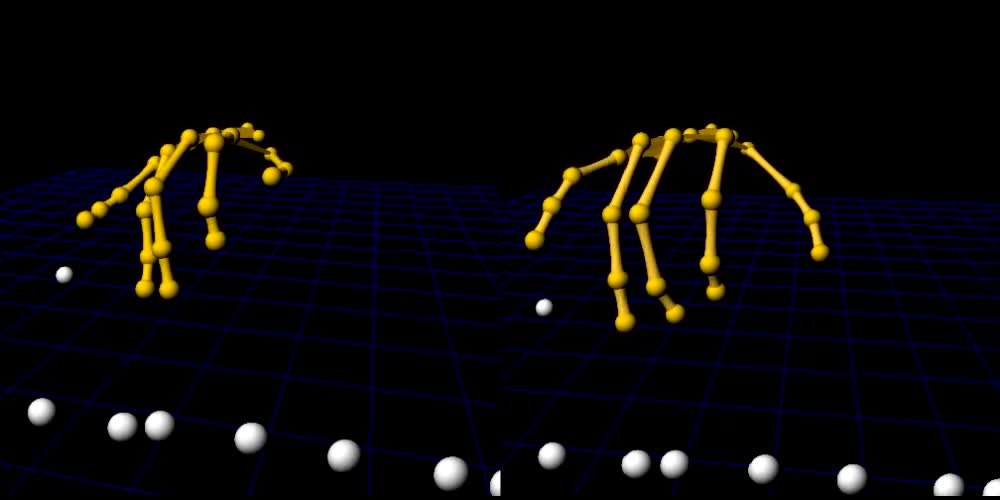
Motion capture (sometimes referred as mocap or mo-cap, for short) is the process of recording high-resolution movement of objects or people into a computer system. It is used in military, entertainment, sports, medical applications, and for validation of computer vision and robots.
In films, television shows and video games, motion capture refers to recording actions of human actors and using that information to animate digital character models in 2D or 3D computer animation. When it includes face and fingers or captures subtle expressions, it is often referred to as performance capture. In many fields, motion capture is sometimes called motion tracking, but in filmmaking and games, motion tracking usually refers more to match moving.
In motion capture sessions, movements of one or more actors are sampled many times per second. Whereas early techniques used images from multiple cameras to calculate 3D positions, often the purpose of motion capture is to record only the movements of the actor, not their visual appearance. This animation data is mapped to a 3D model so that the model performs the same actions as the actor. This process may be contrasted with the older technique of rotoscoping.
Camera movements can also be motion captured so that a virtual camera in the scene will pan, tilt or dolly around the stage driven by a camera operator while the actor is performing. At the same time, the motion capture system can capture the camera and props as well as the actor's performance. This allows the computer-generated characters, images and sets to have the same perspective as the video images from the camera. A computer processes the data and displays the movements of the actor, providing the desired camera positions in terms of objects in the set. Retroactively obtaining camera movement data from the captured footage is known as match moving or camera tracking.
The first virtual actor animated by motion-capture was produced in 1993 by Didier Pourcel and his team at Gribouille. It involved "cloning" the body and face of French comedian Richard Bohringer, and then animating it with still-nascent motion-capture tools.
Motion capture offers several advantages over traditional computer animation of a 3D model:
There are many applications of motion capture. The most common are for video games, movies, and movement capture, however there is a research application for this technology being used at Purdue University in robotics development.
Video games often use motion capture to animate athletes, martial artists, and other in-game characters. As early as 1988, an early form of motion capture was used to animate the 2D player characters of Martech's video game Vixen (performed by model Corinne Russell) and Magical Company's 2D arcade fighting game Last Apostle Puppet Show (to animate digitized sprites). Motion capture was later notably used to animate the 3D character models in the Sega Model arcade games Virtua Fighter (1993) and Virtua Fighter 2 (1994). In mid-1995, developer/publisher Acclaim Entertainment had its own in-house motion capture studio built into its headquarters. Namco's 1995 arcade game Soul Edge used passive optical system markers for motion capture. Motion capture also uses athletes in based-off animated games, such as Naughty Dog's Crash Bandicoot, Insomniac Games' Spyro the Dragon, and Rare's Dinosaur Planet.
Hub AI
Motion capture AI simulator
(@Motion capture_simulator)
Motion capture
Motion capture (sometimes referred as mocap or mo-cap, for short) is the process of recording high-resolution movement of objects or people into a computer system. It is used in military, entertainment, sports, medical applications, and for validation of computer vision and robots.
In films, television shows and video games, motion capture refers to recording actions of human actors and using that information to animate digital character models in 2D or 3D computer animation. When it includes face and fingers or captures subtle expressions, it is often referred to as performance capture. In many fields, motion capture is sometimes called motion tracking, but in filmmaking and games, motion tracking usually refers more to match moving.
In motion capture sessions, movements of one or more actors are sampled many times per second. Whereas early techniques used images from multiple cameras to calculate 3D positions, often the purpose of motion capture is to record only the movements of the actor, not their visual appearance. This animation data is mapped to a 3D model so that the model performs the same actions as the actor. This process may be contrasted with the older technique of rotoscoping.
Camera movements can also be motion captured so that a virtual camera in the scene will pan, tilt or dolly around the stage driven by a camera operator while the actor is performing. At the same time, the motion capture system can capture the camera and props as well as the actor's performance. This allows the computer-generated characters, images and sets to have the same perspective as the video images from the camera. A computer processes the data and displays the movements of the actor, providing the desired camera positions in terms of objects in the set. Retroactively obtaining camera movement data from the captured footage is known as match moving or camera tracking.
The first virtual actor animated by motion-capture was produced in 1993 by Didier Pourcel and his team at Gribouille. It involved "cloning" the body and face of French comedian Richard Bohringer, and then animating it with still-nascent motion-capture tools.
Motion capture offers several advantages over traditional computer animation of a 3D model:
There are many applications of motion capture. The most common are for video games, movies, and movement capture, however there is a research application for this technology being used at Purdue University in robotics development.
Video games often use motion capture to animate athletes, martial artists, and other in-game characters. As early as 1988, an early form of motion capture was used to animate the 2D player characters of Martech's video game Vixen (performed by model Corinne Russell) and Magical Company's 2D arcade fighting game Last Apostle Puppet Show (to animate digitized sprites). Motion capture was later notably used to animate the 3D character models in the Sega Model arcade games Virtua Fighter (1993) and Virtua Fighter 2 (1994). In mid-1995, developer/publisher Acclaim Entertainment had its own in-house motion capture studio built into its headquarters. Namco's 1995 arcade game Soul Edge used passive optical system markers for motion capture. Motion capture also uses athletes in based-off animated games, such as Naughty Dog's Crash Bandicoot, Insomniac Games' Spyro the Dragon, and Rare's Dinosaur Planet.