


Community hub
Recent from talks
Contribute something
Nothing was collected or created yet.
Orange walk
View on Wikipedia

Orange walks, or Orange marches, are a series of parades by members of the Orange Order and other Protestant fraternal societies, held during the summer months in various Commonwealth nations, and most notably across Northern Ireland. The parades typically build up to 12 July celebrations marking Prince William of Orange's victory over King James II and VII at the Battle of the Boyne in 1690.
Orange walks are considered controversial[1][2] and face opposition from Catholics,[2] Irish nationalists, and Scottish nationalists[3] who see the parades as sectarian and triumphalist. They have also drawn criticism in recent years from other religious communities, left-wing groups, and trade unions.[4]
The "marching season"
[edit]
The "marching season" generally refers to the months April to August in Northern Ireland and includes marches by groups such as the Apprentice Boys of Derry, and the Royal Black Institution as well as the Orange Order. The Orange Order is arguably the most active marching group. Typically, each Orange Lodge holds its own march at some time before 12 July, accompanied by at least one marching band. On 12 July each district holds a larger parade consisting of all the lodges in that district, and sometimes including lodges from outside Northern Ireland. This is particularly the case with the Belfast district, whose parade commonly features several Scottish lodges and often some from other countries. In most districts, the parade's location varies from year to year, rotating through suitable towns. Belfast is an exception; it has kept more or less the same route for many decades. The only major parade after the Twelfth is on the last Sunday in October, when lodges celebrate Reformation Day by parading to church.
Some walks commemorate historic events. Most notably, 12 July marches observe the Battle of the Boyne. Marches in Northern Ireland on and around 1 July originally commemorated the participation of the 36th (Ulster) Division in the Battle of the Somme. Since the beginning of the Troubles, most of these parades have evolved into the "mini Twelfth", and have little obvious connection with World War I.
There are still a few explicitly commemorative parades.[5] Reformation Day parades honour Martin Luther, who nailed his 95 theses to the church door in Wittenberg, starting the Reformation that brought about the Protestant churches.
Form of parades
[edit]
All Orange walks include at least one lodge, with officers. The lodge is almost always accompanied by a marching band, often a flute band, but also fife and drum, silver, brass and accordion bands. Participants range from as few as one lodge, up to dozens of lodges for major events such as the Twelfth. Elderly or infirm lodge members often travel the parade route in vehicles such as black taxis.
In recent decades, it has become much more common for members of ladies' lodges to walk, although men still greatly outnumber them in most parades. Larger walks, especially on the Twelfth, may be headed by a figure on a white horse dressed as William of Orange. A few parades include others in historical fancy dress; or, more rarely, a float, such as that constructed for the 1990 Twelfth celebrations to represent the Mountjoy, the ship which lifted the Siege of Derry.
Regalia and accessories
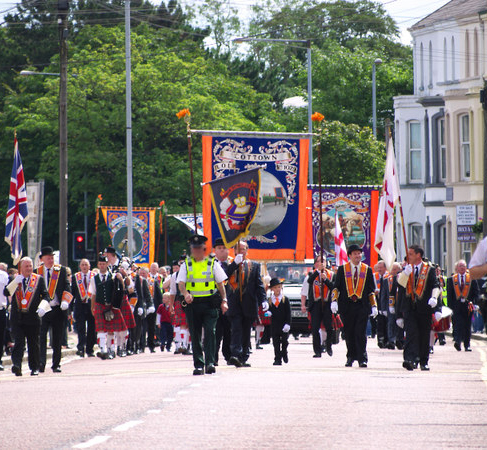
[edit]Parading Orangemen usually wear dark suits. Some Orangemen wear bowler hats and walk with umbrellas, although it is not mandatory. Walkers wear V-shaped orange collarettes (often inaccurately referred to as sashes) bearing the number of their lodge, and often badges showing degrees awarded within the institution, and positions held in the lodge. Some lodge officers also wear elaborate cuffs, and many walkers wear white gloves, although has become less common. Most lodges carry at least one flag, most commonly the Union Flag. Other common flags include the Ulster Banner, the Flag of Scotland and the Orange Order flag. Lodges also usually carry a banner with the lodge's name and number, and usually depicting William of Orange on at least one side. Other popular banner subjects include deceased lodge members, local landmarks, and the Bible with a Crown.

Bands
[edit]Typically, there is one band per lodge. Some bands have formal connections with the lodge, but in most cases it is simply hired for the day. Bands and lodges pair up by word of mouth, through the band or lodge advertising in Protestant publications such as the Orange Standard, or as a result of a lodge member hearing the recordings many bands produce. Most bands have a strongly Protestant ethos and display bannerettes and flags associated with loyalism, and in some cases, paramilitary groups. Many are associated with or named after Protestant areas such as the Shankill Road in Belfast, although the number of "Shankill Road" bands suggest that many of their members must also be from elsewhere. In 1985, concerned that some bands' behaviour was bringing the Order into disrepute, the Grand Orange Lodge instituted a system of contracts requiring bands to behave appropriately. According to writer and former Orangeman Brian Kennaway, the contracts have been largely ineffective, mostly because of the Order's reluctance to enforce them.[6]
Controversy
[edit]Throughout the history of the Orange Order, Orange walks have faced opposition, both from Catholics and nationalists, who have seen them as sectarian and triumphalist; and from the general public, due to inconvenience and controversies associated with them. Although many nationalists find the parades offensive, conflict usually arises only when a walk passes through or near a Catholic-dominated area. During The Troubles, many marchers were verbally abused, had objects thrown at them, and were involved in abusing onlookers, something walkers following the march still do today.[7] The marching season requires a significant police presence to avert violence. In the early 1970s, parading was banned on several occasions, although never on 12 July.[8]
Currently, of the more than 2000 annual parades in Northern Ireland, only a handful are considered majorly contentious. The best known is the Drumcree conflict. The Drumcree area, near Portadown has a history of parading disputes going back to the 19th century. The current dispute centres on the refusal of the Parades Commission to allow the Portadown lodge through the Catholic Garvaghy Road during their annual celebrations in early July.[9] The conflict led to severe rioting in the late 1990s, but the area has been relatively calm in recent years.
Parade opponents in Drumcree and elsewhere have put forward several arguments against the parades:
- That they are sectarian regardless of their route
- That they celebrate the defeat of Irish Catholicism
- That when they go through majority- or traditionally-Catholic areas, they are particularly insulting and triumphalist
- That they cause serious inconvenience to residents, as roads must be closed and, in particularly contentious areas, access to the roads denied
One observer has argued that the Orange Institution and its demonstrations deny Nationalists and Catholics their human rights.[10]
The Orange Order and its supporters have countered that:
- The parades are not sectarian, and that any sectarian activity or violence is perpetuated by outsiders and "hangers-on" over whom the Order has no control
- That inconvenience is caused mostly by the need for police to protect marchers from the violence of their opponents
- That the disputes are not actually about parading, but are a way for republicans to attack Protestantism.
They have also argued that they have a fundamental "right to march"—that any group should be able to walk down "the Queen's highway" without interference. In practice, however, the Order has tended to oppose marches by republicans and other "disloyal" groups on the grounds that there is no right to parade sedition.
The Order has a policy of non-negotiation with residents' groups, as it believes they are dominated by Sinn Féin and do not represent residents' actual opinions.[11]
In a 2011 survey of Orangemen throughout Northern Ireland, 58% said they should be allowed to march through nationalist areas with no restrictions, and 20% said they should negotiate with residents first.[12]
Walks outside of Northern Ireland
[edit]
Orange walks were once common throughout Ireland, especially on 12 July. Since partition, those in the Republic of Ireland have dwindled in number, due to the decline of the Protestant population of the Republic. The last walk in Dublin was in 1937.
The only remaining walks in the Republic take place in County Donegal and County Monaghan, Ulster counties which border Northern Ireland. Within County Donegal, several small Orange walks take place each year in East Donegal, while the main walk within the county takes place each year at Rossnowlagh in South Donegal.[13][14][15][16][17] A major Apprentice Boys 'demonstration' takes place each August in Raphoe, also in East Donegal.[citation needed] The annual picnic in Drum, County Monaghan features a small scale peaceful march. Another small scale march occurs annually at Killeevan.[17] A march organised by Love Ulster, a unionist group inspired by the Orange Order, was scheduled to be held in Dublin in 2006; however, the march was canceled when rioting broke out before it began.[18][19]
Orange walks continue across Scotland, but they are concentrated in Glasgow,[20] Lanarkshire,[21] Ayrshire,[22] Renfrewshire[23] and West Lothian.[24]
In 2003, a survey of 1,029 Scottish people revealed that 53% were either in favour or strongly in favour of banning Orange Walks, and 24% opposed banning them. Of these respondents, Catholics were more likely than Protestants to say that Orange Walks should be banned (66% and 39%, respectively).[25]
It is accepted that events such as national days are marked by parades by other organisations, religious and otherwise, such as the Scouts and the Boys' Brigade—but apart from one-off anniversaries such as centenaries, that tends to be the limit of such activity. This is in stark contrast to Orange Walks which—in some areas of Glasgow—can be seen and heard almost every day during parts of the summer months. Consequently, and also due to disproportionate costs, initiatives have been introduced to the Glasgow City Council to restrict the number of marches.[26]
This disconnect between the frequency of Orange walks and wider societal norms has caused the walks to be more broadly criticised as incitements to hatred and violence.[27] The Grand Orange Lodge of Scotland has supported police moves to fine spectators for sectarian activity.[28] Grand Master Ian Wilson has said: "All the effort that has gone into defending our interests can be destroyed by the stupidity of the few".[27]
Marches were common in Australia at the turn of the 20th century. The Kalgoorlie and Boulder marches in the 1890s and 1900s attracted conflict between Catholics and Protestant marchers. An increase in membership in recent years has seen a revival of the Orange Order in Australia, and an annual Twelfth of July parade is currently held in Adelaide.[29][non-primary source needed] In New Zealand, walks continued until at least the 1920s, but no longer take place.[30]
In Canada, Orange Walks on 12 July were once large public occasions, particularly in the provinces of Ontario and Newfoundland that have a strong Loyalist heritage dating from the time of the American Revolution. Toronto's Orange Parade has been held annually since 1821,[31][32] but its turnout has dwindled in recent decades. Some parades continue to be held in other parts of Canada. Orange walks have occurred in Liverpool.[33]

Notes
[edit]- ^ "Police call for action on sectarianism ahead of Orange walks". BBC News. 17 September 2021. Retrieved 18 September 2021.
- ^ a b Walker, David (16 September 2021). "Protests to be held at Catholic churches in Glasgow during the Orange Walk". Daily Record. Retrieved 18 September 2021.
- ^ Dornan, James (15 July 2021). "James Dornan: It's time to finally deal with bigotry in Scotland". The National.
- ^ "'Don't pass Catholic churches': protests as Glasgow braces for Orange walks". The Guardian. 18 September 2021. Retrieved 18 September 2021.
- ^ Helen Robinson, 'Remembering War in the Midst of Conflict: First World War Commemorations in the Northern Irish Troubles', 20th Century British History, 21, 1 92010), pp86-7.
- ^ Brian Kennaway, The Orange Order: A Tradition Betrayed, London, 2006, pp. 73–4.
- ^ "Calls for Orange walks to be rerouted after priest attack". BBC News. 11 July 2018.
- ^ 'Future policy on processions etc., First Report of the Joint Working Party on Processions etc. (Final Draft)', December 1970, p. 9, HA/32/2/39, Public Records Office of Northern Ireland.
- ^ "CAIN: Issues: Parades: Drumcree developments". Cain.ulst.ac.uk. Archived from the original on 19 July 2011. Retrieved 15 January 2013.
- ^ Mulholland P. (1999) Drumcree: A Struggle for Recognition. Irish Journal of Sociology Vol. 9
- ^ Orange Order press release. Archived 4 September 2006 at the Wayback Machine
- ^ "Order poll on Catholic 'IRA sympathy'" Archived 23 November 2011 at the Wayback Machine. UTV News. 22 November 2011. Retrieved 25 November 2011.
- ^ RTÉ Archives: War and Conflict – Orange Parade Rossnowlagh, 1984. Report by Tommie Gorman (broadcast on RTÉ News, 7 July 1984). https://www.rte.ie/archives/2019/0618/1056025-orangemen-march-in-donegal/
- ^ "Sun shines for Orange Order's Donegal parade". BBC News. 6 July 2019. Retrieved 6 March 2023.
- ^ Feeder Orange Parade halts traffic on main Letterkenny to Derry road (The Donegal Democrat, 12 July 2019). https://www.donegallive.ie/video/home/430727/feeder-parade-halts-traffic-on-main-letterkenny-to-derry-road.html
- ^ Doubts over 'Donegal Twelfth', but local parades get go-ahead (Donegal Daily, 2 June 2021). https://www.donegaldaily.com/2021/06/02/doubts-over-donegal-twelfth-but-local-parades-get-go-ahead
- ^ a b "Welcome to Drum – the only Protestant village in Republic of Ireland". Belfast Telegraph. 20 July 2016. ISSN 0307-1235. Retrieved 6 May 2024.
- ^ "Riots Prevent Loyalist March In Dublin". RTÉ Archives. 25 February 2006. Retrieved 6 May 2024.
- ^ McDonald, Henry (26 February 2006). "Orange march sparks Dublin riots". The Observer. ISSN 0029-7712. Retrieved 6 May 2024.
- ^ Lennon, Holly (30 June 2023). "Thousands to take part in city's biggest Orange parade of the year this weekend". Glasgow Live. Retrieved 6 May 2024.
- ^ "Orange parades 'pass peacefully'". BBC News. 5 July 2008. Retrieved 6 May 2024.
Police said the marches in Glasgow and Lanarkshire passed peacefully.
- ^ Dunn, Ross (2 July 2022). "Ayrshire orange walk route disclosed as more than 3000 expected to march today". Daily Record. Retrieved 6 May 2024.
- ^ "Orange Order parades to take place across Renfrewshire this weekend". The London Gazette. 8 August 2017. Retrieved 6 May 2024.
- ^ Fairnie, Robert (5 July 2019). "Orange Walk in West Lothian resulting in road closures this weekend". Edinburgh Live. Retrieved 6 May 2024.
- ^ "Sectarianism in Glasgow – Final Report". NFO Social Research for Glasgow City Council. January 2003. Retrieved 7 July 2018.
- ^ "Orange parades to be limited in Glasgow city centre". BBC. 9 December 2010. Retrieved 1 September 2020.
- ^ a b Tolmie, Andrew (26 June 2005). "Bigots hijack Orange parade". Sunday Mirror. Retrieved 10 March 2010.
- ^ "Warning to bigots over Orange Walk behaviour". Evening Times. 4 July 2008. Retrieved 1 September 2020.
- ^ "Official Loyal Orange Institution of South Australia Facebook Page" – via Facebook.
- ^ Ruth Dudley Edwards, The Faithful Tribe: An Intimate Portrait of the Loyal Institutions, London, 2000, p. 136.
- ^ Jenny, Yuen (9 July 2011). "Toronto's Orange parade marches through history". Toronto Sun.
- ^ "Upcoming events". Grand Orange Lodge of Canada. Retrieved 5 July 2014.
Toronto's 194rd Annual Orange Parade Saturday July 12th, 2014
- ^ Administrator, liverpoolecho (11 May 2008). "Orange Order's Capital of Culture parade".
Orange walk
View on GrokipediaHistory
Origins in the Late 18th Century
The Orange Order, which organized the earliest Orange walks, originated amid escalating sectarian tensions in Ulster during the 1790s, particularly in County Armagh, where Protestant Peep o' Day Boys clashed with Catholic Defenders over land tenancy disputes, economic grievances, and fears of Catholic mobilization influenced by the United Irishmen and the French Revolution.[9][2] These conflicts reflected broader anxieties among Protestants about eroding ascendancy in the face of potential Catholic emancipation and republican agitation, prompting defensive Protestant associations to formalize.[10] The pivotal event occurred on September 21, 1795, at the Battle of the Diamond near Loughgall, where approximately 1,300 Peep o' Day Boys ambushed and routed around 300 Defenders, killing up to 30 Catholics and wounding others, while suffering minimal losses themselves.[11][2] This victory triggered widespread Protestant reprisals, displacing over 7,000 Catholics from south Armagh in subsequent weeks. Later that same evening, surviving Protestant leaders, including Daniel Winter, James Sloan, and James Wilson, convened at Winter's cottage in Loughgall to establish the Orange Society—named for William III, Prince of Orange—as a fraternal order bound by oaths to defend the Protestant constitution, reject Catholic influence, and maintain loyalty to the House of Hanover.[2][12] The society's rules emphasized mutual defense, secrecy in early lodges, and public demonstrations of faith and allegiance, drawing initial membership from agrarian Protestants wary of both Catholic secret societies and government tolerance of them.[9] Orange walks first appeared as organized public marches shortly after the order's formation, serving as visible assertions of Protestant unity and deterrence against further attacks. The earliest documented parades took place on July 12, 1796—the 106th anniversary of William's victory at the Battle of the Boyne—in Portadown, Lurgan, and Waringstown, featuring lodge members in orange sashes, banners emblazoned with biblical and loyalist motifs, and rudimentary fife-and-drum music to rally participants and spectators.[12] These processions, initially modest with hundreds of marchers, commemorated the Glorious Revolution of 1688 while signaling communal resolve amid ongoing violence, though they occasionally sparked clashes, as in a 1796 Portadown incident resulting in one death. By 1797–1798, as lodges proliferated to over 100 in Ulster, larger walks in Belfast and Lisburn drew thousands, intertwining religious observance with political defiance against the 1798 Rebellion's perceived Catholic undertones.[12][13]Expansion and Institutionalization in the 19th Century
The establishment of the Grand Orange Lodge of Ireland on 21 April 1798 marked a pivotal step in the Order's institutionalization, creating a centralized authority to coordinate disparate lodges formed since 1795 and standardize rituals, oaths, and governance structures.[14] [15] This framework addressed early fragmentation amid sectarian violence, such as clashes with Catholic Defenders, enabling coordinated expansion across Ulster where lodges proliferated in response to fears of republicanism following the 1798 Irish Rebellion.[2] By simplifying degrees—such as the Orange Degree in 1800 and the Plain Purple Degree in 1820—the Order formalized its fraternal and commemorative practices, including annual walks that evolved from ad hoc gatherings into structured public demonstrations of loyalty to the Protestant succession.[2] Geographic expansion accelerated in the early 19th century as Irish Protestant soldiers and migrants transplanted lodges to Great Britain, with initial introductions to England and Scotland by 1798 via yeomanry units.[16] In England, growth concentrated in industrial centers like Liverpool, where a 1819 lodge attack spurred defensive organization and walks; in Scotland, early lodges emerged in Ayrshire, leading to the first recorded Orange walk in 1821, though subsequent violence prompted temporary halts.[16] These translocations reflected causal ties to economic migration and military service, fostering affiliated institutions that mirrored Irish models, including district and provincial grand lodges to oversee parades and mutual aid.[16] Legislative challenges tested but ultimately reinforced institutional resilience; the Unlawful Societies Act of 1825 and Party Processions Act of 1832 banned Orange processions, suppressing overt walks and driving activities clandestine, yet underground networks sustained the Order's core amid Catholic Emancipation in 1829, which heightened Protestant anxieties over ascendancy.[15] Defiance peaked in 1867 when William Johnston organized an illegal 12 July march from Newtownards to Bangor, drawing thousands and resulting in his six-month imprisonment, an event that publicized the Order's commitment to civil liberties and boosted recruitment.[2] The 1872 repeal of procession bans enabled resurgence, with walks institutionalizing as unionist rituals against Home Rule agitation in the 1880s, when landlords and conservatives embraced the Order to rally Protestant solidarity.[2]Evolution During the 20th Century and the Troubles
In the decades following the partition of Ireland under the Government of Ireland Act 1920, Orange parades in Northern Ireland evolved into major public displays reinforcing Protestant unionist identity within the devolved Stormont government, where a significant proportion of ministers—87 of 95 unionist MPs elected by 1969—were Order members.[17] These events, particularly the annual Twelfth of July marches, drew large crowds, with Belfast parades often featuring processions of several miles involving thousands of participants from hundreds of lodges.[18] Parades were temporarily suspended during World War I (1914–1918) and World War II (1939–1945) owing to government-imposed restrictions on public gatherings and the repurposing of Orange halls for wartime needs, such as sheltering Blitz refugees.[19] Postwar resumption saw membership swell to a recorded peak of 93,447 in 1968, reflecting broad appeal among working-class Protestants amid relative political stability.[20] However, the late 1960s civil rights movement challenging unionist privileges foreshadowed heightened tensions, with the 1969 Twelfth marches triggering riots in Belfast, Derry, and Dungiven that displaced hundreds of families and accelerated the descent into the Troubles. From 1969 to 1998, the Troubles intensified scrutiny of parades traversing or bordering nationalist areas, transforming many from routine commemorations into symbols of contested space and loyalist defiance against perceived republican encroachment. Disputes proliferated in the 1970s and 1980s, often involving clashes between marchers, residents, and security forces, as Catholic communities increasingly demanded rerouting to avoid "triumphalist" processions past churches or housing estates.[7] The Order maintained that traditional routes constituted public rights-of-way, resisting changes as erosions of civil liberties, while opponents cited provocative elements like sectarian band tunes. Membership declined sharply during this era, falling to around 35,000 by the early 2000s, factors including urbanization, secularization, and the taint of violence-linked associations.[10] [21] The Drumcree disputes in Portadown epitomized this evolution, escalating from local standoffs to national crises. In 1995, the Royal Ulster Constabulary's initial blockage of the annual march along the nationalist Garvaghy Road after Drumcree Church prompted a 62-day protest encampment, resolved only by police concession allowing the route.[22] Renewed blockades in 1996 and 1997 sparked province-wide loyalist unrest, including arson and shootings that killed at least 18 people across incidents tied to the standoffs.[23] The 1998 Public Processions (Northern Ireland) Act established the Parades Commission, which banned the Drumcree parade's return leg down Garvaghy Road, prompting further riots but institutionalizing determinations based on public order and community relations criteria— a framework the Order contested as biased against Protestant traditions.[24] These events underscored parades' role in sustaining unionist morale amid IRA campaigns but also entrenched regulatory oversight, diminishing their unhindered scale by the Troubles' end.[8]Cultural and Religious Significance
Commemoration of the Glorious Revolution and Battle of the Boyne
The Glorious Revolution of 1688–1689 involved the deposition of the Catholic King James II and the ascension of his Protestant daughter Mary II and her husband William III, Prince of Orange, to the English throne, establishing Protestant dominance and constitutional limits on monarchical power.[25] William's invasion force landed at Brixham on November 5, 1688, leading to James's flight and the subsequent parliamentary settlement that barred Catholics from the throne via the Bill of Rights 1689 and Act of Settlement 1701.[26] Orange walks commemorate this event as a providential deliverance of Protestant Britain from absolutist Catholic rule, viewing it as foundational to civil and religious liberties secured against papal influence.[27] The Battle of the Boyne, fought on July 1, 1690 (Old Style), saw William III's forces decisively defeat James II's army along the River Boyne near Drogheda, Ireland, consolidating Williamite control and paving the way for the Treaty of Limerick, which entrenched Protestant ascendancy.[28] Due to the 1752 calendar reform adding 11 days, the battle's anniversary aligns with July 12 in the modern Gregorian calendar, the date of principal Orange parades known as the Twelfth.[28] These walks honor the victory as a pivotal moment ensuring the Glorious Revolution's outcomes extended to Ireland, preventing a Jacobite restoration and reinforcing the exclusion of Catholic monarchy.[29] In Orange processions, commemoration manifests through regalia such as orange sashes, collarettes, and banners depicting William crossing the Boyne, the relief of Derry, and biblical motifs of Protestant triumph, often accompanied by flute bands playing tunes like "The Sash My Father Wore" and "Lillibulero."[27] Parades culminate in church services, wreath-laying at war memorials, and speeches invoking the battles' legacy of defending the Reformation against "popery and arbitrary power," as articulated in Orange Order declarations. This ritualistic remembrance, rooted in the Order's 1795 founding amid sectarian tensions, underscores fidelity to the 1688 settlement and 1690 victory as bulwarks of Ulster Protestant identity.[30]Defense of Protestant Liberties and Unionist Identity
Orange walks embody the Orange Order's core mission to defend the civil and religious liberties secured for Protestants through the Glorious Revolution of 1688 and the Battle of the Boyne on July 12, 1690, when William III defeated James II, thereby preventing the imposition of Catholic absolutism and affirming parliamentary sovereignty under a Protestant monarch.[31] The parades publicly reaffirm loyalty to these foundational events, which the Order views as guarantors of constitutional protections against religious persecution and arbitrary rule.[2] In Northern Ireland, these processions serve as assertive expressions of Unionist identity, reinforcing communal solidarity among Protestants committed to maintaining the constitutional link with Great Britain amid pressures for Irish unification.[8] By marching through traditional routes, participants signal resilience against nationalist challenges, preserving cultural practices tied to British Protestant heritage and countering perceived erosion of their demographic and political predominance.[32] This role intensified during the Troubles (1968–1998), where parades like those at Drumcree in the 1990s became focal points for defending the right to public assembly as an extension of Protestant liberties.[33] The Order's principles, articulated as support for "civil and religious liberty for all without distinction of class or creed," underscore the walks' purpose in upholding a state that prioritizes Protestant scriptural standards while opposing ecclesiastical interference in governance.[31] Critics from nationalist perspectives often frame the events as triumphalist, yet Order statements emphasize their function in fostering mutual respect through adherence to Reformation ideals rather than sectarian dominance.[34] Participation in annual Twelfth of July parades, drawing thousands of marchers and spectators, sustains this identity by linking contemporary Unionism to historical defenses against Catholic Emancipation threats in the 19th century and republican violence in the 20th.[35]Role in Preserving British-Protestant Traditions
Orange walks function as a primary mechanism for the Orange Order to sustain British-Protestant cultural and religious heritage, particularly among Ulster Protestants and in Scottish loyalist communities. Established in 1795, the Order organizes these parades to publicly affirm Protestant principles derived from the Reformation and the victories of William III, ensuring that traditions such as loyalty to the British Crown and defense of civil and religious liberties remain active in communal life rather than fading into historical abstraction.[36][8] Beyond commemorating the Battle of the Boyne on July 12, these marches extend to other dates that reinforce broader Protestant narratives, including the anniversary of the Battle of the Somme on July 1—where Ulster Division losses in 1916 are honored through wreath-layings and solemn processions—and Reformation Sunday, highlighting doctrines like sola fide. Participants, clad in orange sashes and collarettes emblazoned with biblical motifs, march alongside flute bands and lambeg drummers performing hymns such as "The Sash My Father Wore" and "O God, Our Help in Ages Past," which embed scriptural teachings and historical allegiance into auditory tradition passed to youth.[1][37] This ritual continuity counters cultural erosion in regions facing demographic pressures, with parades drawing tens of thousands annually—such as the 2025 Twelfth events involving multiple districts across Northern Ireland—to foster intergenerational transmission of Ulster-Scots heritage and British unionism. By integrating church services, banner unveilings depicting Protestant martyrs, and oaths of loyalty, the walks embody a lived orthodoxy that prioritizes empirical fidelity to 17th-century constitutional settlements over modern ecumenism.[35][4]The Marching Season
Timeline and Key Commemorative Dates
The principal commemorative date for Orange walks is 12 July, known as "The Twelfth," marking the Gregorian calendar equivalent of the Battle of the Boyne on 1 July 1690 (Julian calendar), when William III's Protestant forces defeated James II's Catholic army near Drogheda, Ireland.[38] This victory is seen by participants as securing Protestant ascendancy and constitutional liberties in the British Isles.[12] Orange walks also evoke the Battle of Aughrim on 12 July 1691 (Julian), another decisive Protestant triumph that ended Jacobite resistance in Ireland.[38] The marching season, during which most Orange Order parades occur, spans from April to late August, with individual lodges often holding walks in the weeks leading to 12 July, accompanied by bands and culminating in major district demonstrations on The Twelfth itself, a public holiday in Northern Ireland.[39] These pre-Twelfth events allow smaller-scale commemorations, while The Twelfth features the largest assemblies, such as those in Belfast and other provincial centers.[40] Historically, the parades trace to the Orange Order's founding on 12 September 1795 amid sectarian clashes in County Armagh, with the first documented walks occurring on 12 July 1796 at Portadown, Lurgan, and Waringstown to honor the Boyne battle.[38] By 1798, larger processions had expanded to Belfast and Lisburn, institutionalizing the annual tradition despite periodic bans, such as the 1832 prohibition lifted after protests.[12] Subsequent key developments include the 1867 Bangor parade led by Rev. Thomas Drew in defiance of restrictions, reinforcing the parades' role in asserting civil rights.[2]| Key Date | Event |
|---|---|
| 1 July 1690 (Julian; 12 July Gregorian) | Battle of the Boyne; foundational victory commemorated annually.[38] |
| 12 July 1691 (Julian) | Battle of Aughrim; secondary but aligned commemoration.[38] |
| 12 September 1795 | Formation of the Orange Order in Loughgall, Armagh.[38] |
| 12 July 1796 | Inaugural Orange parades at Portadown, Lurgan, and Waringstown.[12] |
| April–August (annual) | Marching season, peaking on 12 July with district-wide events.[39] |