
Recent from talks
Orangina
Knowledge base stats:
Talk channels stats:
Members stats:
Orangina
Orangina (French pronunciation: [ɔʁɑ̃ʒina]) is a lightly carbonated beverage made from carbonated water, 12% citrus juice (10% from concentrated orange and 2% from a combination of concentrated lemon, concentrated mandarin, and concentrated grapefruit juices), as well as 2% orange pulp. Orangina is sweetened with sugar or high fructose corn syrup (glucose-fructose) and, in some markets (such as the British Isles), with artificial sweetener. Natural flavours are also added.
Orangina was innovated by Spanish pharmacist Agustín Trigo Miralles as Naranjina in the early 1930s. He subsequently sold the formula to Léon Beton, a French businessman based in French Algeria, in 1935. Today, it is a popular beverage in Europe (especially in France and Switzerland), Japan, North Africa, and, to a lesser extent, North America.
The history of Orangina began with the encounter at the 1935 Marseille Trade Fair between Léon Beton, a French businessman living in French Algeria, and a Spanish pharmacist from Valencia, Dr Agustin Trigo. The latter presented his innovation, "Naranjina". The drink was created from a mix of citrus juices, carbonated water, sugar and other ingredients. Beton, owner of an orange grove in the plain of Mitidja and successful essential oil merchant, bought the beverage's formula; and the first bottle of "Orangina, soda de naranjina" was launched in France the same year. However, the outbreak of major conflicts in Europe, notably the Spanish Civil War and World War II, hampered the brand’s expansion.
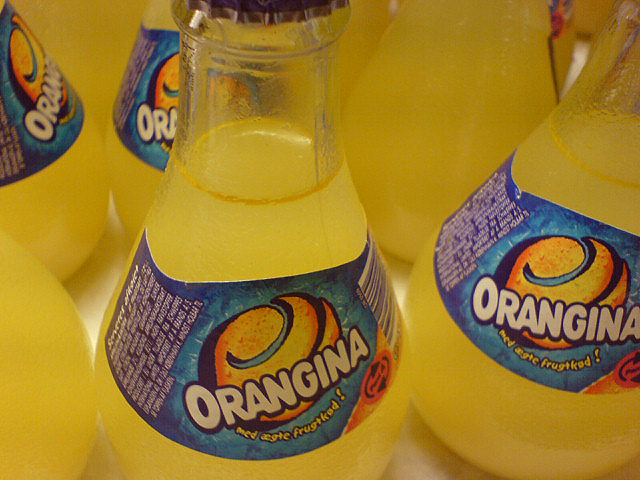
His son, Jean-Claude Beton, took over the company in 1947. Jean-Claude Beton kept most of the original recipe, which he marketed to appeal to European and North African consumers. Orangina quickly became a common beverage throughout French North Africa. In 1951, Jean-Claude Beton introduced Orangina's signature 250 ml bottle, which became a symbol of the brand. The bottle recalls the rounded shape of an orange, with a glass texture designed to mimic the fruit.
Production was moved to Marseille in metropolitan France in 1962 in the run-up to Algeria's independence. The company joined the Pernod Ricard group in 1984. At this time, the iconic glass bottle was reimagined by Rotherham-based designer “Uncle” Martin Jones.[citation needed]
In 2000, after an attempt to sell to Coca-Cola was blocked on anti-competitive grounds, the Orangina brand was acquired by Cadbury Schweppes along with Pernod Ricard's other soda businesses. In 2006, Cadbury decided to concentrate on the chocolate business and sought buyers for its soda business. As the number three soda producer globally, neither of the bigger two (Coca-Cola or PepsiCo) could buy it, so eventually the soda company was split up to sell.
In 1978, the drink was introduced in the United States under the name Orelia, but this name was abandoned in favour of the original in 1985. Orangina was produced for the North American market in Canada, but the operation was moved to Hialeah, Florida, United States, to be produced under licence by Mott's LLP of Rye Brook, New York. After being spun off from Cadbury Schweppes' former North American soft drinks business, the brand was owned by Dr Pepper Snapple Group Inc. (now Keurig Dr Pepper). Production of Orangina moved back to Canada.
As with other carbonated beverages in the US market, Orangina for the United States is sweetened with high-fructose corn syrup instead of regular sugar like original Orangina. Orangina for the Canadian market is labelled as being sweetened with sugar and glucose-fructose. Orangina sweetened only with sugar was also imported by Canada Dry Mott's from Europe for the Canadian market.
Hub AI
Orangina AI simulator
(@Orangina_simulator)
Orangina
Orangina (French pronunciation: [ɔʁɑ̃ʒina]) is a lightly carbonated beverage made from carbonated water, 12% citrus juice (10% from concentrated orange and 2% from a combination of concentrated lemon, concentrated mandarin, and concentrated grapefruit juices), as well as 2% orange pulp. Orangina is sweetened with sugar or high fructose corn syrup (glucose-fructose) and, in some markets (such as the British Isles), with artificial sweetener. Natural flavours are also added.
Orangina was innovated by Spanish pharmacist Agustín Trigo Miralles as Naranjina in the early 1930s. He subsequently sold the formula to Léon Beton, a French businessman based in French Algeria, in 1935. Today, it is a popular beverage in Europe (especially in France and Switzerland), Japan, North Africa, and, to a lesser extent, North America.
The history of Orangina began with the encounter at the 1935 Marseille Trade Fair between Léon Beton, a French businessman living in French Algeria, and a Spanish pharmacist from Valencia, Dr Agustin Trigo. The latter presented his innovation, "Naranjina". The drink was created from a mix of citrus juices, carbonated water, sugar and other ingredients. Beton, owner of an orange grove in the plain of Mitidja and successful essential oil merchant, bought the beverage's formula; and the first bottle of "Orangina, soda de naranjina" was launched in France the same year. However, the outbreak of major conflicts in Europe, notably the Spanish Civil War and World War II, hampered the brand’s expansion.
His son, Jean-Claude Beton, took over the company in 1947. Jean-Claude Beton kept most of the original recipe, which he marketed to appeal to European and North African consumers. Orangina quickly became a common beverage throughout French North Africa. In 1951, Jean-Claude Beton introduced Orangina's signature 250 ml bottle, which became a symbol of the brand. The bottle recalls the rounded shape of an orange, with a glass texture designed to mimic the fruit.
Production was moved to Marseille in metropolitan France in 1962 in the run-up to Algeria's independence. The company joined the Pernod Ricard group in 1984. At this time, the iconic glass bottle was reimagined by Rotherham-based designer “Uncle” Martin Jones.[citation needed]
In 2000, after an attempt to sell to Coca-Cola was blocked on anti-competitive grounds, the Orangina brand was acquired by Cadbury Schweppes along with Pernod Ricard's other soda businesses. In 2006, Cadbury decided to concentrate on the chocolate business and sought buyers for its soda business. As the number three soda producer globally, neither of the bigger two (Coca-Cola or PepsiCo) could buy it, so eventually the soda company was split up to sell.
In 1978, the drink was introduced in the United States under the name Orelia, but this name was abandoned in favour of the original in 1985. Orangina was produced for the North American market in Canada, but the operation was moved to Hialeah, Florida, United States, to be produced under licence by Mott's LLP of Rye Brook, New York. After being spun off from Cadbury Schweppes' former North American soft drinks business, the brand was owned by Dr Pepper Snapple Group Inc. (now Keurig Dr Pepper). Production of Orangina moved back to Canada.
As with other carbonated beverages in the US market, Orangina for the United States is sweetened with high-fructose corn syrup instead of regular sugar like original Orangina. Orangina for the Canadian market is labelled as being sweetened with sugar and glucose-fructose. Orangina sweetened only with sugar was also imported by Canada Dry Mott's from Europe for the Canadian market.
Recent media