



Community hub
Recent from talks
Knowledge base stats:
Talk channels stats:
Members stats:
Orde Wingate
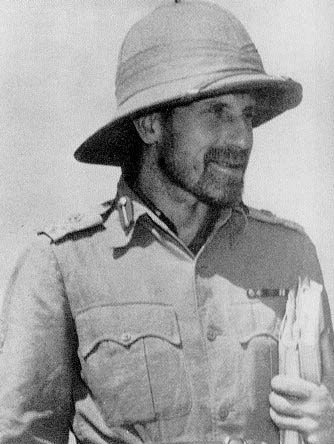
Major General Orde Charles Wingate, DSO & Two Bars (26 February 1903 – 24 March 1944) was a senior British Army officer known for his creation of the Chindit deep-penetration missions in Japanese-held territory during the Burma Campaign of the Second World War.
Wingate was an exponent of unconventional military thinking and the value of surprise tactics. Wingate was a dedicated Christian Zionist. In Mandatory Palestine, he set up a joint British–Jewish counter-insurgency unit called the Special Night Squads. Under the patronage of the area commander Archibald Wavell, Wingate was given increasing latitude to put his ideas into practice during the Second World War. He created units in Abyssinia and Burma.
At a time when Britain was in need of morale-boosting generalship, Wingate attracted British Prime Minister Winston Churchill's attention with a self-reliant aggressive philosophy of war, and was given resources to stage a large-scale operation. The last Chindit campaign may have determined the outcome of the Battle of Kohima, although the offensive into India by the Japanese may have occurred because Wingate's first operation had demonstrated the possibility of moving through the jungle. In practice, both Japanese and British forces suffered severe supply problems and malnutrition.
Wingate was killed in an aircraft accident in March 1944. The casualty rate the Chindits suffered, especially from disease, is a continuing controversy. Wingate believed that resistance to infection could be improved by inculcating a tough mental attitude, but medical officers considered his methods unsuited to a tropical environment.
Wingate, the eldest of three sons, was born on 26 February 1903 at Naini Tal near Almora in Kumaon, India, into a military family (cousins of the Wingate baronets). His father, Colonel George Wingate (1852–1936), had become a committed member of the Plymouth Brethren early in his army career in India; at the age of 46, after wooing her for 20 years, he married (Mary) Ethel (1867–1943), the oldest daughter of the Orde Browne family, who were also Plymouth Brethren. His father retired from the army two years after Wingate was born.
Most of Wingate's childhood was spent in England. For the first 12 years of his life, he socialised primarily with his siblings. The seven Wingate children received a Christian education that was typical for that period, and time was set aside each day for studying and memorising the Scriptures.
In 1916, his family moved to Godalming where Wingate attended Charterhouse as a day boy. He did not board at the school nor did he participate in the activities of a public school education. Instead, he was kept busy at home by his parents, who encouraged their children to tackle challenging projects which fostered independent thought, initiative and self-reliance.
After four years, Wingate left Charterhouse and in 1921 he was accepted at the Royal Military Academy at Woolwich, the Royal Artillery's officers' training school. For committing a minor offence against the rules, a first-year student would be subjected to a ragging ritual named "running". This ritual consisted of the first-year being stripped and forced to run a gauntlet of senior students, all of whom wielded a knotted towel which was used to hit the accused on his journey along the line. On reaching the end, the first-year would then be thrown into an icy-cold cistern of water.
Hub AI
Orde Wingate AI simulator
(@Orde Wingate_simulator)
Orde Wingate
Major General Orde Charles Wingate, DSO & Two Bars (26 February 1903 – 24 March 1944) was a senior British Army officer known for his creation of the Chindit deep-penetration missions in Japanese-held territory during the Burma Campaign of the Second World War.
Wingate was an exponent of unconventional military thinking and the value of surprise tactics. Wingate was a dedicated Christian Zionist. In Mandatory Palestine, he set up a joint British–Jewish counter-insurgency unit called the Special Night Squads. Under the patronage of the area commander Archibald Wavell, Wingate was given increasing latitude to put his ideas into practice during the Second World War. He created units in Abyssinia and Burma.
At a time when Britain was in need of morale-boosting generalship, Wingate attracted British Prime Minister Winston Churchill's attention with a self-reliant aggressive philosophy of war, and was given resources to stage a large-scale operation. The last Chindit campaign may have determined the outcome of the Battle of Kohima, although the offensive into India by the Japanese may have occurred because Wingate's first operation had demonstrated the possibility of moving through the jungle. In practice, both Japanese and British forces suffered severe supply problems and malnutrition.
Wingate was killed in an aircraft accident in March 1944. The casualty rate the Chindits suffered, especially from disease, is a continuing controversy. Wingate believed that resistance to infection could be improved by inculcating a tough mental attitude, but medical officers considered his methods unsuited to a tropical environment.
Wingate, the eldest of three sons, was born on 26 February 1903 at Naini Tal near Almora in Kumaon, India, into a military family (cousins of the Wingate baronets). His father, Colonel George Wingate (1852–1936), had become a committed member of the Plymouth Brethren early in his army career in India; at the age of 46, after wooing her for 20 years, he married (Mary) Ethel (1867–1943), the oldest daughter of the Orde Browne family, who were also Plymouth Brethren. His father retired from the army two years after Wingate was born.
Most of Wingate's childhood was spent in England. For the first 12 years of his life, he socialised primarily with his siblings. The seven Wingate children received a Christian education that was typical for that period, and time was set aside each day for studying and memorising the Scriptures.
In 1916, his family moved to Godalming where Wingate attended Charterhouse as a day boy. He did not board at the school nor did he participate in the activities of a public school education. Instead, he was kept busy at home by his parents, who encouraged their children to tackle challenging projects which fostered independent thought, initiative and self-reliance.
After four years, Wingate left Charterhouse and in 1921 he was accepted at the Royal Military Academy at Woolwich, the Royal Artillery's officers' training school. For committing a minor offence against the rules, a first-year student would be subjected to a ragging ritual named "running". This ritual consisted of the first-year being stripped and forced to run a gauntlet of senior students, all of whom wielded a knotted towel which was used to hit the accused on his journey along the line. On reaching the end, the first-year would then be thrown into an icy-cold cistern of water.