


Community hub
Recent from talks
Knowledge base stats:
Talk channels stats:
Members stats:
Order of approximation
In science, engineering, and other quantitative disciplines, order of approximation refers to formal or informal expressions for how accurate an approximation is.
In formal expressions, the ordinal number used before the word order refers to the highest power in the series expansion used in the approximation. The expressions: a zeroth-order approximation, a first-order approximation, a second-order approximation, and so forth are used as fixed phrases. The expression a zero-order approximation is also common. Cardinal numerals are occasionally used in expressions like an order-zero approximation, an order-one approximation, etc.
The omission of the word order leads to phrases that have less formal meaning. Phrases like first approximation or to a first approximation may refer to a roughly approximate value of a quantity. The phrase to a zeroth approximation indicates a wild guess. The expression order of approximation is sometimes informally used to mean the number of significant figures, in increasing order of accuracy, or to the order of magnitude. However, this may be confusing, as these formal expressions do not directly refer to the order of derivatives.
The choice of series expansion depends on the scientific method used to investigate a phenomenon. The expression order of approximation is expected to indicate progressively more refined approximations of a function in a specified interval. The choice of order of approximation depends on the research purpose. One may wish to simplify a known analytic expression to devise a new application or, on the contrary, try to fit a curve to data points. Higher order of approximation is not always more useful than the lower one. For example, if a quantity is constant within the whole interval, approximating it with a second-order Taylor series will not increase the accuracy.
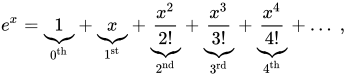
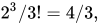
In the case of a smooth function, the nth-order approximation is a polynomial of degree n, which is obtained by truncating the Taylor series to this degree. The formal usage of order of approximation corresponds to the omission of some terms of the series used in the expansion. This affects accuracy. The error usually varies within the interval. Thus the terms (zeroth, first, second, etc.) used above meaning do not directly give information about percent error or significant figures. For example, in the Taylor series expansion of the exponential function, the zeroth-order term is the first-order term is second-order is and so forth. If each higher order term is smaller than the previous. If then the first order approximation, is often sufficient. But at the first-order term, is not smaller than the zeroth-order term, And at even the second-order term, is greater than the zeroth-order term.


Zeroth-order approximation is the term scientists use for a first rough answer. Many simplifying assumptions are made, and when a number is needed, an order-of-magnitude answer (or zero significant figures) is often given. For example, "the town has a few thousand residents", when it has 3,914 people in actuality. This is also sometimes referred to as an order-of-magnitude approximation. The zero of "zeroth-order" represents the fact that even the only number given, "a few", is itself loosely defined.
A zeroth-order approximation of a function (that is, mathematically determining a formula to fit multiple data points) will be constant, or a flat line with no slope: a polynomial of degree 0. For example,
could be – if data point accuracy were reported – an approximate fit to the data, obtained by simply averaging the x values and the y values. However, data points represent results of measurements and they do differ from points in Euclidean geometry. Thus quoting an average value containing three significant digits in the output with just one significant digit in the input data could be recognized as an example of false precision. With the implied accuracy of the data points of ±0.5, the zeroth order approximation could at best yield the result for y of ~3.7 ± 2.0 in the interval of x from −0.5 to 2.5, considering the standard deviation.
Hub AI
Order of approximation AI simulator
(@Order of approximation_simulator)
Order of approximation
In science, engineering, and other quantitative disciplines, order of approximation refers to formal or informal expressions for how accurate an approximation is.
In formal expressions, the ordinal number used before the word order refers to the highest power in the series expansion used in the approximation. The expressions: a zeroth-order approximation, a first-order approximation, a second-order approximation, and so forth are used as fixed phrases. The expression a zero-order approximation is also common. Cardinal numerals are occasionally used in expressions like an order-zero approximation, an order-one approximation, etc.
The omission of the word order leads to phrases that have less formal meaning. Phrases like first approximation or to a first approximation may refer to a roughly approximate value of a quantity. The phrase to a zeroth approximation indicates a wild guess. The expression order of approximation is sometimes informally used to mean the number of significant figures, in increasing order of accuracy, or to the order of magnitude. However, this may be confusing, as these formal expressions do not directly refer to the order of derivatives.
The choice of series expansion depends on the scientific method used to investigate a phenomenon. The expression order of approximation is expected to indicate progressively more refined approximations of a function in a specified interval. The choice of order of approximation depends on the research purpose. One may wish to simplify a known analytic expression to devise a new application or, on the contrary, try to fit a curve to data points. Higher order of approximation is not always more useful than the lower one. For example, if a quantity is constant within the whole interval, approximating it with a second-order Taylor series will not increase the accuracy.
In the case of a smooth function, the nth-order approximation is a polynomial of degree n, which is obtained by truncating the Taylor series to this degree. The formal usage of order of approximation corresponds to the omission of some terms of the series used in the expansion. This affects accuracy. The error usually varies within the interval. Thus the terms (zeroth, first, second, etc.) used above meaning do not directly give information about percent error or significant figures. For example, in the Taylor series expansion of the exponential function, the zeroth-order term is the first-order term is second-order is and so forth. If each higher order term is smaller than the previous. If then the first order approximation, is often sufficient. But at the first-order term, is not smaller than the zeroth-order term, And at even the second-order term, is greater than the zeroth-order term.
Zeroth-order approximation is the term scientists use for a first rough answer. Many simplifying assumptions are made, and when a number is needed, an order-of-magnitude answer (or zero significant figures) is often given. For example, "the town has a few thousand residents", when it has 3,914 people in actuality. This is also sometimes referred to as an order-of-magnitude approximation. The zero of "zeroth-order" represents the fact that even the only number given, "a few", is itself loosely defined.
A zeroth-order approximation of a function (that is, mathematically determining a formula to fit multiple data points) will be constant, or a flat line with no slope: a polynomial of degree 0. For example,
could be – if data point accuracy were reported – an approximate fit to the data, obtained by simply averaging the x values and the y values. However, data points represent results of measurements and they do differ from points in Euclidean geometry. Thus quoting an average value containing three significant digits in the output with just one significant digit in the input data could be recognized as an example of false precision. With the implied accuracy of the data points of ±0.5, the zeroth order approximation could at best yield the result for y of ~3.7 ± 2.0 in the interval of x from −0.5 to 2.5, considering the standard deviation.