



Community hub
Recent from talks
Contribute something
Nothing was collected or created yet.
Significant figures
View on Wikipedia | This article needs additional citations for verification. (July 2013) |
| Fit approximation |
|---|
 |
| Concepts |
| Other fundamentals |
Significant figures, also referred to as significant digits, are specific digits within a number that is written in positional notation that carry both reliability and necessity in conveying a particular quantity. When presenting the outcome of a measurement (such as length, pressure, volume, or mass), if the number of digits exceeds what the measurement instrument can resolve, only the digits that are determined by the resolution are dependable and therefore considered significant.
For instance, if a length measurement yields 114.8 millimetres (mm), using a ruler with the smallest interval between marks at 1 mm, the first three digits (1, 1, and 4, representing 114 mm) are certain and constitute significant figures. Further, digits that are uncertain yet meaningful are also included in the significant figures. In this example, the last digit (8, contributing 0.8 mm) is likewise considered significant despite its uncertainty.[1] Therefore, this measurement contains four significant figures.
Another example involves a volume measurement of 2.98 litres (L) with an uncertainty of ± 0.05 L. The actual volume falls between 2.93 L and 3.03 L. Even if certain digits are not completely known, they are still significant if they are meaningful, as they indicate the actual volume within an acceptable range of uncertainty. In this case, the actual volume might be 2.94 L or possibly 3.02 L, so all three digits are considered significant.[1] Thus, there are three significant figures in this example.
The following types of digits are not considered significant:[2]
- Leading zeros. For instance, 013 kg has two significant figures—1 and 3—while the leading zero is insignificant since it does not impact the mass indication; 013 kg is equivalent to 13 kg, rendering the zero unnecessary. Similarly, in the case of 0.056 m, there are two insignificant leading zeros since 0.056 m is the same as 56 mm, thus the leading zeros do not contribute to the length indication.
- Trailing zeros when they serve as placeholders. In the measurement 1500 m, when the measurement resolution is 100 m, the trailing zeros are insignificant as they simply stand for the tens and ones places. In this instance, 1500 m indicates the length is approximately 1500 m rather than an exact value of 1500 m.
- Spurious digits that arise from calculations resulting in a higher precision than the original data or a measurement reported with greater precision than the instrument's resolution.
A zero after a decimal (e.g., 1.0) is significant, and care should be used when appending such a decimal of zero. Thus, in the case of 1.0, there are two significant figures, whereas 1 (without a decimal) has one significant figure.
Among a number's significant digits, the most significant digit is the one with the greatest exponent value (the leftmost significant digit/figure), while the least significant digit is the one with the lowest exponent value (the rightmost significant digit/figure). For example, in the number "123" the "1" is the most significant digit, representing hundreds (102), while the "3" is the least significant digit, representing ones (100).
To avoid conveying a misleading level of precision, numbers are often rounded. For instance, it would create false precision to present a measurement as 12.34525 kg when the measuring instrument only provides accuracy to the nearest gram (0.001 kg). In this case, the significant figures are the first five digits (1, 2, 3, 4, and 5) from the leftmost digit, and the number should be rounded to these significant figures, resulting in 12.345 kg as the accurate value. The rounding error (in this example, 0.00025 kg = 0.25 g) approximates the numerical resolution or precision. Numbers can also be rounded for simplicity, not necessarily to indicate measurement precision, such as for the sake of expediency in news broadcasts.
Significance arithmetic encompasses a set of approximate rules for preserving significance through calculations. More advanced scientific rules are known as the propagation of uncertainty.
Radix 10 (base-10, decimal numbers) is assumed in the following. (See Unit in the last place for extending these concepts to other bases.)
Identifying significant figures
[edit] | This section needs additional citations for verification. (May 2021) |
Rules to identify significant figures in a number
[edit]
Identifying the significant figures in a number requires knowing which digits are meaningful, which requires knowing the resolution with which the number is measured, obtained, or processed. For example, if the measurable smallest mass is 0.001 g, then in a measurement given as 0.00234 g the "4" is not useful and should be discarded, while the "3" is useful and should often be retained.[3]
- Non-zero digits within the given measurement or reporting resolution are significant.
- 91 has two significant figures (9 and 1) if they are measurement-allowed digits.
- 123.45 has five significant digits (1, 2, 3, 4 and 5) if they are within the measurement resolution. If the resolution is, say, 0.1, then the 5 shows that the true value to 4 significant figures is equally likely to be 123.4 or 123.5.
- Zeros between two significant non-zero digits are significant (significant trapped zeros).
- 101.12003 consists of eight significant figures if the resolution is to 0.00001.
- 125.340006 has seven significant figures if the resolution is to 0.0001: 1, 2, 5, 3, 4, 0, and 0.
- Zeros to the left of the first non-zero digit (leading zeros) are not significant.
- If a length measurement gives 0.052 km, then 0.052 km = 52 m so 5 and 2 are only significant; the leading zeros appear or disappear, depending on which unit is used, so they are not necessary to indicate the measurement scale.
- 0.00034 has 2 significant figures (3 and 4) if the resolution is 0.00001.
- Zeros to the right of the last non-zero digit (trailing zeros) in a number with the decimal point are significant if they are within the measurement or reporting resolution.
- 1.200 has four significant figures (1, 2, 0, and 0) if they are allowed by the measurement resolution.
- 0.0980 has three significant digits (9, 8, and the last zero) if they are within the measurement resolution.
- 120.000 consists of six significant figures (1, 2, and the four subsequent zeroes) if, as before, they are within the measurement resolution.
- Trailing zeros in an integer may or may not be significant, depending on the measurement or reporting resolution.
- 45600 has 3, 4 or 5 significant figures depending on how the last zeros are used. For example, if the length of a road is reported as 45600 m without information about the reporting or measurement resolution, then it is not clear if the road length is precisely measured as 45600 m or if it is a rough estimate. If it is the rough estimation, then only the first three non-zero digits are significant since the trailing zeros are neither reliable nor necessary; 45600 m can be expressed as 45.6 km or as 4.56×10⁴ m in scientific notation, and neither expression requires the trailing zeros.
- An exact number has an infinite number of significant figures.
- If the number of apples in a bag is 4 (exact number), then this number is 4.0000... (with infinite trailing zeros to the right of the decimal point). As a result, 4 does not impact the number of significant figures or digits in the result of calculations with it.
- The Planck constant is defined as exactly h = 6.62607015×10⁻³⁴ J⋅s.[4]
- A mathematical or physical constant has significant figures to its known digits.
- π is a specific real number with several equivalent definitions. All of the digits in its exact decimal expansion 3.14159... are significant. Although many properties of these digits are known – for example, they do not repeat, because π is irrational – not all of the digits are known. As of March 2024, more than 102 trillion digits[5] have been calculated. A 102 trillion-digit approximation has 102 trillion significant digits. In practical applications, far fewer digits are used. The everyday approximation 3.14 has three significant figures and 7 correct binary digits. The approximation 22/7 has the same three correct decimal digits but has 10 correct binary digits. Most calculators and computer programs can handle a 16-digit approximation sufficient for interplanetary navigation calculations.[6]
Ways to denote significant figures in an integer with trailing zeros
[edit]The significance of trailing zeros in a number not containing a decimal point can be ambiguous. For example, it may not always be clear if the number 1300 is precise to the nearest unit (just happens coincidentally to be an exact multiple of a hundred) or if it is only shown to the nearest hundreds due to rounding or uncertainty. Many conventions exist to address this issue. However, these are not universally used and would only be effective if the reader is familiar with the convention:
- An overline, sometimes also called an overbar, or less accurately, a vinculum, may be placed over the last significant figure; any trailing zeros following this are insignificant. For example, 1300 has three significant figures (and hence indicates that the number is precise to the nearest ten).
- Less often, using a closely related convention, the last significant figure of a number may be underlined; for example, "1300" has two significant figures.
- A decimal point may be placed after the number; for example "1300." indicates specifically that trailing zeros are meant to be significant.[7]
As the conventions above are not in general use, the following more widely recognized options are available for indicating the significance of number with trailing zeros:
- Eliminate ambiguous or non-significant zeros by changing the unit prefix in a number with a unit of measurement. For example, the precision of measurement specified as 1300 g is ambiguous, while if stated as 1.30 kg it is not. Likewise 0.0123 L can be rewritten as 12.3 mL.
- Eliminate ambiguous or non-significant zeros by using Scientific Notation: For example, 1300 with three significant figures becomes 1.30×10³. Likewise 0.0123 can be rewritten as 1.23×10⁻². The part of the representation that contains the significant figures (1.30 or 1.23) is known as the significand or mantissa. The digits in the base and exponent (103 or 10−2) are considered exact numbers so for these digits, significant figures are irrelevant.
- Explicitly state the number of significant figures (the abbreviation s.f. is sometimes used): For example "20 000 to 2 s.f." or "20 000 (2 sf)".
- State the expected variability (precision) explicitly with a plus–minus sign, as in 20 000 ± 1%. This also allows specifying a range of precision in-between powers of ten.
Rounding to significant figures
[edit]Rounding to significant figures is a more general-purpose technique than rounding to n digits, since it handles numbers of different scales in a uniform way. For example, the population of a city might only be known to the nearest thousand and be stated as 52,000, while the population of a country might only be known to the nearest million and be stated as 52,000,000. The former might be in error by hundreds, and the latter might be in error by hundreds of thousands, but both have two significant figures (5 and 2). This reflects the fact that the significance of the error is the same in both cases, relative to the size of the quantity being measured.
To round a number to n significant figures:[8][9]
- If the n + 1 digit is greater than 5 or is 5 followed by other non-zero digits, add 1 to the n digit. For example, if we want to round 1.2459 to 3 significant figures, then this step results in 1.25.
- If the n + 1 digit is 5 not followed by other digits or followed by only zeros, then rounding requires a tie-breaking rule. For example, to round 1.25 to 2 significant figures:
- Round half away from zero rounds up to 1.3. This is the default rounding method implied in many disciplines[citation needed] if the required rounding method is not specified.
- Round half to even, which rounds to the nearest even number. With this method, 1.25 is rounded down to 1.2. If this method applies to 1.35, then it is rounded up to 1.4. This is the method preferred by many scientific disciplines, because, for example, it avoids skewing the average value of a long list of values upwards.
- For an integer in rounding, replace the digits after the n digit with zeros. For example, if 1254 is rounded to 2 significant figures, then 5 and 4 are replaced to 0 so that it will be 1300. For a number with the decimal point in rounding, remove the digits after the n digit. For example, if 14.895 is rounded to 3 significant figures, then the digits after 8 are removed so that it will be 14.9.
In financial calculations, a number is often rounded to a given number of places. For example, to two places after the decimal separator for many world currencies. This is done because greater precision is immaterial, and usually it is not possible to settle a debt of less than the smallest currency unit.
In UK personal tax returns, income is rounded down to the nearest pound, whilst tax paid is calculated to the nearest penny.
As an illustration, the decimal quantity 12.345 can be expressed with various numbers of significant figures or decimal places. If insufficient precision is available then the number is rounded in some manner to fit the available precision. The following table shows the results for various total precision at two rounding ways (N/A stands for Not Applicable).
| Precision | Rounded to significant figures |
Rounded to decimal places |
|---|---|---|
| 6 | 12.3450 | 12.345000 |
| 5 | 12.345 | 12.34500 |
| 4 | 12.34 or 12.35 | 12.3450 |
| 3 | 12.3 | 12.345 |
| 2 | 12 | 12.34 or 12.35 |
| 1 | 10 | 12.3 |
| 0 | — | 12 |
Another example for 0.012345. (Remember that the leading zeros are not significant.)
| Precision | Rounded to significant figures |
Rounded to decimal places |
|---|---|---|
| 7 | 0.01234500 | 0.0123450 |
| 6 | 0.0123450 | 0.012345 |
| 5 | 0.012345 | 0.01234 or 0.01235 |
| 4 | 0.01234 or 0.01235 | 0.0123 |
| 3 | 0.0123 | 0.012 |
| 2 | 0.012 | 0.01 |
| 1 | 0.01 | 0.0 |
| 0 | — | 0 |
The representation of a non-zero number x to a precision of p significant digits has a numerical value that is given by the formula:[citation needed]
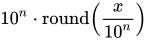
where

which may need to be written with a specific marking as detailed above to specify the number of significant trailing zeros.
Writing uncertainty and implied uncertainty
[edit]Significant figures in writing uncertainty
[edit]It is recommended for a measurement result to include the measurement uncertainty such as , where xbest and σx are the best estimate and uncertainty in the measurement respectively.[10] xbest can be the average of measured values and σx can be the standard deviation or a multiple of the measurement deviation. The rules to write are:[11]

- σx should usually be quoted to only one or two significant figures, as more precision is unlikely to be reliable or meaningful:
- 1.79 ± 0.06 (correct), 1.79 ± 0.96 (correct), 1.79 ± 1.96 (incorrect).
- The digit positions of the last significant figures in xbest and σx are the same, otherwise the consistency is lost. For example, "1.79 ± 0.067" is incorrect, as it does not make sense to have more accurate uncertainty than the best estimate.
- 1.79 ± 0.06 (correct), 1.79 ± 0.96 (correct), 1.79 ± 0.067 (incorrect).
Implied uncertainty
[edit]
Uncertainty may be implied by the last significant figure if it is not explicitly expressed.[1] The implied uncertainty is ± the half of the minimum scale at the last significant figure position. For example, if the mass of an object is reported as 3.78 kg without mentioning uncertainty, then ± 0.005 kg measurement uncertainty may be implied. If the mass of an object is estimated as 3.78 ± 0.07 kg, so the actual mass is probably somewhere in the range 3.71 to 3.85 kg, and it is desired to report it with a single number, then 3.8 kg is the best number to report since its implied uncertainty ± 0.05 kg gives a mass range of 3.75 to 3.85 kg, which is close to the measurement range. If the uncertainty is a bit larger, i.e. 3.78 ± 0.09 kg, then 3.8 kg is still the best single number to quote, since if "4 kg" was reported then a lot of information would be lost.
If there is a need to write the implied uncertainty of a number, then it can be written as with stating it as the implied uncertainty (to prevent readers from recognizing it as the measurement uncertainty), where x and σx are the number with an extra zero digit (to follow the rules to write uncertainty above) and the implied uncertainty of it respectively. For example, 6 kg with the implied uncertainty ± 0.5 kg can be stated as 6.0 ± 0.5 kg.

Arithmetic
[edit]As there are rules to determine the significant figures in directly measured quantities, there are also guidelines (not rules) to determine the significant figures in quantities calculated from these measured quantities.
Significant figures in measured quantities are most important in the determination of significant figures in calculated quantities with them. A mathematical or physical constant (e.g., π in the formula for the area of a circle with radius r as πr2) has no effect on the determination of the significant figures in the result of a calculation with it if its known digits are equal to or more than the significant figures in the measured quantities used in the calculation. An exact number such as 1/2 in the formula for the kinetic energy of a mass m with velocity v as 1/2mv2 has no bearing on the significant figures in the calculated kinetic energy since its number of significant figures is infinite (0.500000...).
The guidelines described below are intended to avoid a calculation result more precise than the measured quantities, but it does not ensure the resulted implied uncertainty close enough to the measured uncertainties. This problem can be seen in unit conversion. If the guidelines give the implied uncertainty too far from the measured ones, then it may be needed to decide significant digits that give comparable uncertainty.
Multiplication and division
[edit]For quantities created from measured quantities via multiplication and division, the calculated result should have as many significant figures as the least number of significant figures among the measured quantities used in the calculation.[12] For example,
- 1.234 × 2 = 2.468 ≈ 2
- 1.234 × 2.0 = 2.468 ≈ 2.5
- 0.01234 × 2 = 0.02468 ≈ 0.02
- 0.012345678 / 0.00234 = 5.2759 ≈ 5.28
with one, two, and one significant figures respectively. (2 here is assumed not an exact number.) For the first example, the first multiplication factor has four significant figures and the second has one significant figure. The factor with the fewest or least significant figures is the second one with only one, so the final calculated result should also have one significant figure.
Exception
[edit]For unit conversion, the implied uncertainty of the result can be unsatisfactorily higher than that in the previous unit if this rounding guideline is followed; For example, 8 inches has the implied uncertainty of ± 0.5 inch = ± 1.27 cm. If it is converted to the centimeter scale and the rounding guideline for multiplication and division is followed, then 20.32 cm ≈ 20 cm with the implied uncertainty of ± 5 cm. If this implied uncertainty is considered as too overestimated, then more proper significant digits in the unit conversion result may be 20.32 cm ≈ 20. cm with the implied uncertainty of ± 0.5 cm.
Another exception of applying the above rounding guideline is to multiply a number by an integer, such as 1.234 × 9. If the above guideline is followed, then the result is rounded as 1.234 × 9.000.... = 11.106 ≈ 11.11. However, this multiplication is essentially adding 1.234 to itself 9 times such as 1.234 + 1.234 + … + 1.234 so the rounding guideline for addition and subtraction described below is more proper rounding approach.[13] As a result, the final answer is 1.234 + 1.234 + … + 1.234 = 11.106 = 11.106 (one significant digit increase).
Addition and subtraction of significant figures
[edit]For quantities created from measured quantities via addition and subtraction, the last significant figure position (e.g., hundreds, tens, ones, tenths, hundredths, and so forth) in the calculated result should be the same as the leftmost or largest digit position among the last significant figures of the measured quantities in the calculation. For example,
- 1.234 + 2 = 3.234 ≈ 3
- 1.234 + 2.0 = 3.234 ≈ 3.2
- 0.01234 + 2 = 2.01234 ≈ 2
- 12000 + 77 = 12077 ≈ 12000
with the last significant figures in the ones place, tenths place, ones place, and thousands place respectively. (2 here is assumed not an exact number.) For the first example, the first term has its last significant figure in the thousandths place and the second term has its last significant figure in the ones place. The leftmost or largest digit position among the last significant figures of these terms is the ones place, so the calculated result should also have its last significant figure in the ones place.
The rule to calculate significant figures for multiplication and division are not the same as the rule for addition and subtraction. For multiplication and division, only the total number of significant figures in each of the factors in the calculation matters; the digit position of the last significant figure in each factor is irrelevant. For addition and subtraction, only the digit position of the last significant figure in each of the terms in the calculation matters; the total number of significant figures in each term is irrelevant.[citation needed] However, greater accuracy will often be obtained if some non-significant digits are maintained in intermediate results which are used in subsequent calculations.[citation needed]
Logarithm and antilogarithm
[edit]The base-10 logarithm of a normalized number (i.e., a × 10b with 1 ≤ a < 10 and b as an integer), is rounded such that its decimal part (called mantissa) has as many significant figures as the significant figures in the normalized number.
- log10(3.000 × 10⁴) = log10(104) + log10(3.000) = 4.000000... (exact number so infinite significant digits) + 0.4771212547... = 4.4771212547 ≈ 4.4771.
When taking the antilogarithm of a normalized number, the result is rounded to have as many significant figures as the significant figures in the decimal part of the number to be antiloged.
- 104.4771 = 29998.5318119... = 30000 = 3.000 × 10⁴.
Transcendental functions
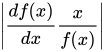
[edit]If a transcendental function (e.g., the exponential function, the logarithm, and the trigonometric functions) is differentiable at its domain element 'x', then its number of significant figures (denoted as "significant figures of ") is approximately related with the number of significant figures in x (denoted as "significant figures of x") by the formula

,

where is the condition number.
Round only on the final calculation result
[edit]When performing multiple stage calculations, do not round intermediate stage calculation results; keep as many digits as is practical (at least one more digit than the rounding rule allows per stage) until the end of all the calculations to avoid cumulative rounding errors while tracking or recording the significant figures in each intermediate result. Then, round the final result, for example, to the fewest number of significant figures (for multiplication or division) or leftmost last significant digit position (for addition or subtraction) among the inputs in the final calculation.[14]
- (2.3494 + 1.345) × 1.2 = 3.6944 × 1.2 = 4.43328 ≈ 4.4.
- (2.3494 × 1.345) + 1.2 = 3.159943 + 1.2 = 4.359943 ≈ 4.4.
Estimating an extra digit
[edit]When using a ruler, initially use the smallest mark as the first estimated digit. For example, if a ruler's smallest mark is 0.1 cm, and 4.5 cm is read, then it is 4.5 (±0.1 cm) or 4.4 cm to 4.6 cm as to the smallest mark interval. However, in practice a measurement can usually be estimated by eye to closer than the interval between the ruler's smallest mark, e.g. in the above case it might be estimated as between 4.51 cm and 4.53 cm.[15]
It is also possible that the overall length of a ruler may not be accurate to the degree of the smallest mark, and the marks may be imperfectly spaced within each unit. However assuming a normal good quality ruler, it should be possible to estimate tenths between the nearest two marks to achieve an extra decimal place of accuracy.[16] Failing to do this adds the error in reading the ruler to any error in the calibration of the ruler.
Estimation in statistic
[edit]When estimating the proportion of individuals carrying some particular characteristic in a population, from a random sample of that population, the number of significant figures should not exceed the maximum precision allowed by that sample size.
Relationship to accuracy and precision in measurement
[edit]Traditionally, in various technical fields, "accuracy" refers to the closeness of a given measurement to its true value; "precision" refers to the stability of that measurement when repeated many times. Thus, it is possible to be "precisely wrong". Hoping to reflect the way in which the term "accuracy" is actually used in the scientific community, there is a recent standard, ISO 5725, which keeps the same definition of precision but defines the term "trueness" as the closeness of a given measurement to its true value and uses the term "accuracy" as the combination of trueness and precision. (See the accuracy and precision article for a full discussion.) In either case, the number of significant figures roughly corresponds to precision, not to accuracy or the newer concept of trueness.
In computing
[edit]Computer representations of floating-point numbers use a form of rounding to significant figures (while usually not keeping track of how many), in general with binary numbers. The number of correct significant figures is closely related to the notion of relative error (which has the advantage of being a more accurate measure of precision, and is independent of the radix, also known as the base, of the number system used).
Electronic calculators supporting a dedicated significant figures display mode are relatively rare.
Among the calculators to support related features are the Commodore M55 Mathematician (1976)[17] and the S61 Statistician (1976),[18] which support two display modes, where DISP+n will give n significant digits in total, while DISP+.+n will give n decimal places.
The Texas Instruments TI-83 Plus (1999) and TI-84 Plus (2004) families of graphical calculators support a Sig-Fig Calculator mode in which the calculator will evaluate the count of significant digits of entered numbers and display it in square brackets behind the corresponding number. The results of calculations will be adjusted to only show the significant digits as well.[19]
For the HP 20b/30b-based community-developed WP 34S (2011) and WP 31S (2014) calculators significant figures display modes SIG+n and SIG0+n (with zero padding) are available as a compile-time option.[20][21] The SwissMicros DM42-based community-developed calculators WP 43C (2019)[22] / C43 (2022) / C47 (2023) support a significant figures display mode as well.
See also
[edit]- Benford's law (first-digit law)
- Engineering notation
- Error bar
- False precision
- Guard digit
- Guesstimate
- IEEE 754 (IEEE floating-point standard)
- Interval arithmetic
- Kahan summation algorithm
- Precision (computer science)
- Round-off error
References
[edit]- ^ a b c Lower, Stephen (2021-03-31). "Significant Figures and Rounding". Chemistry - LibreTexts.
- ^ Chemistry in the Community; Kendall-Hunt:Dubuque, IA 1988
- ^ Giving a precise definition for the number of correct significant digits is not a straightforward matter: see Higham, Nicholas (2002). Accuracy and Stability of Numerical Algorithms (PDF) (2nd ed.). SIAM. pp. 3–5.
- ^ "Resolutions of the 26th CGPM" (PDF). BIPM. 2018-11-16. Archived from the original (PDF) on 2018-11-19. Retrieved 2018-11-20.
- ^ "y-cruncher validation file"
- ^ "How Many Decimals of Pi Do We Really Need? - Edu News". NASA/JPL Edu. Retrieved 2021-10-25.
- ^ Myers, R. Thomas; Oldham, Keith B.; Tocci, Salvatore (2000). Chemistry. Austin, Texas: Holt Rinehart Winston. p. 59. ISBN 0-03-052002-9.
- ^ Engelbrecht, Nancy; et al. (1990). "Rounding Decimal Numbers to a Designated Precision" (PDF). Washington, D.C.: U.S. Department of Education.
- ^ Numerical Mathematics and Computing, by Cheney and Kincaid.
- ^ Luna, Eduardo. "Uncertainties and Significant Figures" (PDF). DeAnza College.
- ^ "Significant Figures". Purdue University – Department of Physics and Astronomy.
- ^ "Significant Figure Rules". Penn State University.
- ^ "Uncertainty in Measurement- Significant Figures". Chemistry - LibreTexts. 2017-06-16.
- ^ de Oliveira Sannibale, Virgínio (2001). "Measurements and Significant Figures (Draft)" (PDF). Freshman Physics Laboratory. California Institute of Technology, Physics Mathematics And Astronomy Division. Archived from the original (PDF) on 2013-06-18.
- ^ "Measurements". slc.umd.umich.edu. University of Michigan. Archived from the original on 2017-07-09. Retrieved 2017-07-03.
As a general rule you should attempt to read any scale to one tenth of its smallest division by visual interpolation[example omitted].
- ^ Experimental Electrical Testing. Newark, NJ: Weston Electrical Instruments Co. 1914. p. 9. Retrieved 2019-01-14.
Experimental Electrical Testing..
- ^ commodore m55 Mathematician Owners Manual (PDF). Palo Alto, California, USA / Luton, UK: Commodore Business Machines Inc. / Mitchells Printers (Luton) Limited. 201318-01. Archived (PDF) from the original on 2023-09-30. Retrieved 2023-09-30. (1+151+1 pages)
- ^ commodore s61 Statistician Owners Handbook. Palo Alto, California, USA: Commodore Business Machines Inc. Archived from the original on 2023-09-30. Retrieved 2023-09-30. (2+114 pages)
- ^ "Solution 30190: Using The Significant Numbers Calculator From The Science Tools App on the TI-83 Plus and TI-84 Plus Family of Graphing Calculators". Knowledge Base. Texas Instruments. 2023. Archived from the original on 2023-09-16. Retrieved 2023-09-30.
- ^ Bit (2014-11-15). "Bit's WP 34S and 31S patches and custom binaries (version: r3802 20150805-1)". MoHPC - The Museum of HP Calculators. Archived from the original on 2023-09-24. Retrieved 2023-09-24.
- ^ Bit (2015-02-07). "[34S & 31S] Unique display mode: significant figures". MoHPC - The Museum of HP Calculators. Archived from the original on 2023-09-24. Retrieved 2023-09-24.
- ^ Mostert, Jaco "Jaymos" (2020-02-11). "Changes from the WP43S to the WP43C" (PDF). v047. Archived (PDF) from the original on 2023-10-01. Retrieved 2023-10-01. (30 pages)
Further reading
[edit]- Delury, D. B. (1958). "Computations with approximate numbers". The Mathematics Teacher. 51 (7): 521–30. doi:10.5951/MT.51.7.0521. JSTOR 27955748.
- Bond, E. A. (1931). "Significant Digits in Computation with Approximate Numbers". The Mathematics Teacher. 24 (4): 208–12. doi:10.5951/MT.24.4.0208. JSTOR 27951340.
- ASTM E29-06b, Standard Practice for Using Significant Digits in Test Data to Determine Conformance with Specifications
External links
[edit]- Significant Figures Video by Khan academy
- The Decimal Arithmetic FAQ – Is the decimal arithmetic ‘significance’ arithmetic?
- Advanced methods for handling uncertainty Archived 2009-04-15 at the Wayback Machine and some explanations of the shortcomings of significance arithmetic and significant figures.
- Significant Figures Calculator – Displays a number with the desired number of significant digits.
- Measurements and Uncertainties versus Significant Digits or Significant Figures Archived 2009-04-15 at the Wayback Machine – Proper methods for expressing uncertainty, including a detailed discussion of the problems with any notion of significant digits.
Significant figures
View on GrokipediaDefinition and Identification
Definition and Purpose
Significant figures are the digits in a numerical value that carry meaning contributing to its precision, particularly in the context of measurements where they reflect the reliability and known accuracy of the reported quantity.[3] According to the NIST Guide to the SI, these are the digits required to express a quantity’s magnitude while indicating which are meaningfully precise, helping to avoid ambiguity in scientific communication.[3] For example, the number 123.45 has five significant figures, indicating that the value is precise to the hundredths place.[4] The primary purpose of significant figures is to convey the inherent uncertainty in measured or calculated values, ensuring that the reported precision matches the actual reliability of the data and preventing the implication of greater accuracy than is justified.[3] By limiting the number of digits to those that are significant, this convention promotes clear communication of measurement limitations in scientific and technical fields, where overprecise reporting could mislead interpretations.[5] The concept of significant figures originated in the 19th century as scientists increasingly emphasized the need for precise reporting of measurements to reflect experimental reliability.[5] Early discussions, such as those by Silas W. Holman in the late 1800s, laid the groundwork for modern rules by addressing how to handle digits in relation to instrumental precision.[5]Rules for Identifying Significant Figures
Significant figures are determined by applying a set of standard conventions to the digits in a numerical value, ensuring that only those digits reflecting the precision of a measurement are counted.[1] These rules apply primarily to measured quantities, where the number of significant figures indicates the reliability of the measurement.[6] The core rules for identifying significant figures are as follows:- All non-zero digits are significant. For example, the number 123 has three significant figures, as each digit contributes to the precision.[7][2]
- Zeros located between non-zero digits are significant. In 1002, for instance, the zero between 1 and 2 is significant, resulting in four significant figures total.[1][6]
- Leading zeros, which appear before the first non-zero digit, are not significant. Thus, 0.0025 has two significant figures, with the leading zeros serving only to position the decimal.[2][7]
- Trailing zeros in a number containing a decimal point are significant. The value 0.00250, for example, has three significant figures, where the trailing zero after the decimal indicates precision to that place.[6][2]
Notation for Ambiguous Cases
In cases where the number of significant figures in a measurement is ambiguous, particularly with trailing zeros in integers lacking a decimal point, specific notation techniques are employed to clarify precision. For instance, trailing zeros without a decimal, such as in 100, may indicate one, two, or three significant figures depending on context, as these zeros could be placeholders rather than measured values.[8] To resolve this, appending a decimal point to the number signals that the trailing zeros are significant; thus, 100. explicitly denotes three significant figures. Scientific notation is the most reliable method to eliminate ambiguity, as it explicitly shows all significant digits in the coefficient. For example, 1.00 × 10² clearly indicates three significant figures for the value 100, while 1 × 10² suggests only one.[9] Similarly, for 1230 with three significant figures, it can be written as 1.23 × 10³.[10] This approach is particularly useful for integers where trailing zeros might otherwise be interpreted as non-significant placeholders.[11] Alternative notations, such as overlines or underlines, are sometimes used in educational or technical contexts to mark specific digits. An overline over the last significant figure, followed by trailing zeros, indicates the zeros are not significant; for example, 500 with an overline over the 5 treats it as one significant figure.[12] Conversely, underlining non-significant zeros, as in 5̲0̲0 for one significant figure, highlights those as placeholders.[13] Placeholders like asterisks may appear in computational or tabular contexts to denote estimated or ambiguous digits, though this is less standardized.[14] These methods primarily address ambiguities in whole numbers without decimals, where trailing zeros do not clearly convey measurement precision.[15] However, there is no universal standard across disciplines, leading to potential inconsistencies; scientific notation remains the preferred and most precise option for unambiguous communication.[16]Rounding and Representation
Rounding to a Specified Number of Significant Figures
Rounding to a specified number of significant figures involves adjusting a numerical value to retain only the desired precision, ensuring that the reported result reflects the appropriate level of accuracy without introducing false certainty. This process requires first identifying the significant figures in the original number, as outlined in the rules for identification, and then applying systematic rounding to the target count. The goal is to round to the nearest value that maintains the correct number of significant digits, typically following the conventional "round half up" method for ties.[17] The steps for rounding are straightforward: (1) Determine the position of the rightmost significant digit that will be retained based on the specified number of figures; this is often the least significant digit in the rounded result. (2) Examine the digit immediately following this position, known as the first non-significant digit. (3) Apply the rounding rule based on that digit's value, and discard all subsequent digits. (4) If rounding up causes a carry-over, propagate it through the number as needed, which may alter preceding digits or even shift the decimal place. This method ensures consistency and minimizes bias in representation.[18][19] The primary rounding rules are as follows: If the first non-significant digit is less than 5, leave the least significant retained digit unchanged. If it is greater than 5, increase the least significant retained digit by 1. For the case where it is exactly 5 (with no non-zero digits following), the standard convention is to round up—incrementing the retained digit by 1—to the nearest value, though this can introduce a slight upward bias over many operations. In some scientific and computational standards, a variant known as bankers' rounding (or round half to even) is used instead, where the retained digit is rounded up only if it is odd, preserving the even digit otherwise; this approach aims to balance rounding errors statistically but is not the default in most general chemistry and physics contexts.[17][18][2] Consider the number 12.346, which has five significant figures. To round to three significant figures, the rightmost retained digit is the 3 (in the tenths place), and the next digit is 4, which is less than 5, so it remains 12.3.[17] For 9.995 rounded to three significant figures, retain the first three digits as 9.99 (up to the hundredths place), and the next digit is 5, which requires rounding up, resulting in 10.0 after carry-over propagates through the digits. These examples illustrate how rounding preserves the leading significant figures while adjusting for precision.[19]Scientific Notation for Clarity
Scientific notation offers a standardized method for representing numbers to unambiguously indicate the number of significant figures, particularly when dealing with very large, very small, or numbers containing ambiguous zeros. The standard format is , where the mantissa satisfies , and all digits in are considered significant unless explicitly stated otherwise.[20] This convention ensures that the precision of a measurement is clearly conveyed without reliance on the placement of zeros, which can be misleading in conventional decimal form.[21] One primary advantage of scientific notation is its ability to eliminate ambiguity from leading and trailing zeros. For example, the decimal number 0.00234 has leading zeros that do not contribute to significance, but expressing it as explicitly shows three significant figures.[22] Likewise, 12300 in decimal form is ambiguous regarding whether it has three, four, or five significant figures due to the trailing zeros, but clarifies that only three digits are significant.[20] This clarity is essential in scientific communication, as it prevents misinterpretation of precision.[21] Another benefit is that scientific notation facilitates rounding to a desired number of significant figures by isolating the mantissa, where adjustments can be made directly before applying the exponent. To convert a number, shift the decimal point in the original value until the mantissa lies between 1 and 10, counting the shifts to determine the exponent (positive for shifts left, negative for shifts right), and ensure the mantissa reflects the appropriate significant digits through rounding if needed.[22] For instance, starting from 12300 and aiming for three significant figures involves rounding to 123 and then shifting to .[20] This process aligns with standard rounding practices to maintain consistency in precision.[21]Expressing Measurement Uncertainty
In measurements, uncertainty is explicitly expressed using the notation , where is the measured value and is the associated uncertainty, often the standard uncertainty or expanded uncertainty. This format conveys both the best estimate and the range within which the true value is likely to lie, with the uncertainty typically reported to one or two significant figures to reflect the precision of the measurement process. The Guide to the Expression of Uncertainty in Measurement (GUM), published by the Joint Committee for Guides in Metrology (JCGM), recommends this symmetric notation to avoid ambiguity, preferring it over alternatives like parentheses for the uncertainty digits unless space is limited.[23] The rules for this notation ensure consistency between the value and its uncertainty: the first nonzero digit of the uncertainty must align with the last significant digit of the value, and the value itself is rounded to the same decimal place as that digit in the uncertainty. For instance, if the calculated uncertainty is 0.035, it is rounded to 0.04 (one significant figure) or 0.035 (two significant figures if higher precision is justified), and the value is then rounded accordingly to match. This alignment prevents overstatement of precision and ensures the reported figures are meaningful. The National Institute of Standards and Technology (NIST) further specifies that uncertainties should include digits that impact at least the second significant figure of the combined uncertainty to maintain reliability.[23][24] Examples illustrate these conventions effectively. A measurement reported as indicates the value is precise to the hundredths place, with the uncertainty's single significant figure (5) aligning at that position; here, the total expression carries four significant figures in the value but emphasizes the uncertainty's role in limiting reliability. Similarly, conveys a value with three significant figures overall, where the uncertainty of 1 (one significant figure) aligns with the units place, suitable for quantities like mass or length where trailing zeros might otherwise be ambiguous. In cases requiring expanded uncertainty for a specific confidence level (e.g., 95%), the notation extends to (with coverage factor ), still following the same digit alignment rules.[23][24] ISO standards, particularly through the GUM (ISO/IEC Guide 98-3:2008), establish that uncertainty is generally expressed with one significant figure for simplicity, resorting to two only when it better represents the distribution or when the leading digit is 1 (to avoid understating variability). This approach balances informativeness with practicality, ensuring reports are not cluttered by excessive digits while adhering to metrological best practices.[23]Arithmetic with Significant Figures
Multiplication and Division Rules
In multiplication and division operations involving measurements, the result must be expressed with the same number of significant figures as the measurement that has the fewest significant figures.[2][12] This rule ensures that the precision of the final result does not exceed the precision of the least precise input value, thereby avoiding the implication of greater accuracy than is justified by the data.[2][25] The rationale for this approach stems from the nature of multiplication and division, which preserve relative precision rather than absolute precision. Significant figures represent the relative uncertainty in a measurement, and when values are multiplied or divided, the relative uncertainties propagate multiplicatively; thus, the overall relative precision is limited by the input with the smallest number of significant figures.[25][26] Mathematically, this can be expressed as: for operations such as or .[8][27] To apply this rule, first determine the number of significant figures in each operand using standard identification guidelines, then perform the calculation and round the result accordingly. For example, consider : the value 2.3 has two significant figures, while 4.56 has three, so the product (10.488) is rounded to two significant figures, yielding 10.[12][26] Similarly, for , 123 has three significant figures and 4.5 has two, so the quotient (27.333...) is rounded to two significant figures, resulting in 27.[2][27] These examples illustrate how the rule maintains consistency in reporting precision across operations.Addition and Subtraction Rules
In addition and subtraction operations involving measurements, the result must reflect the precision of the least precise input value, determined by the position of the last significant digit relative to the decimal point. This ensures that the outcome does not imply greater certainty than warranted by the measurements, as these operations propagate absolute uncertainties additively.[28][29] The precision is governed by the input with the largest absolute uncertainty in its place value, meaning the result is rounded to the same decimal place as the measurement with the fewest decimal places.[30][29] To apply this rule, align the numbers by their decimal points to identify the rightmost position of certainty across all operands. Perform the calculation, then round the result to that position, discarding any digits beyond it. This approach contrasts with multiplication and division, where relative precision (significant figure count) is prioritized over positional alignment.[28][29] For example, consider the addition of 12.52 (two decimal places) and 3.2 (one decimal place): 12.52
+ 3.2
------
15.72
  12.52
+  3.2
------
  15.72
  100.0
+  23.4
------
  123.4
  100.0
+  23.4
------
  123.4