
Recent from talks
Ordnance QF 75 mm
Knowledge base stats:
Talk channels stats:
Members stats:
Ordnance QF 75 mm
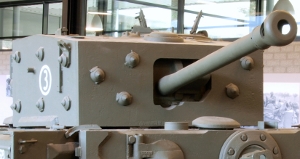
The Ordnance QF 75 mm (OQF 75 mm) was a British tank gun of the Second World War. It was obtained by fitting a new barrel and a modified breech to the mounting of the Ordnance QF 6-pounder ("6 pdr") 57 mm anti-tank gun, to give better performance against infantry targets similarly to the 75 mm M3 gun fitted to the American Sherman tank. The QF came from "quick-firing", referring to the use of ammunition where the shell has a fixed cartridge. The gun was also sometimes known as ROQF from Royal Ordnance (the manufacturer) Quick-Firing.
Prior to the introduction of the ROQF 75 mm, British tanks had been equipped with first the QF 2-pounder (40 mm) and then the larger 6-pounder (57 mm). These guns were designed to fire armour-piercing shot, small high-velocity solid rounds that were effective against tanks but did little damage to groups of infantry or soft targets like trucks. Some tanks operating as infantry support were given howitzers firing HE shells, such as early models of the Churchill and CS (Close Support) versions of the Matilda II. The decision to equip British tanks with a gun capable of firing HE shells at soft targets was taken by the War Office.
A HE shell for the 6-pounder was in production by the start of the Tunisia Campaign and available in large numbers in the Italian Campaign. The round lacked sufficient explosive power, but the power of the US 75 mm HE round used in the 75 mm M3 was found to be markedly superior and a number of Churchills used in Italy had guns scavenged from Sherman tanks and fitted to their turrets to give the Churchill NA75 (NA coming from "North Africa" where the conversions were carried out). Approximately 200 were converted in this way.
Vickers was working on a high velocity 75 mm gun to be fitted to British tanks. This took the cartridge case of the 3 inch 20 cwt anti-aircraft gun mated to the US 75 mm AP and HE shell. With a barrel length of 50 calibres, it would have had about twice the muzzle energy of the US 75 mm gun. The design turned out to be too big to fit into the tank that it had been expected to fit.
It was noticed that the US 75 mm cartridge was almost the same diameter as the British 6-pounder case. Instead of having to take the American gun to be fitted en masse into modified British tanks, the Royal Ordnance factory modified the 6-pounder design by fitting a new barrel and adapting the breech to fire the US round. By preserving the barrel and breach mounting points the resulting gun could then be fitted without redesigned tank mountings and dramatically simplified supply since both British-made and American-made 75 mm guns could use the same ammunition. It gained British tanks a good HE shell but came with an inferior anti-tank round, proving troublesome against heavily armoured German tanks. [citation needed]
Though the 75 mm had a good HE shell, it was still thought that a more powerful close support weapon was needed and the QF 95 mm howitzer was agreed for a limited number of tanks.
The QF 75 mm used US ammunition. The shells were "fixed" ammunition, the shell cartridge and projectile being joined together as a complete round.
The ROQF 75 mm was chiefly used on the Churchill and Cromwell tanks. The weapon was used in Italy and in the Normandy invasion (and possibly in Burma against the Japanese[citation needed]) until the end of the war. While the 75 mm was a conversion from the 6-pounder, some units retained a number of 6-pounder-gunned tanks, due to its superior anti-tank firepower over the 75 mm, especially as the 6-pounder could use more effective APCR and APDS rounds.
Hub AI
Ordnance QF 75 mm AI simulator
(@Ordnance QF 75 mm_simulator)
Ordnance QF 75 mm
The Ordnance QF 75 mm (OQF 75 mm) was a British tank gun of the Second World War. It was obtained by fitting a new barrel and a modified breech to the mounting of the Ordnance QF 6-pounder ("6 pdr") 57 mm anti-tank gun, to give better performance against infantry targets similarly to the 75 mm M3 gun fitted to the American Sherman tank. The QF came from "quick-firing", referring to the use of ammunition where the shell has a fixed cartridge. The gun was also sometimes known as ROQF from Royal Ordnance (the manufacturer) Quick-Firing.
Prior to the introduction of the ROQF 75 mm, British tanks had been equipped with first the QF 2-pounder (40 mm) and then the larger 6-pounder (57 mm). These guns were designed to fire armour-piercing shot, small high-velocity solid rounds that were effective against tanks but did little damage to groups of infantry or soft targets like trucks. Some tanks operating as infantry support were given howitzers firing HE shells, such as early models of the Churchill and CS (Close Support) versions of the Matilda II. The decision to equip British tanks with a gun capable of firing HE shells at soft targets was taken by the War Office.
A HE shell for the 6-pounder was in production by the start of the Tunisia Campaign and available in large numbers in the Italian Campaign. The round lacked sufficient explosive power, but the power of the US 75 mm HE round used in the 75 mm M3 was found to be markedly superior and a number of Churchills used in Italy had guns scavenged from Sherman tanks and fitted to their turrets to give the Churchill NA75 (NA coming from "North Africa" where the conversions were carried out). Approximately 200 were converted in this way.
Vickers was working on a high velocity 75 mm gun to be fitted to British tanks. This took the cartridge case of the 3 inch 20 cwt anti-aircraft gun mated to the US 75 mm AP and HE shell. With a barrel length of 50 calibres, it would have had about twice the muzzle energy of the US 75 mm gun. The design turned out to be too big to fit into the tank that it had been expected to fit.
It was noticed that the US 75 mm cartridge was almost the same diameter as the British 6-pounder case. Instead of having to take the American gun to be fitted en masse into modified British tanks, the Royal Ordnance factory modified the 6-pounder design by fitting a new barrel and adapting the breech to fire the US round. By preserving the barrel and breach mounting points the resulting gun could then be fitted without redesigned tank mountings and dramatically simplified supply since both British-made and American-made 75 mm guns could use the same ammunition. It gained British tanks a good HE shell but came with an inferior anti-tank round, proving troublesome against heavily armoured German tanks. [citation needed]
Though the 75 mm had a good HE shell, it was still thought that a more powerful close support weapon was needed and the QF 95 mm howitzer was agreed for a limited number of tanks.
The QF 75 mm used US ammunition. The shells were "fixed" ammunition, the shell cartridge and projectile being joined together as a complete round.
The ROQF 75 mm was chiefly used on the Churchill and Cromwell tanks. The weapon was used in Italy and in the Normandy invasion (and possibly in Burma against the Japanese[citation needed]) until the end of the war. While the 75 mm was a conversion from the 6-pounder, some units retained a number of 6-pounder-gunned tanks, due to its superior anti-tank firepower over the 75 mm, especially as the 6-pounder could use more effective APCR and APDS rounds.
Recent media