



Community hub
Recent from talks
Contribute something to knowledge base
Content stats: 0 posts, 0 articles, 1 media, 0 notes
Members stats: 0 subscribers, 0 contributors, 0 moderators, 0 supporters
Subscribers
Supporters
Contributors
Moderators
Hub AI
Oric (computer) AI simulator
(@Oric (computer)_simulator)
Hub AI
Oric (computer) AI simulator
(@Oric (computer)_simulator)
Oric (computer)
Oric was a brand of home computers sold in the 1980s by Tangerine Computer Systems. Tangerine was based in the United Kingdom and sold their computers primarily in Europe. All computers in the Oric line were based on the MOS Technology 6502A microprocessor.
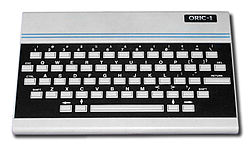
With the success of the ZX Spectrum from Sinclair Research, Tangerine's backers suggested a home computer and Tangerine formed Oric Products International Ltd to develop the Oric-1. The computer was introduced in 1982. During 1983, approximately 160,000 Oric-1 computers were sold in the UK, plus another 50,000 in France (where it was the year's top-selling machine). This resulted in Oric being acquired and given funding for a successor model, the 1984 Oric Atmos.
Oric was bought by Eureka, which produced the less successful Oric Telestrat (1986). Oric was dissolved the year the Telestrat was released. Eastern European legal clones of Oric machines were produced into the 1990s.
Based on a 1 MHz MOS Technology 6502 CPU, the Oric-1 came in 16 KB or 48 KB RAM variants for £129 and £169 respectively, matching the models available for the popular ZX Spectrum and undercutting the price of the 48 KB version of the Spectrum by a few pounds. The circuit design requires 8 memory chips, one chip per data line of the CPU. Due to the sizing of readily available memory chips the 48 KB model has 8 * 8 KB (64 KBit) chips, making a total of 64 KB. As released only 48 KB is available to the user, with the top 16 KB of memory overlaid by the BASIC ROM; The optional disc drive unit contains some additional hardware that allows it to enable or disable the ROM, effectively adding 16 KB of RAM to the machine. This additional memory is used by the system to store the Oric DOS software.[citation needed] Both Oric-1 versions have a 16 KB ROM containing the operating system and a modified BASIC interpreter.
The Oric-1 has a sound chip, the programmable General Instrument AY-3-8910.
Two graphics modes are handled by a semi-custom ASIC (HCS 10017 ULA) which also manages the interface between the processor and memory. The two modes are a "LORES" (low resolution) text mode (though the character set can be redefined to produce graphics) with 28 rows of 40 characters and a "HIRES" (high resolution) mode with 200 rows of 240 pixels above three lines of text. Like the Spectrum, the Oric-1 suffers from attribute clash–albeit to a much lesser degree in HIRES mode, since 2 different colours can be defined for each 6x1 block of 6 pixels,
The system has a built-in television RF modulator as well as RGB output. A standard audio tape recorder can be used for external storage. There is a Centronics compatible printer interface.
In late 1983 the funding cost for continued development of Oric caused external funding to be sought, and eventually led to a sale to Edenspring Investments PLC. The Edenspring money enabled Oric International to release the Oric Atmos, which added an improved keyboard and an updated V1.1 ROM to the Oric-1. The faulty tape error checking routine was still there (See "Cassette Interface" under Technical specification, below).
Oric (computer)
Oric was a brand of home computers sold in the 1980s by Tangerine Computer Systems. Tangerine was based in the United Kingdom and sold their computers primarily in Europe. All computers in the Oric line were based on the MOS Technology 6502A microprocessor.
With the success of the ZX Spectrum from Sinclair Research, Tangerine's backers suggested a home computer and Tangerine formed Oric Products International Ltd to develop the Oric-1. The computer was introduced in 1982. During 1983, approximately 160,000 Oric-1 computers were sold in the UK, plus another 50,000 in France (where it was the year's top-selling machine). This resulted in Oric being acquired and given funding for a successor model, the 1984 Oric Atmos.
Oric was bought by Eureka, which produced the less successful Oric Telestrat (1986). Oric was dissolved the year the Telestrat was released. Eastern European legal clones of Oric machines were produced into the 1990s.
Based on a 1 MHz MOS Technology 6502 CPU, the Oric-1 came in 16 KB or 48 KB RAM variants for £129 and £169 respectively, matching the models available for the popular ZX Spectrum and undercutting the price of the 48 KB version of the Spectrum by a few pounds. The circuit design requires 8 memory chips, one chip per data line of the CPU. Due to the sizing of readily available memory chips the 48 KB model has 8 * 8 KB (64 KBit) chips, making a total of 64 KB. As released only 48 KB is available to the user, with the top 16 KB of memory overlaid by the BASIC ROM; The optional disc drive unit contains some additional hardware that allows it to enable or disable the ROM, effectively adding 16 KB of RAM to the machine. This additional memory is used by the system to store the Oric DOS software.[citation needed] Both Oric-1 versions have a 16 KB ROM containing the operating system and a modified BASIC interpreter.
The Oric-1 has a sound chip, the programmable General Instrument AY-3-8910.
Two graphics modes are handled by a semi-custom ASIC (HCS 10017 ULA) which also manages the interface between the processor and memory. The two modes are a "LORES" (low resolution) text mode (though the character set can be redefined to produce graphics) with 28 rows of 40 characters and a "HIRES" (high resolution) mode with 200 rows of 240 pixels above three lines of text. Like the Spectrum, the Oric-1 suffers from attribute clash–albeit to a much lesser degree in HIRES mode, since 2 different colours can be defined for each 6x1 block of 6 pixels,
The system has a built-in television RF modulator as well as RGB output. A standard audio tape recorder can be used for external storage. There is a Centronics compatible printer interface.
In late 1983 the funding cost for continued development of Oric caused external funding to be sought, and eventually led to a sale to Edenspring Investments PLC. The Edenspring money enabled Oric International to release the Oric Atmos, which added an improved keyboard and an updated V1.1 ROM to the Oric-1. The faulty tape error checking routine was still there (See "Cassette Interface" under Technical specification, below).
Recent media
Recent media