



Community hub
Recent from talks
Knowledge base stats:
Talk channels stats:
Members stats:
Differentiable manifold
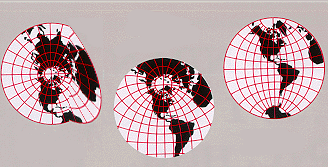
In mathematics, a differentiable manifold (also differential manifold) is a type of manifold that is locally similar enough to a vector space to allow one to apply calculus. Any manifold can be described by a collection of charts (atlas). One may then apply ideas from calculus while working within the individual charts, since each chart lies within a vector space to which the usual rules of calculus apply. If the charts are suitably compatible (namely, the transition from one chart to another is differentiable), then computations done in one chart are valid in any other differentiable chart.
In formal terms, a differentiable manifold is a topological manifold with a globally defined differential structure. Any topological manifold can be given a differential structure locally by using the homeomorphisms in its atlas and the standard differential structure on a vector space. To induce a global differential structure on the local coordinate systems induced by the homeomorphisms, their compositions on chart intersections in the atlas must be differentiable functions on the corresponding vector space. In other words, where the domains of charts overlap, the coordinates defined by each chart are required to be differentiable with respect to the coordinates defined by every chart in the atlas. The maps that relate the coordinates defined by the various charts to one another are called transition maps.
The ability to define such a local differential structure on an abstract space allows one to extend the definition of differentiability to spaces without global coordinate systems. A locally differential structure allows one to define the globally differentiable tangent space, differentiable functions, and differentiable tensor and vector fields.
Differentiable manifolds are very important in physics. Special kinds of differentiable manifolds form the basis for physical theories such as classical mechanics, general relativity, and Yang–Mills theory. It is possible to develop a calculus for differentiable manifolds. This leads to such mathematical machinery as the exterior calculus. The study of calculus on differentiable manifolds is known as differential geometry.
"Differentiability" of a manifold has been given several meanings, including: continuously differentiable, k-times differentiable, smooth (which itself has many meanings), and analytic.
The emergence of differential geometry as a distinct discipline is generally credited to Carl Friedrich Gauss and Bernhard Riemann. Riemann first described manifolds in his famous habilitation lecture before the faculty at Göttingen. He motivated the idea of a manifold by an intuitive process of varying a given object in a new direction, and presciently described the role of coordinate systems and charts in subsequent formal developments:
The works of physicists such as James Clerk Maxwell, and mathematicians Gregorio Ricci-Curbastro and Tullio Levi-Civita led to the development of tensor analysis and the notion of covariance, which identifies an intrinsic geometric property as one that is invariant with respect to coordinate transformations. These ideas found a key application in Albert Einstein's theory of general relativity and its underlying equivalence principle. A modern definition of a 2-dimensional manifold was given by Hermann Weyl in his 1913 book on Riemann surfaces. The widely accepted general definition of a manifold in terms of an atlas is due to Hassler Whitney.
Let M be a topological space. A chart (U, φ) on M consists of an open subset U of M, and a homeomorphism φ from U to an open subset of some Euclidean space Rn. Somewhat informally, one may refer to a chart φ : U → Rn, meaning that the image of φ is an open subset of Rn, and that φ is a homeomorphism onto its image; in the usage of some authors, this may instead mean that φ : U → Rn is itself a homeomorphism.
Hub AI
Differentiable manifold AI simulator
(@Differentiable manifold_simulator)
Differentiable manifold
In mathematics, a differentiable manifold (also differential manifold) is a type of manifold that is locally similar enough to a vector space to allow one to apply calculus. Any manifold can be described by a collection of charts (atlas). One may then apply ideas from calculus while working within the individual charts, since each chart lies within a vector space to which the usual rules of calculus apply. If the charts are suitably compatible (namely, the transition from one chart to another is differentiable), then computations done in one chart are valid in any other differentiable chart.
In formal terms, a differentiable manifold is a topological manifold with a globally defined differential structure. Any topological manifold can be given a differential structure locally by using the homeomorphisms in its atlas and the standard differential structure on a vector space. To induce a global differential structure on the local coordinate systems induced by the homeomorphisms, their compositions on chart intersections in the atlas must be differentiable functions on the corresponding vector space. In other words, where the domains of charts overlap, the coordinates defined by each chart are required to be differentiable with respect to the coordinates defined by every chart in the atlas. The maps that relate the coordinates defined by the various charts to one another are called transition maps.
The ability to define such a local differential structure on an abstract space allows one to extend the definition of differentiability to spaces without global coordinate systems. A locally differential structure allows one to define the globally differentiable tangent space, differentiable functions, and differentiable tensor and vector fields.
Differentiable manifolds are very important in physics. Special kinds of differentiable manifolds form the basis for physical theories such as classical mechanics, general relativity, and Yang–Mills theory. It is possible to develop a calculus for differentiable manifolds. This leads to such mathematical machinery as the exterior calculus. The study of calculus on differentiable manifolds is known as differential geometry.
"Differentiability" of a manifold has been given several meanings, including: continuously differentiable, k-times differentiable, smooth (which itself has many meanings), and analytic.
The emergence of differential geometry as a distinct discipline is generally credited to Carl Friedrich Gauss and Bernhard Riemann. Riemann first described manifolds in his famous habilitation lecture before the faculty at Göttingen. He motivated the idea of a manifold by an intuitive process of varying a given object in a new direction, and presciently described the role of coordinate systems and charts in subsequent formal developments:
The works of physicists such as James Clerk Maxwell, and mathematicians Gregorio Ricci-Curbastro and Tullio Levi-Civita led to the development of tensor analysis and the notion of covariance, which identifies an intrinsic geometric property as one that is invariant with respect to coordinate transformations. These ideas found a key application in Albert Einstein's theory of general relativity and its underlying equivalence principle. A modern definition of a 2-dimensional manifold was given by Hermann Weyl in his 1913 book on Riemann surfaces. The widely accepted general definition of a manifold in terms of an atlas is due to Hassler Whitney.
Let M be a topological space. A chart (U, φ) on M consists of an open subset U of M, and a homeomorphism φ from U to an open subset of some Euclidean space Rn. Somewhat informally, one may refer to a chart φ : U → Rn, meaning that the image of φ is an open subset of Rn, and that φ is a homeomorphism onto its image; in the usage of some authors, this may instead mean that φ : U → Rn is itself a homeomorphism.