
Orientability
View on Wikipedia


In mathematics, orientability is a property of some topological spaces such as real vector spaces, Euclidean spaces, surfaces, and more generally manifolds that allows a consistent definition of "clockwise" and "anticlockwise".[1] It generalizes the concept of curve orientation, which for a plane simple closed curve is defined based on whether the curve interior is to the left or to the right of the curve. A space is orientable if such a consistent definition exists. In this case, there are two possible definitions, and a choice between them is an orientation of the space. Real vector spaces, Euclidean spaces, and spheres are orientable. A space is non-orientable if "clockwise" is changed into "counterclockwise" after running through some loops in it, and coming back to the starting point. This means that a geometric shape, such as  , that moves continuously along such a loop is changed into its own mirror image
  . A Möbius strip is an example of a non-orientable space.
Various equivalent formulations of orientability can be given, depending on the desired application and level of generality. Formulations applicable to general topological manifolds often employ methods of homology theory, whereas for differentiable manifolds more structure is present, allowing a formulation in terms of differential forms. A generalization of the notion of orientability of a space is that of orientability of a family of spaces parameterized by some other space (a fiber bundle) for which an orientation must be selected in each of the spaces which varies continuously with respect to changes in the parameter values.
Orientable surfaces
[edit]
A surface in the Euclidean space is orientable if a chiral two-dimensional figure (for example, ) cannot be moved around the surface and back to where it started so that it looks like its own mirror image (). Otherwise the surface is non-orientable. An abstract surface (i.e., a two-dimensional manifold) is orientable if a consistent concept of clockwise rotation can be defined on the surface in a continuous manner. That is to say that a loop going around one way on the surface can never be continuously deformed (without overlapping itself) to a loop going around the opposite way. This turns out to be equivalent to the question of whether the surface contains no subset that is homeomorphic to the Möbius strip. Thus, for surfaces, the Möbius strip may be considered the source of all non-orientability.


For an orientable surface, a consistent choice of "clockwise" (as opposed to counter-clockwise) is called an orientation, and the surface is called oriented. For surfaces embedded in Euclidean space, an orientation is specified by the choice of a continuously varying surface normal at every point. If such a normal exists at all, then there are always two ways to select it: or . More generally, an orientable surface admits exactly two orientations, and the distinction between an oriented surface and an orientable surface is subtle and frequently blurred. An orientable surface is an abstract surface that admits an orientation, while an oriented surface is a surface that is abstractly orientable, and has the additional datum of a choice of one of the two possible orientations.


Examples
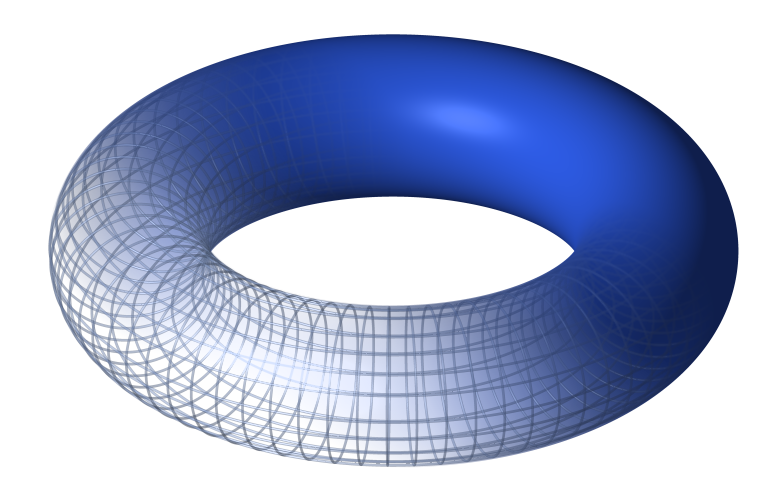
[edit]Most surfaces encountered in the physical world are orientable. Spheres, planes, and tori are orientable, for example. But Möbius strips, real projective planes, and Klein bottles are non-orientable. They, as visualized in -dimensions, all have just one side. The real projective plane and Klein bottle cannot be embedded in , only immersed with nice intersections.

Note that locally an embedded surface always has two sides, so a near-sighted ant crawling on a one-sided surface would think there is an "other side". The essence of one-sidedness is that the ant can crawl from one side of the surface to the "other" without going through the surface or flipping over an edge, but simply by crawling far enough.
In general, the property of being orientable is not equivalent to being two-sided; however, this holds when the ambient space (such as above) is orientable. For example, a torus embedded in


can be one-sided, and a Klein bottle in the same space can be two-sided; here refers to the Klein bottle.

Orientation by triangulation
[edit]Any surface has a triangulation: a decomposition into triangles such that each edge on a triangle is glued to at most one other edge. Each triangle is oriented by choosing a direction around the perimeter of the triangle, associating a direction to each edge of the triangle. If this is done in such a way that, when glued together, neighboring edges are pointing in the opposite direction, then this determines an orientation of the surface. Such a choice is only possible if the surface is orientable, and in this case there are exactly two different orientations.
If the figure can be consistently positioned at all points of the surface without turning into its mirror image, then this will induce an orientation in the above sense on each of the triangles of the triangulation by selecting the direction of each of the triangles based on the order red-green-blue of colors of any of the figures in the interior of the triangle.
This approach generalizes to any -manifold having a triangulation. However, some 4-manifolds do not have a triangulation, and in general for some -manifolds have triangulations that are inequivalent.


Orientability and homology
[edit]If denotes the first homology group of a closed surface , then is orientable if and only if has a trivial torsion subgroup. More precisely, if is orientable then is a free abelian group, and if not then where is free abelian, and the factor is generated by the middle curve in a Möbius band embedded in .


Orientability of manifolds
[edit]Let M be a connected topological n-manifold. There are several possible definitions of what it means for M to be orientable. Some of these definitions require that M has extra structure, like being differentiable. Occasionally, n = 0 must be made into a special case. When more than one of these definitions applies to M, then M is orientable under one definition if and only if it is orientable under the others.[2][3]
Orientability of differentiable manifolds
[edit]The most intuitive definitions require that be a differentiable manifold. This means that the transition functions in the atlas of are -functions. Such a function admits a Jacobian determinant. When the Jacobian determinant is positive, the transition function is said to be orientation preserving. An oriented atlas on is an atlas for which all transition functions are orientation preserving. is orientable if it admits an oriented atlas. When , an orientation of is a maximal oriented atlas. (When , i.e. is a point, an orientation of is a function .)


Orientability and orientations can also be expressed in terms of the tangent bundle. The tangent bundle is a vector bundle, so it is a fiber bundle with structure group . That is, the transition functions of the manifold induce transition functions on the tangent bundle which are fiberwise linear transformations. If the structure group can be reduced to the group of positive determinant matrices, or equivalently if there exists an atlas whose transition functions determine an orientation preserving linear transformation on each tangent space, then the manifold is orientable. Conversely, is orientable if and only if the structure group of the tangent bundle can be reduced in this way. Similar observations can be made for the frame bundle.


Another way to define orientations on a differentiable manifold is through volume forms. A volume form is a nowhere vanishing section of , the top exterior power of the cotangent bundle of . For example, has a standard volume form given by . Given a volume form on , the collection of all charts for which the standard volume form pulls back to a positive multiple of is an oriented atlas. The existence of a volume form is therefore equivalent to orientability of the manifold.




Volume forms and tangent vectors can be combined to give yet another description of orientability. If is a basis of tangent vectors at a point , then the basis is said to be right-handed if . A transition function is orientation preserving if and only if it sends right-handed bases to right-handed bases. The existence of a volume form implies a reduction of the structure group of the tangent bundle or the frame bundle to . As before, this implies the orientability of . Conversely, if is orientable, then local volume forms can be patched together to create a global volume form, orientability being necessary to ensure that the global form is nowhere vanishing.


Homology and the orientability of general manifolds
[edit]At the heart of all the above definitions of orientability of a differentiable manifold is the notion of an orientation preserving transition function. This raises the question of what exactly such transition functions are preserving. They cannot be preserving an orientation of the manifold because an orientation of the manifold is an atlas, and it makes no sense to say that a transition function preserves or does not preserve an atlas of which it is a member.
This question can be resolved by defining local orientations. On a one-dimensional manifold, a local orientation around a point corresponds to a choice of left and right near that point. On a two-dimensional manifold, it corresponds to a choice of clockwise and counter-clockwise. These two situations share the common feature that they are described in terms of top-dimensional behavior near but not at . For the general case, let be a topological -manifold. A local orientation of around a point is a choice of generator of the group

To see the geometric significance of this group, choose a chart around . In that chart there is a neighborhood of which is an open ball around the origin . By the excision theorem, is isomorphic to . The ball is contractible, so its homology groups vanish except in degree zero, and the space is an -sphere, so its homology groups vanish except in degrees and . A computation with the long exact sequence in relative homology shows that the above homology group is isomorphic to . A choice of generator therefore corresponds to a decision of whether, in the given chart, a sphere around is positive or negative. A reflection of through the origin acts by negation on , so the geometric significance of the choice of generator is that it distinguishes charts from their reflections.


On a topological manifold, a transition function is orientation preserving if, at each point in its domain, it fixes the generators of . From here, the relevant definitions are the same as in the differentiable case. An oriented atlas is one for which all transition functions are orientation preserving, is orientable if it admits an oriented atlas, and when , an orientation of is a maximal oriented atlas.
Intuitively, an orientation of ought to define a unique local orientation of at each point. This is made precise by noting that any chart in the oriented atlas around can be used to determine a sphere around , and this sphere determines a generator of . Moreover, any other chart around is related to the first chart by an orientation preserving transition function, and this implies that the two charts yield the same generator, whence the generator is unique.
Purely homological definitions are also possible. Assuming that is closed and connected, is orientable if and only if the th homology group is isomorphic to the integers . An orientation of is a choice of generator of this group. This generator determines an oriented atlas by fixing a generator of the infinite cyclic group and taking the oriented charts to be those for which pushes forward to the fixed generator. Conversely, an oriented atlas determines such a generator as compatible local orientations can be glued together to give a generator for the homology group .[4]


Orientation and cohomology
[edit]A manifold is orientable if and only if the first Stiefel–Whitney class vanishes. In particular, if the first cohomology group with coefficients is zero, then the manifold is orientable. Moreover, if is orientable and vanishes, then parametrizes the choices of orientations.[5] This characterization of orientability extends to orientability of general vector bundles over , not just the tangent bundle.


The orientation double cover
[edit]Around each point of there are two local orientations. Intuitively, there is a way to move from a local orientation at a point to a local orientation at a nearby point : when the two points lie in the same coordinate chart , that coordinate chart defines compatible local orientations at and . The set of local orientations can therefore be given a topology, and this topology makes it into a manifold.

More precisely, let be the set of all local orientations of . To topologize we will specify a subbase for its topology. Let be an open subset of chosen such that is isomorphic to . Assume that is a generator of this group. For each in , there is a pushforward function . The codomain of this group has two generators, and maps to one of them. The topology on is defined so that


is open.
There is a canonical map that sends a local orientation at to . It is clear that every point of has precisely two preimages under . In fact, is even a local homeomorphism, because the preimages of the open sets mentioned above are homeomorphic to the disjoint union of two copies of . If is orientable, then itself is one of these open sets, so is the disjoint union of two copies of . If is non-orientable, however, then is connected and orientable. The manifold is called the orientation double cover.


Manifolds with boundary
[edit]If is a manifold with boundary, then an orientation of is defined to be an orientation of its interior. Such an orientation induces an orientation of . Indeed, suppose that an orientation of is fixed. Let be a chart at a boundary point of which, when restricted to the interior of , is in the chosen oriented atlas. The restriction of this chart to is a chart of . Such charts form an oriented atlas for .


When is smooth, at each point of , the restriction of the tangent bundle of to is isomorphic to , where the factor of is described by the inward pointing normal vector. The orientation of is defined by the condition that a basis of is positively oriented if and only if it, when combined with the inward pointing normal vector, defines a positively oriented basis of .


Orientable double cover
[edit]A closely related notion uses the idea of covering space. For a connected manifold take , the set of pairs where is a point of and is an orientation at ; here we assume is either smooth so we can choose an orientation on the tangent space at a point or we use singular homology to define orientation. Then for every open, oriented subset of we consider the corresponding set of pairs and define that to be an open set of . This gives a topology and the projection sending to is then a 2-to-1 covering map. This covering space is called the orientable double cover, as it is orientable. is connected if and only if is not orientable.


Another way to construct this cover is to divide the loops based at a basepoint into either orientation-preserving or orientation-reversing loops. The orientation preserving loops generate a subgroup of the fundamental group which is either the whole group or of index two. In the latter case (which means there is an orientation-reversing path), the subgroup corresponds to a connected double covering; this cover is orientable by construction. In the former case, one can simply take two copies of , each of which corresponds to a different orientation.
Orientation of vector bundles
[edit]A real vector bundle, which a priori has a structure group, is called orientable when the structure group may be reduced to , the group of matrices with positive determinant. For the tangent bundle, this reduction is always possible if the underlying base manifold is orientable and in fact this provides a convenient way to define the orientability of a smooth real manifold: a smooth manifold is defined to be orientable if its tangent bundle is orientable (as a vector bundle). Note that as a manifold in its own right, the tangent bundle is always orientable, even over nonorientable manifolds.


Related concepts
[edit]Lorentzian geometry
[edit]In Lorentzian geometry, there are two kinds of orientability: space orientability and time orientability. These play a role in the causal structure of spacetime.[6] In the context of general relativity, a spacetime manifold is space orientable if, whenever two right-handed observers head off in rocket ships starting at the same spacetime point, and then meet again at another point, they remain right-handed with respect to one another. If a spacetime is time-orientable then the two observers will always agree on the direction of time at both points of their meeting. In fact, a spacetime is time-orientable if and only if any two observers can agree which of the two meetings preceded the other.[7]
Formally, the pseudo-orthogonal group has a pair of characters: the space orientation character and the time orientation character ,



Their product is the determinant, which gives the orientation character. A space-orientation of a pseudo-Riemannian manifold is identified with a section of the associated bundle


where is the bundle of pseudo-orthogonal frames. Similarly, a time orientation is a section of the associated bundle


See also
[edit]References
[edit]- ^ Munroe, Marshall Evans (1963). Modern multidimensional calculus. Addison-Wesley. p. 263.
- ^ Spivak, Michael (1965). Calculus on Manifolds. HarperCollins. ISBN 978-0-8053-9021-6.
- ^ Hatcher, Allen (2001). Algebraic Topology. Cambridge University Press. ISBN 978-0521795401.
- ^ Hatcher 2001, p. 236 Theorem 3.26(a)
- ^ Lawson, H. Blaine; Michelsohn, Marie-Louise (1989). Spin Geometry. Princeton University Press. p. 79 Theorem 1.2. ISBN 0-691-08542-0.
- ^ Hawking, S.W.; Ellis, G.F.R. (1973). The Large Scale Structure of Space-Time. Cambridge University Press. ISBN 0-521-20016-4.
- ^ Hadley, Mark J. (2002). "The Orientability of Spacetime" (PDF). Classical and Quantum Gravity. 19 (17): 4565–71. arXiv:gr-qc/0202031v4. Bibcode:2002CQGra..19.4565H. CiteSeerX 10.1.1.340.8125. doi:10.1088/0264-9381/19/17/308.
External links
[edit]- Orientation of manifolds Archived 2013-05-03 at the Wayback Machine at the Manifold Atlas.
- Orientation covering Archived 2019-04-10 at the Wayback Machine at the Manifold Atlas.
- Orientation of manifolds in generalized cohomology theories Archived 2013-11-02 at the Wayback Machine at the Manifold Atlas.
- The Encyclopedia of Mathematics article on Orientation.
| Fields |  | |
|---|---|---|
| Key concepts | ||
| Metrics and properties | ||
| Key results | ||


Orientability
View on GrokipediaSurfaces
Definition and examples
In topology, a surface is orientable if it admits an oriented atlas, where transition maps between charts have positive Jacobian determinants, allowing a consistent orientation of tangent spaces across the surface.[7] For surfaces embedded in , this is equivalent to admitting a continuous choice of unit normal vector field, allowing a consistent distinction between "left" and "right" or a handedness across the entire surface.[8] This contrasts with non-orientable surfaces, where any attempt to assign such a consistent orientation leads to a contradiction, such as a reversal of handedness along certain closed paths.[3] Classic examples of orientable surfaces include the sphere and the torus. The sphere, defined as the set of points at unit distance from the origin in , supports a continuous outward-pointing normal vector field, confirming its orientability.[9] Similarly, the torus, formed by revolving a circle around an axis in its plane without intersecting it, admits a consistent normal field and is thus orientable.[10] Non-orientable surfaces are exemplified by the Möbius strip, the real projective plane, and the Klein bottle. The Möbius strip, first described by August Ferdinand Möbius in 1858, is constructed from a rectangular strip by identifying the two short edges after applying a single half-twist to one end, resulting in a one-sided surface where a path around the central curve reverses orientation.[11][12] The real projective plane , which models lines through the origin in , can be formed by taking a disk and identifying antipodal points on its boundary; this surface embeds a Möbius strip and is non-orientable.[13][14] The Klein bottle, a closed surface, arises from a square by identifying one pair of opposite edges in the same direction and the other pair with reversed orientations (one twisted); like the others, it contains a Möbius strip and cannot maintain consistent orientation, though it requires four dimensions for embedding without self-intersection.[15][16]Local versus global orientability
Local orientability refers to the property that every point on a surface possesses a neighborhood homeomorphic to an open disk in the plane, where a consistent orientation can be assigned locally, such as by choosing a basis for the tangent space that respects a right-hand rule.[7] This local consistency ensures that the surface behaves like an oriented Euclidean plane in sufficiently small regions, and it holds for all smooth surfaces without singularities.[17] In contrast, global orientability requires the existence of a consistent orientation across the entire surface, meaning that local orientations can be chosen such that they agree on overlapping neighborhoods, yielding a continuous choice of basis for the tangent bundle.[7] This global property is equivalent to the surface being two-sided, where an embedding in three-dimensional space allows a coherent distinction between "inside" and "outside" without reversal.[18] For instance, the sphere is globally orientable, permitting a uniform normal vector field pointing outward everywhere.[7] A key criterion for distinguishing orientability is the presence of closed curves on the surface: a surface is non-orientable if it contains a closed curve, such as a loop traversing a Möbius strip, that reverses the local orientation when followed around its path.[19] Traversing such a curve leads to an inconsistency in the orientation, as the initial local basis returns flipped, preventing a global coherent choice.[7] For compact surfaces, global orientability is equivalently characterized by the vanishing of the first Stiefel-Whitney class $ w_1 $, a cohomology class in $ H^1(S; \mathbb{Z}/2\mathbb{Z}) $ that detects orientation-reversing loops through its action on the tangent bundle.[7] Intuitively, $ w_1 = 0 $ implies the tangent bundle is orientable, allowing a global section of oriented frames, whereas a nonzero $ w_1 $ signals the bundle's twist, akin to an odd number of crosscaps in the surface's construction.[20] In embedding terms, two-sided surfaces, like the torus embedded in , admit a trivial normal bundle, supporting a consistent transverse direction, while one-sided surfaces, such as the real projective plane, have a non-trivial normal bundle, where any embedding merges the two sides into one.[18]Orientability via triangulation
A triangulation of a surface is a decomposition of the surface into a finite collection of triangles (2-simplices), along with their edges (1-simplices) and vertices (0-simplices), such that the triangles meet edge-to-edge without overlaps or gaps, and the link of every vertex is a cycle.[10] This combinatorial structure provides a discrete model for the surface, enabling algorithmic verification of topological properties like orientability.[21] Orientability can be determined combinatorially by attempting to assign orientations to the triangles such that adjacent triangles induce opposite orientations on their shared edges. Specifically, orient each triangle by selecting a cyclic ordering of its three vertices, say clockwise . For two adjacent triangles sharing an edge , the induced orientation on that edge from one triangle must be the reverse of that from the other (e.g., versus ). This consistent labeling ensures a global "handedness" across the surface; the existence of such a labeling without conflicts confirms orientability.[22] Equivalently, the dual graph of the triangulation—where vertices represent triangles and edges connect adjacent triangles—must be bipartite, allowing a 2-coloring that corresponds to the two possible global orientations.[10] To check for coherent orientation, an algorithm can traverse the triangulation starting from one triangle, propagating the orientation to adjacent triangles via shared edges, and verifying consistency around cycles. Begin by orienting an initial triangle arbitrarily. For each neighboring triangle, assign its orientation so that the shared edge receives the opposite direction. If a conflict arises—such as returning to a previously oriented triangle via a different path with an incompatible assignment—the surface is non-orientable. This process can be implemented via depth-first search on the dual graph, running in linear time relative to the number of triangles. Failure to find a global consistent orientation indicates the presence of an odd-length cycle in the dual graph, corresponding to a Möbius-like twist.[21][22] A classic example illustrating non-orientability is the real projective plane (), which admits a triangulation with 6 vertices, 15 edges, and 10 triangular faces. One such triangulation arises from identifying opposite faces of a cube or via the polygonal schema with edges labeled a b c a b c, where each letter appears twice with matching directions, creating twisted identifications. Attempting to orient the triangles reveals a conflict: traversing a closed path that encircles an odd number of twisted edges reverses the orientation, making a consistent global assignment impossible. This combinatorial obstruction confirms 's non-orientability, distinguishing it from orientable surfaces like the sphere or torus.[21][10] While the Euler characteristic (where V, E, F are the numbers of vertices, edges, and faces) alone does not determine orientability—since both the torus (, orientable) and Klein bottle (, non-orientable) share this value—it aids classification when combined with the triangulation's orientability check. For closed surfaces, orientable ones satisfy for genus , and the combinatorial verification ensures the decomposition aligns with this formula without orientation paradoxes.[22]Manifolds
Topological orientability
A topological manifold is a second-countable Hausdorff topological space that is locally homeomorphic to the Euclidean space for some fixed integer .[7] These spaces provide the foundational setting for studying orientability without requiring additional structure such as differentiability. A topological -manifold is orientable if it admits an oriented atlas, meaning an atlas such that for any two charts and with nonempty intersection, the transition map is an orientation-preserving homeomorphism of open subsets of . Here, a homeomorphism is orientation-preserving if it induces the positive generator on the top relative homology group , equivalently having local degree .[7] This condition ensures a consistent choice of local orientation across overlapping charts, allowing the manifold to be "consistently oriented" pointwise without contradictions. Equivalently, is orientable if there exists a consistent choice of orientation at each point, formalized as a continuous function assigning to every a generator of the local homology group such that neighboring points have compatible orientations under homeomorphisms.[7] Another equivalent characterization is that the orientation double cover , a two-sheeted covering space classifying orientations, is disconnected (consisting of two connected components).[7] In this covering, each fiber corresponds to the two possible local orientations at a base point, and disconnection implies a global choice is possible. Examples of orientable topological manifolds include the -sphere and the -torus for any , extending the familiar cases from surfaces.[7] Non-orientable examples include the real projective space for even , where transition maps reverse orientation in certain charts, generalizing the non-orientability of .[7] For compact orientable -manifolds without boundary, the Euler characteristic satisfies when is odd; this parity result arises from the structure of the homology groups and Poincaré duality but holds intuitively from the pairing of cells in even and odd dimensions.[7]Smooth orientability
In the context of smooth manifolds, orientability is defined through the existence of an orientation atlas, which is a smooth atlas where the transition maps between any two charts have Jacobians with positive determinants everywhere on their domains. This ensures a consistent choice of orientation on the tangent spaces across the manifold, distinguishing it from the coarser topological notion by incorporating differentiability.[23] A smooth n-dimensional manifold is orientable if and only if it admits a nowhere-vanishing smooth n-form, known as a volume form, which provides a global tool for defining oriented integrals and volumes. Such a volume form induces an orientation by specifying, at each point, an equivalence class of positively oriented bases for the tangent space, and conversely, any orientation atlas allows the construction of such a form using partitions of unity.[23][24] Smooth orientability is equivalently characterized by the reduction of the frame bundle of the manifold—a principal -bundle whose fibers are all ordered bases of the tangent spaces—to a principal -subbundle, consisting of oriented frames with positive determinant. This reduction captures the consistent choice of orientation-preserving bases and connects orientability to the geometry of the tangent bundle.[23] For example, the n-sphere admits a standard smooth structure that is orientable for every , as it supports a canonical volume form derived from its embedding in . In contrast, the real projective space with its standard smooth structure is non-orientable when is even, due to transition maps that reverse orientation in certain charts, while it is orientable when is odd.[23] A key differential criterion for smooth orientability is that the integral of a compactly supported top-degree form over the manifold is well-defined and independent of the choice of atlas only if the manifold is orientable; without such an orientation, the sign ambiguity in non-compatible charts prevents a consistent global integration. This property underpins applications like Stokes' theorem on oriented manifolds.[23][24]Orientability and homology
Singular homology provides an algebraic tool to detect the orientability of manifolds through their top-dimensional homology groups. For an -dimensional topological manifold , the th singular homology group with integer coefficients captures global topological features, including orientation properties.[7] A fundamental result states that a closed connected -manifold is orientable if and only if . In this case, the group is generated by a fundamental class , which represents a coherent choice of local orientations across the manifold. For non-orientable closed connected -manifolds, , as there is no such generator due to the inconsistency introduced by orientation-reversing loops.[7] The proof of this result relies on the orientation sheaf. Equivalently, a manifold is orientable if and only if its orientation sheaf admits a nowhere-zero global section. Such a section provides a consistent choice of local orientations across the entire manifold. Orientability corresponds to the sheaf being trivial (constant ), allowing a global section that defines the fundamental class in . In the non-orientable case, the sheaf is the twisted integer sheaf , and the top homology with constant coefficients vanishes because cycles cannot be coherently oriented without torsion that forces the group to zero. Local orientations exist everywhere, but global gluing fails, leading to boundaries in all top-dimensional chains.[7] The correspondence between a homology class and a section of the orientation sheaf (also known as the orientation sheaf) is a foundational concept in the study of manifolds. To understand why a non-orientable manifold must have a surjective map from its first homology group to , we have to look at the relationship between the fundamental group and the local orientations of the manifold. What "Detect" Means Precisely In topology, "detecting" an orientation flip means that there is an algebraic object (like a group element or a cohomology class) that distinguishes between orientation-preserving loops and orientation-reversing loops. The relationship between the fundamental group of the orientation double cover and the fundamental group of the base manifold is defined by the way loops in behave with respect to orientation.- The Subgroup Relationship
Since is a 2-sheeted covering space, the induced map on fundamental groups is an injective homomorphism.
For a connected, non-orientable manifold :
The image is a normal subgroup of index 2 in .
This means that is "twice as large" as in terms of its group structure. - Orientation-Preserving Loops
The subgroup consists precisely of the classes of orientation-preserving loops in .
Recall the orientation homomorphism :
- if the loop preserves orientation.
- if the loop reverses orientation.
The fundamental group of the orientation double cover is the kernel of this map:
Why is it a loop in the cover?
A loop in lifts to a path in . If is orientation-preserving, the lift starts and ends on the same "sheet," making it a closed loop in . If reverses orientation, the lift starts on one sheet and ends on the other, so it is not a loop in .
- Summary of Cases
- Orientable manifold: The orientation double cover is disconnected (two copies of ).
(per component). - Non-orientable manifold: The orientation double cover is connected.
.
The Möbius strip has .
A loop going around the strip once () reverses orientation.
A loop going around twice () preserves orientation.
The orientation double cover of the Möbius strip is an annulus (a cylinder), which has .
The map maps the generator of the annulus's to in the Möbius strip's . The index is indeed 2. This relationship interacts with the first Stiefel-Whitney class in cohomology. The Proof Theorem: If is a connected, non-orientable manifold, there exists a surjective homomorphism .
- The Existence of a Surjection from
By definition, a manifold is non-orientable if and only if there exists at least one orientation-reversing loop. This means the orientation homomorphism cannot be the zero map. Since the codomain is (which only has two elements), any non-zero map must be surjective. - The Hurewicz Theorem / Abelianization
The first homology group is the abelianization of the fundamental group:
- Factorization through the Abelianization
A standard property of group theory states that any homomorphism from a group to an abelian group factors uniquely through the abelianization of . Since is abelian, the map induces a unique homomorphism making the diagram commute: . - Conclusion
Since is surjective, the induced map must also be surjective. If were not surjective, its image would be trivial, forcing the image of to be trivial, contradicting non-orientability. Thus, must admit a surjective homomorphism onto .
Even order contains a subgroup isomorphic to .
Surjects onto contains a normal subgroup of index 2 (which becomes the kernel of the homomorphism). The most standard example of a 3-manifold where does not contain a component is the non-orientable bundle over . The Example: This manifold is constructed by taking and gluing the face at to the face at using an orientation-reversing homeomorphism of the sphere (such as a reflection across the equator or the antipodal map).
- The Homology Groups
- (It is connected)
- (Since it is non-orientable and closed)
- Why is just
- The "Rule" Still Holds
| Property | Orientable Manifold (M) | Non-Orientable Manifold (M) |
|---|---|---|
| Top Homology () | (generated by the fundamental class) | (cycles cannot be consistently oriented) |
| Sub-top Homology () | Always torsion-free (Free Abelian) | Always contains torsion (specifically a part) |
| Property | Closed Non-Orientable | Non-Orientable with Boundary |
|---|---|---|
| Top Homology () | ||
| Sub-top Homology () | Contains torsion | Torsion-free (Free Abelian) |
| Example () | Klein Bottle: | Möbius Strip: |
| [!NOTE] | ||
| While might be torsion-free for a non-orientable manifold with boundary, the relative homology will still be , reflecting the fact that you cannot find a consistent global orientation (fundamental class) for the space. | ||
| For any compact -dimensional manifold with a non-empty boundary (), the -th homology group is always zero, regardless of whether the manifold is orientable or non-orientable. |
| Property | Orientable (with bdry) | Non-Orientable (with bdry) |
|---|---|---|
| Absolute | ||
| Relative | (contains the fundamental class ) | |
| Manifold Type | ||
|---|---|---|
| Closed, Orientable | Torsion-free | |
| Closed, Non-Orientable | torsion | |
| Boundary, Orientable | Torsion-free | |
| Boundary, Non-Orientable | Torsion-free |
| Manifold | (First Homology) | Contains summand? | Orientability |
|---|---|---|---|
| Yes | Non-orientable | ||
| No | Non-orientable | ||
| (Lens Space) | No | Orientable |
| Manifold (M) | Dim (n) | Sub-top Homology H_{n-1} | Torsion Part |
|---|---|---|---|
| Real Projective Plane () | 2 | ||
| Klein Bottle () | 2 | ||
| Non-orientable bundle over | 3 | ||
| 3 |
The Local-to-Global Relationship
For any -manifold , there is a fundamental relationship between global homology and local orientations: Local Orientation: At any point , the local homology group is isomorphic to . A choice of generator for this group is a local orientation at . The Orientation Sheaf: The orientation sheaf is the disjoint union of all these local groups. A section of this sheaf is a function that assigns a local orientation to every point in in a way that is locally "consistent." The Map: There is a natural map from the global homology group to the space of sections:Why this matters for the proof
This correspondence is used to prove that for a connected non-compact manifold: Compact Support: Any cycle is a finite formal sum of simplices, so its image is always compact. The "Zero" Constraint To understand why a section with compact support must be zero, we can break it down into three logical steps:- The Sheaf is "Locally Constant"
- The Identity Theorem for Connected Spaces
- The Role of Non-Compactness
- Compact Support: If a section has compact support, it means that outside of some bounded compact set , the section must be zero.
- Non-Compactness: By definition, a non-compact manifold "goes on forever." It cannot be contained within any compact set . Therefore, the region outside of () is never empty.
- There must be points in the "outside" region () where .
- Because is connected, if is zero at those points, the Identity Theorem forces to be zero everywhere.