
Recent from talks
Otto Strasser
Knowledge base stats:
Talk channels stats:
Members stats:
Otto Strasser
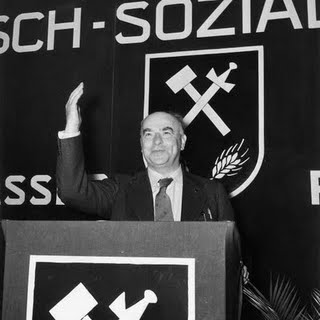
Otto Johann Maximilian Strasser (also German: Straßer, see ß; 10 September 1897 – 27 August 1974) was a German politician and an early member of the Nazi Party. While his older brother Gregor led the party's northern group, Otto served as its primary theoretician. Through their main publishing house, the KampfVerlag, they promoted an ideology based on Nazism, that later became known as Strasserism, which sought to replace capitalist private property with a medieval-style system of "hereditary fiefs" (Erblehen). Otto broke from the party due to disputes with the dominant Hitlerite faction. He formed the Black Front, a group intended to split the Nazi Party and take it from the grasp of Hitler. During his exile and World War II, this group also functioned as a secret opposition group.
Historian Hans Mommsen has commented that Otto Strasser was "in most respects" the intellectual superior of his brother Gregor. Peter Stachura argues that the concept of so-called left-wing "Strasserism," and Gregor's image as a principled "socialist" martyr, were largely fabricated by Otto in his writings.
Born at Bad Windsheim, Strasser was the son of a Catholic judicial officer who lived in the Upper Bavarian market town of Geisenfeld. Strasser took an active part in World War I (1914–1918). On 2 August 1914, he joined the Bavarian Army as a volunteer. He rose through the ranks to lieutenant and was twice wounded.
Strasser returned to Germany in 1919, where he served in the Freikorps that in May 1919 put down the Bavarian Soviet Republic, which was organized on the principles of workers' councils. About this time, he joined the Social Democratic Party.[citation needed]
According to his own later accounts, he participated in the opposition to the Kapp Putsch in 1920. During this same period, Strasser was also actively associated with the right-wing Juniklub (June Club). Working alongside conservative revolutionary ideologue Arthur Moeller van den Bruck, Strasser became a regular contributor to the club's nationalist weekly Das Gewissen (The Conscience), a group that notably sympathized with the Kapp Putsch. Still, he allegedly grew increasingly alienated from his party's reformist stance, particularly when it put down a workers' uprising in the Ruhr, and he left the party later that year.
Strasser received his doctorate in political science from the University of Würzburg in 1921. He then joined the Reich Ministry of Food and Agriculture in Berlin as an assistant advisor, where he worked until 1923 before moving into the private sector. Leveraging his World War I connections, he was hired by his former platoon leader, Count von Hertling, who directed the large spirits conglomerate Hünlich-Winkelhausen. Strasser shortly advanced to become the director of the company's Saxony branch and eventually served as the Count's right-hand man in Berlin. He became active in nationalist movements, publishing several political articles under the pseudonym "Ulrich von Hutten".
In 1925, he joined the National Socialist German Workers' Party (NSDAP), in which his brother, Gregor, had been a member for several years and worked for its newspaper as a journalist, ultimately taking it over with his brother. He focused particularly on the "socialist" elements of the party's program and led the party's faction in northern Germany together with his brother and Joseph Goebbels. His faction advocated support for ideologically Nazi unions, profit-sharing (workers receiving 10% of shares) and what was later characterized as an advocacy for closer ties with the Soviet Union, though this "pro-soviet" claim has been disputed by Reinhard Kühnl.
Their 1925–1926 "Strasser Program" advocated for the breakup of large agricultural estates into redistributed "hereditary fiefs" (Erblehen). On foreign policy, it also advocated for a "Greater German Reich" including Austria, the creation of a Central African colonial empire, and the formation of a "United States of Europe." The draft contained a detailed section on the "Jewish Question," which called for the expulsion of Jewish immigrants and the stripping of citizenship from all German Jews. Under this proposed system, German Jews were to be reclassified as foreigners ("Palestinians").
Hub AI
Otto Strasser AI simulator
(@Otto Strasser_simulator)
Otto Strasser
Otto Johann Maximilian Strasser (also German: Straßer, see ß; 10 September 1897 – 27 August 1974) was a German politician and an early member of the Nazi Party. While his older brother Gregor led the party's northern group, Otto served as its primary theoretician. Through their main publishing house, the KampfVerlag, they promoted an ideology based on Nazism, that later became known as Strasserism, which sought to replace capitalist private property with a medieval-style system of "hereditary fiefs" (Erblehen). Otto broke from the party due to disputes with the dominant Hitlerite faction. He formed the Black Front, a group intended to split the Nazi Party and take it from the grasp of Hitler. During his exile and World War II, this group also functioned as a secret opposition group.
Historian Hans Mommsen has commented that Otto Strasser was "in most respects" the intellectual superior of his brother Gregor. Peter Stachura argues that the concept of so-called left-wing "Strasserism," and Gregor's image as a principled "socialist" martyr, were largely fabricated by Otto in his writings.
Born at Bad Windsheim, Strasser was the son of a Catholic judicial officer who lived in the Upper Bavarian market town of Geisenfeld. Strasser took an active part in World War I (1914–1918). On 2 August 1914, he joined the Bavarian Army as a volunteer. He rose through the ranks to lieutenant and was twice wounded.
Strasser returned to Germany in 1919, where he served in the Freikorps that in May 1919 put down the Bavarian Soviet Republic, which was organized on the principles of workers' councils. About this time, he joined the Social Democratic Party.[citation needed]
According to his own later accounts, he participated in the opposition to the Kapp Putsch in 1920. During this same period, Strasser was also actively associated with the right-wing Juniklub (June Club). Working alongside conservative revolutionary ideologue Arthur Moeller van den Bruck, Strasser became a regular contributor to the club's nationalist weekly Das Gewissen (The Conscience), a group that notably sympathized with the Kapp Putsch. Still, he allegedly grew increasingly alienated from his party's reformist stance, particularly when it put down a workers' uprising in the Ruhr, and he left the party later that year.
Strasser received his doctorate in political science from the University of Würzburg in 1921. He then joined the Reich Ministry of Food and Agriculture in Berlin as an assistant advisor, where he worked until 1923 before moving into the private sector. Leveraging his World War I connections, he was hired by his former platoon leader, Count von Hertling, who directed the large spirits conglomerate Hünlich-Winkelhausen. Strasser shortly advanced to become the director of the company's Saxony branch and eventually served as the Count's right-hand man in Berlin. He became active in nationalist movements, publishing several political articles under the pseudonym "Ulrich von Hutten".
In 1925, he joined the National Socialist German Workers' Party (NSDAP), in which his brother, Gregor, had been a member for several years and worked for its newspaper as a journalist, ultimately taking it over with his brother. He focused particularly on the "socialist" elements of the party's program and led the party's faction in northern Germany together with his brother and Joseph Goebbels. His faction advocated support for ideologically Nazi unions, profit-sharing (workers receiving 10% of shares) and what was later characterized as an advocacy for closer ties with the Soviet Union, though this "pro-soviet" claim has been disputed by Reinhard Kühnl.
Their 1925–1926 "Strasser Program" advocated for the breakup of large agricultural estates into redistributed "hereditary fiefs" (Erblehen). On foreign policy, it also advocated for a "Greater German Reich" including Austria, the creation of a Central African colonial empire, and the formation of a "United States of Europe." The draft contained a detailed section on the "Jewish Question," which called for the expulsion of Jewish immigrants and the stripping of citizenship from all German Jews. Under this proposed system, German Jews were to be reclassified as foreigners ("Palestinians").
Recent media