Hubbry Logo
search
logo
1911072

Overarm bowling

logo
Community Hub0 Subscribers
Read side by side
from Wikipedia
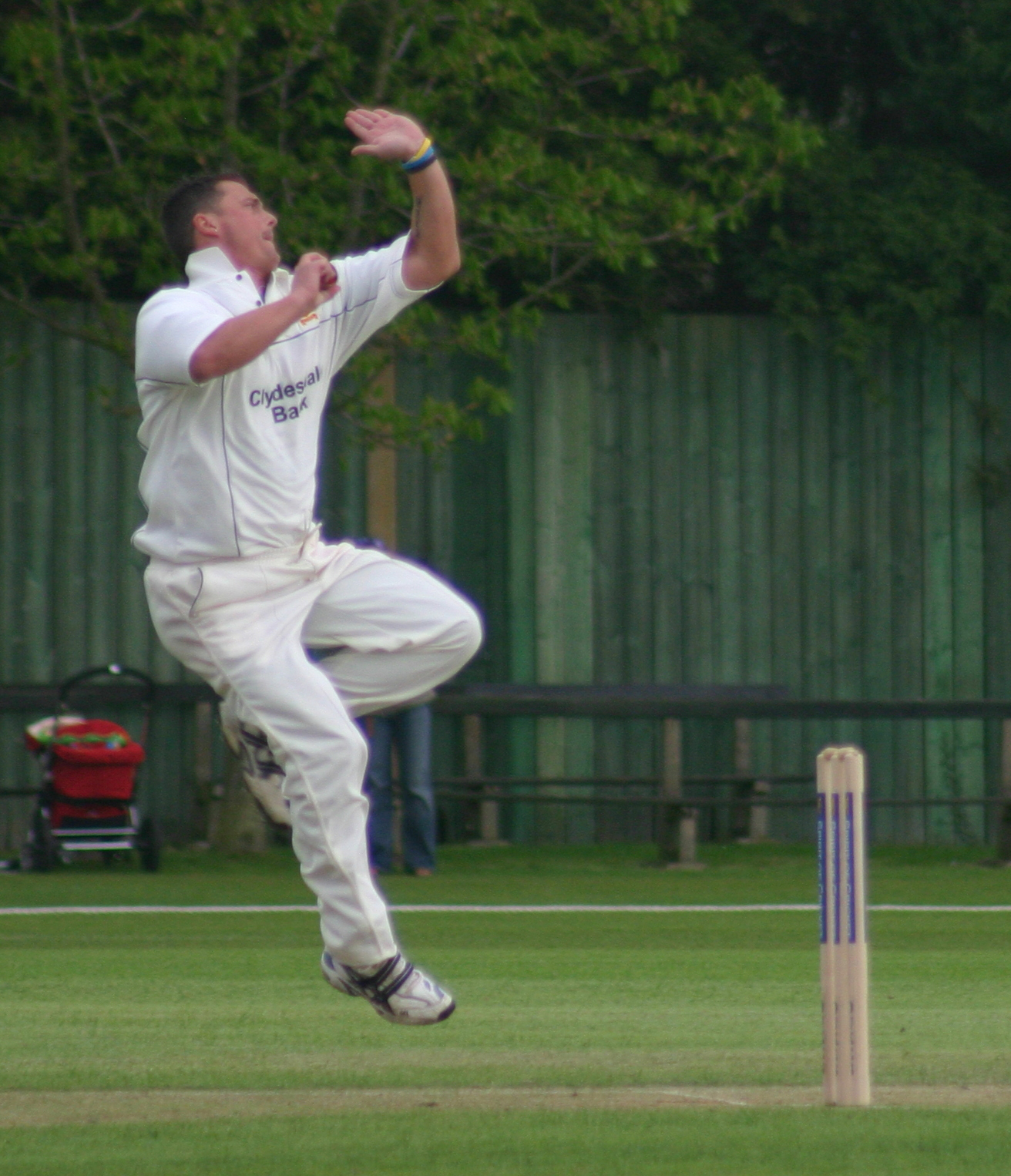
English cricketer Darren Gough about to deliver the ball overarm-style.

In cricket, overarm bowling refers to a delivery in which the bowler's hand is above shoulder height.

When cricket originated all bowlers delivered the ball underarm, where the bowler's hand is below waist height. However, so the story goes, John Willes became the first bowler to use a "round-arm" technique after practising with his sister Christine Willes, who had used the technique, as she was unable to bowl underarm due to her wide and huge skirt impeding her delivery of the ball.[1][failed verification]

A roundarm delivery is where the hand is between shoulder height and waist height;

After roundarm was legalised in 1835 with the bowler allowed to deliver the ball at shoulder height, it was not long before some bowlers began to raise the hand above the shoulder. The Laws of Cricket at that time directed that such a delivery be called a no-ball. In 1845, the law was strengthened by removing the benefit of doubt from the bowler in height of hand questions, the umpire's view of the incident being final.

Even so, it was only a matter of time before confrontation occurred. The problem was that many umpires were themselves bowlers and believed that the bowler should be allowed to bowl with a fully raised hand. The watershed was reached on 26 August 1862 at The Oval when Surrey hosted All-England. The England bowler Edgar Willsher deliberately bowled overarm and was no-balled six times in succession by umpire John Lillywhite, ironically the son of William Lillywhite, the famous bowler who had done so much to have roundarm legalised in 1835.

In what was surely a pre-rehearsed demonstration, Willsher and the other eight professionals in the England team staged a walk-off, leaving their two amateur colleagues looking non-plussed in the middle. Play continued next day, but Lillywhite diplomatically withdrew and was replaced by another umpire.

MCC responded to this "crisis" with rather more haste than they had to roundarm, and changed the Laws of Cricket in time for the 1864 season. Law 10 was rewritten to allow the bowler to bring his arm through at any height providing he kept it straight and did not throw the ball. This completed the evolution of bowling and the overarm style has remained predominant ever since, though some conservatives (including W G Grace, no less) did continue to bowl roundarm till the end of their careers; and even underarm itself was still seen occasionally.

An interesting historical development of the legalisation of overarm was that for many years, 1864 was deemed to mark the start of "first-class cricket" which suggested that earlier cricket was "second-class". The 1864 origin has been strongly challenged: see also First-class cricket.

References

[edit]

External sources

[edit]

Further reading

[edit]
Revisions and contributorsEdit on WikipediaRead on Wikipedia
from Grokipedia
Overarm bowling is the primary delivery action in cricket, in which the bowler releases the ball with the arm fully extended above shoulder height, allowing for greater speed, bounce, and variation compared to earlier underarm or roundarm methods.[1] This technique became the standard form of bowling in the sport following its formal legalization by the Marylebone Cricket Club (MCC) in 1864, marking a pivotal evolution in cricket's gameplay.[2] The origins of overarm bowling trace back to the 19th century, when bowlers sought to gain an advantage by gradually raising their delivery arm beyond the restrictions of underarm bowling, which involved releasing the ball below waist height and dominated the game until around the 1800s.[1] Roundarm bowling, legalized by the MCC in 1835 and characterized by the arm at shoulder level, served as an intermediate step, but bowlers like Edgar Willsher pushed boundaries by employing overarm actions, leading to controversies such as Willsher being no-balled six times during a match at The Oval in 1862.[3] These incidents, including a temporary halt in play to replace umpires, highlighted the need for change and directly influenced the 1864 rule update that permitted overarm delivery without penalty.[1] The adoption of overarm bowling profoundly transformed cricket, enabling faster deliveries and more dynamic tactics that elevated the bowler's role in dismissing batsmen, while also prompting subsequent regulations like the 15-degree elbow extension limit introduced in 2004 by the International Cricket Council (ICC).[4] By the first Test match in 1877 between England and Australia, overarm had become the default action, contributing to the sport's increased competitiveness and global appeal throughout the modern era.[2] Today, it remains integral to all formats of the game, from Test cricket to limited-overs variants, underscoring its enduring legacy in shaping cricket's strategic and physical demands.[1]

Historical Development

Origins and Evolution

Underarm bowling, the original style in cricket, involved delivering the ball by rolling or skimming it along the ground, often in a lobbing motion to induce bounce.[1] This technique dominated the sport from its early formalized rules in the 18th century until the late 1700s, when batsmen began exploiting its predictability to score freely with powerful drives.[5] The limitations of underarm delivery, which restricted pace and variation, prompted bowlers to seek innovations that could challenge batting dominance and restore balance to the game.[6] The transition to roundarm bowling emerged around 1800, with early experiments credited to Tom Walker of the Hambledon Club, who in 1788 attempted a higher delivery but was warned against it by his team for deviating from underarm norms.[7] John Willes of Kent further popularized the style in the early 19th century, motivated by the need for increased pace and bounce to counter advancing batsmanship; he openly used roundarm in practice and matches despite initial resistance.[7] An unverified anecdote attributes the innovation's inspiration to Willes's sister, Christina Willes, who in the early 1800s reportedly bowled roundarm to her brother in their garden because her voluminous skirts hindered the underarm action.[8] These developments marked a deliberate push for greater athleticism in bowling, allowing the arm to swing from shoulder height rather than below the waist.[5] Debates over roundarm's fairness intensified from 1827 to 1835, fueled by accusations that it unfairly altered the ball's trajectory and gave bowlers an undue advantage, leading to trial matches between All-England and Sussex sides to test its impact.[7] The controversy culminated in partial acceptance by 1835, when the Marylebone Cricket Club (MCC) revised the laws to permit the hand to reach shoulder level, effectively legalizing roundarm and phasing out underarm as the primary style.[5] This shift set the stage for further evolution in the 1850s and 1860s, as bowlers like Edgar Willsher experimented with raising the arm fully above the shoulder to achieve even greater speed and deceptive variations, driven by the ongoing quest to outpace increasingly sophisticated batting techniques.[1] Willsher's deliberate overarm trials, though initially contentious, accelerated the move toward the modern overarm action that would soon become standard.[7]

Legalization and Key Events

In 1835, the Marylebone Cricket Club (MCC) amended the Laws of Cricket to legalize roundarm bowling, permitting bowlers to raise their arm to shoulder height during delivery, though full overarm actions were still deemed "throwing" and prohibited.[7][9] This change followed years of controversy and widespread use of roundarm despite initial resistance from umpires and traditionalists.[7] A pivotal controversy arose on 26 August 1862 during a match between Surrey and an All-England XI at The Oval, where England bowler Edgar Willsher was no-balled six times in succession by umpire John Lillywhite for deliberately using an overarm action.[1][3] In protest, Willsher and eight other England fielders walked off the field, halting play and sparking significant public outcry that highlighted the growing demand for overarm acceptance.[1] The umpires were subsequently replaced to allow the match to resume without further interruptions. The incident underscored the impracticality of enforcing outdated restrictions and contributed to the push for reform.[1] Responding to mounting pressure, the MCC revised Law 10 in 1864 to permit overarm bowling, stipulating that the bowler's arm must remain straight and not bent at the elbow during release to avoid classification as a throw.[7][3] This landmark adjustment effectively ended prohibitions on arm height, allowing bowlers greater freedom while maintaining fairness standards.[1] Following the 1864 change, overarm bowling rapidly gained prominence and became the standard delivery method in professional cricket, including the inaugural Test match in 1877 between England and Australia.[3] Although underarm persisted in some informal and lower-level play into the early 20th century, overarm's adoption transformed the sport's dynamics by enabling faster and more varied bowling.[7]

Technique and Mechanics

Delivery Action

The delivery action in overarm bowling, as practiced in cricket, consists of a coordinated sequence of phases that generate momentum, transfer energy, and propel the ball toward the batsman while maintaining balance and control. The process begins with the run-up, where the bowler starts approximately 15 to 30 meters behind the bowling crease to build horizontal velocity through a series of controlled strides.[10] This phase contributes 15 to 19 percent of the final ball release speed by gradually accelerating the bowler's body mass, with arms pumping rhythmically and the head kept steady to ensure alignment toward the target.[10] Excessive speed in the run-up, exceeding about 85 percent of maximum sprint capacity, can lead to loss of control, but optimal approach velocities around 5 meters per second facilitate efficient momentum transfer.[11] In the load phase, immediately following the run-up, the bowler plants the back foot (the non-bowling-side foot) upon landing from a leaping pre-delivery stride, pivoting on that leg to initiate rotation. This back-foot contact generates vertical ground reaction forces up to 2.9 times body weight and braking forces around 1 body weight, redirecting momentum forward while aligning the body in either a side-on or front-on position relative to the target.[10] The bowling arm is drawn back above shoulder height during this pivot, with shoulders rotating to become perpendicular to the crease, setting up the torso for counter-rotation and loading elastic energy in the hips and core.[12] The non-bowling arm acts as a counterbalance, often extended forward to stabilize the upper body against the backward lean, which can reach about 10 degrees in side-on actions.[10] The release point occurs during the delivery stride, as the front foot plants firmly to transfer the bowler's weight forward, producing peak vertical ground reaction forces of 4 to 6 times body weight and braking forces up to 4.47 times body weight.[10] The elbow leads the bowling arm in a near-straight path downward from its loaded position, with the front knee extending to an angle greater than 150 degrees for optimal energy transfer and a braced leg to minimize collapse, which affects 86 percent of sub-elite bowlers and reduces efficiency.[11][12] The ball is released at a height typically around head level or slightly above—approximately 107 to 112 percent of the bowler's standing height—allowing for trajectory control through wrist flexion and arm circumduction, which together contribute 41 to 50 percent of the release speed.[10][12] Following release, the follow-through phase ensures safe deceleration and recovery, with the bowling arm continuing its path downward across the body toward the opposite thigh, while the non-bowling arm folds inward for balance.[12] This controlled slowing occurs over 2 to 3 recovery steps aligned toward the batsman, dissipating remaining momentum to prevent injury from abrupt stops, particularly to the lower back and shoulders.[10] Poor follow-through alignment, observed in 83 percent of analyzed amateur actions, can compromise overall technique and increase strain.[11] The overarm action leverages basic physics to achieve high velocities, up to 161.3 km/h in elite fast bowling, through sequential kinetic chain activation: hip drive initiates pelvic rotation, followed by shoulder counter-rotation that amplifies arm speed via torque generation across the torso.[13] This separation between hips and shoulders at back-foot contact—often exceeding 30 degrees—transfers linear run-up momentum into angular velocity, with the upper arm reaching near-vertical positions (around 200 degrees relative to the trunk) to maximize projection efficiency.[12] Grip adjustments at release can subtly influence trajectory for different deliveries, but the core mechanics remain centered on this rotational leverage.[10]

Grip and Release

In overarm bowling, the standard seam grip involves placing the index and middle fingers on either side of the seam, with the thumb positioned underneath the ball for support and control, allowing the bowler to maintain a firm yet relaxed hold that facilitates accurate release. This grip, often with the fingers slightly spread apart, ensures the seam remains vertical for straight deliveries, while the third finger can be bent to tuck against the ball for added stability. Variations include a two-finger grip, using only the index and middle fingers without the thumb for certain swing deliveries, or a three-finger grip incorporating the ring finger along the seam to alter trajectory and enhance seam movement.[14][15][16] The release mechanics emphasize a fully extended arm passing over the shoulder, with the hand positioned behind the ball to impart forward momentum, culminating in a sharp wrist snap at the point of release to generate backspin for increased bounce or sidespin for lateral deviation. For seam movement, finger positioning orients the seam upright for conventional straight bounce, while tilting it—such as pointing toward slips for outswing or fine leg for inswing—exploits atmospheric conditions to create swing, with the polished side of the ball facing the direction of desired deviation. The wrist cock, initiated during the arm's downward path, must be precise to avoid over-rotation, ensuring the ball follows the intended flight path.[15][14][16] Common errors in grip and release include an overly tight hold with the thumb pressing too hard, which restricts wrist flexibility and reduces pace, or an early release before full arm extension, leading to loss of velocity and erratic direction often resulting in wides. Improper wrist cock, such as failing to keep it straight and behind the ball, can cause inconsistent seam presentation and poor control, while misalignment of fingers away from the seam may prevent effective spin or swing. These issues are mitigated through drills focusing on relaxed grips and timed releases. The standard cricket ball, weighing 155.9 to 163 grams, is essential for achieving predictable flight paths, as its leather cover and raised seam interact with air to enable these techniques.[14][15][17]

Variations in Overarm Bowling

Pace Variations

Fast bowling, a primary pace variation in overarm bowling, involves delivering the ball at high velocities typically ranging from 140 to 160 km/h to overwhelm batsmen with speed and bounce.[18] This raw pace is generated through a combination of a lengthy run-up, explosive hip and shoulder rotation, and a sling-like arm action that maximizes kinetic energy transfer from the bowler's body to the ball.[19] Elite express bowlers, such as Shoaib Akhtar who reached 161 km/h, rely on this technique to surprise batsmen, often exploiting seam movement or sheer velocity to induce edges or hurried defensive shots.[18] The bouncer represents a tactical subtype of fast bowling, where a short-pitched delivery is directed to rear up to chest or head height, intimidating the batsman and disrupting their rhythm.[20] Bowled with the same high-arm overarm action as standard fast deliveries, the bouncer climbs steeply off the pitch due to its length and pace, forcing batsmen into evasive actions or risky pulls and hooks.[21] While integral to overarm bowling since its legalization in 1864, which enabled greater speed and trajectory control, the bouncer faced scrutiny during the 1930s Bodyline series, leading to modern restrictions such as limiting short-pitched balls to two per over in One Day Internationals and one per over in Twenty20 Internationals to prevent intimidation.[22] To counter aggressive batting, fast bowlers employ slower ball variations that reduce velocity while preserving the overarm action, deceiving batsmen through pace contrast rather than spin.[23] In recent T20 cricket as of 2025, variations like slower bouncers have gained prominence for their surprise element. Common examples include cutters, where the ball is gripped and released with finger pressure to impart subtle seam deviation at speeds 10-20 km/h below the bowler's stock pace, and knuckleballs, which use the knuckles to grip and flick the ball for an erratic dip and slower trajectory.[24] These variations, popularized in T20 cricket by bowlers like Andrew Tye, maintain the illusion of full pace until the ball hangs in the air, often resulting in mistimed lofted shots.[25] Optimal body alignment is crucial for generating express pace, with the side-on stance—where the bowler's hips and shoulders align perpendicular to the target at back-foot contact—being favored by modern quicks for its efficiency in harnessing torso twist and shoulder counter-rotation.[26] This technique allows for a delayed arm circumduction and straighter knee extension during delivery; studies have identified key technique variables, including delayed arm circumduction and straighter knee extension, along with run-up speed and trunk flexion, that together explain up to 74% of the variance in ball release speed among elite bowlers.[27] In contrast to the front-on stance, which aligns the body more directly toward the batsman, the side-on action is associated with lower ground reaction force loading rates.[26] Repetitive high-speed overarm actions in fast bowling impose significant stress on the shoulder and lower back, elevating injury risks such as lumbar stress fractures and rotator cuff strains.[28] Biomechanical studies highlight that mixed actions, combining side-on and front-on elements, increase lumbar shear forces, while overuse in adolescent bowlers correlates with a high incidence of spondylolysis, reported in studies as 15-30% prevalence.[29] These findings have spurred modern interventions, including workload monitoring and technique modifications, to mitigate chronic issues prevalent among pace bowlers.[30]

Spin Variations

Spin variations in overarm bowling rely on the bowler's fingers or wrist to impart rotational force on the ball, creating turn and deception upon pitching, which distinguishes them from pace-oriented deliveries that emphasize linear speed.[31] This technique evolved from roundarm styles in the mid-19th century, with full overarm legalization in 1864 by the Marylebone Cricket Club (MCC), allowing greater height and control for spin generation compared to the restricted arm raise in roundarm bowling.[7] Overarm action enables bowlers to loop the ball higher, enhancing flight and dip while maintaining deception through subtle wrist or finger flicks during release. Off-spin, typically delivered by a right-arm bowler, involves the fingers imparting clockwise rotation (viewed from above), causing the ball to turn from off to leg for a right-handed batsman after pitching.[31] The grip features the first finger placed over the seam, with the ball held tightly and released via a finger flick rather than mere wrist rolling, allowing the ball to drift in the air before turning sharply on contact with the pitch.[31] This variation targets the batsman's outside edge by pitching on or around off stump, exploiting footwork errors. Leg-spin employs a wrist-dominant action for counterclockwise rotation, turning the ball from leg to off toward a right-handed batsman, often with pronounced bounce due to the wrist snap.[31] The grip positions the first and second fingers around the seam, the third finger supporting underneath, and the thumb lightly steadying, with the seam initially pointing toward slip; release occurs with the wrist cocked and flicked sharply to drive the spin.[31] For leg-spin, the back of the hand faces the batsman at release, optimizing wrist flexibility and control over trajectory.[31] A key deception within leg-spin is the googly, bowled with the same grip but released over the little finger from the back of the hand, rotating the wrist oppositely so the seam points toward fine leg and the ball turns away from the right-hander like an off-break.[31] The arm ball serves as a straight delivery mimicking spin pace but without significant turn, released with a straight arm to skid onto the batsman after pitching.[32] In left-arm orthodox spin (equivalent to right-arm off-spin), it is gripped with the index and middle fingers spread across the seam, the ball resting against the third finger, and released with minimal wrist turn to go straight on, often drifting in before continuing without deviation.[32] Flight and dip are achieved through overarm height and spin rate, creating a looping trajectory that slows in the air due to air resistance and Magnus effect, luring the batsman into mistimed shots. High revolutions per minute (RPMs), combined with bowling into the wind, cause the ball to "dip" sharply upon nearing the batsman, as reduced spin allows gravity to pull it downward faster than anticipated. This overarm evolution from roundarm improved dip control by permitting higher release points, enhancing deception over earlier flatter trajectories.[7]

Rules and Legality

In cricket, a legal overarm delivery is governed by Law 21 of the Marylebone Cricket Club (MCC) Laws of Cricket, which requires that the ball be bowled rather than thrown. Under Law 21.2 (Fair delivery – the arm), the elbow joint is not straightened partially or completely from the instant the bowler's arm reaches the level of the shoulder in the delivery swing until the ball has left the hand. This definition shall not debar a bowler from flexing or rotating the wrist in the delivery swing. Overarm bowling—where the hand is above the shoulder height at release—is permitted as the standard action. A throw is deemed unfair if the elbow straightens from a flexed position after the arm passes the horizontal until the ball is released, though natural wrist flexion and rotation are allowed.[33] To accommodate natural hyperextension in bowling actions, the International Cricket Council (ICC) introduced the 15-degree rule in 2004, permitting a maximum elbow flexion of 15 degrees during the delivery swing for all bowlers, regardless of pace or spin. This threshold was refined in 2005 through updated testing protocols to enhance precision in measurement, using biomechanical analysis at accredited centers to assess elbow extension between the arm's horizontal position and release. If the elbow extends beyond 15 degrees or involves a jerking motion, the delivery is classified as a throw, resulting in a no-ball penalty, a free hit in limited-overs formats, and potential warnings or suspension for repeat offenses under Law 21.3.[34][4] Historically, the 1864 revision of the laws legalized overarm bowling but mandated a fully straight arm to distinguish it from throwing, focusing on visual judgment without quantitative tolerances. In contrast, modern enforcement relies on advanced biomechanical tools for objective verification, ensuring fairness while recognizing physiological variations in arm actions. An exception exists for underarm deliveries, which are prohibited in all matches unless both captains agree prior to the start of play, typically limited to non-international games.[35][33]

Enforcement and Controversies

The enforcement of overarm bowling legality in cricket primarily falls to on-field umpires, who are responsible for identifying and reporting suspect actions during matches using visual observation or standard video footage, including slow-motion replays for confirmation.[36] If an umpire or match referee suspects a contravention of the elbow extension limit, they submit a formal report to the International Cricket Council (ICC), triggering a structured review process.[36] Post-match, ICC-accredited panels conduct independent assessments, utilizing high-speed video analysis and 3D motion capture modeling at specialized biomechanical laboratories to measure elbow flexion-extension precisely from the upper arm horizontal position to the point of ball release.[36] A notable period of controversy arose during the 2014 "chucking crisis," when the ICC intensified scrutiny on suspect actions, leading to suspensions for several prominent bowlers whose elbow extensions exceeded the 15-degree threshold. Enforcement controversies have continued into the 2020s, with cases such as Bangladesh all-rounder Shakib Al Hasan's suspension in December 2024 for an illegal action during county cricket, which affected his international eligibility, and Zimbabwe's Kelis Ndhlovu's ban in August 2025, highlighting persistent challenges in consistent application as of November 2025.[37][38] Pakistan's Saeed Ajmal was indefinitely suspended from international bowling in September 2014 after biomechanical testing confirmed illegal extension in his off-spin deliveries, effectively sidelining him until clearance in February 2015.[39] Similarly, West Indies spinner Shane Shillingford faced suspension in December 2013 for excessive elbow bend and was cleared after modifying his action in early 2014.[40] This wave of bans, affecting multiple players including Mohammad Hafeez and Angelo Mathews, sparked debates on the fairness of retroactive testing and the impact on careers, with critics arguing the ICC's crackdown disrupted team strategies mid-series.[41] Technological advancements play a central role in these assessments, with biomechanical laboratories employing calibrated high-speed cameras and proprietary software to quantify elbow angles, accounting for variations in bowling styles such as front-on, side-on, or mixed actions through standardized protocols that isolate extension from natural hyperextension.[36] While systems like Hawk-Eye provide supplementary video tracking for match officials, the core measurement relies on 3D modeling to ensure objectivity, though tolerances remain uniform at 15 degrees across styles to maintain equity.[42] Bowlers reported for illegal actions enter an appeals process, where they may undergo remedial training to correct their technique and request re-testing at an ICC-accredited center, potentially lifting suspensions upon clearance; this mirrors historical disputes, such as the 1862 incident at The Oval where English bowler Edgar Willsher was no-balled six times for overarm delivery, prompting his teammates to walk off in protest and accelerating rule clarifications.[1][36] Enforcement exhibits global variations, with stricter oversight in international cricket governed directly by ICC regulations and panels, often resulting in immediate suspensions, compared to domestic leagues where national boards may apply more lenient monitoring or delayed reviews due to resource constraints.[36] This disparity has led to instances where bowlers cleared domestically face international bans, underscoring the need for harmonized standards across formats.

Impact on the Game

Changes to Gameplay

The legalization of overarm bowling by the Marylebone Cricket Club (MCC) in 1864 marked a pivotal shift in cricket, introducing greater pace and bounce that diminished the previous dominance of batsmen accustomed to slower underarm deliveries. This change compelled batsmen to adopt more aggressive techniques to counter the increased speed and trajectory, often resulting in shorter innings compared to the protracted matches of the underarm era, where batsmen could occupy the crease for extended periods due to the ball's low velocity and minimal deviation.[1][43] Tactically, overarm bowling facilitated aggressive strategies, most notably exemplified in the 1932-33 Ashes series when England employed bodyline tactics—short-pitched deliveries aimed at the batsman's body with a clustered leg-side field—to neutralize Australia's dominant batsman Don Bradman, leading to injuries and diplomatic tensions. These tactics prompted immediate MCC interventions, including a 1933 ban on deliberate body targeting and subsequent 1934 restrictions limiting the number of fielders on the leg side behind square to no more than two, which curtailed such intimidatory approaches and enhanced player safety while preserving competitive balance.[44][45] The heightened speed and seam movement from overarm deliveries also revolutionized fielding, enabling positions like slips and gully to exploit edges off the bat; slips, placed behind the batsman on the off-side, became essential for catching deflections from fast bowlers, often with up to four in place during aggressive phases, while the gully fielder covered the gap between slips and point for additional close catches. This adjustment transformed defensive strategies, shifting emphasis from broad ground coverage to precise slip cordons that pressured batsmen into riskier shots.[46] Overarm bowling accelerated the game's overall evolution, transitioning from multi-day underarm contests characterized by slow scoring to modern formats like Test matches, One-Day Internationals (ODIs), and Twenty20 (T20) cricket, where bowlers leverage variations such as yorkers—full-length deliveries targeting the base of the stumps—and slower balls to disrupt timing and induce errors. These innovations shortened match durations and promoted dynamic play, with T20 innings often concluding in under three hours compared to the days-long underarm games of the 18th century.[23][47] Statistically, the introduction of overarm bowling initially resulted in first-innings scores averaging around 300 in the late 19th and early 20th centuries amid bowler-friendly conditions, reflecting reduced run accumulation compared to later eras. In contemporary Tests, however, overall batting strike rates have risen from the low 40s in the 1990s to the low 50s as of 2023, attributable to advanced bowling variations that force adaptive, higher-tempo batting while maintaining wicket-taking opportunities.[48][49]

Notable Overarm Bowlers

One of the earliest pioneers of overarm bowling was Edgar Willsher, an English cricketer who in the 1860s pushed the boundaries of the delivery style despite initial resistance from umpires. During a match between England and Surrey at The Oval in 1862, Willsher was no-balled six times in succession for bowling overarm, leading him and eight teammates to walk off the field in protest; this incident highlighted the growing tension over bowling actions and contributed to the Marylebone Cricket Club's legalization of overarm bowling in 1864.[1][50] In the early 1900s, Sydney Barnes emerged as a master of swing bowling using the overarm action, revolutionizing the technique with his ability to generate sharp movement both in the air and off the pitch. Playing for England in 27 Test matches between 1901 and 1914, Barnes claimed 189 wickets at an average of 16.43, often employing a medium-fast pace that combined seam movement with late swing to devastating effect.[51] Among fast bowlers, Malcolm Marshall of the West Indies exemplified overarm pace and accuracy in the 1980s, forming part of a formidable quartet that dominated international cricket. In 81 Tests, Marshall took 376 wickets at an average of 20.94— the lowest among bowlers with over 200 Test dismissals—using his high-arm action to produce bouncers, inswingers, and precise yorkers that troubled batsmen worldwide.[52][53] This tally, achieved primarily through overarm seam bowling, stood as the West Indies' record until 1998 and underscored his role in transforming fast bowling's tactical depth.[52] South Africa's Dale Steyn carried the overarm fast bowling legacy into the 2000s with express pace and subtle variations, including reverse swing and aggressive bouncers that made him one of the era's most feared exponents. Over 93 Tests from 2004 to 2019, Steyn secured 439 wickets at an average of 22.95 and a strike rate of 42.3, ranking him among the top fast bowlers since 2000 for his ability to maintain high speeds above 140 km/h while varying lengths and lines effectively.[54][55] In spin bowling, Shane Warne revived leg-spin through overarm delivery in the 1990s and 2000s, blending flight, drift, and sharp turn to captivate global audiences. Debuting for Australia in 1992, Warne took 708 Test wickets at 25.41, but his defining moment came in the 1993 Ashes at Old Trafford, where his first ball in England—known as the "Ball of the Century"—drifted past Mike Gatting before spinning back to clip the off stump, igniting a leg-spin renaissance.[56] Sri Lanka's Muttiah Muralitharan further innovated overarm spin with his wrist-spin technique, imparting exceptional flight and turn on off-breaks and variations like the doosra during the 1990s and 2000s. As the highest wicket-taker in Test history with 800 dismissals at 22.72, Muralitharan's hyperextended arm and wrist flick allowed him to generate prodigious spin from overarm release, deceiving batsmen with balls that either turned away or straightened unexpectedly.[57][58] Highlighting diversity in overarm bowling, Australia's Cathryn Fitzpatrick dominated women's cricket as a fast bowler from the 1990s to mid-2000s, recognized for her express pace that reached up to 125 km/h. In 13 Tests and 109 ODIs, she claimed 60 Test wickets at 19.11 and became the first woman to reach 100 ODI wickets (180 total at 16.56), using her high overarm action to deliver searing yorkers and bouncers that established her as the fastest female bowler of her generation.[59][60]

References

User Avatar
No comments yet.