Hubbry Logo
Leg spinLeg spinMain
Open search
Leg spin
Community hub
Leg spin
logo
8 pages, 0 posts
0 subscribers
Be the first to start a discussion here.
Leg spin
Leg spin
from Wikipedia

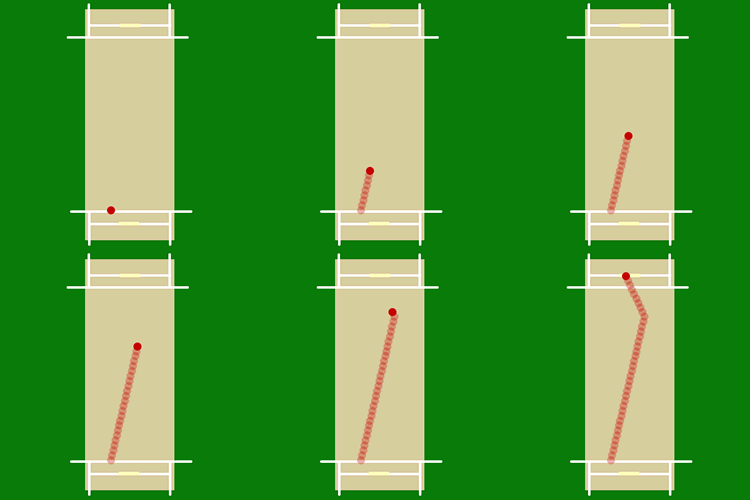
A leg spin or leg break delivery bowled from over the wicket.
A leg spin or leg break delivery bowled from around the wicket.

Leg spin is a type of spin bowling in cricket. A bowler who uses this technique is called a leg spinner. Leg spinners bowl with their right-arm and a wrist spin action. The leg spinner's normal delivery is called a leg break,[1] which spins from right to left (from the bowler's perspective) when the ball bounces on the pitch. For a right-handed batter, the ball breaks towards them from the leg side, hence the name 'leg break'.

Leg spinners bowl mostly leg breaks, varying them by adjusting the line and length, and amount of side spin versus topspin of the deliveries. Leg spinners also typically use variations of flight by sometimes looping the ball in the air, allowing any cross-breeze and the aerodynamic effects of the spinning ball to cause the ball to dip and drift before bouncing and spinning or "turning", sharply. Leg spinners also bowl other types of delivery, which spin differently, such as the googly.

The terms 'leg spin', 'leg spinner', 'leg break' and 'leggie' are used in slightly different ways by different sources.

The bowlers with the second- and fourth-highest number of wickets in the history of Test cricket, Shane Warne and Anil Kumble, respectively, were leg spinners.[2] One famous example of leg spin is Warne's Ball of the Century.

History

[edit]

In the 1970s and 1980s, it was thought that leg spin would disappear from the game due to the success of West Indian, and later Australian teams, exclusively using fast bowlers. During this time Abdul Qadir of Pakistan was the highest-profile leg spinner in the world and is sometimes credited with "keeping the art alive".[3][4] However, leg spin has again become popular with cricket fans and a successful part of cricket teams, driven largely by the success of Shane Warne, beginning with his spectacular Ball of the Century to Mike Gatting in 1993.

Comparison with other types of bowling

[edit]

A left-handed bowler who bowls with the same (wrist spin) action as a leg spinner is known as a left-arm unorthodox spin bowler. The ball itself spins in the opposite direction.

The same kind of trajectory, which spins from right to left on pitching, when performed by a left-arm bowler is known as left-arm orthodox spin bowling.[5][6]

As with all spinners, leg spinners bowl the ball far more slowly (70–90 km/h or 45–55 mph) than fast bowlers. The fastest leg spinners will sometimes top 100 km/h (60 mph). While very difficult to bowl accurately, good leg spin is considered one of the most threatening types of bowling to bat against for a right-handed batter, since the flight and sharp turn make the ball's movement extremely hard to read, and the turn away from the right-handed batter is more dangerous than the turn into the right-handed batter generated by an off spinner. Any miscalculation can result in an outside edge off the bat and a catch going to the wicket-keeper or slip fielders. Alternatively, for a ball aimed outside the leg stump, the breaking may be so sharp that the ball goes behind a right-handed batter and hits the stumps – the batter is then said (informally) to be "bowled around his or her legs". A left-handed batter has less difficulty facing leg spin bowling, because the ball moves in towards the batter's body, meaning the batter's legs are usually in the path of the ball if it misses the bat or takes an edge. This makes it difficult for the bowler to get the batter out bowled or caught from a leg break.

Leg spin: Some sources make the term 'leg spin' synonymous with leg break,[7][8][9] implying that other deliveries bowled by a leg spinner do not count as 'leg spin'. However, other sources use the term 'leg spin' more widely, to include all deliveries bowled by a leg spinner, including non-leg break deliveries.[10][11][12]

Mason Crane bowling a leg break during the 2017–18 Ashes series

Leg break: In the definition of a leg break, some sources actually include the bowler being a leg spinner,[13][14][15] which implies that only leg spinners can bowl leg breaks; all leg breaks are bowled by leg spinners. Other sources do not include the bowler being a leg spinner in the definition of a leg break, and say a leg break is simply a delivery that spins from the legside to the offside,[16][17][18] and so can also be bowled by other types of bowler.[19][20][21][22] In this case, leg breaks are (only) mostly bowled by leg spinners.[23]

Leg spinner: The term leg spinner can be used to mean either the bowler[24][25] or the leg break delivery.[26][27]

Leggie: The term leggie can also be used to mean either the bowler[28] or the leg break delivery.[29]

Technique

[edit]

A leg break is bowled by holding the cricket ball in the palm of the hand with the seam running across under all the fingers. As the ball is released, the wrist is rotated to the left and the ball flicked by the ring finger, giving the ball an anti-clockwise spin as seen from behind.

To grip the ball for a leg-spinning delivery, the ball is placed into the palm with the seam parallel to the palm. The first two fingers then spread and grip the ball, and the third and fourth fingers close together and rest against the side of the ball. The first bend of the third finger should grasp the seam. The thumb resting against the side is up to the bowler but should impart no pressure. When the ball is bowled, the third finger will apply most of the spin. The wrist is cocked as it comes down by the hip, and the wrist moves sharply from right to left as the ball is released, adding more spin. The ball is tossed up to provide flight. The batter will see the hand with the palm facing towards them when the ball is released.

Notable leg spin bowlers

[edit]
Shane Warne bowling a leg spin delivery

Players listed below have been included as they meet specific criteria which the general cricketing public would recognise as having achieved significant success in the art of leg spin bowling. For example: leading wicket-takers, and inventors of new deliveries.

Other deliveries bowled by leg spin bowlers

[edit]

Highly skilled leg spin bowlers are also able to bowl deliveries that behave unexpectedly, including the googly, which turns the opposite way to a normal leg break and the top spinner, which does not turn but dips sharply and bounces higher than other deliveries. A few leg spinners such as Abdul Qadir, Anil Kumble, Shane Warne and Mushtaq Ahmed have also mastered the flipper, a delivery that like a top spinner goes straight on landing, but floats through the air before skidding and keeping low, often dismissing batters leg before wicket or bowled. Another variation in the arsenal of some leg spinners is the slider, but travels more straight on.

See also

[edit]

References

[edit]
[edit]
Revisions and contributorsEdit on WikipediaRead on Wikipedia
from Grokipedia
Leg spin, also known as leg-break bowling, is a style of in in which the bowler imparts spin on the so that, after pitching, it deviates from the toward the from the perspective of a right-handed batsman. This delivery is executed by gripping the with the first and second fingers spread across the seam, the third finger providing support, and the thumb lightly steadying it, with the seam oriented toward the slips. The key to the spin lies in the action: at release, the bowler rotates the sharply so the emerges from between the thumb and first finger, snapping over the fingers to create (for a right-arm bowler), causing the deviation. Often regarded as one of the most challenging yet effective techniques in , leg spin demands natural flexibility, precise control of length and flight, and extensive practice to master, making it both difficult to bowl consistently and formidable for batsmen to negotiate due to its potential for sharp turn and bounce. The origins of leg spin trace back to the late 19th and early 20th centuries in , where it evolved as part of the broader development of , with the —a deceptive variation that spins in the opposite direction—credited to Bernard Bosanquet around 1900. This innovation quickly spread, notably influencing South African cricket, where four leg-spin and bowlers helped secure a 4–1 series victory over in 1905–06, marking a pivotal moment in the style's international recognition. Over time, leg spin flourished in countries like , , and , with practitioners refining variations such as the top-spinner (for extra bounce), the flipper (a quicker, skidding delivery), and the slider, enhancing its versatility across formats from matches to limited-overs . Notable leg spinners have left indelible marks on the game, including 's , who popularized the flipper and took 216 Test wickets in the 1920s and 1930s; 's , who claimed 149 wickets at an average of 29.55 between 1953 and 1962, renowned for his classical action and two types of googlies; and modern icons like (, 1992-2007), with 708 Test wickets, and (, 1990-2008), who took 619 wickets while blending leg spin with aggressive variations. The style's evolution continues in contemporary , where bowlers like () adapt it for T20's fast-paced demands by varying pace and using drift to deceive batsmen, underscoring leg spin's enduring role as a strategic weapon despite periods of decline due to batting dominance and pitch conditions.

Fundamentals

Definition and Characteristics

Leg spin, also known as leg-break bowling, is a type of in where the bowler imparts spin on the ball primarily using the wrist, causing it to deviate from the toward the after pitching for a right-handed batsman (or vice versa for a left-handed batsman). This style contrasts with , which turns the ball in the opposite direction from off to leg. Emerging in the late , leg spin relies on the bowler's ability to generate revolutions on the ball to exploit the pitch's surface and deceive the batsman. Key characteristics of leg spin include its reliance on wrist action to achieve high spin rates, often resulting in sharp turn, pronounced drift in the air due to the , and unpredictable bounce that can challenge the batsman's footwork and shot selection. Unlike techniques such as or left-arm orthodox, which primarily use finger placement for rotation, leg spin demands greater wrist flexibility and seam orientation to maximize deviation, allowing for a fuller delivery that floats in the air before breaking away. This wrist-driven method enables variations in , making the ball appear slower through the air while accelerating off the pitch, which heightens its deceptive potential. In the hierarchy of , leg spin occupies a prominent position as one of the most attacking and skillful variants, often employed to target the and force errors from batsmen. Basic terminology includes the "leg break," the standard delivery that turns away from the batsman, and the "," a disguised variation that spins in the opposite direction to the leg break, both integral to the bowler's arsenal for varying pace and line. Strategically, leg spinners use turn and flight to build pressure in both and limited-overs formats, encouraging defensive play or mistimed shots on turning pitches, thereby supporting wicket-taking opportunities for the fielding side.

Grip and Wrist Position

The standard grip for leg spin positions the seam of the vertically, with the index and middle fingers spread across the top of the seam to provide leverage, the placed purposefully on or alongside the seam to assist in spin generation, the tucked underneath for stability, and the thumb resting lightly opposite without applying firm pressure. This setup, often described as "two fingers up, two fingers down," allows the to drag across the seam during release, generating the primary . A relaxed hold is essential, as excessive tension can hinder the ball's rotation. The is cocked sharply backward in preparation, positioning the underside toward the batsman and the back of the hand upward, resembling a "12 o'clock" alignment at the point of release. This configuration enables a pronated snap—rotating the palm-downward—to impart spin on the for a right-arm bowler, causing it to turn from leg to after pitching. Variations in allow pace control; a more flexed position increases revolutions for slower, sharper turn, while a straighter accelerates the delivery. Common errors include over-gripping, which creates muscle tension and reduces spin efficiency, or misaligning the seam, which diminishes drift and control. Inconsistent finger placement, such as wrapping too tightly, often leads to a "scrambled seam" and erratic trajectory, making the ball easier for batsmen to read and punish. Leg spinners use a standard , with the providing natural grip on the pitch. On rough or worn surfaces, bowlers adapt by targeting areas of increased to enhance the ball's purchase and potential turn without altering the grip.

Technique

Bowling Action

The bowling action in leg spin begins with a short run-up designed to build through smooth , typically involving a straight-line approach for optimal balance and . This phase allows the bowler to gather pace gradually, often incorporating an overhead or slightly slingy arm action to introduce without disrupting flow. The run-up is generally shorter than that of fast bowlers, emphasizing consistency to ensure the delivery stride lands precisely. During the delivery stride, the bowler pivots on the non-bowling foot (back foot) at impact to initiate , followed by bracing the bowling foot (front foot) upon landing, which points approximately 30° toward the for stability. This bracing enables powerful hip , transferring from the lower body through the core to the upper body, thereby enhancing the force applied to the . The hips achieve near-full forward in a cradle position, with the rear hip contributing additional at the point of release to amplify spin potential. Arm and shoulder alignment plays a pivotal role, with the bowling arm abducted and externally rotated to maintain a high path, keeping the humerus parallel to the ground during the stride for maximum leverage. The shoulder girdle rotates clockwise by about 30° relative to the hips, aligning the upper body side-on to the target and facilitating an effective wrist flick. A common fault is a low elbow position during the arm swing, which reduces pace by limiting energy transfer and compromising overall alignment. Leg spinners deliver at speeds typically ranging from 70 to 90 km/h, with elite practitioners often averaging around 75 km/h; these velocities are deliberately moderated to prioritize flight and turn over raw pace, allowing adjustments based on conditions to induce batsman error.

Release and Follow-Through

The release phase in leg spin bowling represents the culmination of the bowler's stride and arm action, where an explosive uncocking of the occurs to maximize spin impartation. This motion involves rapid wrist extension and radial deviation, generating that the fingers—particularly the index and middle—use to apply the final rotational force on the ball just before it leaves the hand. Wrist spinners, including leg spinners, achieve high spin rates of approximately 30 revolutions per second through this mechanism, with optimal application occurring 0.155 to 0.233 seconds prior to release to enhance angular impulse. The height of release, averaging around 199 cm, plays a key role in creating the characteristic loop or flight, allowing the ball to hang in the air longer and deceive the batsman. Following release, the bowler's follow-through ensures balance and consistency, with the arm extending fully forward and passing close to the opposite to maintain control and line accuracy. This phase involves pivoting on the front foot, facilitating rear leg rotation that supports overall body alignment and repeatable deliveries. A balanced landing on the non-bowling foot is crucial for preserving momentum without over-rotation, which could disrupt length control. Proper execution here directly influences the bowler's ability to target specific lengths consistently across overs. Injury prevention is integral to the follow-through, as spin bowlers are prone to shoulder strain from the repetitive high-torque wrist and arm motions. Gradual deceleration of the arm during recovery minimizes abrupt stresses on the rotator cuff and surrounding muscles, reducing the risk of overuse injuries common in wrist spinners. Training drills emphasizing smooth recovery, such as slow-motion simulations of the full action without the ball, help reinforce balanced landing and forward extension, promoting long-term shoulder health. Bowlers control pace and flight by varying release height: a higher point produces slower, looping trajectories that exploit air resistance for greater dip, while a lower release accelerates the ball for flatter, quicker deliveries. This adjustment, combined with wrist snap intensity, allows leg spinners to alternate between deceptive loops (average velocity around 14 m/s) and more direct attacks, enhancing tactical versatility without altering the core action.

Physics and Mechanics

Spin Generation and Drift

Leg spin is generated through the application of via the bowler's and finger action at the point of release, imparting a predominantly (from the bowler's perspective) to the for a right-arm leg spinner. This arises from the rapid pronation and flexion of the , combined with the sequential release of the using the index and middle fingers, which maximizes angular impulse and achieves spin rates typically exceeding 2,000 . The resulting is essential for the subsequent aerodynamic effects during flight. The clockwise spin induces the Magnus effect, whereby the ball experiences a lateral perpendicular to its direction of travel and spin axis due to asymmetric air pressure distribution across its surface. Air flows faster over the side spinning against the direction of motion, creating lower pressure there compared to the opposite side, which generates a deflecting the ball sideways. For leg spin, the spin axis is typically tilted slightly upward and sideways, combining horizontal drift with some vertical dip to enhance in flight. Drift in leg spin occurs as a result of this air pressure differential, causing the ball to curve in the air toward the for a right-arm bowler facing a right-handed batsman—effectively an inswing motion from the batsman's viewpoint. This aerial movement can displace the by up to 20 cm over its flight path under favorable conditions like crosswinds, making it challenging for the batsman to predict the . The magnitude of drift depends on spin rate, ball speed (around 80-90 km/h), and environmental factors such as , with higher spin rates amplifying the effect. Pitch conditions significantly influence the overall deviation in leg spin, as dry and worn surfaces allow the ball to maintain higher spin rates post-release by providing better initial grip during the bowler's approach and delivery, leading to greater lateral movement. Rough, cracked pitches exacerbate this by increasing the potential for pronounced deviation, though the primary aerial drift remains governed by the Magnus force. The wrist snap in technique contributes briefly to optimizing this for effective spin generation.

Bounce, Turn, and Trajectory

In leg spin bowling, the ball's bounce is characterized by a tendency to rear up higher and more unpredictably than in non-spinning deliveries due to the tilted spin axis, which imparts an additional vertical component to the post-pitch . This elevated and erratic bounce arises from the interaction between the ball's element and the pitch surface, causing the ball to lift sharply toward the batsman's upper body, often complicating defensive shots. Pitch wear exacerbates this effect by creating uneven surfaces that amplify the irregularity of the rebound. The turn off the pitch in leg spin manifests as significant sideways deviation from the toward the , typically ranging from 0.5 to 1 meter in matches, though exceptional cases can approach 2 meters under optimal conditions. This lateral movement results from frictional grip between the 's seam and the pitch, enhanced by factors such as ball scuffing, which roughens one side and increases upon impact, and overall pitch deterioration that provides greater purchase for the spinning . Leg spin deliveries follow a distinctive arc featuring a looped flight path designed for , where the ball slows in the air due to enhanced drag from the , encouraging the batsman to advance prematurely. Combined with in-flight drift, this creates an overall S-shaped path: initial lateral movement toward the pre-pitch, followed by sharp off-side deviation post-pitch, maximizing uncertainty. Several variables influence the bounce height in leg spin, generally reaching 1.0 to 1.5 meters at the batsman's position. Taller bowlers achieve higher release points, elevating the initial and resulting bounce (e.g., a 2.2-meter release yields approximately 1.15 meters at the stumps on a firm pitch). Faster pace increases forward momentum, potentially raising bounce on responsive surfaces, while pitch type—such as dry, grippy conditions—promotes greater vertical rebound through higher coefficients of restitution.

History

Origins and Early Adoption

Leg spin emerged in late 19th-century as part of broader wrist-spin experiments aimed at imparting break from the after the legalization of in 1864, though it initially struggled against the rise of more reliable off-breaks. The delivery's roots trace to underarm leg breaks, but overarm adaptations were rare until Lancashire's A. G. Steel demonstrated its potential in during the , becoming one of the earliest documented practitioners to achieve consistent turn. Steel's success, including taking the first with an overarm leg break in 1884 against , marked a pivotal moment in legitimizing on prepared pitches. A significant advancement came with the invention of the around 1900 by 's Bernard Bosanquet, a deceptive variation that turned the opposite way to a standard leg break, adding unpredictability to . This innovation gained international prominence during South Africa's 1906-07 series against , where four bowlers proficient in leg spin and googlies—Dave Nourse, Gordon , Aubrey Faulkner, and Reggie Schwarz—played key roles in a 4-0 victory, showcasing the style's effectiveness on matting pitches and boosting its global adoption. Early adopters refined the technique amid growing interest in circuits, with emerging in the early 1900s as a pioneer who imparted leg break through finger leverage rather than traditional snap, delivering it at medium pace for enhanced . Barnes' method, honed on English wickets, allowed sharp turn without telegraphing , influencing subsequent generations despite his primary reputation as a swing bowler. The first notable use came during the 1902 Ashes series, where England's Len Braund employed leg spin effectively at , contributing to a dramatic victory and highlighting its viability in international play. Initial challenges included widespread skepticism over leg spin's inconsistency, particularly on wet or damp English pitches where the ball failed to grip and turn predictably, limiting its adoption compared to seam or off-spin options. This unreliability confined early exponents to drier conditions, though colonial matting pitches in places like proved ideal, as Barnes exploited their extra bounce and grip for devastating effect during England's 1913-14 tour. Adoption spread to in the through players like Arthur Mailey, whose wristy leg breaks and googlies thrived on the continent's firmer surfaces, bridging English innovations to Antipodean success.

Evolution and Key Eras

The golden age of leg spin unfolded primarily during and 1950s, marked by Australian dominance that showcased the delivery's potential on uncovered pitches. , debuting for in 1925 but peaking in , revolutionized leg spin with his precise leg breaks and deceptive googlies, capturing 216 wickets at an average of 24.21 and influencing generations through his emphasis on flight and turn. Bill O'Reilly complemented this era in , taking 144 wickets with his aggressive wrist action and sharp drift, earning praise from as the finest bowler he faced for his ability to exploit batting weaknesses. extended this legacy into the 1950s, amassing 248 wickets through variations like the flipper while captaining , serving as a direct precursor to later wrist spinners by blending artistry with tactical acumen. From the to the , leg spin entered a period of decline as structural changes in the game diminished its effectiveness. Covered pitches, introduced widely to protect surfaces from rain, minimized the uneven wear that once aided spinners' grip and turn, leading to more predictable bounce favoring batsmen. The adoption of batting helmets in the late reduced the psychological edge of fast bowling's intimidation, encouraging teams to prioritize four-man pace attacks over spin options, as exemplified by the ' relentless seamers who dominated . This shift, accelerated by the rise of limited-overs formats, resulted in fewer opportunities for leg spinners, with the art nearly fading from prominence by the mid-. Leg spin's revival gained momentum in the 1990s, propelled by Shane Warne's extraordinary impact, which transformed a dying craft into a spectacle of skill and strategy. Warne, debuting in 1992, claimed 708 Test wickets by blending traditional leg breaks with modern variations, dismantling batting lineups and inspiring a global resurgence that countered the fast-bowling era's legacy. In the T20 format, emerging post-2003, leg spinners adapted to shorter boundaries by emphasizing quicker releases, deceptive flight, and slower through the air to induce mishits, enabling them to thrive in high-scoring games despite reduced overs. Post-2000s initiatives, drawing from Warne's techniques, have emphasized wrist-spin fundamentals in academies and youth programs, fostering a new cohort of practitioners worldwide. The global spread of leg spin accelerated in the subcontinent, where turning tracks suited its nuances, leading to widespread adoption in and from the mid-20th century. In , Subash Gupte emerged as a pioneer in the 1950s, taking 149 Test wickets with his googly-heavy leg spin that bamboozled batsmen on home soil, establishing as a cornerstone of the attack. followed suit, with reviving the art in the 1980s through 236 Test wickets via flamboyant flight and sharp turn, influencing successors like Mushtaq Ahmed. In , leg spin integrated steadily since the 1970s amid the sport's formalization, evolving from occasional use by pioneers like Peggy Antonio to a dominant force by the 2010s, with players like and later exploiting variations in limited-overs play. Pivotal events shaped leg spin's trajectory, including Kerry Packer's revolution, which professionalized the game and provided spinners with intensive match practice under lights, sustaining their skills amid the pace-heavy shift. In the 2020s, data analytics have further optimized leg spin by tracking metrics such as , drift angles, and batsman-specific responses, allowing bowlers to refine deliveries for maximum deception in all formats.

Comparisons

With Off Spin

Leg spin and , both forms of , differ fundamentally in the direction of turn they impart on the ball, affecting the batsman's required footwork and decision-making. For a right-arm leg spinner bowling to a right-handed batsman, the delivery turns from the towards the after pitching, often requiring the batsman to advance down the pitch or play with soft hands to counter the away movement and potential sharp deviation. Conversely, a right-arm ner's delivery turns from the towards the , compelling the batsman to adopt a more compact stance, defend their pads, or employ sweeps to neutralize the inward angle. This directional contrast arises from the opposing spin axes, with both relying on the for aerial drift but in reverse directions—leg spin drifting away from the batsman while drifts in. Tactically, leg spin emphasizes attacking the off stump through pronounced drift and potential sharp turn, setting up dismissals via bowled, caught behind, or edged to slips, though in T20 cricket it concedes more runs (approximately 16% higher against right-handers, p=0.05) due to its unpredictability. , by contrast, targets the leg stump to exploit lbw opportunities or leg-side catches, offering greater run control but fewer wickets overall. A hallmark of leg spin's arsenal is the , which reverses the turn to imitate , enabling the bowler to deceive the batsman into playing for away movement only to face inward deviation. The techniques diverge in grip and action: leg spin employs , where the bowler rotates the wrist sharply at release to generate higher spin rates compared to , enabling greater turn but at the expense of accuracy and control. relies on , rolling the ball off the index and middle fingers for a more consistent, lower-spin delivery (longer stride length, p < 0.001; greater release height, p < 0.001). This wrist-dominant approach in leg spin yields a higher risk-reward profile, with sharper potential turn rewarding skilled practitioners but increasing the likelihood of loose balls on flatter surfaces. Both variations excel on rough or wearing pitches, where surface grip amplifies turn and bounce, allowing the to deviate unpredictably after pitching. However, leg spin's away-turning trajectory for right-handers makes it more vulnerable to lbw dismissals being overturned or avoided, as batsmen can pad defensive shots on the with less fear of the straightening sufficiently for an umpire's call, unlike off spin's inward movement that aligns better with lbw criteria. and off spinners often coexist in balanced attacks to cover both sides of the batsman.

With Pace and Seam Bowling

Leg spin and pace or seam bowling represent contrasting approaches in cricket, primarily differing in their reliance on speed. Leg spinners typically deliver the ball at speeds between 70 and 90 km/h, allowing more time for the ball to turn off the pitch and deceive the batsman through prolonged flight and spin. In contrast, pace bowlers operate at much higher velocities, often exceeding 130 km/h, using raw speed to generate intimidating bounce and seam movement that challenges the batsman's reaction time and forces errors through sheer . This slower pace of leg spin emphasizes tactical variation over outright velocity, while prioritizes exploiting atmospheric conditions for lateral deviation. Deception forms another key distinction, with leg spin employing flight, overspin, and variable turn to mislead the batsman on and direction. The ball's loop in the air creates uncertainty about its spot, compounded by potential sharp deviation after pitching, making it harder for batsmen to read compared to the more linear path of seam deliveries. Seam bowlers, conversely, rely on swing—induced by seam orientation and ball shine—or subtle seam movement off the pitch, which follows a more predictable line but varies in degree based on pitch wear and bowler skill. Leg spin's variability in turn direction (via stock balls or variations like the ) adds an layer of unpredictability absent in seam bowling's generally consistent lateral motion. In terms of game impact, particularly in ODIs and T20s, leg spinners excel in controlling the middle overs by building dot balls and restricting scoring rates through economical lengths around 5-7 meters, adapting to flat pitches by increasing pace slightly to limit attacking shots. Pace and seam bowlers, however, dominate the powerplay and death overs, leveraging new-ball swing for early breakthroughs and yorkers for late containment, where their speed disrupts rhythm and induces mishits under pressure. This phased specialization allows leg spin to stifle run accumulation during buildup periods, contrasting pace's role in aggressive wicket-taking phases. From a perspective, leg spinners are often paired with pacers to provide variety, combining spin's subtlety with pace's intimidation to unsettle batsmen across conditions and match situations. Injury profiles also diverge: leg spinners face higher risks of shoulder issues, such as strains from repetitive wrist and arm torque, while pace bowlers are more prone to back injuries, including stress fractures from high-impact delivery strides. This complementary dynamic enhances overall attack balance but requires tailored fitness management for each type.

Notable Bowlers

Historical Figures

, an English bowler active in the early 1900s to 1910s, is regarded as a pioneer of wrist-spin leg bowling, mastering the art of imparting sharp turn from medium pace on any pitch surface. He claimed 189 wickets in just 27 Test matches at an average of 16.43, demonstrating exceptional control and variation that troubled batsmen across conditions. In Australia's golden era of leg spin during the 1920s and 1930s, emerged as a transformative figure, taking 216 Test wickets with his precise leg-breaks and inventing the flipper—a low-trajectory delivery flicked from the wrist to skid onto the batsman. His impact was evident in the 1924-25 series, where, on debut in the fifth Test at , he captured 11 wickets for 82 runs, including 5 for 45 and 6 for 37, helping secure a victory. Grimmett's economy rate hovered around 2.5, reflecting his miserly control in an era of expansive batting. Complementing Grimmett was Bill O'Reilly, another Australian leg spinner of the 1930s, who amassed 144 Test wickets at an average of 22.59 through aggressive flighted deliveries that invited false shots. O'Reilly's economy rate of 1.94 underscored his dominance, often dismantling innings with relentless pressure and sharp turn. Post-World War II, revitalized leg spin in the 1950s and 1960s, capturing 248 Test wickets while captaining with tactics that emphasized aggressive to exploit pitch wear. His leadership, blending probing leg-breaks with strategic field placements, elevated the role of spinners in winning series, such as the 1958-59 . In the 1980s, Pakistan's spearheaded the revival of leg spin in the subcontinent, taking 236 Test wickets at an average of 32.80 and an economy rate of 2.71, inspiring a generation by proving wrist spin's viability on turning tracks. Qadir's flamboyant style and key hauls, like 30 wickets in the 1987-88 series against , rekindled interest in the craft amid a pace-dominated era.

Modern and Contemporary Examples

The revival of leg spin in the 1990s and 2000s was epitomized by of Australia, who took 708 wickets in 145 Tests between 1992 and 2007, redefining the art form with his mastery of flight, drift, and variations like the and flipper. His iconic dismissal of England's with the "" during the 1993 series at marked a pivotal comeback, inspiring a global resurgence in wrist-spin bowling after a period of decline. Warne's influence extended to limited-overs cricket, where he claimed 57 wickets in 55 IPL matches for at an economy of 7.27, contributing to their 2008 title win through tactical acumen and deceptive variations. On the Indian subcontinent, of emerged as a leg-spin stalwart in the same era, securing 619 wickets from 1990 to 2008, the most by any Indian bowler, with a reputation for his potent that troubled right-handers on turning pitches. Kumble's accuracy and ability to extract bounce made him a key figure in India's spin-heavy attacks, including a record 10 wickets in an innings against in 1999 at . Similarly, 's Mushtaq Ahmed played 52 s from 1990 to 2003, taking 185 wickets through subtle flight and deception, often varying pace to outfox batsmen in ODIs where he claimed 161 scalps at an economy of 4.12. In the contemporary landscape, Afghanistan's Rashid Khan has dominated T20 cricket since his debut in 2015, amassing over 500 wickets across all T20 formats by late 2025 with an economy rate below 7, establishing himself as the preeminent leg spinner in the shortest format. His IPL career with Gujarat Titans and earlier teams includes 163 wickets up to the 2025 season, highlighted by economical spells that restricted high-scoring lineups, such as his 15 wickets in IPL 2025 at an economy of 9.34 despite a form dip. Australia's Adam Zampa has solidified his role as a white-ball specialist in the 2020s, taking 92 wickets in 50 ODIs and 77 in 51 T20Is by 2025, with standout performances like 5 for 19 against Bangladesh in the 2024 T20 World Cup, leveraging sharp turn and variations in limited-overs scenarios. Women's cricket has seen growing contributions from leg spinners in the 2020s, with New Zealand's rising prominently as a leg-spin , claiming over 200 international wickets by November 2025, including a career-best 4 for 20 in T20Is against in 2024 and reaching her 100th ODI wicket during the , aiding New Zealand's campaigns in Tests and limited-overs cricket. 's has also emerged as a key leg-spinner, taking over 50 international wickets by 2025 with variations that have been effective in white-ball formats. Modern leg spin has benefited from analytics-driven training, with data on ball-tracking and grip variations enhancing deception in T20 formats, where spinners like Warne achieved success rates of around 25% per in IPL, underscoring the delivery's adaptability to aggressive batting. This global diversity, from subcontinental pitches to T20 leagues, highlights leg spin's enduring relevance across formats and genders.

Variations and Other Deliveries

Googly and Wrong'un

The is a deceptive variation bowled by a leg spinner that turns from off to leg for a right-handed batsman, opposite to the direction of the conventional leg break, thereby functioning as a disguised off-break. This delivery was invented by English cricketer Bernard Bosanquet in 1900, initially as a novelty party trick to entertain his teammates, though it required two years of refinement before seeing competitive use. The grip for the mirrors that of the standard leg break, with the index and middle fingers placed across the seam and the thumb positioned underneath for support, while the ring finger rests slightly to the side. At release, however, the undergoes a pronounced 180-degree pronation, positioning the back of the hand toward the batsman and the palm facing outward, which allows for a subtler flick primarily driven by the ring finger to impart the reverse spin. This mechanism produces a that maintains a pace comparable to the stock leg break but exhibits reduced lateral deviation, enhancing its subtlety and disguise within the bowler's . Tactically, the serves to disrupt the batsman's setup by exploiting the identical arm action of the leg break, luring them into playing for turn away from their body only for the ball to drift inward and potentially induce edges or lbw dismissals. In matches, its effectiveness stems from judicious deployment—typically forming a significant but limited portion of the leg spinner's arsenal to preserve surprise—though overuse risks telegraphing the variation and diminishing its impact. The wrong'un, often used interchangeably with the (particularly in Australian ) but distinguished in certain styles as a slower iteration relying more on finger action than snap to generate spin, results in greater dip and loop for added deception on slower pitches. In the subcontinent, bowlers such as Mushtaq Ahmed adapted this variant by varying pace and incorporating drift, tailoring it to grip-heavy surfaces where the extra dip could force batsmen into premature forward movement or mistimed shots.

Flipper and Top Spinner

The flipper is an auxiliary leg spin delivery characterized by a low, skidding achieved through a low release from beneath the hand, where the ball is squeezed out from between the thumb and forefinger, imparting back-spin that causes it to hurry onto the batsman after pitching. This variation was invented by Australian leg spinner in , who developed it as a means to add pace and to his repertoire during his career spanning the . The delivery can reach speeds of up to 100 km/h, significantly quicker than a standard leg break, allowing it to skid low and fast with minimal turn. Tactically, the flipper is particularly effective on flat pitches, where it targets lbw or dismissals by beating the bat inside edge and keeping low to trap batsmen in front of the stumps. It serves as a surprise weapon in combination with other variations like the to disrupt batting rhythm. Its use has declined in T20 due to the risk of no-balls from the lower trajectory and the need for precise control to avoid overstepping. The top spinner, another straight variation, involves a forward roll of the during release to impart over-spin, resulting in the ball skidding on with extra bounce rather than turning away from the right-hand batsman. This delivery is held with the seam pointing straight down the and released from a position between the leg break and actions, enabling yorker-length variations that rush the batsman. In application, the top spinner cramps the batsman for room by hurrying straight on with heightened bounce, forcing defensive shots or hurried footwork, and is often used to vary pace within an over on responsive pitches. Like the flipper, it carries no-ball risks in shorter formats if the action dips too low, contributing to its relative rarity in T20 scenarios. Mastering both the flipper and top spinner demands years of dedicated practice to achieve consistent control, , and , with these deliveries deeply embedded in Australian and subcontinental leg spin traditions where wrist action refinement is emphasized from an early age.

References

Add your contribution
Related Hubs
User Avatar
No comments yet.