



Community hub
Recent from talks
Knowledge base stats:
Talk channels stats:
Members stats:
PITX2
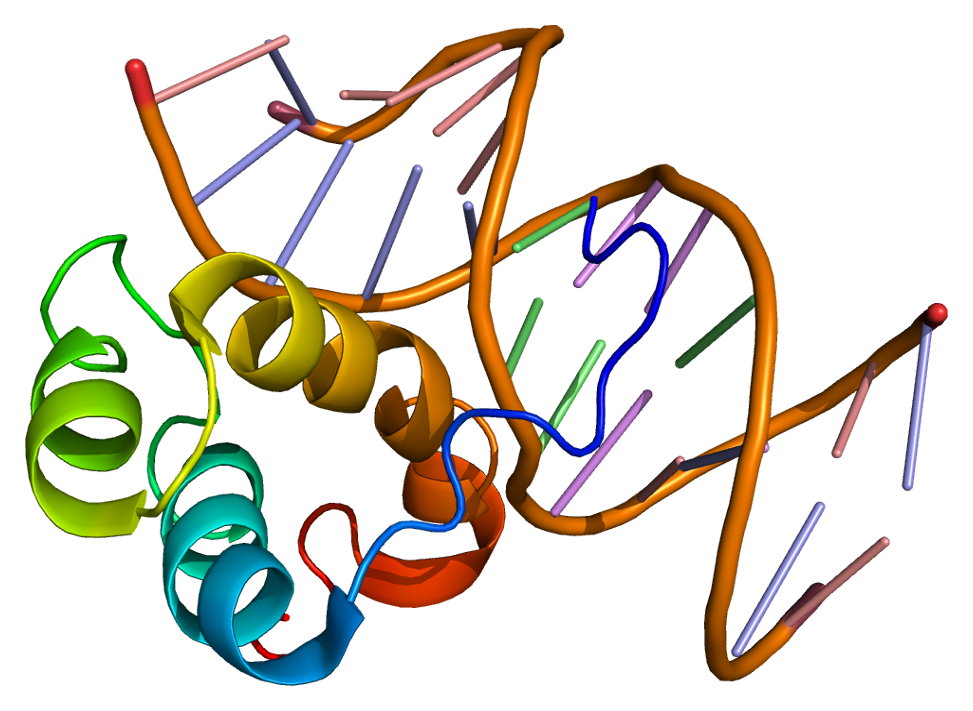
Paired-like homeodomain transcription factor 2 also known as pituitary homeobox 2 is a protein that in humans is encoded by the PITX2 gene.
This gene encodes a member of the RIEG/PITX homeobox family, which is in the bicoid class of homeodomain proteins. This protein acts as a transcription factor and regulates procollagen lysyl hydroxylase gene expression. This protein is involved in the development of the eye, tooth, and abdominal organs. This protein acts as a transcriptional regulator involved in the basal and hormone-regulated activity of prolactin. A similar protein in other vertebrates is involved in the determination of left-right asymmetry during development. Three transcript variants encoding distinct isoforms have been identified for this gene.
Pitx2 is responsible for the establishment of the left-right axis, the asymmetrical development of the heart, lungs, and spleen, twisting of the gut and stomach, as well as the development of the eyes. Once activated Pitx2 will be locally expressed in the left lateral mesoderm, tubular heart, and early gut which leads to the asymmetrical development of organs and looping of the gut. When Pitx2 is deleted, the irregular morphogenesis of organs results on the left hand side. Pitx2 is left-laterally expressed controlling the morphology of the left visceral organs. Expression of Pitx2 is controlled by an intronic enhancer ASE and Nodal. It appears that while Nodal controls cranial expression of Pitx2, ASE controls left – right expression of Pitx2, which leads to the asymmetrical development of the left sided visceral organs, such as the spleen and liver. Collectively, Pitx2 first acts to prevent the apoptosis of the extraocular muscles followed by acting as the myogenic programmer of the extraocular muscle cells. There have also been studies showing different isoforms of the transcription factor: Pitx2a, Pitx2b, and Pitx2c, each with distinct and non-overlapping functions.
Studies have shown that in chick embryos, Pitx2 is a direct regulator of cVg1, a growth factor homologous to mammalian GDF1. cVg1 is a Transforming growth factor beta signal that is expressed posteriorly before the formation of the embryo germ layers. The Pitx2 regulation of cVg1 is essential both during normal embryonic development and during establishment of polarity in twins created by experimental division of a single, original embryo. Pitx2 is shown to be essential for upregulation of cVg1 through the binding of enhancers, and is necessary for the proper expression of cVg1 in the posterior marginal zone. Expression of cVg1 in the PMZ is in turn necessary for the proper development of the primitive streak. Experimental knockouts of the PITX2 gene are associated with the subsequent upregulation of related Pitx1, which is able to partially compensate for the loss of Pitx2. Pitx2's ability to regulate the polarity of the embryo may be responsible for the ability of developing chicks to establish proper polarity in embryos created by cuts performed as late as the blastoderm stage.
Pitx2 plays a role in limb myogenesis. Pitx2 can determine the development and activation of the MyoD gene (the gene responsible for skeletal myogenesis). Studies have shown that expression of Pitx2 happens before MyoD is expressed in muscles. Further studies show that Pitx2 is directly recruited to act on the MyoD core enhancer and thus, directing the expression of the MyoD gene. Pitx 2 is in a parallel pathway with Myf5 and Myf6, as both paths effect expression of MyoD. However, in the absence of the parallel pathway, Pitx2 can continue activating MyoD genes. The expression of Pitx2 saves MyoD gene expression and keeps expressing this gene for limb myogenesis. Yet, the Pitx 2 pathway is PAX3 dependent and requires this gene to enact limb myogenesis. Studies support this finding as in the absence of PAX3, there is Pitx2 expression deficit and thus, MyoD does not express itself in limb myogenesis. The Pitx2 gene is thus shown to be downstream of Pax3 and serve as an intermediate between Pax3 and MyoD. In conclusion, Pitx2 plays an integral role in limb myogenesis.
Pitx2 isoforms are expressed in a sexually dimorphic manner during rat gonadal development.
Pitx2 expression has been shown to be important for normal anterior pituitary gland development. Studies using mice embryos established Pitx2 expression is required in a dosage dependent manner. Mice with a homozygous null mutation of the Pitx2 gene showed that it is not required for initial pituitary formation but is needed for further development. Littermates of normal homozygotes, Pitx2+/+, versus homozygous null, Pitx2-/-, at embryonic day 10.5 provided a comparison of differing pouch sizes and cell types. Mice with the homozygous null gene had a smaller pouch and mesenchymal cell growth and differentiation arrested. While embryos with a hypomorphic mutation, Pitx2neo/+, of the gene were considered morphologically normal. Along with normal pituitary expansion, Pitx2 is needed for normal expression of cell transcription genes of hormones produced in the anterior pituitary. Of which are luteinizing hormone (LH), follicle stimulating hormone (FSH), gonadotropin-releasing hormone (GnRH), growth hormone (GH), and thyroid stimulating hormone (TSH). A study conducted using Pitx2neo/neo mice at postnatal day 1, found the transcripts of hormone genes for LH beta (LHb) and FSH beta (FSHb), and GnRH receptor (GnRHR) were nearly absent or nearly abolished, respectively. While transcription genes for GH and TSH producing cells, and growth hormone releasing hormone receptor (GHRHR) of Pitx2neo homozygous mice were moderately reduced. Further analysis of the transcription factors, Gata2, Egr1 and SF1, involved in LHb and FSHb differentiation found a reduction or absence of them in Pitx2neo/neo mice. The transcription factors, Prop1 and Pit1, which control development of GH and TSH producing cells, were also studied in Pitx2neo homozygous mice but only Pit1 expression was reduced. A reduction or absence of the transcription factors of the gonadotropin cells of the anterior pituitary leads to a loss of full pituitary cell function.
Mutations in this gene are associated with Axenfeld-Rieger syndrome (ARS), iridogoniodysgenesis syndrome (IGDS), and sporadic cases of Peters anomaly. This protein plays a role in the terminal differentiation of somatotroph and lactotroph cell phenotypes.
Hub AI
PITX2 AI simulator
(@PITX2_simulator)
PITX2
Paired-like homeodomain transcription factor 2 also known as pituitary homeobox 2 is a protein that in humans is encoded by the PITX2 gene.
This gene encodes a member of the RIEG/PITX homeobox family, which is in the bicoid class of homeodomain proteins. This protein acts as a transcription factor and regulates procollagen lysyl hydroxylase gene expression. This protein is involved in the development of the eye, tooth, and abdominal organs. This protein acts as a transcriptional regulator involved in the basal and hormone-regulated activity of prolactin. A similar protein in other vertebrates is involved in the determination of left-right asymmetry during development. Three transcript variants encoding distinct isoforms have been identified for this gene.
Pitx2 is responsible for the establishment of the left-right axis, the asymmetrical development of the heart, lungs, and spleen, twisting of the gut and stomach, as well as the development of the eyes. Once activated Pitx2 will be locally expressed in the left lateral mesoderm, tubular heart, and early gut which leads to the asymmetrical development of organs and looping of the gut. When Pitx2 is deleted, the irregular morphogenesis of organs results on the left hand side. Pitx2 is left-laterally expressed controlling the morphology of the left visceral organs. Expression of Pitx2 is controlled by an intronic enhancer ASE and Nodal. It appears that while Nodal controls cranial expression of Pitx2, ASE controls left – right expression of Pitx2, which leads to the asymmetrical development of the left sided visceral organs, such as the spleen and liver. Collectively, Pitx2 first acts to prevent the apoptosis of the extraocular muscles followed by acting as the myogenic programmer of the extraocular muscle cells. There have also been studies showing different isoforms of the transcription factor: Pitx2a, Pitx2b, and Pitx2c, each with distinct and non-overlapping functions.
Studies have shown that in chick embryos, Pitx2 is a direct regulator of cVg1, a growth factor homologous to mammalian GDF1. cVg1 is a Transforming growth factor beta signal that is expressed posteriorly before the formation of the embryo germ layers. The Pitx2 regulation of cVg1 is essential both during normal embryonic development and during establishment of polarity in twins created by experimental division of a single, original embryo. Pitx2 is shown to be essential for upregulation of cVg1 through the binding of enhancers, and is necessary for the proper expression of cVg1 in the posterior marginal zone. Expression of cVg1 in the PMZ is in turn necessary for the proper development of the primitive streak. Experimental knockouts of the PITX2 gene are associated with the subsequent upregulation of related Pitx1, which is able to partially compensate for the loss of Pitx2. Pitx2's ability to regulate the polarity of the embryo may be responsible for the ability of developing chicks to establish proper polarity in embryos created by cuts performed as late as the blastoderm stage.
Pitx2 plays a role in limb myogenesis. Pitx2 can determine the development and activation of the MyoD gene (the gene responsible for skeletal myogenesis). Studies have shown that expression of Pitx2 happens before MyoD is expressed in muscles. Further studies show that Pitx2 is directly recruited to act on the MyoD core enhancer and thus, directing the expression of the MyoD gene. Pitx 2 is in a parallel pathway with Myf5 and Myf6, as both paths effect expression of MyoD. However, in the absence of the parallel pathway, Pitx2 can continue activating MyoD genes. The expression of Pitx2 saves MyoD gene expression and keeps expressing this gene for limb myogenesis. Yet, the Pitx 2 pathway is PAX3 dependent and requires this gene to enact limb myogenesis. Studies support this finding as in the absence of PAX3, there is Pitx2 expression deficit and thus, MyoD does not express itself in limb myogenesis. The Pitx2 gene is thus shown to be downstream of Pax3 and serve as an intermediate between Pax3 and MyoD. In conclusion, Pitx2 plays an integral role in limb myogenesis.
Pitx2 isoforms are expressed in a sexually dimorphic manner during rat gonadal development.
Pitx2 expression has been shown to be important for normal anterior pituitary gland development. Studies using mice embryos established Pitx2 expression is required in a dosage dependent manner. Mice with a homozygous null mutation of the Pitx2 gene showed that it is not required for initial pituitary formation but is needed for further development. Littermates of normal homozygotes, Pitx2+/+, versus homozygous null, Pitx2-/-, at embryonic day 10.5 provided a comparison of differing pouch sizes and cell types. Mice with the homozygous null gene had a smaller pouch and mesenchymal cell growth and differentiation arrested. While embryos with a hypomorphic mutation, Pitx2neo/+, of the gene were considered morphologically normal. Along with normal pituitary expansion, Pitx2 is needed for normal expression of cell transcription genes of hormones produced in the anterior pituitary. Of which are luteinizing hormone (LH), follicle stimulating hormone (FSH), gonadotropin-releasing hormone (GnRH), growth hormone (GH), and thyroid stimulating hormone (TSH). A study conducted using Pitx2neo/neo mice at postnatal day 1, found the transcripts of hormone genes for LH beta (LHb) and FSH beta (FSHb), and GnRH receptor (GnRHR) were nearly absent or nearly abolished, respectively. While transcription genes for GH and TSH producing cells, and growth hormone releasing hormone receptor (GHRHR) of Pitx2neo homozygous mice were moderately reduced. Further analysis of the transcription factors, Gata2, Egr1 and SF1, involved in LHb and FSHb differentiation found a reduction or absence of them in Pitx2neo/neo mice. The transcription factors, Prop1 and Pit1, which control development of GH and TSH producing cells, were also studied in Pitx2neo homozygous mice but only Pit1 expression was reduced. A reduction or absence of the transcription factors of the gonadotropin cells of the anterior pituitary leads to a loss of full pituitary cell function.
Mutations in this gene are associated with Axenfeld-Rieger syndrome (ARS), iridogoniodysgenesis syndrome (IGDS), and sporadic cases of Peters anomaly. This protein plays a role in the terminal differentiation of somatotroph and lactotroph cell phenotypes.