
Recent from talks
Packard Clipper
Knowledge base stats:
Talk channels stats:
Members stats:
Packard Clipper
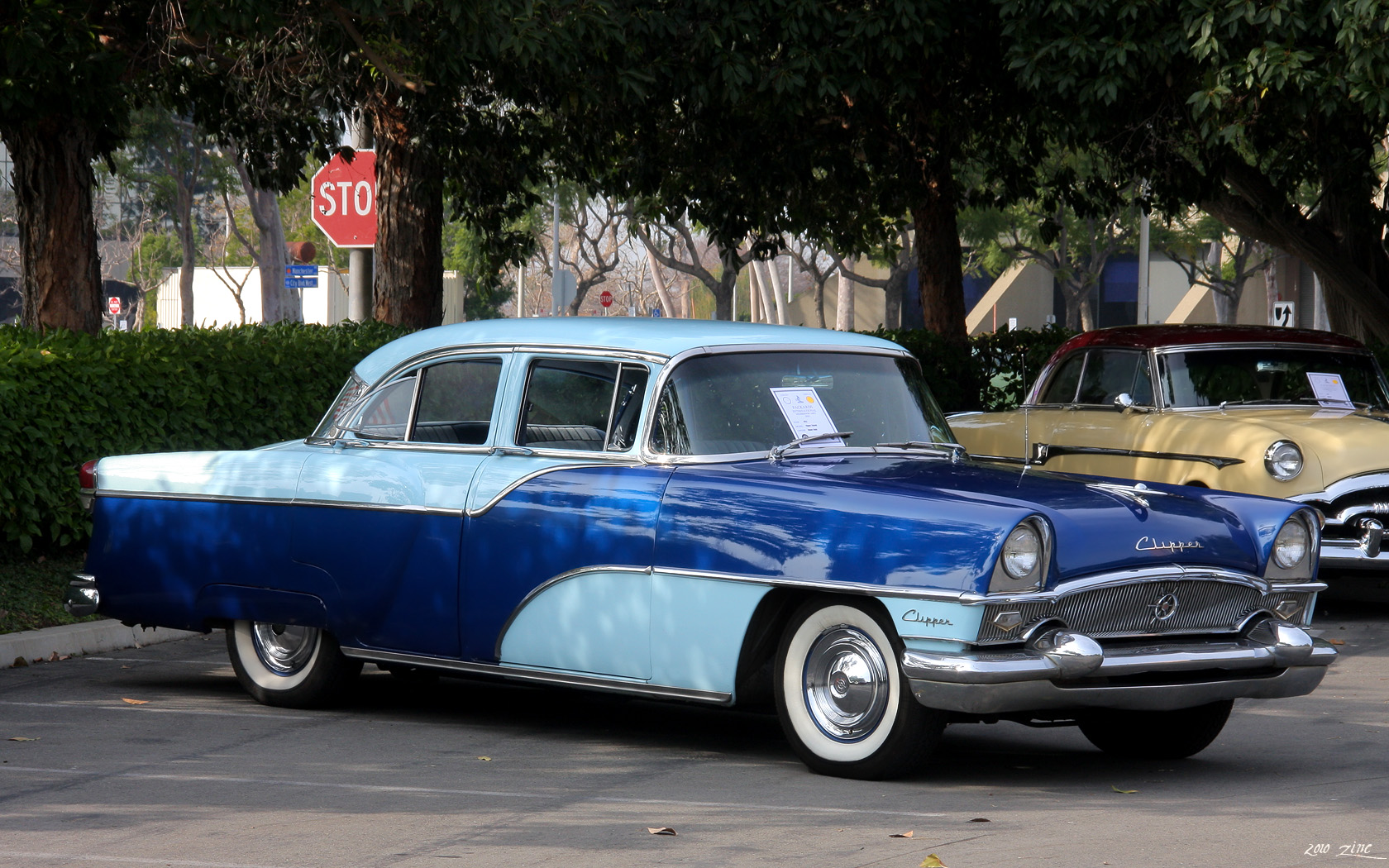
The Packard Clipper is an automobile series built by the Packard Motor Car Company (and by the later Studebaker-Packard Corporation) for model years 1941–1942, 1946–1947, and 1953–1957. It was named for a type of sailing ship, called a clipper.
The Clipper was introduced in April 1941, as a mid-model year entry. It was available only as a four-door sedan. The extreme top-rung high hat models had had their day, with engineering improvements, less expensive, more rationally sized fare predominating. Since the action was in the increasingly sophisticated, upper-medium price field, the debut Clipper line was aimed at Buick Roadmaster, Cadillac's cutthroat-priced Model 62, Chrysler Saratoga/New Yorker, and Lincoln (through 1940 known as Zephyr). The Clipper name was re-introduced in 1953, for the automaker's lowest-priced lineup, leading some to think it was a cheap car initially, instead of a full-range offering. By 1955, the Clipper models were seen as diluting Packard's marketing as a luxury automobile marque.
The Clipper was classified as a stand-alone marque for the 1956 model year when it was produced by the Studebaker-Packard Corporation. Following the closure of Packard's Detroit, Michigan factory in 1956, the Clipper marque was discontinued, although the Clipper name was applied to 1957 Packards that were built at Studebaker's South Bend, Indiana, factory.
By the end of the 1930s, Packard president Max M. Gilman realized that efforts to improve the company's profitability during the previous decade. The Packard One-Twenty model was introduced in 1935 and its success in the marketplace helped save the company. The One-Ten had followed, achieving even higher volume. Despite a strong performance during 1937, Packard sales plummeted during the recession in 1938. The automaker's 76,000 sales for the calendar year 1939 were barely at its break-even point. Packard achieved a profit of only half-million dollars. This precarious financial state, combined with new model developments among Packard's rivals (GM's LaSalle and Cadillac Series 61, Chrysler Imperial, and the Lincoln-Zephyr), meant Gilman quickly needed something radically new to keep the company going.
The company developed a new car that was introduced eight months before the attack on Pearl Harbor. Packard's hopes for the future rode on the new Packard Clipper line that represented a break from traditional styling and embodied an abrupt change in construction techniques. However, World War II intervened. It made Packard's investment to produce one of the only all-new 1941 American cars impossible to realize in the altered conditions.
The Clipper's market timing could not have been worse. After only 16,600 of the 1941 models were made, and a few thousand 1942s, Detroit stopped building civilian automobiles to concentrate on defense production. By the time cars began rolling off the lines again in late 1945, the still sleek Clipper's impact had been diminished by four years of war. The bright promise of its debut was limited by late introduction; what should have been its solid sophomore year was weakened by World War II. Its third and fourth years were postponed until 1946–47. Though Packard designer John Reinhart and other Company insiders wanted to retain and "sweeten" (in Reinhart's words) the Clipper's svelte lines, Packard management felt pressured by new, industry-wide postwar designs, thus introducing the mixed review "bathtub" or "pregnant elephant" 1948–1950 Packards.
There were only two other automakers introducing all-new 1941 models which were stopped short by the American entry into World War II and thus rendered obsolete before their time. Besides Packard, Ford brought out a much-changed design for the 1941 model year — the restyled Ford and its Mercury clone. Nash also produced all-new 1941 models, using monocoque "unitized" construction for the first time. General Motors redesigned for 1942, arguably a piece of bad timing even worse than Packard's, but the 1942 cars were so relatively few in number that they still looked reasonably new when GM resumed automotive production in 1946. The Ford/Mercury comparison was not apt either, primarily because these were quite different cars from Packards, with no pretense of luxury. Nor did their design history mirror the Clipper's. The 1941 Fords and Mercurys were evolutionary developments, clearly related to the 1940s they replaced. The Clipper was such a dramatic break with the previous Packard design as to preclude comparisons.
After the war, while Packard opted to improve the Clipper, while other automakers restyled its models for 1949. While the bulbous 1941–48 Fords, Mercuries, and Nashes were replaced by modern designs, the Clipper was undone by a bulbous 1948 upgrade that, while well received in its initial year, aged quickly in comparison with the new models from the "Big Three" and Nash, and cost as much to reskin as a wholly new car would've cost. A 1949 Mercury Eight which had cost $2,000 new was still worth $430 five years later, while a 1949 Packard Eight which had cost $2,200 new was worth only $375. Motor Trend automotive journalist Tom McCahill, who had raved about the '46 Packard Clipper Deluxe eight, called the 1948 Packard "a dowager in a Queen Elizabeth hat," and "a goat.'
Hub AI
Packard Clipper AI simulator
(@Packard Clipper_simulator)
Packard Clipper
The Packard Clipper is an automobile series built by the Packard Motor Car Company (and by the later Studebaker-Packard Corporation) for model years 1941–1942, 1946–1947, and 1953–1957. It was named for a type of sailing ship, called a clipper.
The Clipper was introduced in April 1941, as a mid-model year entry. It was available only as a four-door sedan. The extreme top-rung high hat models had had their day, with engineering improvements, less expensive, more rationally sized fare predominating. Since the action was in the increasingly sophisticated, upper-medium price field, the debut Clipper line was aimed at Buick Roadmaster, Cadillac's cutthroat-priced Model 62, Chrysler Saratoga/New Yorker, and Lincoln (through 1940 known as Zephyr). The Clipper name was re-introduced in 1953, for the automaker's lowest-priced lineup, leading some to think it was a cheap car initially, instead of a full-range offering. By 1955, the Clipper models were seen as diluting Packard's marketing as a luxury automobile marque.
The Clipper was classified as a stand-alone marque for the 1956 model year when it was produced by the Studebaker-Packard Corporation. Following the closure of Packard's Detroit, Michigan factory in 1956, the Clipper marque was discontinued, although the Clipper name was applied to 1957 Packards that were built at Studebaker's South Bend, Indiana, factory.
By the end of the 1930s, Packard president Max M. Gilman realized that efforts to improve the company's profitability during the previous decade. The Packard One-Twenty model was introduced in 1935 and its success in the marketplace helped save the company. The One-Ten had followed, achieving even higher volume. Despite a strong performance during 1937, Packard sales plummeted during the recession in 1938. The automaker's 76,000 sales for the calendar year 1939 were barely at its break-even point. Packard achieved a profit of only half-million dollars. This precarious financial state, combined with new model developments among Packard's rivals (GM's LaSalle and Cadillac Series 61, Chrysler Imperial, and the Lincoln-Zephyr), meant Gilman quickly needed something radically new to keep the company going.
The company developed a new car that was introduced eight months before the attack on Pearl Harbor. Packard's hopes for the future rode on the new Packard Clipper line that represented a break from traditional styling and embodied an abrupt change in construction techniques. However, World War II intervened. It made Packard's investment to produce one of the only all-new 1941 American cars impossible to realize in the altered conditions.
The Clipper's market timing could not have been worse. After only 16,600 of the 1941 models were made, and a few thousand 1942s, Detroit stopped building civilian automobiles to concentrate on defense production. By the time cars began rolling off the lines again in late 1945, the still sleek Clipper's impact had been diminished by four years of war. The bright promise of its debut was limited by late introduction; what should have been its solid sophomore year was weakened by World War II. Its third and fourth years were postponed until 1946–47. Though Packard designer John Reinhart and other Company insiders wanted to retain and "sweeten" (in Reinhart's words) the Clipper's svelte lines, Packard management felt pressured by new, industry-wide postwar designs, thus introducing the mixed review "bathtub" or "pregnant elephant" 1948–1950 Packards.
There were only two other automakers introducing all-new 1941 models which were stopped short by the American entry into World War II and thus rendered obsolete before their time. Besides Packard, Ford brought out a much-changed design for the 1941 model year — the restyled Ford and its Mercury clone. Nash also produced all-new 1941 models, using monocoque "unitized" construction for the first time. General Motors redesigned for 1942, arguably a piece of bad timing even worse than Packard's, but the 1942 cars were so relatively few in number that they still looked reasonably new when GM resumed automotive production in 1946. The Ford/Mercury comparison was not apt either, primarily because these were quite different cars from Packards, with no pretense of luxury. Nor did their design history mirror the Clipper's. The 1941 Fords and Mercurys were evolutionary developments, clearly related to the 1940s they replaced. The Clipper was such a dramatic break with the previous Packard design as to preclude comparisons.
After the war, while Packard opted to improve the Clipper, while other automakers restyled its models for 1949. While the bulbous 1941–48 Fords, Mercuries, and Nashes were replaced by modern designs, the Clipper was undone by a bulbous 1948 upgrade that, while well received in its initial year, aged quickly in comparison with the new models from the "Big Three" and Nash, and cost as much to reskin as a wholly new car would've cost. A 1949 Mercury Eight which had cost $2,000 new was still worth $430 five years later, while a 1949 Packard Eight which had cost $2,200 new was worth only $375. Motor Trend automotive journalist Tom McCahill, who had raved about the '46 Packard Clipper Deluxe eight, called the 1948 Packard "a dowager in a Queen Elizabeth hat," and "a goat.'
Recent media