



Community hub
Recent from talks
Knowledge base stats:
Talk channels stats:
Members stats:
Packard Twelve
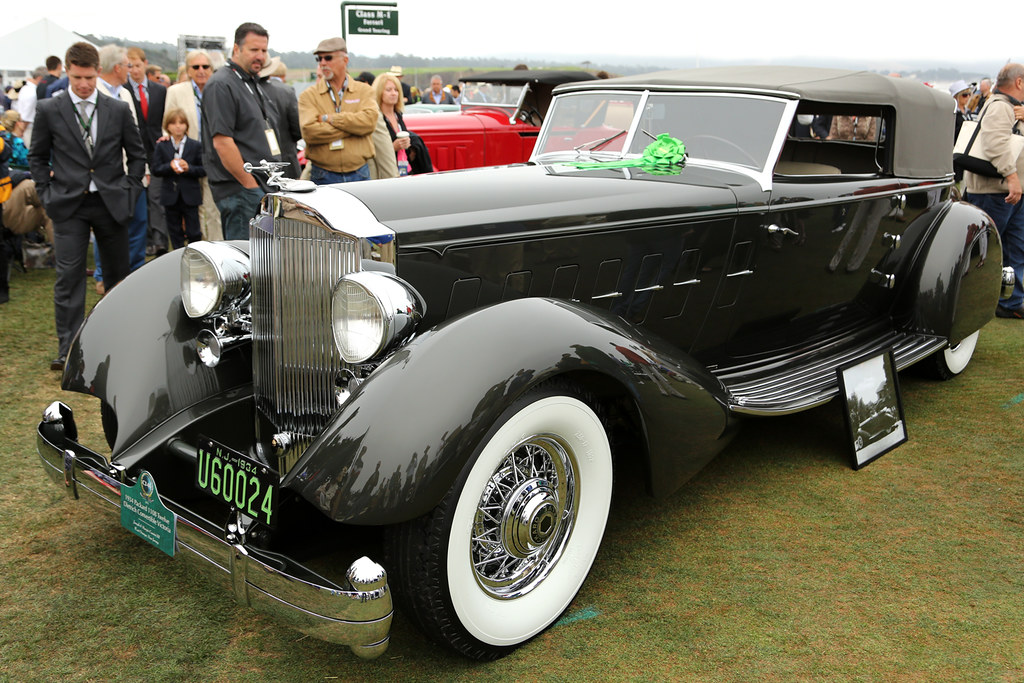
The Packard Twelve was a range of V12-engined luxury automobiles built by the Packard Motor Car Company in Detroit, Michigan. The car was built from model year 1916 until 1923, then it returned 1933 until 1939. As a sign of changing times, the majority of second generation Packard Twelves received standard bodywork, with custom bodywork gradually losing favor. Many of the custom cars were actually only "semi-customs", with Dietrich assembling Packard-made bodies with special touches.
Packard introduced the Twin Six to stay competitive with Marmon, Pierce-Arrow, Rolls-Royce, Renault and other luxury brands. Cadillac and Lincoln began offering large luxury products starting in the late 1910s.
Large displacement engines provided the horsepower and torque their clients wanted and due to the low quality of gasoline fuel at the time, and low compression ratios, 50 bhp was more than adequate. It is estimated that the rating equivalent of early gasoline available varied from 40 to 60 octane and that the "High-Test", sometimes referred to as "fighting grade", probably averaged 50 to 65 octane.
The first company produced 12-cylinder engine was in 1916, called the Packard Twin Six (1-25, 1-35) signifying two different wheelbases of 125 in (3,200 mm) and 135 in (3,400 mm), and was for four years the only product sold until the Single Six returned in 1921. The standard paint scheme for open cars, touring sedans, phaetons, and runabouts was Packard blue with cream yellow striping on body and door panels, with black used on the underbody, radiator, fenders, chassis and running gear with no striping. Wheels were painted cream yellow with black stripes. Closed body choices were painted similar without cream yellow painted wheels. Brightwork was nickel plated, and a Warner speedometer, with a Waltham clock, among other items, were standard equipment. Optionally, the choice of interior and exterior colors were endless to accommodate the customers preferences.
Ten different body styles were available on either wheelbase while coupe and runabout body styles were only offered on the 125" wheelbase. The engine was a 60 degree L-head displacing 424.1 cu in (6,950 cc) producing 88 hp (66 kW) at 2600 rpm. Detachable heads and larger radiators came in 1916, a center-mounted gear shifter and brake levers in 1917.
The range consisted of three series, built from May 1915 until June 1923. It was available with a shorter wheelbase from 1915 until May 1919. From 1915 to 1920, the Twin Six was the sole offering from Packard. Production was 30,941 automobiles. Prices started at US$3,050 ($90,241 in 2025 dollars ) to US$5,150 ($152,374 in 2025 dollars ) for the Imperial Limousine. The 1919 Third Series Twin Six 3-25 Runabout was used as the pace car for the 1919 Indianapolis 500 auto race.
For 1933 Packard reintroduced a twelve-cylinder engine, initially called the "Twin Six", then changing the name to "Packard Twelve," to align it with the rest of the Packard lineup. This was the 10th Series and two models were on offer: the 1005 and the 1006 had wheelbases of 142 in (3,606.80 mm) and 147 in (3,733.80 mm). The Twin Six' double drop frame was replaced by a tapered design. Convertibles and roadsters used leftover ninth series bodies with a smaller radiator than the all-new tenth series models.
The Twin Six' V12-engine was retained without major change. The cylinder blocks are at a 67-degree angle, bore and stroke 3+7⁄16 and 4 in (87.3 and 101.6 mm) respectively. A 445.5 cu in (7,300 cc) displacement was the result and maximum power is 160 hp (119 kW) at 3200 rpm. The cooling system was improved and a new Bendix-Stromberg EE-3 carburetor with an automatic choke was introduced, increasing power somewhat. A single dry-plate clutch replaced the earlier twin-plate model, matched to a floor-shifted three-speed manual transmission and a new one-piece driveshaft. The existing mechanical brakes were also adopted for the Twelve.
Hub AI
Packard Twelve AI simulator
(@Packard Twelve_simulator)
Packard Twelve
The Packard Twelve was a range of V12-engined luxury automobiles built by the Packard Motor Car Company in Detroit, Michigan. The car was built from model year 1916 until 1923, then it returned 1933 until 1939. As a sign of changing times, the majority of second generation Packard Twelves received standard bodywork, with custom bodywork gradually losing favor. Many of the custom cars were actually only "semi-customs", with Dietrich assembling Packard-made bodies with special touches.
Packard introduced the Twin Six to stay competitive with Marmon, Pierce-Arrow, Rolls-Royce, Renault and other luxury brands. Cadillac and Lincoln began offering large luxury products starting in the late 1910s.
Large displacement engines provided the horsepower and torque their clients wanted and due to the low quality of gasoline fuel at the time, and low compression ratios, 50 bhp was more than adequate. It is estimated that the rating equivalent of early gasoline available varied from 40 to 60 octane and that the "High-Test", sometimes referred to as "fighting grade", probably averaged 50 to 65 octane.
The first company produced 12-cylinder engine was in 1916, called the Packard Twin Six (1-25, 1-35) signifying two different wheelbases of 125 in (3,200 mm) and 135 in (3,400 mm), and was for four years the only product sold until the Single Six returned in 1921. The standard paint scheme for open cars, touring sedans, phaetons, and runabouts was Packard blue with cream yellow striping on body and door panels, with black used on the underbody, radiator, fenders, chassis and running gear with no striping. Wheels were painted cream yellow with black stripes. Closed body choices were painted similar without cream yellow painted wheels. Brightwork was nickel plated, and a Warner speedometer, with a Waltham clock, among other items, were standard equipment. Optionally, the choice of interior and exterior colors were endless to accommodate the customers preferences.
Ten different body styles were available on either wheelbase while coupe and runabout body styles were only offered on the 125" wheelbase. The engine was a 60 degree L-head displacing 424.1 cu in (6,950 cc) producing 88 hp (66 kW) at 2600 rpm. Detachable heads and larger radiators came in 1916, a center-mounted gear shifter and brake levers in 1917.
The range consisted of three series, built from May 1915 until June 1923. It was available with a shorter wheelbase from 1915 until May 1919. From 1915 to 1920, the Twin Six was the sole offering from Packard. Production was 30,941 automobiles. Prices started at US$3,050 ($90,241 in 2025 dollars ) to US$5,150 ($152,374 in 2025 dollars ) for the Imperial Limousine. The 1919 Third Series Twin Six 3-25 Runabout was used as the pace car for the 1919 Indianapolis 500 auto race.
For 1933 Packard reintroduced a twelve-cylinder engine, initially called the "Twin Six", then changing the name to "Packard Twelve," to align it with the rest of the Packard lineup. This was the 10th Series and two models were on offer: the 1005 and the 1006 had wheelbases of 142 in (3,606.80 mm) and 147 in (3,733.80 mm). The Twin Six' double drop frame was replaced by a tapered design. Convertibles and roadsters used leftover ninth series bodies with a smaller radiator than the all-new tenth series models.
The Twin Six' V12-engine was retained without major change. The cylinder blocks are at a 67-degree angle, bore and stroke 3+7⁄16 and 4 in (87.3 and 101.6 mm) respectively. A 445.5 cu in (7,300 cc) displacement was the result and maximum power is 160 hp (119 kW) at 3200 rpm. The cooling system was improved and a new Bendix-Stromberg EE-3 carburetor with an automatic choke was introduced, increasing power somewhat. A single dry-plate clutch replaced the earlier twin-plate model, matched to a floor-shifted three-speed manual transmission and a new one-piece driveshaft. The existing mechanical brakes were also adopted for the Twelve.