


Community hub
Recent from talks
Contribute something to knowledge base
Content stats: 0 posts, 0 articles, 1 media, 0 notes
Members stats: 0 subscribers, 0 contributors, 0 moderators, 0 supporters
Subscribers
Supporters
Contributors
Moderators
Hub AI
Paleo-Indians AI simulator
(@Paleo-Indians_simulator)
Hub AI
Paleo-Indians AI simulator
(@Paleo-Indians_simulator)
Paleo-Indians
Paleo-Indians (also spelled Paleoindians) were the first peoples who entered and subsequently inhabited the Americas towards the end of the Late Pleistocene period. The word comes from the prefix paleo- comes from the Ancient Greek adjective: παλαιός, romanized: palaiós, lit. 'old; ancient', and "Indian", which has been historically used to refer to Indigenous peoples of the Americas. The term Paleo-Indian applies specifically to the lithic period in the Western Hemisphere and is distinct from the term Paleolithic.
Traditional theories suggest that big-animal hunters crossed the Bering Strait from North Asia into the Americas over a land bridge (Beringia). This bridge existed from 45,000 to 12,000 BCE (47,000–14,000 BP). Small isolated groups of hunter-gatherers migrated alongside herds of large herbivores far into Alaska. From c. 16,500 – c. 13,500 BCE (c. 18,500 – c. 15,500 BP), ice-free corridors developed along the Pacific coast and valleys of North America. This allowed land animals, followed by humans, to migrate south into the interior of the continent. The people went on foot or used boats along the coastline. The dates and routes of the peopling of the Americas remain subjects of ongoing debate. There were likely three waves of ancient settlers from the Bering Sea to the American continent.
Stone tools, particularly projectile points and scrapers, are the primary evidence of the earliest human activity in the Americas. Archeologists and anthropologists use surviving crafted lithic flaked tools to classify cultural periods. Scientific evidence links Indigenous Americans to eastern Siberian populations by the distribution of blood types, and genetic composition as indicated by molecular data, such as DNA. There is evidence for at least two separate migrations.
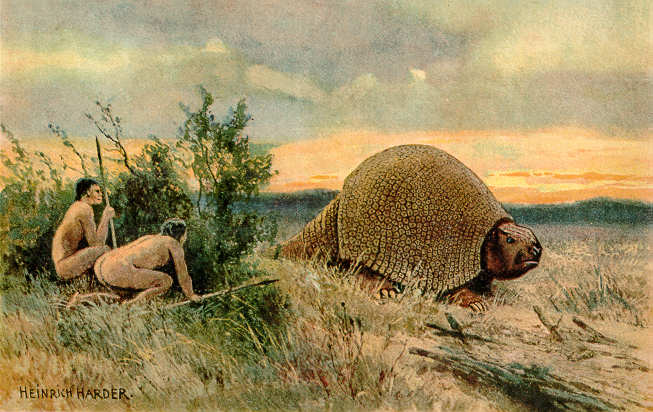
Paleoindians lived alongside and hunted many now extinct megafauna (large animals), with most large animals across the Americas becoming extinct towards the end of the Paleoindian period as part of the Late Pleistocene megafauna extinctions. The potential role of human hunting in the extinctions has been the subject of much controversy. From 8000 to 7000 BCE (10,000–9,000 BP) the climate stabilized, leading to a rise in population and lithic technology advances, resulting in a more sedentary lifestyle during the following Archaic Period.
The term "Paleoindian" was first coined by Frank H. H. Roberts in the 1940 work Developments in the Problem of the North American Paleo-Indian, in which the term was used to specifically apply to archaeological assemblages that were perceived to be relatively "old" and "adapted to conditions unlike those in modern times", with a number of early adopters of the term, such as James Bennett Griffin in 1946, including archaeological assemblages now considered part of the North American Archaic period, contrasting it with the term "Neo-Indian", which Griffin used to characterise assemblages with technology resembling the Neolithic of the Old World. John Witthoft in 1952 saw it as a technological stage that lacked "pecked and ground" stone tools. The first author to use it to specifically refer to the first inhabitants to the Americas was Hannah Marie Wormington in 1957, viewing them as those peoples who had lived the in the Americas prior to 6000 years ago, who had lived alongside now-extinct animals and produced fluted stone points. According to The settlement of the American continents: a multidisciplinary approach to human biogeography, in contemporary North American archaeology the term "Paleoindian" is used to specifically refer to "(1) the earliest well-documented culture in North America, (2) the characteristics of sites and artifact assemblages, and (3) a particular economic livelihood".
Researchers continue to study and discuss the specifics of Paleo-Indian migration to and throughout the Americas, including the dates and routes traveled. The traditional theory holds that these early migrants moved into Beringia between eastern Siberia and present-day Alaska 17,000 years ago, at a time when the Quaternary glaciation significantly lowered sea levels. These people are believed to have followed herds of now-extinct pleistocene megafauna along ice-free corridors that stretched between the Laurentide and Cordilleran ice sheets. An alternative proposed scenario involves migration, either on foot or using boats, down the Pacific coast to South America. Evidence of the latter would have been submerged by a sea-level rise of more than a hundred meters following the end of the Last Glacial Period.
The time range of the peopling of the Americas remains a source of substantial debate. Conventional estimates have it that humans reached North America at some point between 15,000 and 20,000 years ago. However, some groups of humans may have reached South America as early as 25,000 years ago. One of the few areas of agreement is the origin from Siberia, with widespread habitation of the Americas during the end of the Last Glacial Period, and more specifically after the end of the Last Glacial Maximum around 16,000 to 13,000 years before present.
The Palaeoindian period is generally considered to end around 9000 to 8000 years Before Present (abbreviated BP, a calendar system that treats the year 1950 AD/CE as year zero). The term "Paleoamerican" is sometimes used to refer to the pre-Clovis Paleoindian period, usually in a South American context, and with controversial connotations of the hypothesis of an earlier migration wave to the Americas prior to the arrival of the ancestors of modern Indigenous peoples of the Americas. Some authors have suggested that archaeological sites in the Americas prior to 13,500-13,000 years BP should be assigned to the Upper Paleolithic, which is then followed by the Paleoindian period.
Paleo-Indians
Paleo-Indians (also spelled Paleoindians) were the first peoples who entered and subsequently inhabited the Americas towards the end of the Late Pleistocene period. The word comes from the prefix paleo- comes from the Ancient Greek adjective: παλαιός, romanized: palaiós, lit. 'old; ancient', and "Indian", which has been historically used to refer to Indigenous peoples of the Americas. The term Paleo-Indian applies specifically to the lithic period in the Western Hemisphere and is distinct from the term Paleolithic.
Traditional theories suggest that big-animal hunters crossed the Bering Strait from North Asia into the Americas over a land bridge (Beringia). This bridge existed from 45,000 to 12,000 BCE (47,000–14,000 BP). Small isolated groups of hunter-gatherers migrated alongside herds of large herbivores far into Alaska. From c. 16,500 – c. 13,500 BCE (c. 18,500 – c. 15,500 BP), ice-free corridors developed along the Pacific coast and valleys of North America. This allowed land animals, followed by humans, to migrate south into the interior of the continent. The people went on foot or used boats along the coastline. The dates and routes of the peopling of the Americas remain subjects of ongoing debate. There were likely three waves of ancient settlers from the Bering Sea to the American continent.
Stone tools, particularly projectile points and scrapers, are the primary evidence of the earliest human activity in the Americas. Archeologists and anthropologists use surviving crafted lithic flaked tools to classify cultural periods. Scientific evidence links Indigenous Americans to eastern Siberian populations by the distribution of blood types, and genetic composition as indicated by molecular data, such as DNA. There is evidence for at least two separate migrations.
Paleoindians lived alongside and hunted many now extinct megafauna (large animals), with most large animals across the Americas becoming extinct towards the end of the Paleoindian period as part of the Late Pleistocene megafauna extinctions. The potential role of human hunting in the extinctions has been the subject of much controversy. From 8000 to 7000 BCE (10,000–9,000 BP) the climate stabilized, leading to a rise in population and lithic technology advances, resulting in a more sedentary lifestyle during the following Archaic Period.
The term "Paleoindian" was first coined by Frank H. H. Roberts in the 1940 work Developments in the Problem of the North American Paleo-Indian, in which the term was used to specifically apply to archaeological assemblages that were perceived to be relatively "old" and "adapted to conditions unlike those in modern times", with a number of early adopters of the term, such as James Bennett Griffin in 1946, including archaeological assemblages now considered part of the North American Archaic period, contrasting it with the term "Neo-Indian", which Griffin used to characterise assemblages with technology resembling the Neolithic of the Old World. John Witthoft in 1952 saw it as a technological stage that lacked "pecked and ground" stone tools. The first author to use it to specifically refer to the first inhabitants to the Americas was Hannah Marie Wormington in 1957, viewing them as those peoples who had lived the in the Americas prior to 6000 years ago, who had lived alongside now-extinct animals and produced fluted stone points. According to The settlement of the American continents: a multidisciplinary approach to human biogeography, in contemporary North American archaeology the term "Paleoindian" is used to specifically refer to "(1) the earliest well-documented culture in North America, (2) the characteristics of sites and artifact assemblages, and (3) a particular economic livelihood".
Researchers continue to study and discuss the specifics of Paleo-Indian migration to and throughout the Americas, including the dates and routes traveled. The traditional theory holds that these early migrants moved into Beringia between eastern Siberia and present-day Alaska 17,000 years ago, at a time when the Quaternary glaciation significantly lowered sea levels. These people are believed to have followed herds of now-extinct pleistocene megafauna along ice-free corridors that stretched between the Laurentide and Cordilleran ice sheets. An alternative proposed scenario involves migration, either on foot or using boats, down the Pacific coast to South America. Evidence of the latter would have been submerged by a sea-level rise of more than a hundred meters following the end of the Last Glacial Period.
The time range of the peopling of the Americas remains a source of substantial debate. Conventional estimates have it that humans reached North America at some point between 15,000 and 20,000 years ago. However, some groups of humans may have reached South America as early as 25,000 years ago. One of the few areas of agreement is the origin from Siberia, with widespread habitation of the Americas during the end of the Last Glacial Period, and more specifically after the end of the Last Glacial Maximum around 16,000 to 13,000 years before present.
The Palaeoindian period is generally considered to end around 9000 to 8000 years Before Present (abbreviated BP, a calendar system that treats the year 1950 AD/CE as year zero). The term "Paleoamerican" is sometimes used to refer to the pre-Clovis Paleoindian period, usually in a South American context, and with controversial connotations of the hypothesis of an earlier migration wave to the Americas prior to the arrival of the ancestors of modern Indigenous peoples of the Americas. Some authors have suggested that archaeological sites in the Americas prior to 13,500-13,000 years BP should be assigned to the Upper Paleolithic, which is then followed by the Paleoindian period.
Recent media
Recent media