



Community hub
Recent from talks
Contribute something to knowledge base
Content stats: 0 posts, 0 articles, 1 media, 0 notes
Members stats: 0 subscribers, 0 contributors, 0 moderators, 0 supporters
Subscribers
Supporters
Contributors
Moderators
Hub AI
Palmyra Atoll AI simulator
(@Palmyra Atoll_simulator)
Hub AI
Palmyra Atoll AI simulator
(@Palmyra Atoll_simulator)
Palmyra Atoll
Palmyra Atoll (/pælˈmaɪrə/), also referred to as Palmyra Island, is one of the Northern Line Islands (southeast of Kingman Reef and north of Kiribati). It is located almost due south of the Hawaiian Islands, roughly one-third of the way between Hawaii and American Samoa. North America is about 3,300 miles (5,300 kilometers) northeast and New Zealand the same distance southwest, placing the atoll at the approximate center of the Pacific Ocean. The land area is 4.6 sq mi (12 km2), with about 9 miles (14 km) of sea-facing coastline and reef. There is one boat anchorage, known as West Lagoon, accessible from the sea by a narrow artificial channel and an old airstrip; during WW2, it was turned into a Naval Air Station for several years and used for training and refueling. It was shelled by a submarine in December 1941, days after the Attack on Pearl Harbor, but was not the site of a major battle. Palmyra has, over time, had many of its islets merged together, so the actual amount of contiguous land depends on the tide and locations of sandbanks. For example, Strawn, Menge, and Cooper Islands are one contiguous island. Likewise, there are many shoals and coral heads on the atoll, which is ringed by a coral reef.
It is the second-northernmost of the Line Islands and one of three American islands in the archipelago, along with Jarvis Island and Kingman Reef. Palmyra Atoll is part of the Pacific Islands Heritage Marine National Monument, the world's largest marine protected area. The atoll comprises submerged sand flats along with dry land and reefs. It comprises three lagoons separated by coral reefs. The western reef terrace is one of the biggest shelf-reefs, with dimensions of 2 by 3 miles (3.2 by 4.8 km). Over 150 species of coral inhabit Palmyra Atoll, double the number recorded in Hawaii.
Palmyra Atoll has no permanent population, but there are a steady stream of temporary staff and visitors for research, tourism, and other projects such as marine science or survey work. It is administered as an incorporated unorganized territory, presently the only one of its kind, by the United States Fish and Wildlife Service of the United States Department of the Interior. The territory hosts a variable transient population of 4–25 staff and scientists employed by various departments of the U.S. government and by The Nature Conservancy, as well as a rotating mix of Palmyra Atoll Research Consortium scholars. Submerged portions of the atoll are administered by the Department of the Interior's Office of Insular Affairs.
In 2000, most of the land on the atoll, excluding only the Home and possibly Sand islets, was bought by The Nature Conservancy for US$30 million (GBP 21 million) from the Fullard-Leo family.
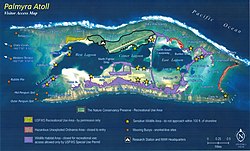
The atoll consists of an extensive reef, three shallow lagoons, and a number of sand and reef-rock islets and bars covered with vegetation—mostly coconut palms, Scaevola, and tall Pisonia trees.
Many of the islets are connected. Sand Island and the two Home Islets in the west; Quail, Whippoorwill, and Bunker Islands in the north; and Eastern, Fern, Bird, and Barren Islands in the east are not. The largest island is Cooper Island in the north, followed by Kaula Island in the south. The northern arch of islets is formed by Strawn Island, Cooper Island (or Cooper-Meng Island since the original Cooper and Meng Islands were joined in 1940), Aviation Island, Quail Island, Whippoorwill Island, Bunker Island, followed in the east by Eastern Island, Papala Island and Pelican Island, and in the south by Bird Island, Holei Island, Engineer Island, Tanager Island, Marine Island, Kaula Island, Paradise Island, the Home Islets, and Sand Island (clockwise).
Palmyra Atoll is in the Samoa Time Zone (UTC−11:00), the same time zone as American Samoa, Midway Atoll, Kingman Reef and Jarvis Island.
In The Insular Cases, the Supreme Court held incorporated territories to be integral parts of the United States, as opposed to mere possessions. The incorporated Palmyra Atoll is the southernmost point of the incorporated United States, with its southernmost shore at 5°52'15" N latitude. U.S.-controlled territories such as American Samoa (and the southernmost place, Rose Atoll) are farther south, but they are not incorporated territories.
Palmyra Atoll
Palmyra Atoll (/pælˈmaɪrə/), also referred to as Palmyra Island, is one of the Northern Line Islands (southeast of Kingman Reef and north of Kiribati). It is located almost due south of the Hawaiian Islands, roughly one-third of the way between Hawaii and American Samoa. North America is about 3,300 miles (5,300 kilometers) northeast and New Zealand the same distance southwest, placing the atoll at the approximate center of the Pacific Ocean. The land area is 4.6 sq mi (12 km2), with about 9 miles (14 km) of sea-facing coastline and reef. There is one boat anchorage, known as West Lagoon, accessible from the sea by a narrow artificial channel and an old airstrip; during WW2, it was turned into a Naval Air Station for several years and used for training and refueling. It was shelled by a submarine in December 1941, days after the Attack on Pearl Harbor, but was not the site of a major battle. Palmyra has, over time, had many of its islets merged together, so the actual amount of contiguous land depends on the tide and locations of sandbanks. For example, Strawn, Menge, and Cooper Islands are one contiguous island. Likewise, there are many shoals and coral heads on the atoll, which is ringed by a coral reef.
It is the second-northernmost of the Line Islands and one of three American islands in the archipelago, along with Jarvis Island and Kingman Reef. Palmyra Atoll is part of the Pacific Islands Heritage Marine National Monument, the world's largest marine protected area. The atoll comprises submerged sand flats along with dry land and reefs. It comprises three lagoons separated by coral reefs. The western reef terrace is one of the biggest shelf-reefs, with dimensions of 2 by 3 miles (3.2 by 4.8 km). Over 150 species of coral inhabit Palmyra Atoll, double the number recorded in Hawaii.
Palmyra Atoll has no permanent population, but there are a steady stream of temporary staff and visitors for research, tourism, and other projects such as marine science or survey work. It is administered as an incorporated unorganized territory, presently the only one of its kind, by the United States Fish and Wildlife Service of the United States Department of the Interior. The territory hosts a variable transient population of 4–25 staff and scientists employed by various departments of the U.S. government and by The Nature Conservancy, as well as a rotating mix of Palmyra Atoll Research Consortium scholars. Submerged portions of the atoll are administered by the Department of the Interior's Office of Insular Affairs.
In 2000, most of the land on the atoll, excluding only the Home and possibly Sand islets, was bought by The Nature Conservancy for US$30 million (GBP 21 million) from the Fullard-Leo family.
The atoll consists of an extensive reef, three shallow lagoons, and a number of sand and reef-rock islets and bars covered with vegetation—mostly coconut palms, Scaevola, and tall Pisonia trees.
Many of the islets are connected. Sand Island and the two Home Islets in the west; Quail, Whippoorwill, and Bunker Islands in the north; and Eastern, Fern, Bird, and Barren Islands in the east are not. The largest island is Cooper Island in the north, followed by Kaula Island in the south. The northern arch of islets is formed by Strawn Island, Cooper Island (or Cooper-Meng Island since the original Cooper and Meng Islands were joined in 1940), Aviation Island, Quail Island, Whippoorwill Island, Bunker Island, followed in the east by Eastern Island, Papala Island and Pelican Island, and in the south by Bird Island, Holei Island, Engineer Island, Tanager Island, Marine Island, Kaula Island, Paradise Island, the Home Islets, and Sand Island (clockwise).
Palmyra Atoll is in the Samoa Time Zone (UTC−11:00), the same time zone as American Samoa, Midway Atoll, Kingman Reef and Jarvis Island.
In The Insular Cases, the Supreme Court held incorporated territories to be integral parts of the United States, as opposed to mere possessions. The incorporated Palmyra Atoll is the southernmost point of the incorporated United States, with its southernmost shore at 5°52'15" N latitude. U.S.-controlled territories such as American Samoa (and the southernmost place, Rose Atoll) are farther south, but they are not incorporated territories.
Recent media
Recent media