Hubbry Logo
Rose AtollRose AtollMain
Open search
Rose Atoll
Community hub
Rose Atoll
logo
8 pages, 0 posts
0 subscribers
Be the first to start a discussion here.
Rose Atoll
Rose Atoll
from Wikipedia

Key Information

Rose Atoll Marine National Monument
IUCN category V (protected landscape/seascape)
Oceanographers deploy a buoy inside Rose Atoll
Map
Coordinates14°32′45″S 168°09′00″W / 14.5458333°S 168.15°W / -14.5458333; -168.15
Area8,571,633 acres (3,468,817 ha)[1]
Created2009
Governing bodyU.S. Fish and Wildlife Service
WebsiteRose Atoll Marine National Monument
Map of the Samoan Islands, showing the location of Rose Atoll


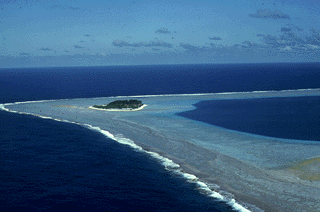
Rose Atoll, sometimes called Rose Island or Motu O Manu ("Bird Island") by people of the Manu'a Islands, is an oceanic atoll within the U.S. territory of American Samoa. An uninhabited wildlife refuge, it is the southernmost point belonging to the United States, about 170 miles (150 nmi; 270 km) to the east of Tutuila, the principal island of American Samoa. The land area is just 0.05 km2 (12 acres) at high tide. The total area of the atoll, including lagoon and reef flat amounts to 6.33 km2 (1,560 acres). Just west of the northernmost point is a channel into the lagoon, about 80 metres (260 ft) wide. There are two islets on the northeastern rim of the reef, larger Rose Island, 3.5 metres (11 ft) high, in the east and the non-vegetated Sand Island, 1.5 metres (5 ft) high, in the north.

The Rose Atoll Marine National Monument that lies on the two outstanding islands of the atoll is managed cooperatively between the U.S. Fish and Wildlife Service and the government of American Samoa.[2]

The nearly square atoll is one of the smallest in the world, measuring only 2.6 km × 2.7 km (1.6 mi × 1.7 mi). It is also the only atoll of the Samoan Islands. (Swains Island is also an atoll, but only politically part of American Samoa, not geographically.)

Rose Atoll is quite isolated, the closest island to it being Taʻū, 140 km (87 mi) to the WNW.

History

[edit]

The earliest Western sighting was June 13, 1722, during the voyage of Jacob Roggeveen, who called it Vuil Eiland "useless island."[3] The name Rose Island comes from its sighting by Louis de Freycinet in 1819. He named it after his wife Rose. While the second woman to circumnavigate the globe, Rose de Freycinet was the first to tell her tale.[4] In his official report Louis de Freycinet records that 'I named Rose Island, from the name of someone who is extremely dear to me'.[5] Soon afterwards, in 1824, it was seen by the expedition under Otto von Kotzebue, who named it Kordinkov after his First Lieutenant.

Apollo 10 returned to Earth in the ocean near Rose Atoll on May 26, 1969. The three astronauts were treated to a lavish welcome at Pago Pago International Airport before being flown to Hawai’i.[6]

Protection

[edit]

The island was protected as the Rose Atoll National Wildlife Refuge in 1973 with 39,066 acres (61.04 sq mi; 46.09 sq nmi; 158.09 km2), only 20 acres (8.1 ha) of which is emergent. The wildlife refuge is managed by the United States Fish and Wildlife Service.[7]

Rose Atoll Marine National Monument is a United States National Monument covering 8,571,633 acres (13,393.18 sq mi; 10,113.45 sq nmi; 34,688.17 km2). It was established in 2009.[8] At the signing of the order establishing the monument, President George W. Bush noted that "the waters surrounding the atoll are the home of many rare species, including giant clams and reef sharks—as well as an unusual abundance of rose-colored corals".[9] The monument's marine areas were incorporated into the National Marine Sanctuary of American Samoa in 2014; they are co-managed by the Fish and Wildlife Service and the Office of National Marine Sanctuaries, a component of the National Oceanic and Atmospheric Administration (NOAA).

President Bush signs paperwork establishing the Rose Atoll Marine National Monument on January 6, 2009.

Fauna

[edit]
Pink coralline algae at Rose Atoll.

Rose Atoll contains the largest populations of giant clams, nesting seabirds and rare reef fish in all of American Samoa. The fish population is different from the rest of the region due to a high concentration of carnivorous fish and low concentration of herbivorous fish. Almost 270 different species of fish have been recorded in the last 15 years. Tuna, mahi-mahi, billfish, barracuda and sharks reside outside the lagoon. In deeper waters, tunicates and stalked crinoids have been spotted by scuba expeditions. Sea mammals such as the endangered humpback whale and the dolphin genus Stenella also use the waters.[10]

The atoll is a critical nesting habitat for the threatened green turtle and the endangered hawksbill turtle. The turtles migrate between American Samoa and other Pacific island nations. Their nesting season is between the months of August and February.

It is a nesting site for rare species of petrels, shearwaters, and terns. Approximately 97% of American Samoa's seabird population resides on Rose Atoll. Each of the 12 bird species is federally protected. Red-footed boobies and greater and lesser frigate birds nest in the buka trees. Black noddies and white terns nest in the middle and lower branches. The root system is used by reef herons and red-tailed tropic birds. Other birds can be found in the Pisonia forest, the only one left in Samoa.[11] The atoll has been recognised as an Important Bird Area (IBA) by BirdLife International because it supports a breeding population of some 400,000 sooty terns, as estimated in 1974.[12]

See also

[edit]

References

[edit]
[edit]
Revisions and contributorsEdit on WikipediaRead on Wikipedia
from Grokipedia
Rose Atoll is a remote, uninhabited coral atoll in the South Pacific Ocean, situated approximately 180 miles east-southeast of Pago Pago Harbor on , the principal island of , making it the southernmost point of the territory south of the . It comprises two small islets—Rose Island (17 acres) and Sand Island (about 7 acres, varying with storms)—enclosing a up to 1.2 miles wide and 98 feet deep, connected to the ocean by a single natural pass, with a maximum of above . Recognized as one of the world's smallest atolls, its emergent land totals just 21 acres surrounding a 1,600-acre , formed over millions of years on an ancient volcanic foundation by reef-building corals, , and clams. Ecologically, Rose Atoll is a vital , often called the "Islands of Seabirds" or "Village of Seabirds" for hosting nearly 97% of American Samoa's population, including 12 of federally protected migratory seabirds that nest and roost on its islets. The surrounding marine environment supports around 100 distinct coral —primarily rose-colored —along with 272 of (seven newly described by scientists at the site), populations of rare giant clams, and endangered hawksbill and threatened green sea turtles. It also serves as a seasonal for humpback and pilot whales, dolphins, and other pelagic , contributing to the resilience of the Samoan Archipelago's ecosystem amid threats like . Designated as a on August 24, 1973, through a cooperative agreement between the U.S. Fish and Wildlife Service and the government, Rose Atoll was further protected as part of the Rose Atoll Marine National Monument on January 6, 2009, via Presidential Proclamation 8337, encompassing over 13,000 square miles of submerged lands and waters to safeguard its unique biological communities and cultural significance. The site remains closed to public access to prevent disturbances, with joint management by the U.S. Fish and Wildlife Service, , and local authorities focused on research, monitoring, and restoration efforts to combat , , and sea-level rise.

Geography

Location and Extent

Rose Atoll is situated at 14°32′52″ S and 168°08′34″ W , marking its position in the southwestern . As the easternmost point of , it lies approximately 130 nautical miles (about 240 km) east-southeast of Pago Pago Harbor on Island, the main island of the territory. This remote location positions Rose Atoll as the southernmost U.S. land and sea area south of the , within the broader archipelago. The encompasses a total area of roughly 6.56 km² (1,621 acres), which includes the enclosed and surrounding flat. Its emergent land area measures approximately 0.085 km² (21 acres), consisting of two small islets that vary slightly in size due to tidal and storm influences. The structure is nearly square, with sides spanning about 2.4 km, enclosing a up to 2 km across at its widest point. These boundaries are defined by a continuous coralline algal rim, interrupted only by a single narrow pass connecting the to the open ocean.

Physical Features

Rose Atoll consists of two small islets situated on the northeastern rim of its encircling : the larger Rose Island, also known as Motu Rose, which covers approximately 17 acres with a maximum of (3 meters), and the smaller Sand Island, averaging about 7 acres with an of roughly 1.5 meters that varies due to tidal influences and processes. Rose Island features a more stable, vegetated surface composed of raised reef rock and soft formed from fragmented , while Sand Island remains largely unvegetated and subject to frequent reshaping by waves and currents. At the center of the atoll lies a lagoon measuring about 1.2 miles (1.9 kilometers) in width and reaching depths of up to 98 feet (30 meters), fully enclosed by a that restricts water exchange primarily through a narrow channel on the western side. This lagoon is characterized by a relatively shallow terrace surrounding its deeper central basin, with the enclosing reef dominated by crustose that imparts a distinctive hue to the structure. Geologically, Rose Atoll formed as a atoll atop a submerged volcanic , representing the easternmost and likely oldest feature in the Samoan island chain, capped by a carbonate platform built through successive layers of growth over the underlying volcanic base. The atoll's low-lying nature, with no point exceeding 10 feet above , renders it highly vulnerable to marine overwash events, exacerbated by storm surges and rising sea levels that can inundate the islets and alter their morphology. Located approximately 170 miles east of in , this configuration underscores its isolation and exposure to Pacific swells.

History

European Discovery

The first recorded European sighting of Rose Atoll took place on 13 June 1722, during the Dutch expedition led by in search of the southern continent Incognita. Roggeveen, commanding three ships, observed the remote from afar and named it Vuil Eiland (Foul Island), likely due to its low-lying islets surrounded by hazardous reefs that made approach difficult. No landing was attempted, and the sighting received little attention in subsequent European records. Nearly a century later, on 21 1819, the French navigator Louis Claude Desaulses de Freycinet approached the atoll aboard the corvette Uranie as part of a scientific voyage around the world. Freycinet renamed it Île Rose (Rose Island) in honor of his wife, Rose Pinon de Freycinet, who had accompanied him secretly on the expedition—the first European woman to circumnavigate the globe. Like Roggeveen, Freycinet did not land but documented the atoll's position and features in his expedition's hydrographic surveys. Prior to these European encounters, documentation of 18th- and 19th-century Polynesian knowledge or use of Rose Atoll remains limited, though it is likely that from nearby islands periodically visited for resource gathering over preceding centuries, as suggested by the traditional Samoan name “Motu o Manu” (Isle of Birds); however, no detailed European expeditions explored the site until Freycinet's naming. The atoll's isolation, approximately 150 nautical miles east-southeast of , contributed to its obscurity in early European navigation charts.

Modern Significance

In 1969, Rose Atoll's remote position in the South Pacific was underscored by the of NASA's Apollo 10 spacecraft on May 26, approximately 235 miles northwest of the atoll. The mission, which served as a for the , concluded with the command module landing in the ocean at coordinates 15°04′S 164°39′W, recovered by the USS Princeton, emphasizing the atoll's isolation in a vast oceanic expanse far from major landmasses. Environmental threats to Rose Atoll emerged prominently in the late , including a major ship grounding in October 1993 when the Taiwanese vessel Jin Shiang Fa struck the western , spilling about 100,000 gallons of , 500 gallons of lube oil, and 2,500 pounds of , which posed severe risks to the marine ecosystem. This incident, occurring within the boundaries of the Rose Atoll , led to immediate contamination of and shoreline habitats, prompting rapid response efforts by U.S. agencies. Just months later, in April 1994, widespread affected numerous scleractinian species across the atoll's reefs to depths of 66 feet, driven by elevated sea surface temperatures associated with the El Niño-Southern Oscillation event, further stressing the fragile system. Scientific research has highlighted Rose Atoll's ecological significance through key milestones, such as 1974 avian surveys that estimated the breeding population of sooty terns (Onychoprion fuscatus) at around 400,000 individuals, representing a dominant portion of the atoll's assemblage. Since the , efforts to monitor marine species have included satellite tagging of green turtles (Chelonia mydas), with studies from 2012 to 2019 tracking post-nesting migrations of over 40 individuals to foraging grounds in and other central South Pacific regions, providing insights into connectivity across the ocean basin.

Protection and Management

Establishment of Reserves

Rose Atoll National Refuge was established on August 24, 1973, by the U.S. Fish and Wildlife Service through a cooperative agreement with the Government of under the authority of the Fish and Wildlife Act of 1956. The refuge encompasses approximately 1,621 acres, consisting of 21 acres of emergent land across two small islets—Rose Island and Sand Island—and a 1,600-acre surrounded by reefs. This designation was driven by the need to protect the atoll's extensive seabird colonies, including species such as the and white tern, and its fragile marine habitats from historical overexploitation and emerging threats from unregulated fishing. Building on the refuge, President proclaimed the Rose Atoll Marine on January 6, 2009, invoking the of 1906 to extend protections seaward. The monument covers approximately 13,451 square miles (about 8.6 million acres or 10,156 square nautical miles) of , encompassing the entire and extending 50 nautical miles from the mean high line to safeguard submerged lands and waters. The proclamation's primary motivations included preserving the atoll's exceptional ecosystems, which support diverse vulnerable to overexploitation through , and maintaining critical habitats for seabirds and endangered sea turtles amid growing environmental pressures.

Governance and Administration

Rose Atoll is co-managed by the U.S. Fish and Wildlife Service (USFWS) for its terrestrial portions as the Rose Atoll National Wildlife Refuge and by the National Oceanic and Atmospheric Administration (NOAA) for the surrounding marine areas as the Rose Atoll Marine National Monument, a framework established in 2009 under Presidential Proclamation 8337. This interagency partnership coordinates conservation efforts, including monitoring, research, and enforcement, with USFWS focusing on wildlife habitat protection and NOAA overseeing marine ecosystem management, such as fishery regulations and coral reef assessments. The refuge operates under a 1973 cooperative agreement with the Government of American Samoa, ensuring alignment with local priorities while adhering to federal laws like the National Wildlife Refuge System Administration Act. Public access to the atoll has been restricted since its 1973 designation as a , limiting entry to permitted scientific research and official management activities to minimize disturbance and protect sensitive habitats. Special use permits are issued on a case-by-case basis, with strict best management practices enforced, including measures to prevent contamination. The marine monument enforces a no-take policy, banning and extractive activities within its boundaries to safeguard and ecosystems. On the international stage, Rose Atoll forms part of the archipelago and is designated as a Key Area by , highlighting its critical role in conserving endemic and marine . Current policies, guided by the 2014 Comprehensive Conservation Plan and interagency updates, prioritize protocols to combat threats, such as requiring gear freezing for 48 hours, hull cleaning, and bans on fresh produce or soil to preserve the atoll's ecological integrity. In July 2025, NOAA designated critical habitat under the Endangered Species Act for five threatened Indo-Pacific coral , including areas around Rose Atoll, to support their recovery and enhance protections.

Biodiversity

Terrestrial Flora

The terrestrial flora of Rose Atoll is limited by the atoll's small size, isolation, and exposure to harsh environmental conditions, consisting primarily of native littoral forest and beach strand species on the two islets. Rose Island, the larger and more vegetated islet, supports a patchy littoral forest dominated by the shrub Tournefortia argentea (tausuni), which forms a canopy up to 25 feet tall and has become the primary vegetation following the decline of taller trees. Historically, the forest was characterized by dense stands of Pisonia grandis (pu'a vai, bird's-eye tree), but these have been reduced to only a few unhealthy individuals due to pest infestations and storm damage. Other associated species in the littoral zone include Cordia subcordata (taukanave), Hibiscus tiliaceus, Hernandia nymphaeifolia, and Terminalia samoensis, while the beach strand features prostrate herbs such as Portulaca lutea (tamole) and Boerhavia repens. Vegetation coverage on Rose Island encompasses approximately 15 acres of littoral forest and over 3 acres of beach strand, representing a modest increase in from four vascular plants in 1990 to eight by 2010 following rat eradication efforts. Canopy cover, combining Tournefortia argentea and , has fluctuated significantly, reaching 48% in 1990 before declining to 18% by 1998 due to storm-induced erosion and die-offs. In contrast, Sand Island remains sparsely vegetated or intermittently barren, with any established plants—such as occasional Portulaca lutea or Tournefortia argentea—frequently washed away by wave action and lacking persistent cover due to shifting sands. This limited vegetation plays a crucial role in the ecosystem by providing essential nesting and roosting substrates for seabirds, including red-footed boobies and brown noddies, whose in turn enriches soil nutrients and supports overall productivity. The flora faces ongoing threats from and climate-related disturbances, though the atoll's remoteness minimizes introductions. Introduced palms (Cocos nucifera) have proliferated since Hurricane Olaf in 2005, outcompeting native canopy species and potentially altering habitat structure if unchecked. While non-native like Cenchrus echinatus and Chloris barbata occur sporadically, invasive concerns remain low overall due to the atoll's isolation. Pisonia grandis is particularly vulnerable to cyclones, with six major storms since 1987 causing widespread uprooting and favoring the more resilient Tournefortia argentea; further endangers the low-elevation vegetation (rising no higher than 10 feet above ) through inundation, , and reduced sediment supply from acidifying reefs.

Seabirds and Wildlife

Rose Atoll serves as a critical breeding ground for seabirds, hosting approximately 97% of American Samoa's seabird population across 12 federally protected migratory species. The atoll's two small islands provide essential nesting habitats in littoral forests and beach strands, supporting species such as the sooty tern (Onychoprion fuscatus), brown noddy (Anous stolidus), white tern (Gygis alba), and red-footed booby (Sula sula). The sooty tern forms the largest colony, with an estimated 400,000 individuals recorded in 1974, though more recent surveys indicate over 100,000 breeding pairs, reflecting its status as one of the most abundant ground-nesting seabirds on the atoll. Brown noddies, numbering around 200 breeding pairs, and white terns, with about 60 pairs, primarily nest in trees, while red-footed boobies, estimated at 700 pairs, utilize both tree and ground sites. These populations benefit from the atoll's isolation, which minimizes human disturbance, though species exhibit insular tameness that increases vulnerability to rare intrusions. Sea turtles also rely on Rose Atoll for nesting, particularly the endangered (Chelonia mydas), with 24–36 females nesting annually on the beach strand from August to February in a 2–5 year cycle; surveys from 2012 to 2019 identified a minimum of 138 unique females over the period. The endangered hawksbill turtle (Eretmochelys imbricata) is frequently sighted in the lagoon but has no confirmed nesting records at the site, making Rose Atoll the largest turtle nesting area in overall. Satellite telemetry studies have tracked post-nesting migrations of green turtles, revealing routes extending to and other central South Pacific regions, with seven individuals monitored between 1993 and 1995 demonstrating connectivity to broader oceanic habitats. Hatchlings face risks from light disorientation and trampling, prompting management practices like the use of red lights during surveys. Other notable wildlife includes giant clams (Tridacna maxima), which form one of the largest populations in , estimated at around 27,800 individuals in the lagoon and reef areas during 1994–1995 surveys, with recent 2024 assessments confirming high densities and low mortality rates serving as key ecosystem engineers through filter-feeding and with . Occasional sightings of marine mammals, such as spinner dolphins (Stenella longirostris), occur in offshore waters, alongside humpback and pilot whales, contributing to the atoll's role as a transient for cetaceans. Population trends for seabirds show overall stability or increases following the 1991–1993 eradication of invasive ship rats (Rattus rattus), which previously preyed on eggs and chicks, limiting colonies; however, some species like brown noddies and white terns have experienced declines due to ongoing predation by native birds such as curlews and turnstones, as well as disruptions from hurricanes. Rose Atoll's significance is further recognized by its designation as a Key Area, qualifying under international criteria for its concentrations of breeding seabirds and supporting migratory stopovers for at least seven species. Ongoing monitoring, including and , aims to address these pressures and sustain the atoll's avian and reptilian populations.

Marine Ecosystems

Rose Atoll's marine ecosystems are characterized by a vibrant fringing coral reef system dominated by coralline algae, which imparts a distinctive pink hue to the reef structure and serves as the primary reef-building organism. This algal dominance is unique among Samoan atolls, where coralline algae outcompete stony corals in forming the reef framework, creating a robust platform resistant to physical erosion. The reef supports approximately 100 coral species, including prominent genera such as Acropora, Porites, Favia, Montipora, Astreopora, Montastrea, and Pocillopora, which contribute to high benthic diversity despite the algae's prevalence. The enclosed lagoon, spanning about 1,600 acres with depths ranging from shallow shelves to a maximum of 98 feet, hosts a rich array of , including over 270 of reef-associated . Notable among these are the bumphead (Bolbometopon muricatum), a large critical for maintaining reef health, alongside rare endemics unique to waters. Invertebrate biodiversity is equally impressive, featuring small giant clams (Tridacna maxima) in vibrant hues of electric blue, gold, and teal, as well as sea cucumbers and sea urchins that play key roles in nutrient cycling and grazing. These thrive in the 's patch reefs—about 15 isolated structures rising from depths of 20 to 50 feet, primarily concentrated in the southwestern sector—and on the expansive lagoon floor covered in sand, rubble, and sparse coral growth. As part of the Rose Atoll Marine National Monument, established in 2009, the area functions as a no-take , prohibiting fishing and extraction to foster ecosystem recovery and sustain high biomass levels. This protection has been vital for vulnerable species, including the highest densities of giant clams in the Samoan Archipelago and foraging grounds for endangered green sea turtles (Chelonia mydas), which also nest on adjacent shores. The outer slope, descending steeply from the reef crest to depths exceeding 98 feet, transitions into deeper fore- habitats that support additional fish and assemblages, enhancing overall connectivity across the atoll's depth gradient from surface waters to 30 meters.

Threats and Conservation

Environmental Risks

Rose Atoll faces significant environmental risks from , including rising sea levels and , which threaten its low-lying islets and ecosystems. Sea levels in the region have risen approximately 6 inches over the last century, with historical average rates near averaging 0.16 inches per year from 1993 to present (excluding local effects on main islands); current global trends indicate about 0.13 inches per year as of 2025. Projections indicate a further rise of 0.59 to 1.93 feet by 2100, exacerbating of the atoll's sandy islets and littoral forests, as growth must outpace both and natural to maintain habitat elevation. , driven by increasing atmospheric CO2 levels, has reduced carbonate ion availability, slowing coral and increasing , potentially halting the formation of protective reef crests. Coral bleaching events, often linked to elevated sea surface temperatures during El Niño periods, have repeatedly stressed the atoll's reefs. The 1994 event, associated with a strong El Niño-Southern Oscillation (ENSO), caused widespread bleaching to depths of 66 feet, resulting in significant coral mortality, particularly near areas of prior disturbance. Recurrent episodes occurred in 2002 and 2003, with another severe bleaching during the 2015-2016 El Niño, when American Samoa reefs, including those at Rose Atoll, experienced high levels of thermal stress leading to substantial coral loss. The 2023-2024 global bleaching event, the fourth on record, further impacted Pacific reefs, including Rose Atoll, with elevated temperatures causing additional coral stress and mortality. These events highlight the vulnerability of the atoll's coral communities to warming oceans, with recovery challenged by repeated thermal anomalies. Natural disasters pose additional threats through physical disruption of habitats. Cyclones, such as Category 5 Hurricane in 2005 and in 2004, have uprooted vegetation and damaged reefs, with at least six significant storms affecting the area since 1987. King tides, the highest annual spring tides, frequently cause overwash events that erode beaches, inundate nesting sites for seabirds like the gray-backed tern, and transport saltwater inland, altering and vegetation. Seismic activity from the nearby Samoan volcanic chain, including the active Vailuluʻu located between Taʻu and Rose Atoll, contributes to regional tectonic instability, potentially influencing rates and underwater . Long-term geological processes further compound these risks, as the atoll formed atop a subsiding volcanic foundation, requiring continuous upward growth to counteract gradual sinking and maintain islet elevations against ongoing degradation. degradation, evidenced by shifts from to turf algae dominance in impacted areas, reduces overall structural integrity and habitat resilience, amplifying the effects of and habitat loss across the . These trends underscore the atoll's susceptibility, where even minor changes in could lead to widespread inundation and declines.

Human Impacts and Mitigation

Human activities have significantly impacted Rose Atoll through the introduction of , primarily via shipwrecks. In 1993, the grounding of the Taiwanese vessel Jin Shiang Fa on the atoll's not only spilled approximately 100,000 gallons of but also introduced rats ( spp.), which had been eradicated from the island just a year prior in 1992. These rats preyed on eggs and chicks, reduced seedling germination of native like Pisonia grandis, and contributed to ecosystem degradation before their successful re-eradication by the U.S. Fish and Wildlife Service (FWS) in subsequent years. Additionally, alien ants and scale insects, likely introduced through similar human-mediated vectors, have infested the atoll's unique Pisonia forest—the last remaining such community in —causing defoliation and mortality of trees. Illegal activities further threaten the atoll's biodiversity. Poaching of seabirds and sea turtles occurs sporadically, driven by local and foreign actors seeking eggs, meat, or shells, despite strict prohibitions within the national wildlife refuge and marine monument boundaries. Overfishing outside the monument's protected waters exacerbates pressure on reef fish populations, with unregulated longline and artisanal fisheries in adjacent areas depleting species that rely on the atoll as a spawning ground. Pollution from maritime incidents compounds these issues; the 1993 Jin Shiang Fa spill caused widespread coral mortality and lingering oil residues on reef flats, while ongoing accumulation of plastic debris—entangled fishing gear, bottles, and microplastics—harms marine life through ingestion and habitat smothering. Mitigation efforts focus on prevention and restoration led by federal agencies and local partners. The FWS and (NOAA) enforce strict protocols for all visits, including freezing gear and clothing for at least 48 hours to eliminate potential like or , alongside rigorous permit reviews. Ongoing monitoring programs by FWS and NOAA track presence, pollution levels, and illegal activities through aerial surveys, underwater assessments, and collaboration with the for enforcement against poaching and trespassing. Community education initiatives in , supported by NOAA and local organizations, raise awareness about the atoll's ecological importance and promote compliance with conservation laws through programs, workshops, and to reduce accidental introductions and illegal harvesting. Recent invasive removal campaigns continue to address persistent threats to the Pisonia forest and habitats.

References

Add your contribution
Related Hubs
User Avatar
No comments yet.