
Recent from talks
Pan-Slavic language
Knowledge base stats:
Talk channels stats:
Members stats:
Pan-Slavic language
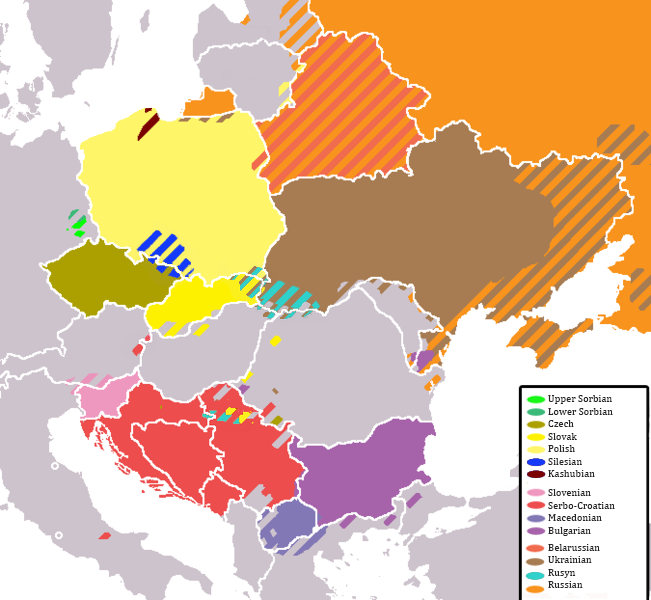
A pan-Slavic language is a zonal auxiliary language for communication among the Slavic peoples.
There are approximately 400 million speakers of the Slavic languages. In order to communicate with each other, speakers of different Slavic languages often resort to international lingua francas, primarily English or Russian. But since Slavic languages are closely related lexically and grammatically and are comparatively easier to learn when another Slavic language is already known, there have been numerous attempts to construct a more neutral auxiliary language that could act as a common language for slavophones. The earliest pan-Slavic linguistic efforts preceded academic knowledge and reconstruction of Proto-Slavic, which was likely spoken between 2nd century BCE and 6th century CE, from which all Slavic languages developed in following centuries.
The history of zonal Slavic languages is closely connected with Pan-Slavism, an ideology that endeavors cultural and political unification of all Slavs, based on the conception that all Slavic people are part of a single Slavic nation. Along with this belief came also the need for an umbrella Slavic language. The strongest candidate for that position among modern languages is Russian, the language of the largest (and, during most of the 19th century, the only) Slavic state, and mother tongue of more than half of Slavs. This option enjoys most of its popularity in Russia itself, but has also been favoured by Pan-Slavists abroad, for example the Slovak Ľudovít Štúr. Others have proposed that Old Church Slavonic would be a better and more neutral solution. In previous centuries, Old Church Slavonic had served as an administrative language across a large part of the Slavic world, and it is still used on a large scale in Eastern Orthodox liturgy, where it plays a role similar to Latin in the West. Old Church Slavonic has the additional advantage of being similar to the common ancestor of the Slavic languages, Proto-Slavic. However, it has several practical disadvantages as well: its grammar is complex, and its vocabulary is characterized by many words that have been lost from the modern languages, as well as an absence of words for modern concepts. Hence, early pan-Slavic language projects aimed at modernizing Old Church Slavonic and adapting it to the needs of everyday communication.[citation needed]
The first pan-Slavic grammar, Gramatíčno izkâzanje ob rúskom jezíku by the Croatian priest Juraj Križanić, was written in 1665. He referred to the language as Ruski jezik ("Russian language"), but in reality it was mostly based on a mixture of the Russian edition of Church Slavonic and his own Southern Chakavian dialect of Croatian. Križanić used it not only for this grammar, but also in other works, including the treatise Politika (1663–1666). According to an analysis of the Dutch Slavist Tom Ekman, 59% of the words used in Politika are of common Slavic descent, 10% come from Russian and Church Slavonic, 9% from Croatian and 2.5% from Polish.
Križanić was not the first who attempted writing in a language understandable to all Slavs. In 1583 another Croatian priest, Šime Budinić, had translated the Summa Doctrinae Christanae by Petrus Canisius into Slovignsky, in which he used both the Latin and Cyrillic alphabets.
After Križanić, numerous other efforts have been made to create an umbrella language for the speakers of Slavic languages. A notable example is Universalis Lingua Slavica by the Slovak attorney Ján Herkeľ (1786–1853), published in Latin in 1826. Unlike Križanić' project, this project was closer to the West Slavic languages.[citation needed]
During the second half of the 19th century Pan-Slavic language projects were mostly the domain of Slovenes and Croats. In this era of awakening national consciousness, the Russians were the only Slavs who had their own state; other Slavic peoples inhabited large, mostly non-Slavic states, and clear borders between the various nations were mostly lacking. Among the numerous efforts at creating written standards for the South Slavic languages there were also efforts at establishing a common South Slavic language, Illyrian, that might also serve as a literary language for all Slavs in the future. Of special importance is the work of Matija Majar (1809–1892), a Slovenian Austroslavist who later converted to Pan-Slavism. In 1865 he published Uzajemni Pravopis Slavjanski ("Mutual Slavic Orthography"). In this work, he postulated that the best way for Slavs to communicate with other Slavs was by taking their own language as a starting point and then modifying it in steps. First, he proposed changing the orthography of each individual language into a generic ("mutual") Pan-Slavic orthography, subsequently he described a grammar that was based on comparing five major Slavic languages of his days: Old Church Slavonic, Russian, Polish, Czech and Serbian. Apart from a book about the language itself, Majar also used it for a biography of Cyril and Methodius and for a magazine he published in the years 1873–1875, Slavjan. A fragment in the language can still be seen on the altar of Majar's church in Görtschach. Other Pan-Slavic language projects were published in the same period by the Croatian Matija Ban, the Slovenes Radoslav Razlag and Božidar Raič, as well as the Bulgarian Grigor Parlichev[non-primary source needed] – all based on the idea of combining Old Church Slavonic with elements from the modern South Slavic languages.[citation needed]
All authors mentioned above were motivated by the belief that all Slavic languages were dialects of one single Slavic language rather than separate languages. They deplored the fact that these dialects had diverged beyond mutual comprehensibility, and the Pan-Slavic language they envisioned was intended to reverse this process. Their long-term objective was that this language would replace the individual Slavic languages. Majar, for example, compared the Pan-Slavic language with standardized languages like Ancient Greek and several modern languages:
Hub AI
Pan-Slavic language AI simulator
(@Pan-Slavic language_simulator)
Pan-Slavic language
A pan-Slavic language is a zonal auxiliary language for communication among the Slavic peoples.
There are approximately 400 million speakers of the Slavic languages. In order to communicate with each other, speakers of different Slavic languages often resort to international lingua francas, primarily English or Russian. But since Slavic languages are closely related lexically and grammatically and are comparatively easier to learn when another Slavic language is already known, there have been numerous attempts to construct a more neutral auxiliary language that could act as a common language for slavophones. The earliest pan-Slavic linguistic efforts preceded academic knowledge and reconstruction of Proto-Slavic, which was likely spoken between 2nd century BCE and 6th century CE, from which all Slavic languages developed in following centuries.
The history of zonal Slavic languages is closely connected with Pan-Slavism, an ideology that endeavors cultural and political unification of all Slavs, based on the conception that all Slavic people are part of a single Slavic nation. Along with this belief came also the need for an umbrella Slavic language. The strongest candidate for that position among modern languages is Russian, the language of the largest (and, during most of the 19th century, the only) Slavic state, and mother tongue of more than half of Slavs. This option enjoys most of its popularity in Russia itself, but has also been favoured by Pan-Slavists abroad, for example the Slovak Ľudovít Štúr. Others have proposed that Old Church Slavonic would be a better and more neutral solution. In previous centuries, Old Church Slavonic had served as an administrative language across a large part of the Slavic world, and it is still used on a large scale in Eastern Orthodox liturgy, where it plays a role similar to Latin in the West. Old Church Slavonic has the additional advantage of being similar to the common ancestor of the Slavic languages, Proto-Slavic. However, it has several practical disadvantages as well: its grammar is complex, and its vocabulary is characterized by many words that have been lost from the modern languages, as well as an absence of words for modern concepts. Hence, early pan-Slavic language projects aimed at modernizing Old Church Slavonic and adapting it to the needs of everyday communication.[citation needed]
The first pan-Slavic grammar, Gramatíčno izkâzanje ob rúskom jezíku by the Croatian priest Juraj Križanić, was written in 1665. He referred to the language as Ruski jezik ("Russian language"), but in reality it was mostly based on a mixture of the Russian edition of Church Slavonic and his own Southern Chakavian dialect of Croatian. Križanić used it not only for this grammar, but also in other works, including the treatise Politika (1663–1666). According to an analysis of the Dutch Slavist Tom Ekman, 59% of the words used in Politika are of common Slavic descent, 10% come from Russian and Church Slavonic, 9% from Croatian and 2.5% from Polish.
Križanić was not the first who attempted writing in a language understandable to all Slavs. In 1583 another Croatian priest, Šime Budinić, had translated the Summa Doctrinae Christanae by Petrus Canisius into Slovignsky, in which he used both the Latin and Cyrillic alphabets.
After Križanić, numerous other efforts have been made to create an umbrella language for the speakers of Slavic languages. A notable example is Universalis Lingua Slavica by the Slovak attorney Ján Herkeľ (1786–1853), published in Latin in 1826. Unlike Križanić' project, this project was closer to the West Slavic languages.[citation needed]
During the second half of the 19th century Pan-Slavic language projects were mostly the domain of Slovenes and Croats. In this era of awakening national consciousness, the Russians were the only Slavs who had their own state; other Slavic peoples inhabited large, mostly non-Slavic states, and clear borders between the various nations were mostly lacking. Among the numerous efforts at creating written standards for the South Slavic languages there were also efforts at establishing a common South Slavic language, Illyrian, that might also serve as a literary language for all Slavs in the future. Of special importance is the work of Matija Majar (1809–1892), a Slovenian Austroslavist who later converted to Pan-Slavism. In 1865 he published Uzajemni Pravopis Slavjanski ("Mutual Slavic Orthography"). In this work, he postulated that the best way for Slavs to communicate with other Slavs was by taking their own language as a starting point and then modifying it in steps. First, he proposed changing the orthography of each individual language into a generic ("mutual") Pan-Slavic orthography, subsequently he described a grammar that was based on comparing five major Slavic languages of his days: Old Church Slavonic, Russian, Polish, Czech and Serbian. Apart from a book about the language itself, Majar also used it for a biography of Cyril and Methodius and for a magazine he published in the years 1873–1875, Slavjan. A fragment in the language can still be seen on the altar of Majar's church in Görtschach. Other Pan-Slavic language projects were published in the same period by the Croatian Matija Ban, the Slovenes Radoslav Razlag and Božidar Raič, as well as the Bulgarian Grigor Parlichev[non-primary source needed] – all based on the idea of combining Old Church Slavonic with elements from the modern South Slavic languages.[citation needed]
All authors mentioned above were motivated by the belief that all Slavic languages were dialects of one single Slavic language rather than separate languages. They deplored the fact that these dialects had diverged beyond mutual comprehensibility, and the Pan-Slavic language they envisioned was intended to reverse this process. Their long-term objective was that this language would replace the individual Slavic languages. Majar, for example, compared the Pan-Slavic language with standardized languages like Ancient Greek and several modern languages:
Recent media