


Community hub
Recent from talks
Contribute something to knowledge base
Content stats: 0 posts, 0 articles, 1 media, 0 notes
Members stats: 0 subscribers, 0 contributors, 0 moderators, 0 supporters
Subscribers
Supporters
Contributors
Moderators
Hub AI
Florida panhandle AI simulator
(@Florida panhandle_simulator)
Hub AI
Florida panhandle AI simulator
(@Florida panhandle_simulator)
Florida panhandle
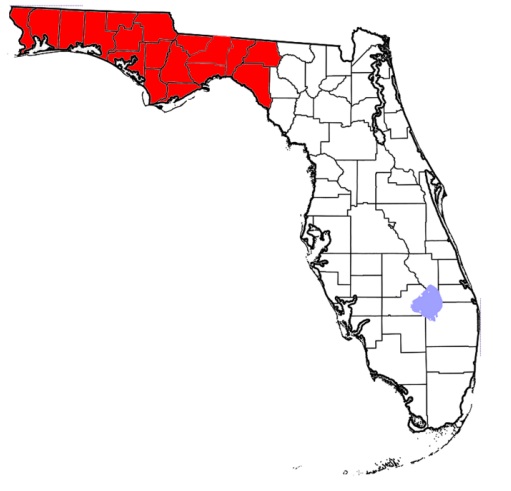
The Florida panhandle (also known as West Florida and Northwest Florida) is the northwestern part of the U.S. state of Florida. It is a salient roughly 200 miles (320 km) long, bordered by Alabama on the west and north, Georgia on the north, and the Gulf of Mexico to the south. Its eastern boundary is arbitrarily defined. It is defined by its southern culture and rural demographics in contrast to urbanized central and southern Florida, as well as closer cultural links to Alabama and Georgia. Its major communities include Pensacola, Navarre, Destin, Panama City Beach, and Tallahassee.
As is the case with the other eight U.S. states that have panhandles, the geographic meaning of the term is inexact and elastic. References to the Florida panhandle always include the ten counties west of the Apalachicola River, a natural geographic boundary, which was the historic dividing line between the British colonies of West Florida and East Florida. These western counties also lie in the Central Time Zone (with the exception of Gulf County, which is divided between the Eastern and Central Time zones), while the rest of the state is in the Eastern Time Zone. References to the panhandle may also include some or all of eleven counties immediately east of the Apalachicola known as the Big Bend region, along the curve of Apalachee Bay.
Like the rest of North Florida, including North Central Florida, the panhandle is more similar in culture and climate to the Deep South than the rest of the state, particularly than Central Florida and South Florida in the lower peninsula. The Florida panhandle is known for its conservative politics, religious adherence, and "piney woods".
The largest city in the panhandle is Tallahassee, the state capital, population 196,169 (2020). However, the largest city west of the Appalachicola river is Pensacola, which has a population of 54,312 (2020) and also has the largest Metropolitan area in the entire panhandle with a population of 511,502 (2020). This metro area includes the second- and third-largest communities in the region, Pensacola and Navarre. The total population of the panhandle, as of the 2010 census, was 1,407,925, just under 7.5% of Florida's total population as recorded in the same census. At roughly 70 persons per square mile, its population density is less than 20% of Florida's as a whole.
Emerald Coast, a term coined in 1983, refers in general to the beaches and coastal resorts from Pensacola to Port St. Joe, but is sometimes used to refer, by extension, to the panhandle as a whole, especially west of the Apalachicola. Earlier designations include "Playground of the Gulfcoast" and the "Miracle Strip", especially for the area between Fort Walton Beach and Panama City. Coastal regions of the following counties (if not the entirety of the counties themselves) are usually included when referring to the Emerald Coast:
Coastal portions of Bay County are also regularly included when referring to the Emerald Coast, but with somewhat less regularity than the four aforementioned counties listed above.
The Forgotten Coast is a trademarked term coined in the early 1990s used to refer to the coastal portion of the Florida panhandle extending from Mexico Beach or southeastern Bay County on the Gulf of Mexico to St. Marks on Apalachee Bay. It is usually not considered a part of the Emerald Coast, which lies directly adjacent to the west. Coastal regions of the following counties (if not the entirety of the counties themselves) are usually included when referring to the Forgotten Coast:
The Apalachicola River is the largest river of the panhandle. It is formed by the junction of several rivers, including the Chattahoochee and the Flint, where the boundaries of Alabama, Georgia, and Florida meet. From there, it flows southward to the town of Apalachicola.
Florida panhandle
The Florida panhandle (also known as West Florida and Northwest Florida) is the northwestern part of the U.S. state of Florida. It is a salient roughly 200 miles (320 km) long, bordered by Alabama on the west and north, Georgia on the north, and the Gulf of Mexico to the south. Its eastern boundary is arbitrarily defined. It is defined by its southern culture and rural demographics in contrast to urbanized central and southern Florida, as well as closer cultural links to Alabama and Georgia. Its major communities include Pensacola, Navarre, Destin, Panama City Beach, and Tallahassee.
As is the case with the other eight U.S. states that have panhandles, the geographic meaning of the term is inexact and elastic. References to the Florida panhandle always include the ten counties west of the Apalachicola River, a natural geographic boundary, which was the historic dividing line between the British colonies of West Florida and East Florida. These western counties also lie in the Central Time Zone (with the exception of Gulf County, which is divided between the Eastern and Central Time zones), while the rest of the state is in the Eastern Time Zone. References to the panhandle may also include some or all of eleven counties immediately east of the Apalachicola known as the Big Bend region, along the curve of Apalachee Bay.
Like the rest of North Florida, including North Central Florida, the panhandle is more similar in culture and climate to the Deep South than the rest of the state, particularly than Central Florida and South Florida in the lower peninsula. The Florida panhandle is known for its conservative politics, religious adherence, and "piney woods".
The largest city in the panhandle is Tallahassee, the state capital, population 196,169 (2020). However, the largest city west of the Appalachicola river is Pensacola, which has a population of 54,312 (2020) and also has the largest Metropolitan area in the entire panhandle with a population of 511,502 (2020). This metro area includes the second- and third-largest communities in the region, Pensacola and Navarre. The total population of the panhandle, as of the 2010 census, was 1,407,925, just under 7.5% of Florida's total population as recorded in the same census. At roughly 70 persons per square mile, its population density is less than 20% of Florida's as a whole.
Emerald Coast, a term coined in 1983, refers in general to the beaches and coastal resorts from Pensacola to Port St. Joe, but is sometimes used to refer, by extension, to the panhandle as a whole, especially west of the Apalachicola. Earlier designations include "Playground of the Gulfcoast" and the "Miracle Strip", especially for the area between Fort Walton Beach and Panama City. Coastal regions of the following counties (if not the entirety of the counties themselves) are usually included when referring to the Emerald Coast:
Coastal portions of Bay County are also regularly included when referring to the Emerald Coast, but with somewhat less regularity than the four aforementioned counties listed above.
The Forgotten Coast is a trademarked term coined in the early 1990s used to refer to the coastal portion of the Florida panhandle extending from Mexico Beach or southeastern Bay County on the Gulf of Mexico to St. Marks on Apalachee Bay. It is usually not considered a part of the Emerald Coast, which lies directly adjacent to the west. Coastal regions of the following counties (if not the entirety of the counties themselves) are usually included when referring to the Forgotten Coast:
The Apalachicola River is the largest river of the panhandle. It is formed by the junction of several rivers, including the Chattahoochee and the Flint, where the boundaries of Alabama, Georgia, and Florida meet. From there, it flows southward to the town of Apalachicola.
Recent media
Recent media