
Recent from talks
Panthalassa
Knowledge base stats:
Talk channels stats:
Members stats:
Panthalassa
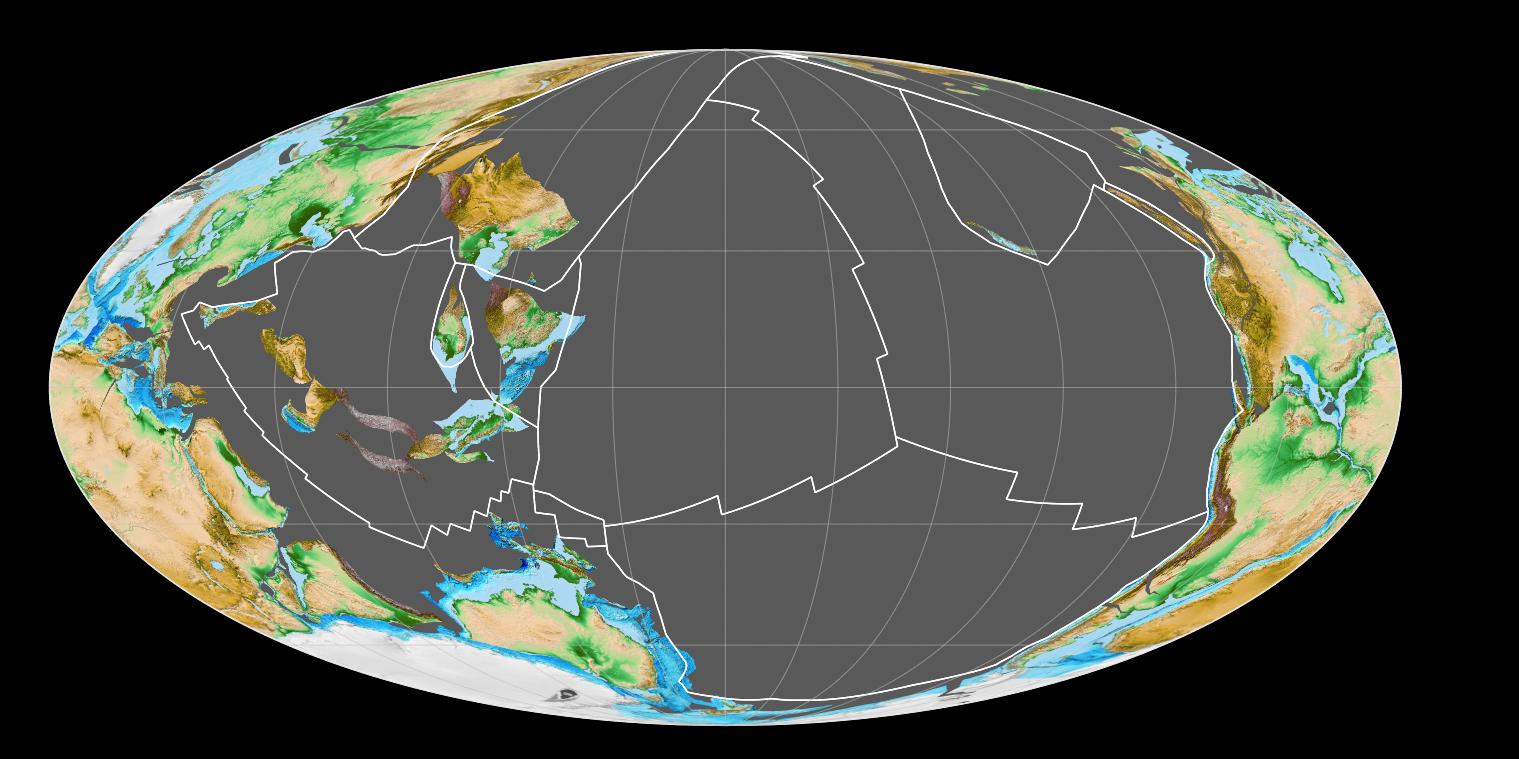
Panthalassa, also known as the Panthalassic Ocean or Panthalassan Ocean (from Greek πᾶν "all" and θάλασσα "sea"), was the vast superocean that encompassed planet Earth and surrounded the supercontinent Pangaea, the latest in a series of supercontinents in the history of Earth. During the Paleozoic–Mesozoic transition (c. 250 Ma), the ocean occupied almost 70% of Earth's surface, with the supercontinent Pangaea taking up the remaining one third. The original, ancient ocean floor has now completely disappeared because of the continuous subduction along the continental margins on its circumference. Panthalassa is also referred to as the Paleo-Pacific ("old Pacific") or Proto-Pacific because the Pacific Ocean is a direct continuation of Panthalassa.
The supercontinent Rodinia began to break up 870–845 Ma probably as a consequence of a superplume caused by mantle slab avalanches along the margins of the supercontinent. In a second episode c. 750 Ma the western half of Rodinia started to rift apart: western Kalahari and South China broke away from the western margins of Laurentia; and by 720 Ma Australia and East Antarctica had also separated. In the Early Jurassic the Pacific Plate opened originating from a triple junction between the Panthalassic Farallon, Phoenix, and Izanagi plates. Panthalassa can be reconstructed based on magnetic lineations and fracture zones preserved in the western Pacific.
Most of the oceanic plates that formed the ocean floor of Panthalassa have been subducted and so traditional plate tectonic reconstructions based on magnetic anomalies can therefore be used only for remains from the Cretaceous and later. The former margins of the ocean, however, contain allochthonous terranes with preserved Triassic–Jurassic intra-Panthalassic volcanic arcs, including Kolyma–Omolon (northeast Asia), Anadyr–Koryak (east Asia), Oku–Niikappu (Japan), and Wrangellia and Stikinia (western North America). Furthermore, seismic tomography is being used to identify subducted slabs in the mantle from which the location of former Panthalassic subduction zones can be derived. A series of such subduction zones, called Telkhinia, defines two separate oceans or systems of oceanic plates—the Pontus and Thalassa oceans. Named marginal oceans or oceanic plates include (clockwise) Mongol-Okhotsk (now a suture between Mongolia and Sea of Okhotsk), Oimyakon (between Asian craton and Kolyma-Omolon), Slide Mountain Ocean (British Columbia), and Mezcalera (western Mexico).
The eastern margin of the ocean coincided with the western margin (modern coordinates) of the continent Laurentia. The western margin of Laurentia originated during the Neoproterozoic break-up of Rodinia. The North American Cordillera is an accretionary orogen, which grew by the progressive addition of allochthonous terranes along this margin from the Late Palaeozoic. Devonian back-arc volcanism reveals how this eastern Panthalassic margin developed in the mid-Paleozoic into the active margin it still is today.
Most of the continental fragments, volcanic arcs, and ocean basins added to Laurentia this way contained faunas of Tethyan or Asian affinity. Similar terranes added to the northern Laurentia, in contrast, have affinities with Baltica, Siberia, and the northern Caledonies. The latter terranes were probably accreted along the eastern Panthalassa margin by a Caribbean–Scotia-style subduction system.
The evolution of the Panthalassa–Tethys boundary is poorly known because little oceanic crust is preserved—both the Izanagi and the conjugate Pacific Ocean floor is subducted and the ocean ridge that separated them probably subducted c. 60–55 Ma. Today, the region is dominated by the collision of the Australian Plate with a complex network of plate boundaries in south-east Asia, including the Sundaland block. Spreading along the Pacific-Phoenix ridge ended 83 Ma at the Osbourn Trough at the Tonga-Kermadec Trench.
During the Permian, atolls developed near the Equator on the mid-Panthalassic seamounts. As Panthalassa subducted along its western margin during the Triassic and Early Jurassic, those seamounts and palaeo-atolls were accreted as allochthonous limestone blocks and fragments along the Asian margin. One such migrating atoll complex now form a two-kilometre-long (1.2 mi) and 100-to-150-metre-wide (330–490 ft) body of limestone in central Kyushu, south-west Japan.
Fusuline foraminifera, a now extinct order of single-celled organisms, diversified extensively and developed gigantism—the genus Eopolydiexodina, for example, reached up to 16 cm (6.3 in) in size—and structural sophistication, including symbiont relationships with photosynthesising algae, during the Late Carboniferous and Permian, in what is known as the Carboniferous-Earliest Permian Biodiversification Event. The Capitanian mass extinction event c. 260 Ma, however, put an end to that development, with only dwarf taxa persisting throughout the Permian until the final fusuline extinction in the Great Dying c. 252 Ma. Permian fusulines also developed a remarkable provincialism by which fusulines can be grouped into six domains. Because of the large size of Panthalassa, a hundred million years could separate the accretion of different groups of fusulines. Assuming a minimum accretion rate of 3 centimetres per year (1.2 in/year), the seamount chains on which those groups evolved would be separated by at least 3,000 km (1,900 mi). Those groups apparently evolved in completely different environments.
Hub AI
Panthalassa AI simulator
(@Panthalassa_simulator)
Panthalassa
Panthalassa, also known as the Panthalassic Ocean or Panthalassan Ocean (from Greek πᾶν "all" and θάλασσα "sea"), was the vast superocean that encompassed planet Earth and surrounded the supercontinent Pangaea, the latest in a series of supercontinents in the history of Earth. During the Paleozoic–Mesozoic transition (c. 250 Ma), the ocean occupied almost 70% of Earth's surface, with the supercontinent Pangaea taking up the remaining one third. The original, ancient ocean floor has now completely disappeared because of the continuous subduction along the continental margins on its circumference. Panthalassa is also referred to as the Paleo-Pacific ("old Pacific") or Proto-Pacific because the Pacific Ocean is a direct continuation of Panthalassa.
The supercontinent Rodinia began to break up 870–845 Ma probably as a consequence of a superplume caused by mantle slab avalanches along the margins of the supercontinent. In a second episode c. 750 Ma the western half of Rodinia started to rift apart: western Kalahari and South China broke away from the western margins of Laurentia; and by 720 Ma Australia and East Antarctica had also separated. In the Early Jurassic the Pacific Plate opened originating from a triple junction between the Panthalassic Farallon, Phoenix, and Izanagi plates. Panthalassa can be reconstructed based on magnetic lineations and fracture zones preserved in the western Pacific.
Most of the oceanic plates that formed the ocean floor of Panthalassa have been subducted and so traditional plate tectonic reconstructions based on magnetic anomalies can therefore be used only for remains from the Cretaceous and later. The former margins of the ocean, however, contain allochthonous terranes with preserved Triassic–Jurassic intra-Panthalassic volcanic arcs, including Kolyma–Omolon (northeast Asia), Anadyr–Koryak (east Asia), Oku–Niikappu (Japan), and Wrangellia and Stikinia (western North America). Furthermore, seismic tomography is being used to identify subducted slabs in the mantle from which the location of former Panthalassic subduction zones can be derived. A series of such subduction zones, called Telkhinia, defines two separate oceans or systems of oceanic plates—the Pontus and Thalassa oceans. Named marginal oceans or oceanic plates include (clockwise) Mongol-Okhotsk (now a suture between Mongolia and Sea of Okhotsk), Oimyakon (between Asian craton and Kolyma-Omolon), Slide Mountain Ocean (British Columbia), and Mezcalera (western Mexico).
The eastern margin of the ocean coincided with the western margin (modern coordinates) of the continent Laurentia. The western margin of Laurentia originated during the Neoproterozoic break-up of Rodinia. The North American Cordillera is an accretionary orogen, which grew by the progressive addition of allochthonous terranes along this margin from the Late Palaeozoic. Devonian back-arc volcanism reveals how this eastern Panthalassic margin developed in the mid-Paleozoic into the active margin it still is today.
Most of the continental fragments, volcanic arcs, and ocean basins added to Laurentia this way contained faunas of Tethyan or Asian affinity. Similar terranes added to the northern Laurentia, in contrast, have affinities with Baltica, Siberia, and the northern Caledonies. The latter terranes were probably accreted along the eastern Panthalassa margin by a Caribbean–Scotia-style subduction system.
The evolution of the Panthalassa–Tethys boundary is poorly known because little oceanic crust is preserved—both the Izanagi and the conjugate Pacific Ocean floor is subducted and the ocean ridge that separated them probably subducted c. 60–55 Ma. Today, the region is dominated by the collision of the Australian Plate with a complex network of plate boundaries in south-east Asia, including the Sundaland block. Spreading along the Pacific-Phoenix ridge ended 83 Ma at the Osbourn Trough at the Tonga-Kermadec Trench.
During the Permian, atolls developed near the Equator on the mid-Panthalassic seamounts. As Panthalassa subducted along its western margin during the Triassic and Early Jurassic, those seamounts and palaeo-atolls were accreted as allochthonous limestone blocks and fragments along the Asian margin. One such migrating atoll complex now form a two-kilometre-long (1.2 mi) and 100-to-150-metre-wide (330–490 ft) body of limestone in central Kyushu, south-west Japan.
Fusuline foraminifera, a now extinct order of single-celled organisms, diversified extensively and developed gigantism—the genus Eopolydiexodina, for example, reached up to 16 cm (6.3 in) in size—and structural sophistication, including symbiont relationships with photosynthesising algae, during the Late Carboniferous and Permian, in what is known as the Carboniferous-Earliest Permian Biodiversification Event. The Capitanian mass extinction event c. 260 Ma, however, put an end to that development, with only dwarf taxa persisting throughout the Permian until the final fusuline extinction in the Great Dying c. 252 Ma. Permian fusulines also developed a remarkable provincialism by which fusulines can be grouped into six domains. Because of the large size of Panthalassa, a hundred million years could separate the accretion of different groups of fusulines. Assuming a minimum accretion rate of 3 centimetres per year (1.2 in/year), the seamount chains on which those groups evolved would be separated by at least 3,000 km (1,900 mi). Those groups apparently evolved in completely different environments.
Recent media