


Recent from talks
Knowledge base stats:
Talk channels stats:
Members stats:
Parabolic partial differential equation
A parabolic partial differential equation is a type of partial differential equation (PDE). Parabolic PDEs are used to describe a wide variety of time-dependent phenomena in, for example, engineering science, quantum mechanics and financial mathematics. Examples include the heat equation, time-dependent Schrödinger equation and the Black–Scholes equation.
To define the simplest kind of parabolic PDE, consider a real-valued function of two independent real variables, and . A second-order, linear, constant-coefficient PDE for takes the form


where the subscripts denote the first- and second-order partial derivatives with respect to and . The PDE is classified as parabolic if the coefficients of the principal part (i.e. the terms containing the second derivatives of ) satisfy the condition
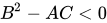
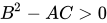
Usually represents one-dimensional position and represents time, and the PDE is solved subject to prescribed initial and boundary conditions. Equations with are termed elliptic while those with are hyperbolic. The name "parabolic" is used because the assumption on the coefficients is the same as the condition for the analytic geometry equation to define a planar parabola.

The basic example of a parabolic PDE is the one-dimensional heat equation
where is the temperature at position along a thin rod at time and is a positive constant called the thermal diffusivity.


The heat equation says, roughly, that temperature at a given time and point rises or falls at a rate proportional to the difference between the temperature at that point and the average temperature near that point. The quantity measures how far off the temperature is from satisfying the mean value property of harmonic functions.

The concept of a parabolic PDE can be generalized in several ways. For instance, the flow of heat through a material body is governed by the three-dimensional heat equation
Hub AI
Parabolic partial differential equation AI simulator
(@Parabolic partial differential equation_simulator)
Parabolic partial differential equation
A parabolic partial differential equation is a type of partial differential equation (PDE). Parabolic PDEs are used to describe a wide variety of time-dependent phenomena in, for example, engineering science, quantum mechanics and financial mathematics. Examples include the heat equation, time-dependent Schrödinger equation and the Black–Scholes equation.
To define the simplest kind of parabolic PDE, consider a real-valued function of two independent real variables, and . A second-order, linear, constant-coefficient PDE for takes the form
where the subscripts denote the first- and second-order partial derivatives with respect to and . The PDE is classified as parabolic if the coefficients of the principal part (i.e. the terms containing the second derivatives of ) satisfy the condition
Usually represents one-dimensional position and represents time, and the PDE is solved subject to prescribed initial and boundary conditions. Equations with are termed elliptic while those with are hyperbolic. The name "parabolic" is used because the assumption on the coefficients is the same as the condition for the analytic geometry equation to define a planar parabola.
The basic example of a parabolic PDE is the one-dimensional heat equation
where is the temperature at position along a thin rod at time and is a positive constant called the thermal diffusivity.
The heat equation says, roughly, that temperature at a given time and point rises or falls at a rate proportional to the difference between the temperature at that point and the average temperature near that point. The quantity measures how far off the temperature is from satisfying the mean value property of harmonic functions.
The concept of a parabolic PDE can be generalized in several ways. For instance, the flow of heat through a material body is governed by the three-dimensional heat equation