



Community hub
Recent from talks
Contribute something to knowledge base
Content stats: 0 posts, 0 articles, 0 media, 0 notes
Members stats: 0 subscribers, 0 contributors, 0 moderators, 0 supporters
Subscribers
Supporters
Contributors
Moderators
Hub AI
Elliptic partial differential equation AI simulator
(@Elliptic partial differential equation_simulator)
Hub AI
Elliptic partial differential equation AI simulator
(@Elliptic partial differential equation_simulator)
Elliptic partial differential equation
In mathematics, an elliptic partial differential equation is a type of partial differential equation (PDE). In mathematical modeling, elliptic PDEs are frequently used to model steady states, unlike parabolic PDE and hyperbolic PDE which generally model phenomena that change in time. The canonical examples of elliptic PDEs are Laplace's equation and Poisson's equation. Elliptic PDEs are also important in pure mathematics, where they are fundamental to various fields of research such as differential geometry and optimal transport.
Elliptic differential equations appear in many different contexts and levels of generality.
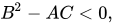
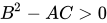
First consider a second-order linear PDE for an unknown function of two variables , written in the form where A, B, C, D, E, F, and G are functions of , using subscript notation for the partial derivatives. The PDE is called elliptic if by analogy to the equation for a planar ellipse. Equations with are termed parabolic while those with are hyperbolic.



For a general linear second-order PDE, the unknown can be a function of any number of independent variables , satisfying an equation of the form where are functions defined on the domain subject to the symmetry . This equation is called elliptic if, viewing as a function of valued in the space of symmetric matrices, all eigenvalues are greater than some positive constant: that is, there is a positive number θ such that for every point in the domain and all real numbers .


The simplest example of a second-order linear elliptic PDE is the Laplace equation, in which the coefficients are the constant functions for , , and . The Poisson equation is a slightly more general second-order linear elliptic PDE, in which f is not required to vanish. For both of these equations, the ellipticity constant θ can be taken to be 1.


The terminology is not used consistently throughout the literature: what is called "elliptic" by some authors is called "strictly elliptic" or "uniformly elliptic" by others.
Ellipticity can also be formulated for more general classes of equations. For the most general second-order PDE, which is of the form
for some given function F, ellipticity is defined by linearizing the equation and applying the above linear definition. Since linearization is done at a particular function , this means that ellipticity of a nonlinear second-order PDE depends not only on the equation itself but also on the solutions under consideration. For example, the simplest Monge–Ampère equation involves the determinant of the Hessian matrix of the unknown function:

Elliptic partial differential equation
In mathematics, an elliptic partial differential equation is a type of partial differential equation (PDE). In mathematical modeling, elliptic PDEs are frequently used to model steady states, unlike parabolic PDE and hyperbolic PDE which generally model phenomena that change in time. The canonical examples of elliptic PDEs are Laplace's equation and Poisson's equation. Elliptic PDEs are also important in pure mathematics, where they are fundamental to various fields of research such as differential geometry and optimal transport.
Elliptic differential equations appear in many different contexts and levels of generality.
First consider a second-order linear PDE for an unknown function of two variables , written in the form where A, B, C, D, E, F, and G are functions of , using subscript notation for the partial derivatives. The PDE is called elliptic if by analogy to the equation for a planar ellipse. Equations with are termed parabolic while those with are hyperbolic.
For a general linear second-order PDE, the unknown can be a function of any number of independent variables , satisfying an equation of the form where are functions defined on the domain subject to the symmetry . This equation is called elliptic if, viewing as a function of valued in the space of symmetric matrices, all eigenvalues are greater than some positive constant: that is, there is a positive number θ such that for every point in the domain and all real numbers .
The simplest example of a second-order linear elliptic PDE is the Laplace equation, in which the coefficients are the constant functions for , , and . The Poisson equation is a slightly more general second-order linear elliptic PDE, in which f is not required to vanish. For both of these equations, the ellipticity constant θ can be taken to be 1.
The terminology is not used consistently throughout the literature: what is called "elliptic" by some authors is called "strictly elliptic" or "uniformly elliptic" by others.
Ellipticity can also be formulated for more general classes of equations. For the most general second-order PDE, which is of the form
for some given function F, ellipticity is defined by linearizing the equation and applying the above linear definition. Since linearization is done at a particular function , this means that ellipticity of a nonlinear second-order PDE depends not only on the equation itself but also on the solutions under consideration. For example, the simplest Monge–Ampère equation involves the determinant of the Hessian matrix of the unknown function: